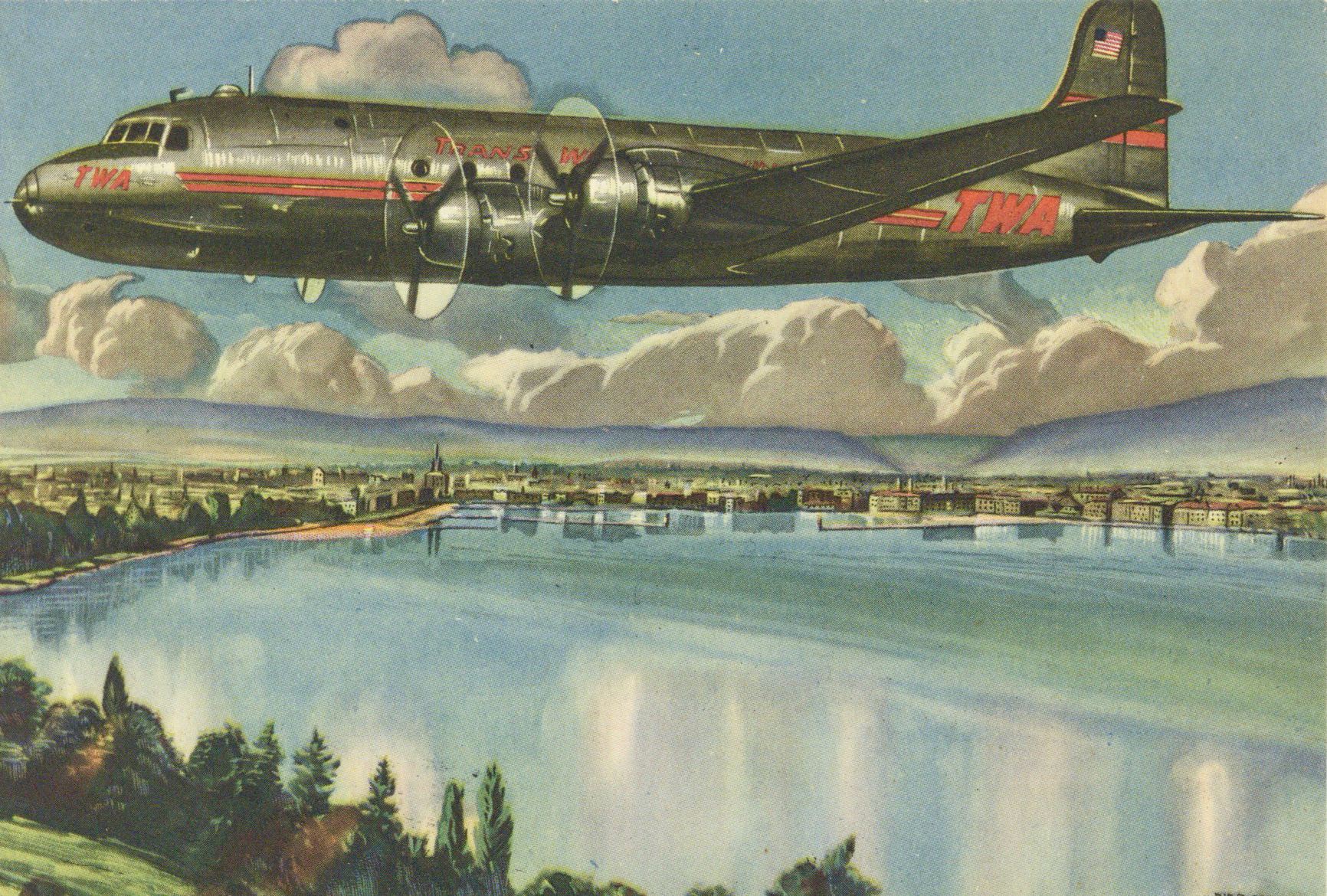
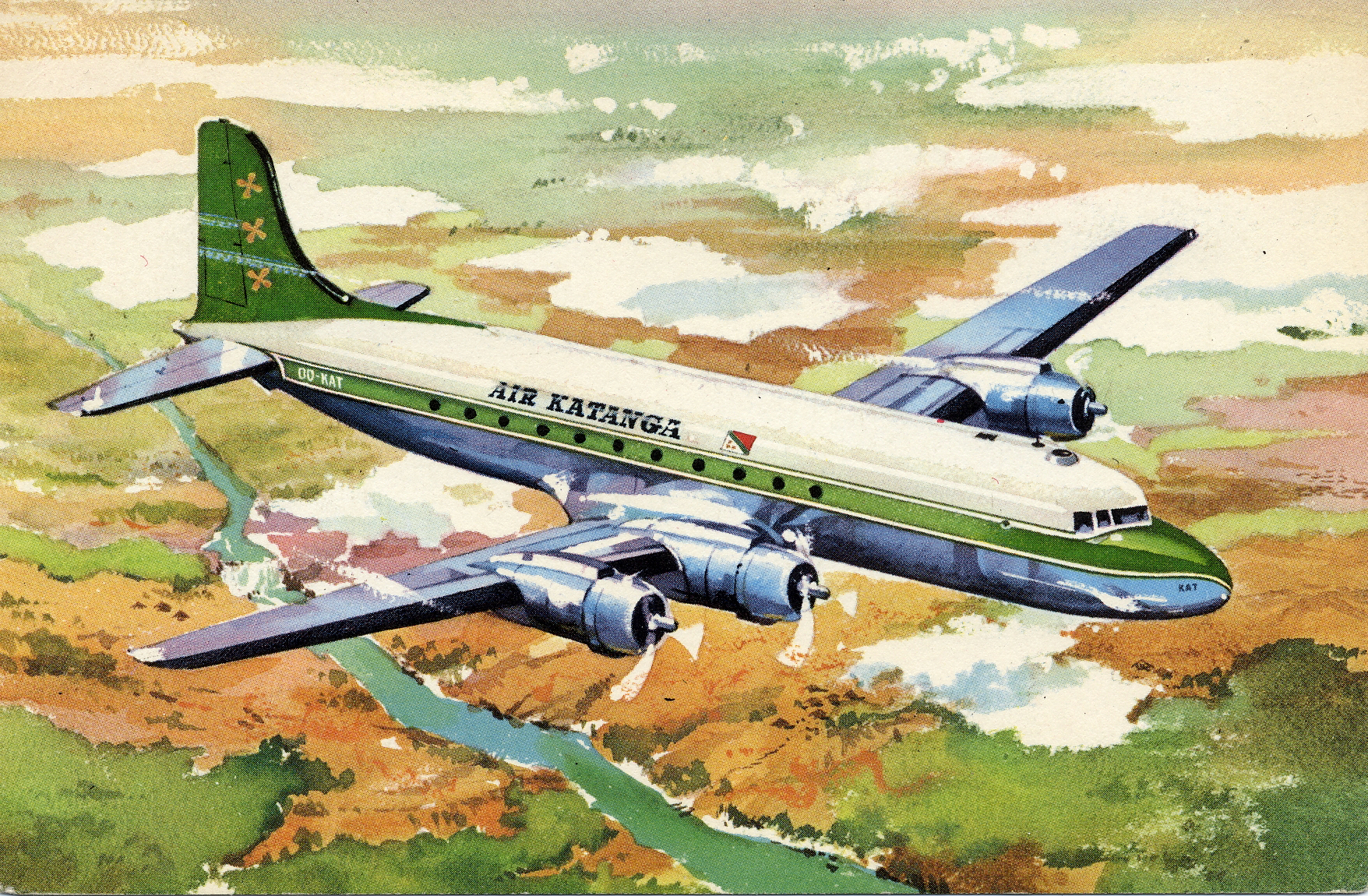
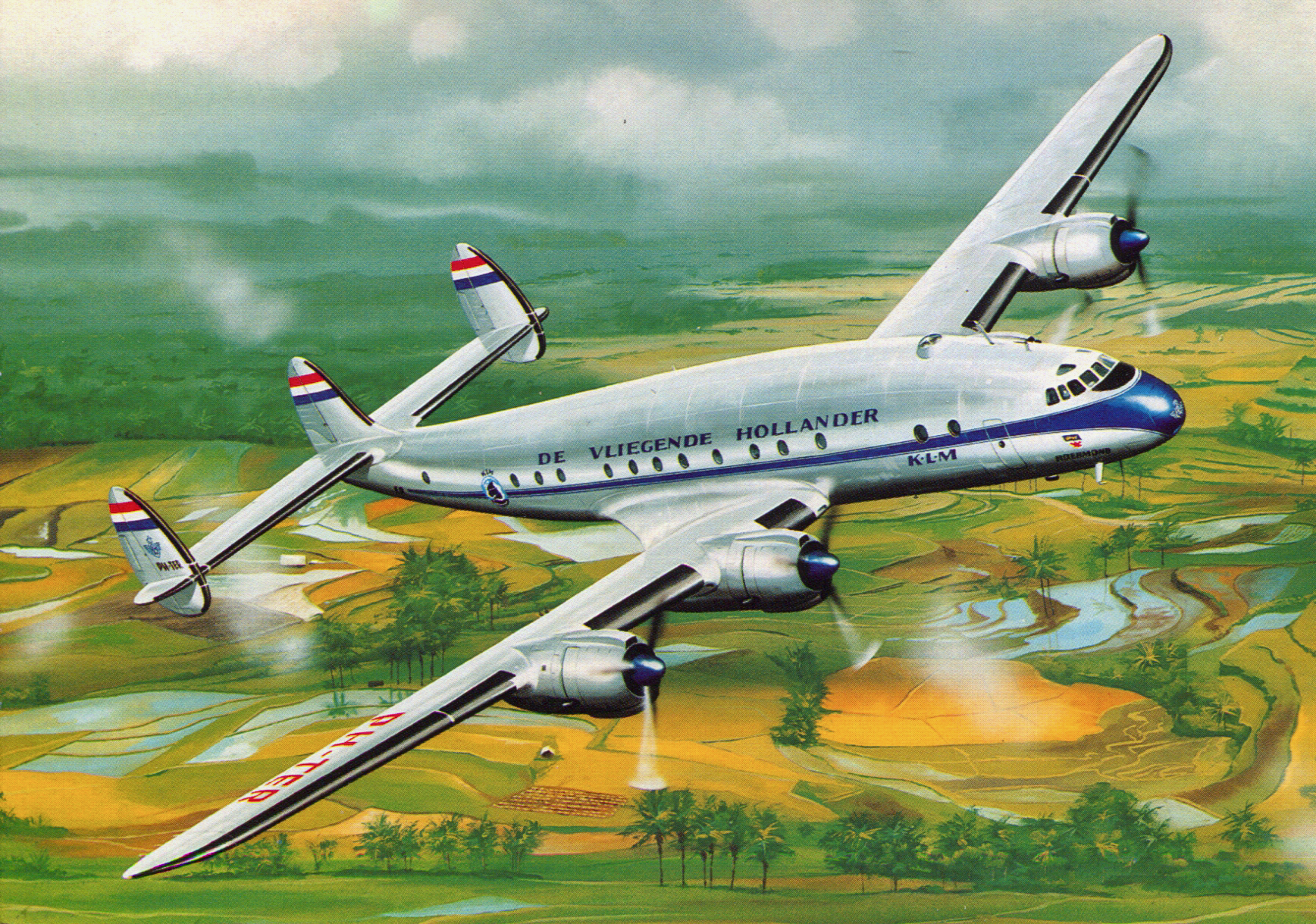
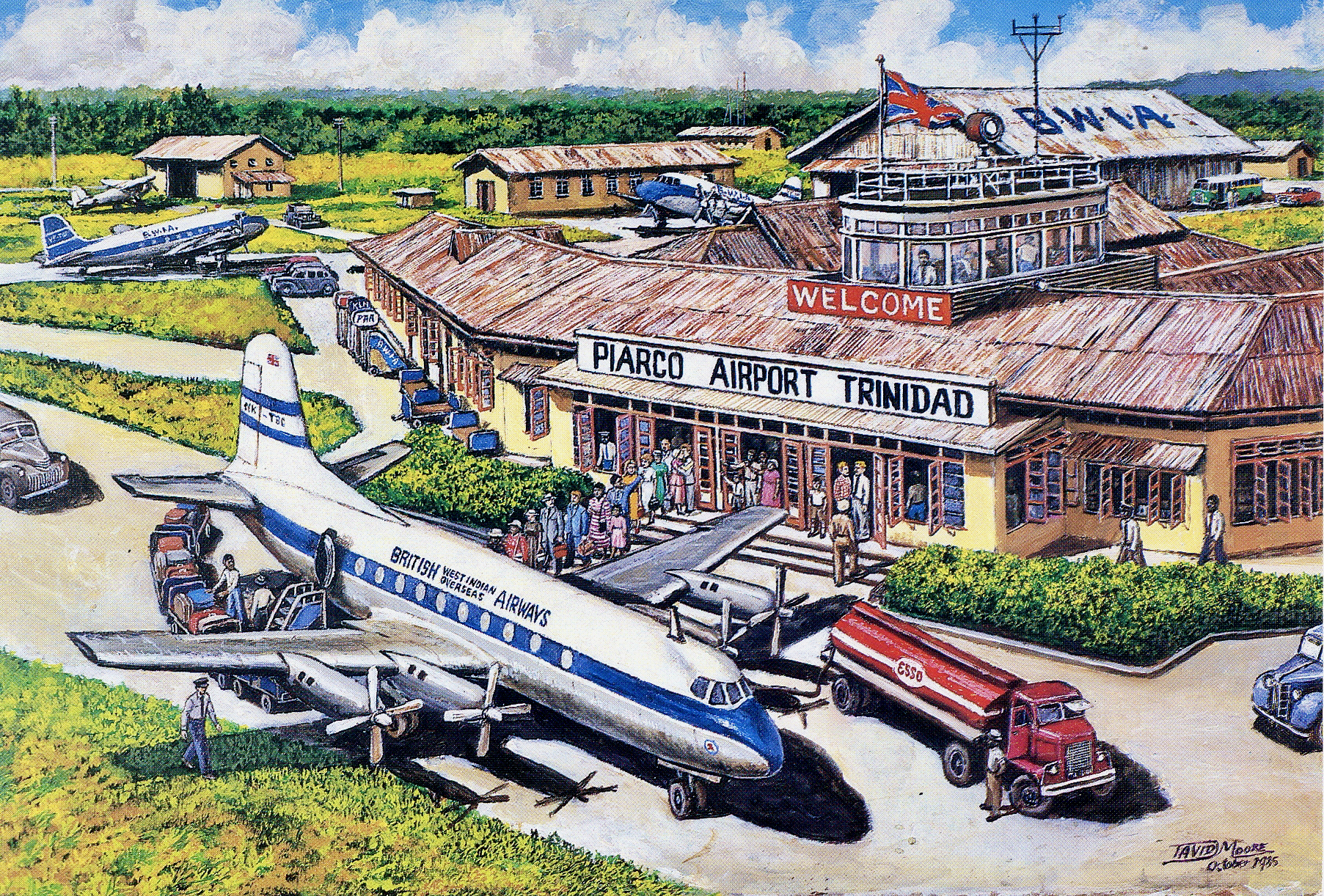
In celebration of the 50th annual Airliners International show and convention, held in Denver, CO, June 24-27, this article for the Captain’s Log of the World Airline Historical Society covers Denver’s main airport as illustrated on postcards.
From 1929 to February 1995, Denver’s primary airport was located at what was eventually named “Stapleton International Airport.” On February 28, 1995, Stapleton was closed to flights and replaced by an entirely new airport: “Denver International Airport (DEN).”
Denver’s primary airport opened on October 17, 1929, as “Denver Municipal Airport.” It was called the “Union Station of the Air” and claimed to be the most modern in the U.S. at the time. The two main airlines serving Denver in the 1930s were United and Continental.
After a 1944 expansion, the airport’s name was changed to Stapleton Airfield in honor of Denver Mayor Benjamin Stapleton, who strongly supported the development of Denver Airport.
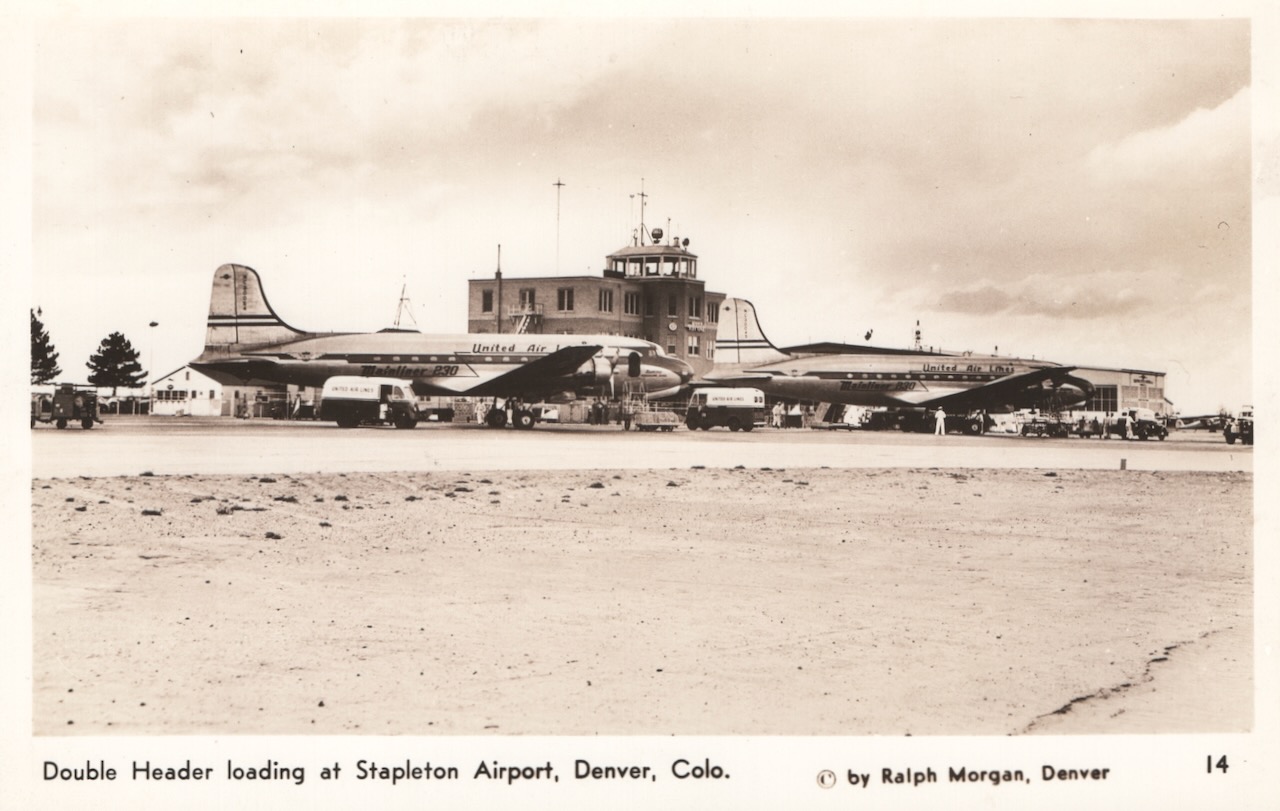
United Air Lines Douglas DC-4s at Denver Stapleton Airport, about 1946. “Real photo” postcard by Ralph Morgan, Denver, no. 14. The original terminal building and control tower can be seen in the rear center.
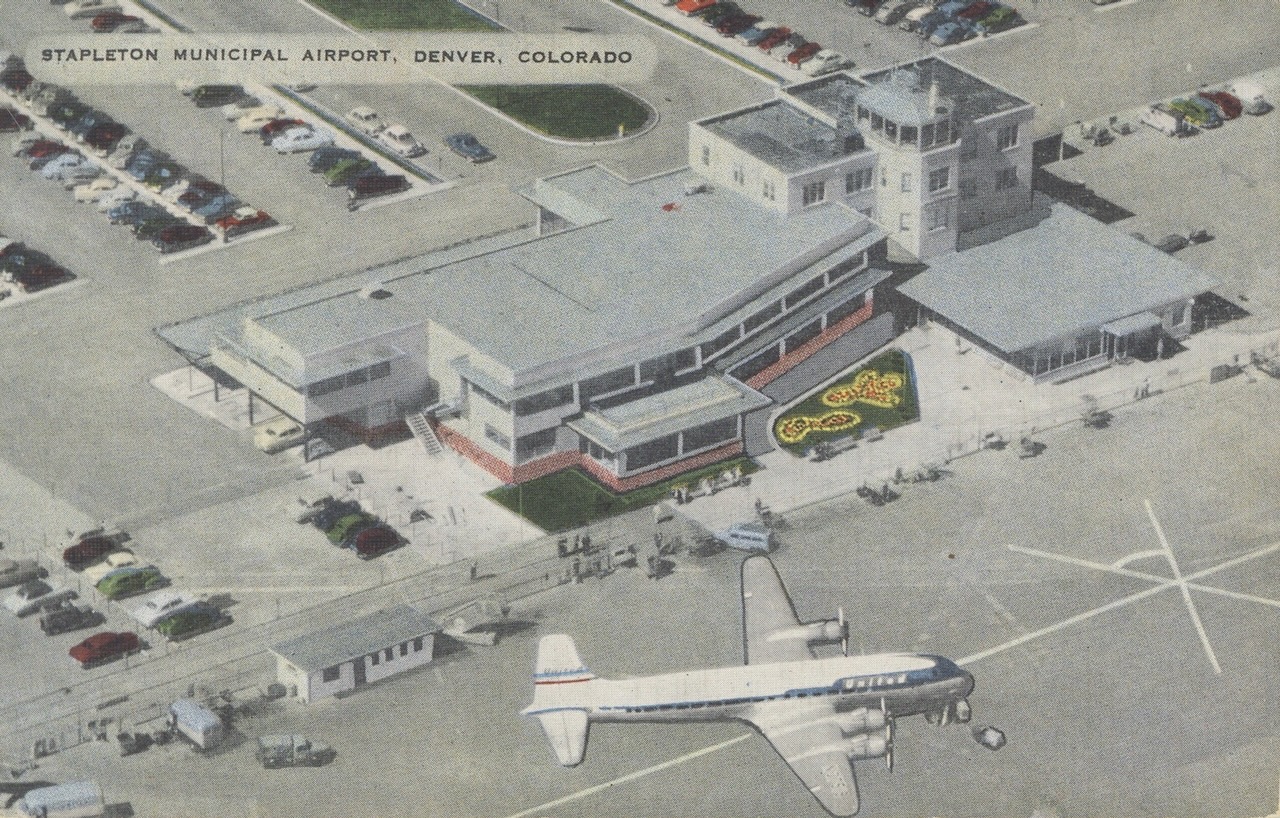
United Air Lines Douglas DC-6 at Denver Stapleton Airport, early 1950s. Pub’r Elmer C. Clark, Denver; Printer E. C. Kropp Co., Milwaukee, no. 28059N, ‘linen’ finish. The card back says “Stapleton Field is considered one of the finest fields in the West and has some 67 flights per day to supply prompt service to all parts of the United States.”
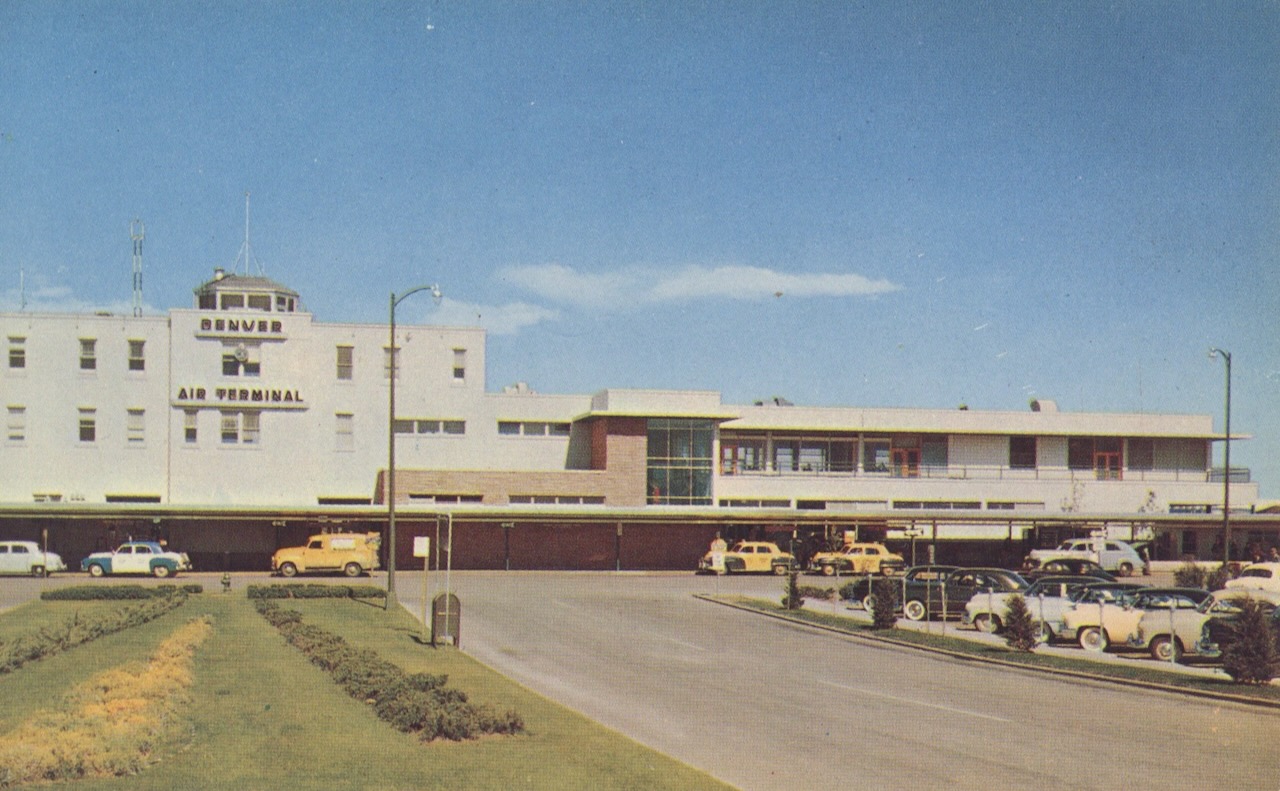
Front of Denver Stapleton Airport terminal building, early 1950s. Pub’r Colourpicture, Boston, no. P5495.
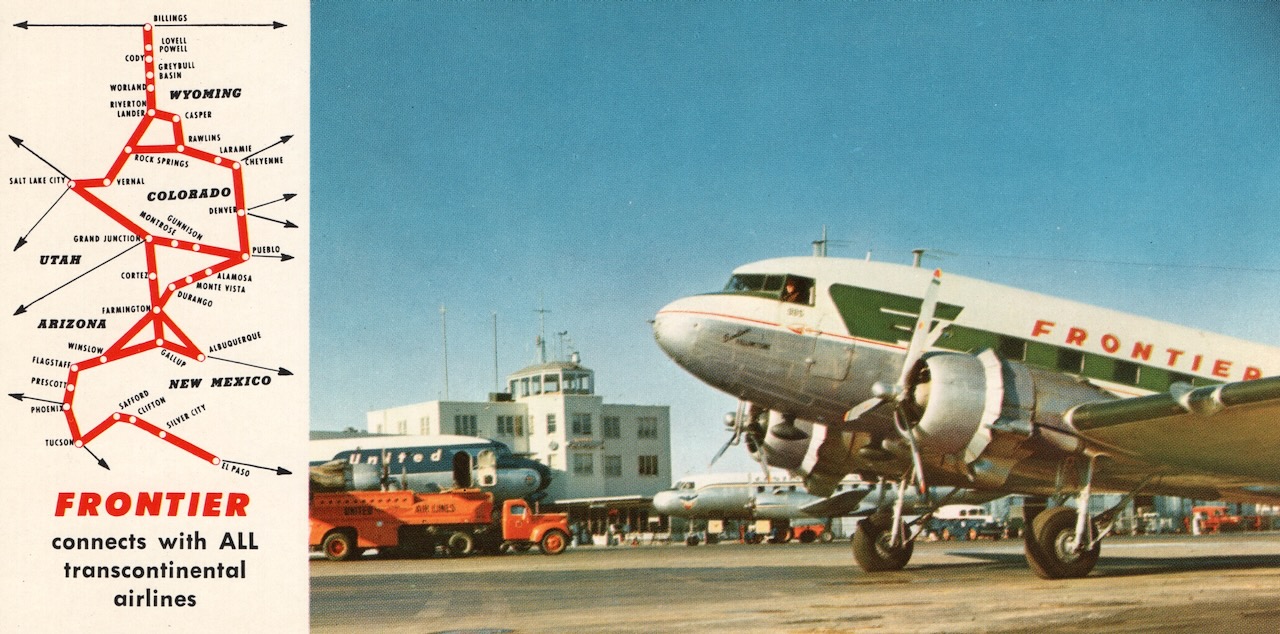
Frontier Airlines Douglas DC-3 at Denver Stapleton Airport, with United and Continental aircraft in rear. Airline issue, 1950s. The original Frontier Airlines was formed in 1950 by a merger of Arizona Airways, Challenger Airlines, and Monarch Airlines, and was headquartered at Stapleton Airport. It ceased operations on August 24, 1986.
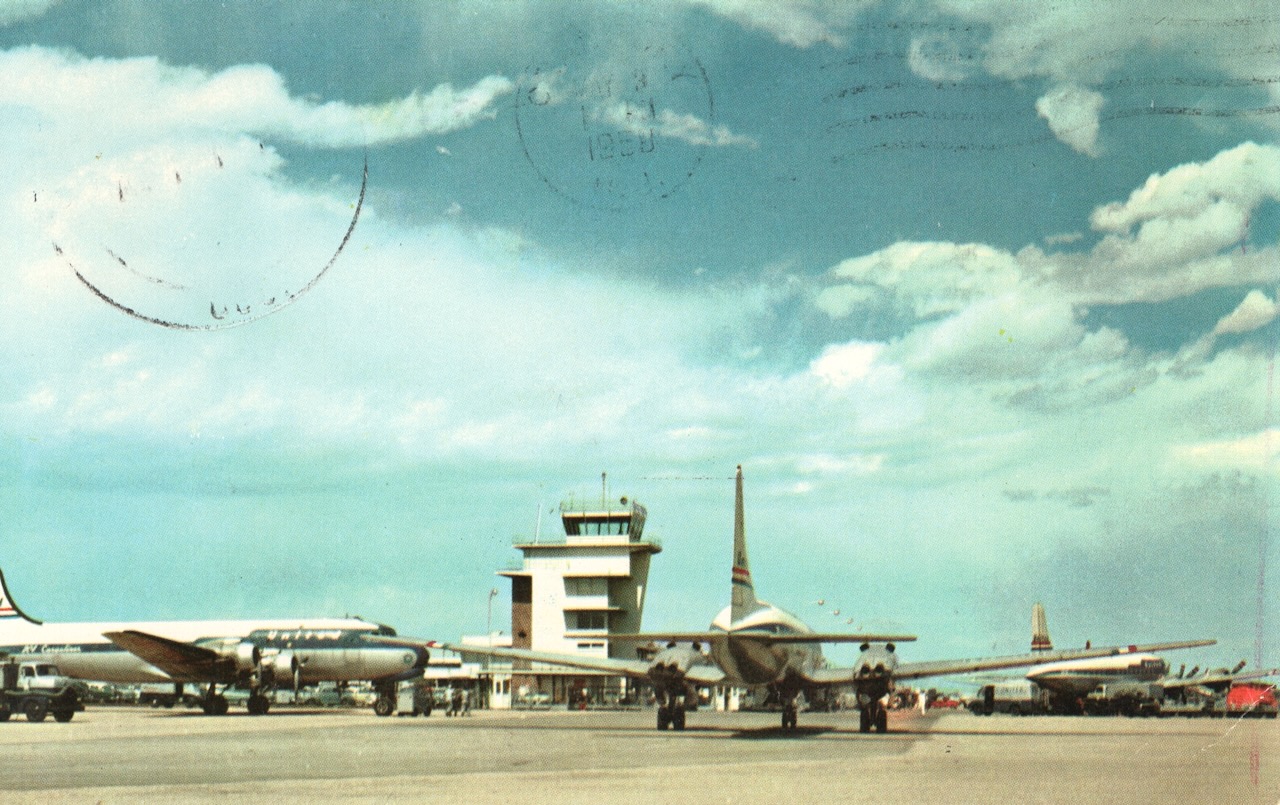
Denver Stapleton Airport’s new six-story control tower, completed in June 1953, with United Air Lines aircraft on the ramp. Postmarked May 3, 1958. Pub’r Cooper Postcard Co., Lakewood CO, no. 51; Printer A. B. Hirschfeld Press, Denver.
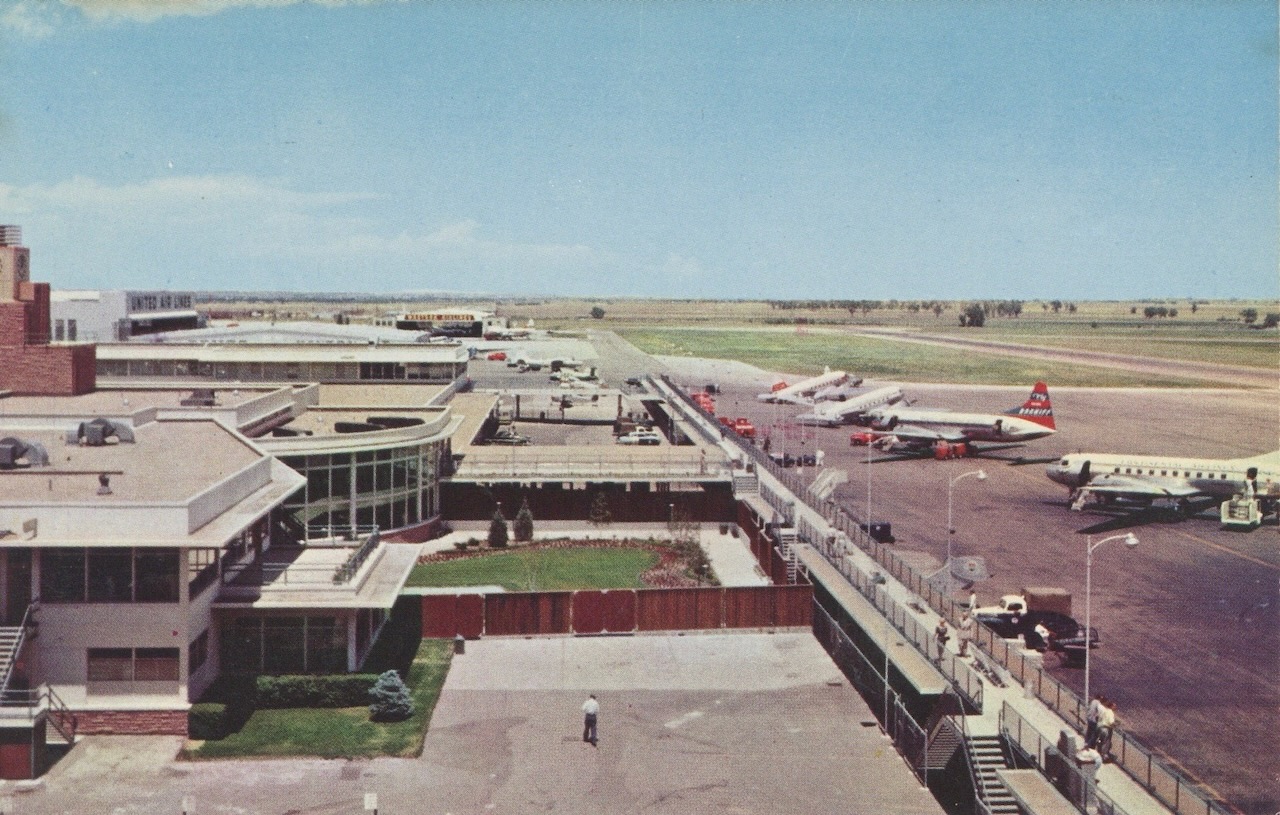
Braniff Airways and Continental Airlines Convair aircraft, and two Douglas DC-3s, on ramp at Denver Stapleton Airport, 1956. Pub’r Cooper Post Card Co., Lakewood, Colorado, no. 6C-K327. Here you can see the terminal and concourse area, updated in 1954, and a passenger walkway viewing area. The main airlines serving Denver at that time were United, Continental, Braniff, Western, Frontier, TWA, and Central. Continental, like Frontier, had its headquarters at the time at Stapleton.
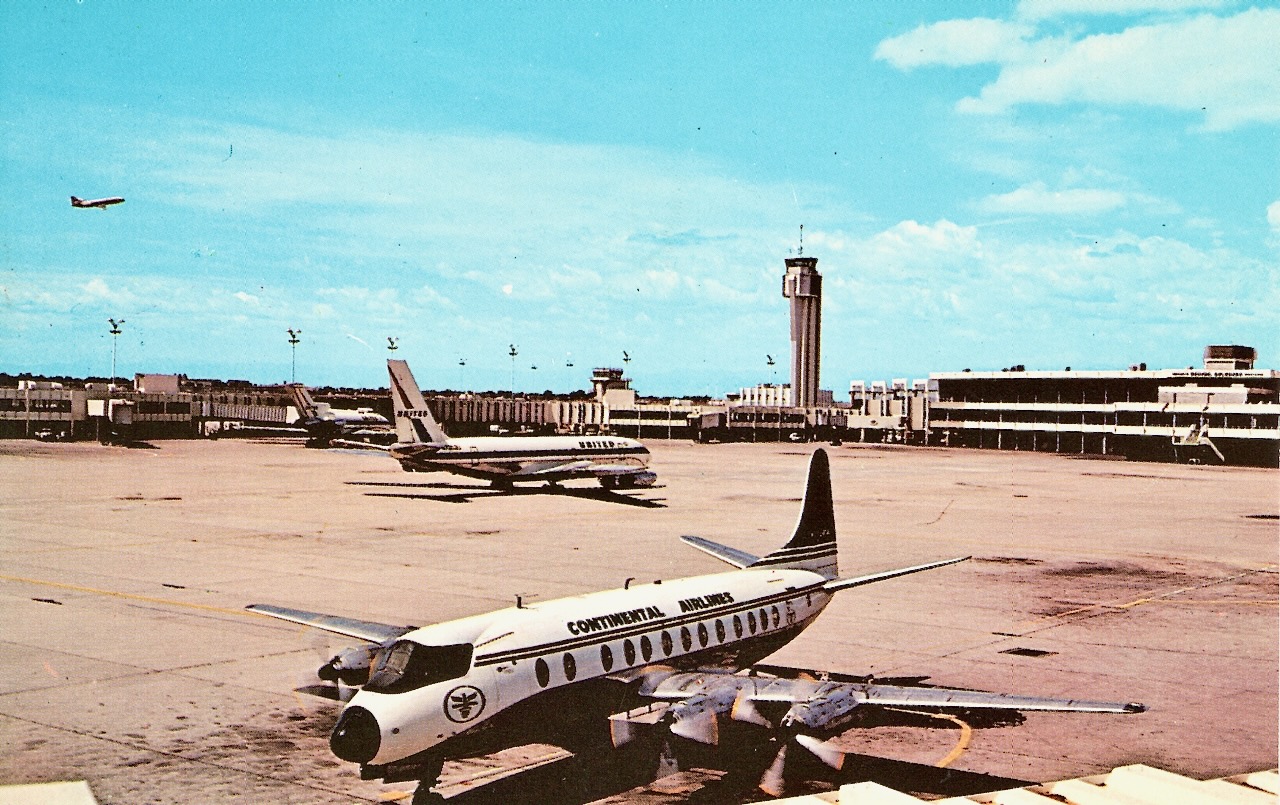
Continental Airlines Vickers Viscount at Denver Stapleton Airport, 1960s. Pub’r Colourpicture, Boston, no. P70865; dist’r G. R. Dickson Co., Denver. Here you can see the new iconic 12-story control tower that opened in 1962-63.
Although Stapleton Airport closed in 1995, its 12-story control tower still exists and is preserved as a historic landmark. The tower is now the home of FlyteCo Tower, an aviation-themed brewery and entertainment complex. The Doubletree Hotel, host for Airliners International 2026, is near the former Stapleton Airport area, and the show’s welcome reception will be held in the FlyteCo Tower, with tours of the tower available.
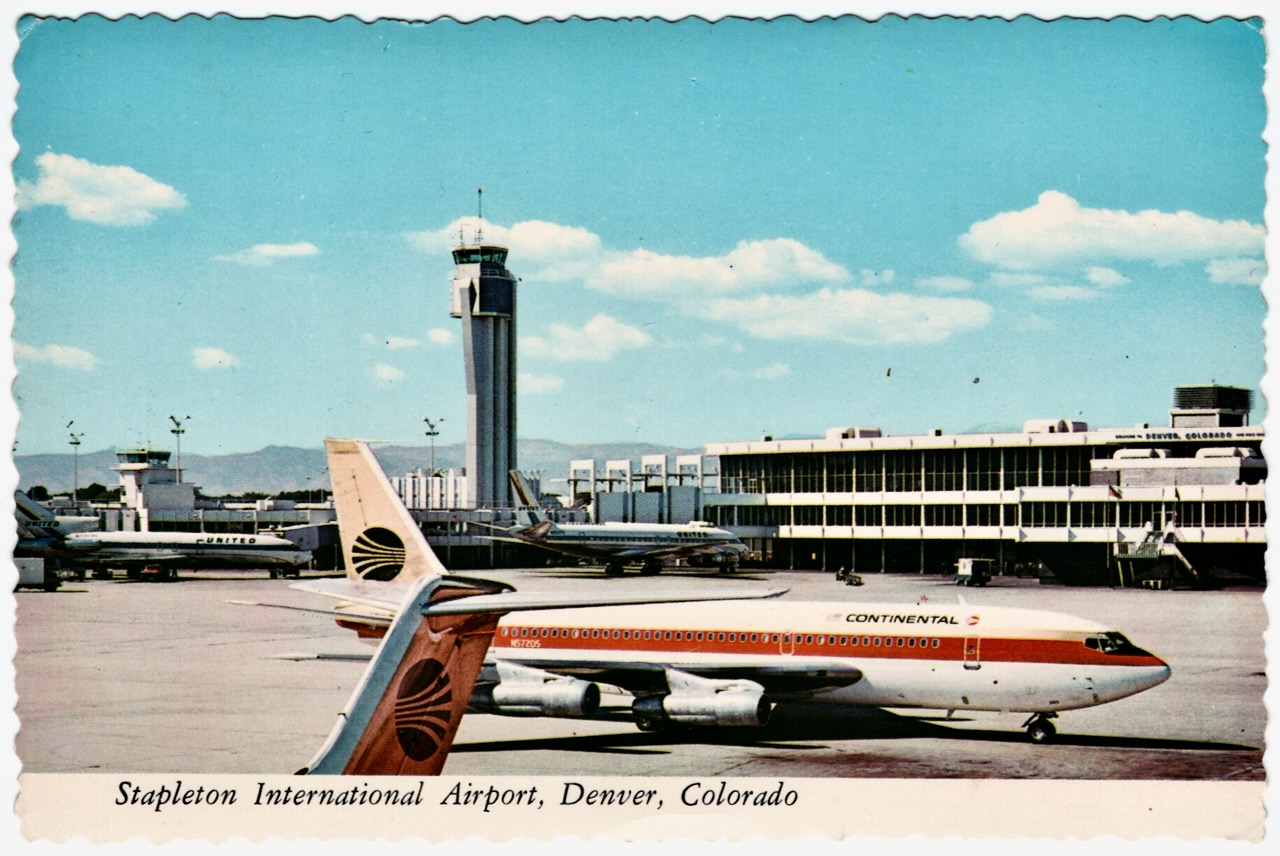
The jet age arrived in Denver in May 1959 when Continental Airlines started operating 707s into Stapleton Airport. My own very first flight was in December 1959 on a Continental 707 “Golden Jet” from Los Angeles (LAX) to Denver Stapleton. This postcard shows Continental Airlines Boeing 720, N57205, at Stapleton, with its tail bearing the classic Continental logo designed by Saul Bass and introduced in 1968. Pub’r Colourpicture, Boston, no. P87834; dist’r G. R. Dickson Co., Denver. The word “International” was added to Stapleton’s name in 1964.
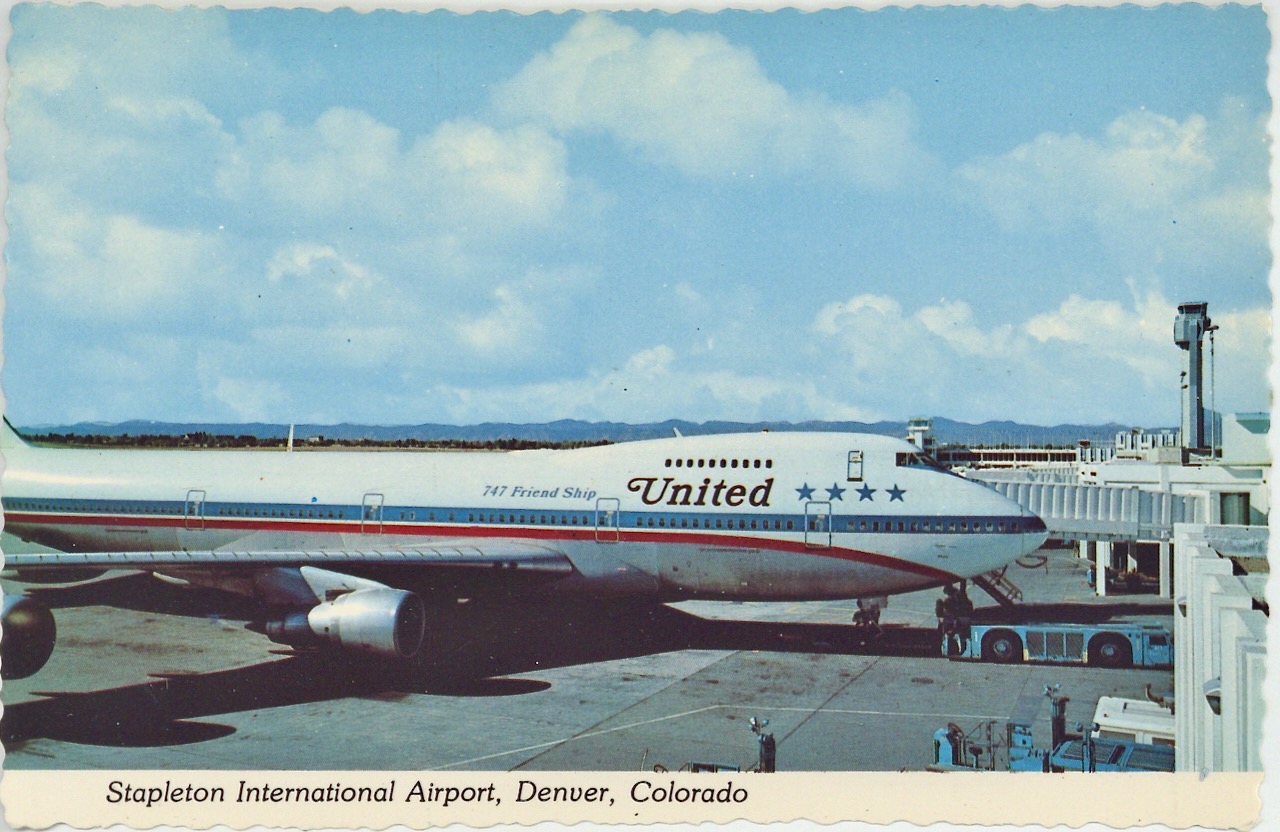
A United Airlines Boeing 747-200 at Stapleton International Airport, in United’s “Friend Ship” livery with four stars, in use during 1972 – 1974. Pub’r Colourpicture, no. P308472; Distributed by G.R. Dickson Co., Denver.
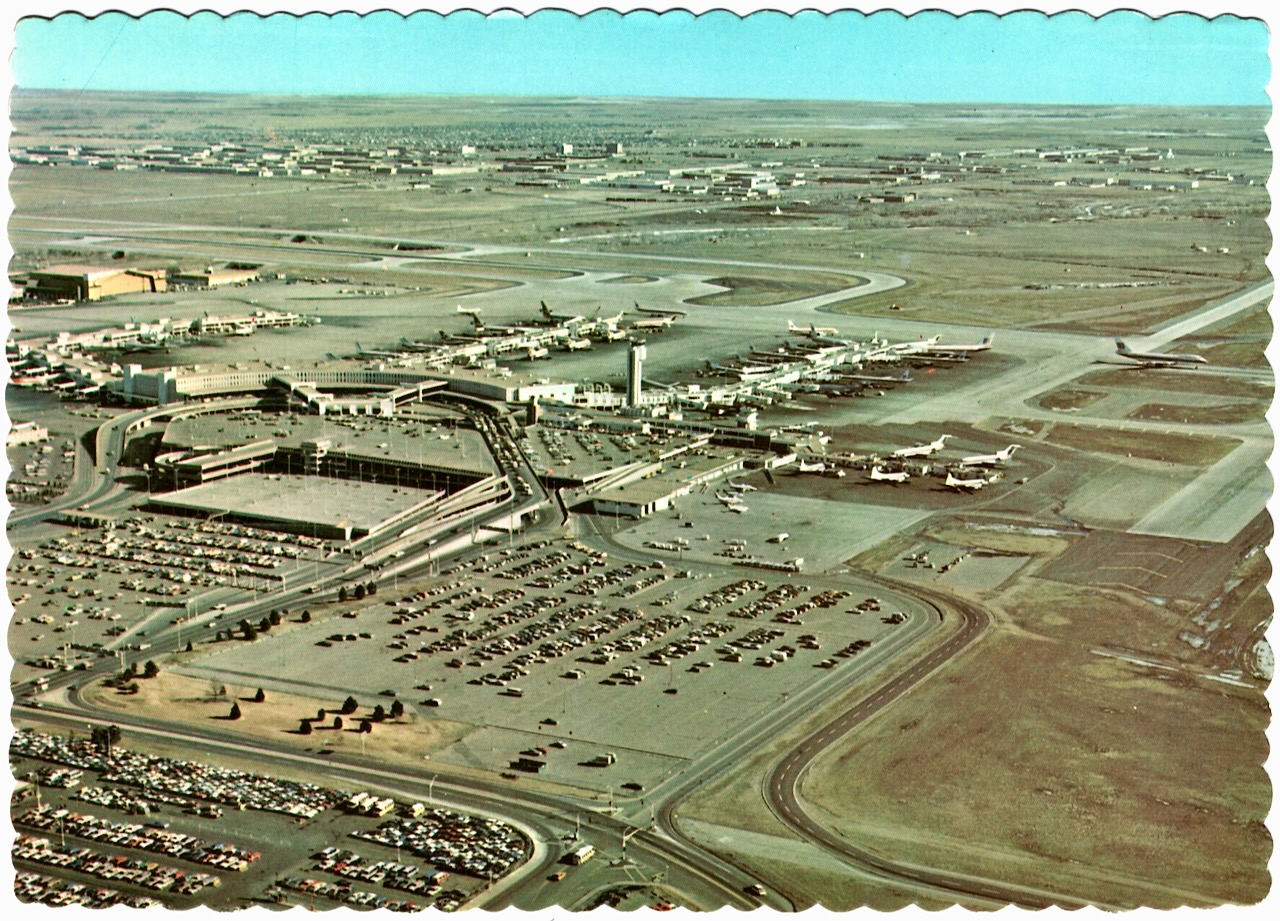
Aerial view of Denver Stapleton International Airport, probably early 1980s. Pub’r Sanborn Souvenir, Denver; printed by Dexter Press, no. 57034-D. Ex Allan Van Wickler Coll’n. Here you see the “horseshoe” arrangement of the main terminal roadways and the two main concourses in the middle — Concourse B for United and Concourse C for Continental. The original concourse, A, is to the right; and Concourse D, built in 1972, is to the left. Later, in 1988, Concourse E opened to the left of the view in this postcard.
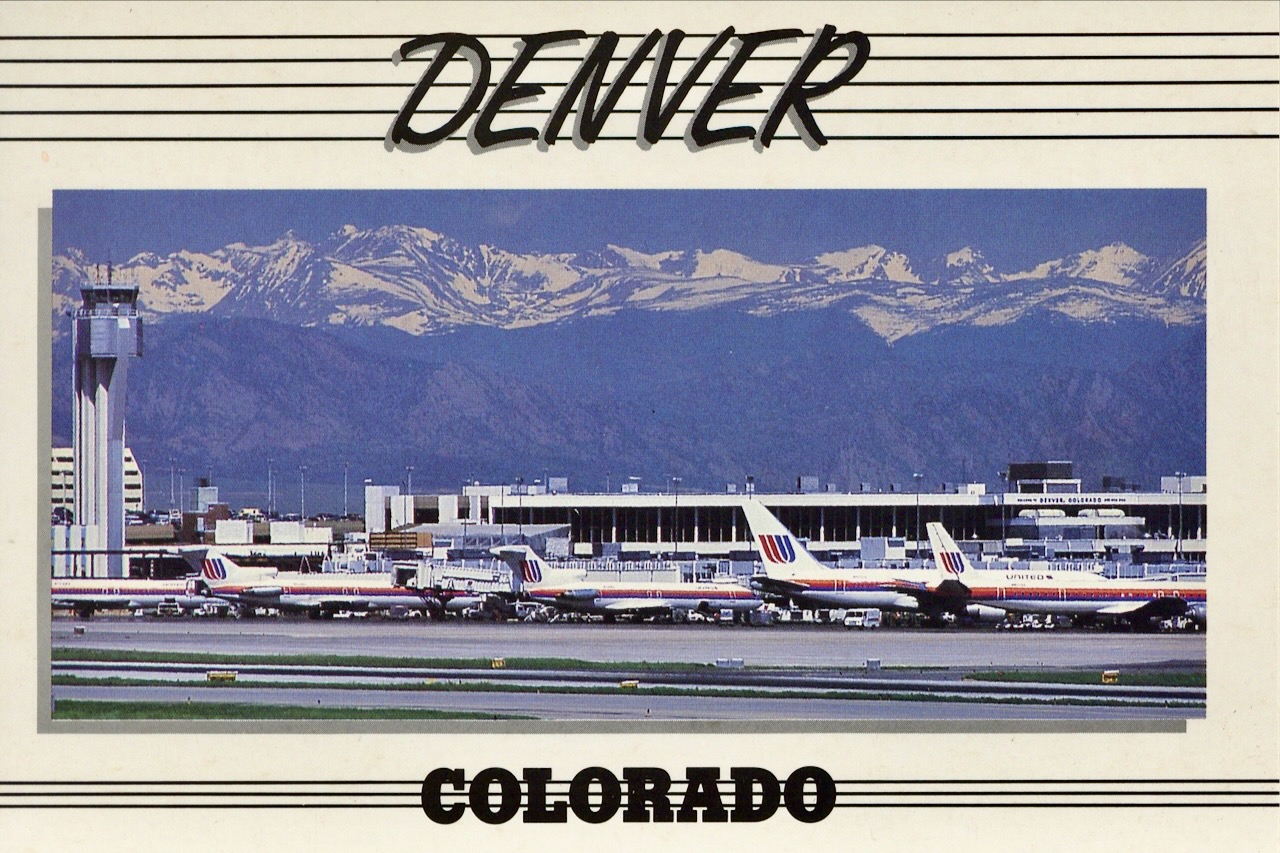
United Airlines aircraft at its Denver hub, Stapleton International Airport, probably in the 1980s. Printer Mike Roberts, Oakland, CA, nos. B16284/D-133; dist’r G. R. Dickson, Denver; photo by Arthur H. Bilsten. Boeing 727s and a 767 can be seen along with a Douglas DC-8. The double “U” logo on the United tails was designed by Saul Bass and introduced in 1974, and United operated the first commercial service of a 767, from Chicago to Denver Stapleton, in May 1982.
The rapid growth of Stapleton’s passenger traffic, coupled with the inability to acquire more land for expansion, led to the construction of a new primary airport for Denver. Following many years of planning and construction, Denver International Airport was finally ready. The last flight departed Stapleton on February 27, 1995, and Denver International Airport opened the next morning. Stapleton was decommissioned, and today the only remaining structure is the preserved 12-story control tower. The rest of Stapleton Airport is now a multipurpose development, including residences, businesses, and parks.
Today’s primary Denver airport, Denver International (DEN), which opened February 28, 1995, can only be described with superlatives. Its sheer size is overwhelming — 53 square miles (137.8 square km) of land, about twice the land area of Manhattan and about twice that of Dallas-Ft. Worth Airport. Its terminal, named after pioneering airline pilot and Denver native Elrey Jeppesen, contains 2.6 million square feet (241,548 square meters) of space and leads to over 170 gates. The terminal’s translucent white tented peaks, designed to simulate the Rocky Mountains in the background, look stunning from the air and impressive from ground level.
Denver International now has six non-intersecting runways. Five are 12,000 ft. (3657m) each in length. The sixth runway (16R/34L) is 16,000 ft. (4875m), over three miles long, the longest commercial runway in North America. That extra length is particularly useful because of Denver’s mile-high elevation and summer heat. Moreover, because of the airport’s enormous land area, it has room to add up to six additional runways if and when needed.
In 2025, over 82 million passengers passed through Denver International Airport, making it the 4th busiest airport in the U.S. and the world’s 10th busiest airport. Denver Airport expects further growth and has adopted a two-phase strategic plan – “Vision 100” to prepare the airport to serve 100 million passengers annually in the next several years, and “Operation 2045” for an expected 120 million+ passengers by its 50th anniversary in 2045.
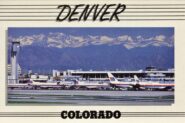
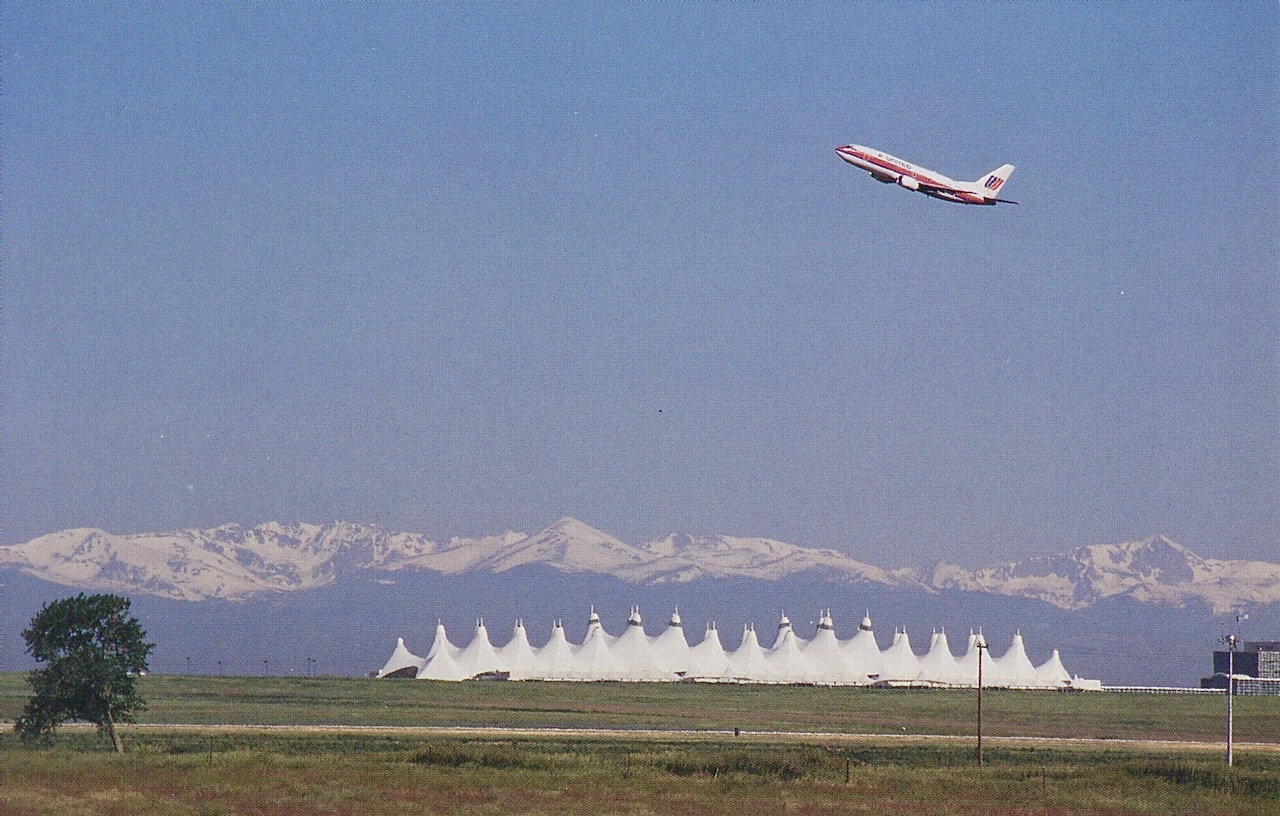
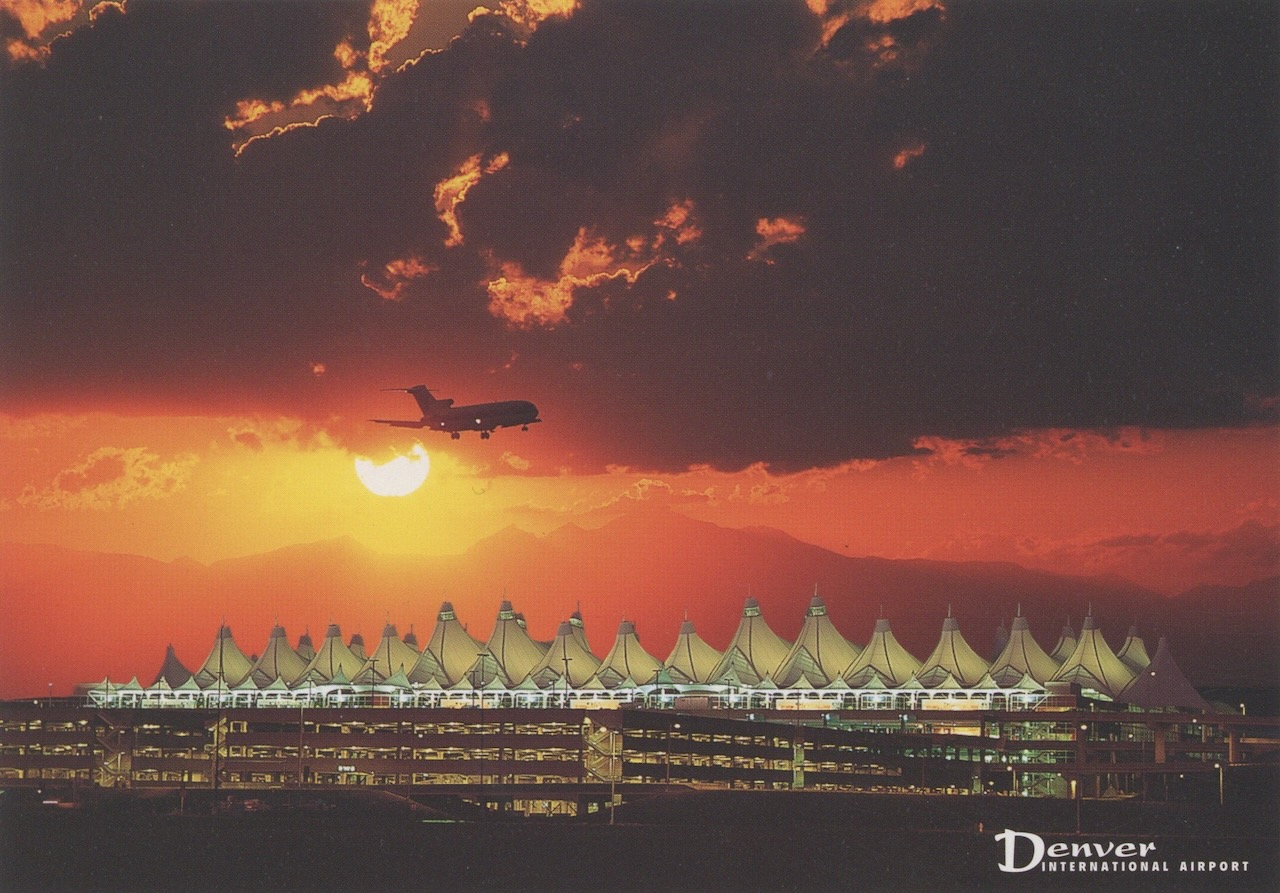
Denver International Airport opened on February 28, 1995, replacing Denver Stapleton International Airport. As seen in this postcard, the white tented peaks of the airport’s Jeppesen Terminal stand out impressively, with the Rocky Mountains in the background and a United Airlines plane climbing after takeoff. Publ’r Sanborn Ltd., Commerce City, Colorado; photo by Ron Ruhoff.
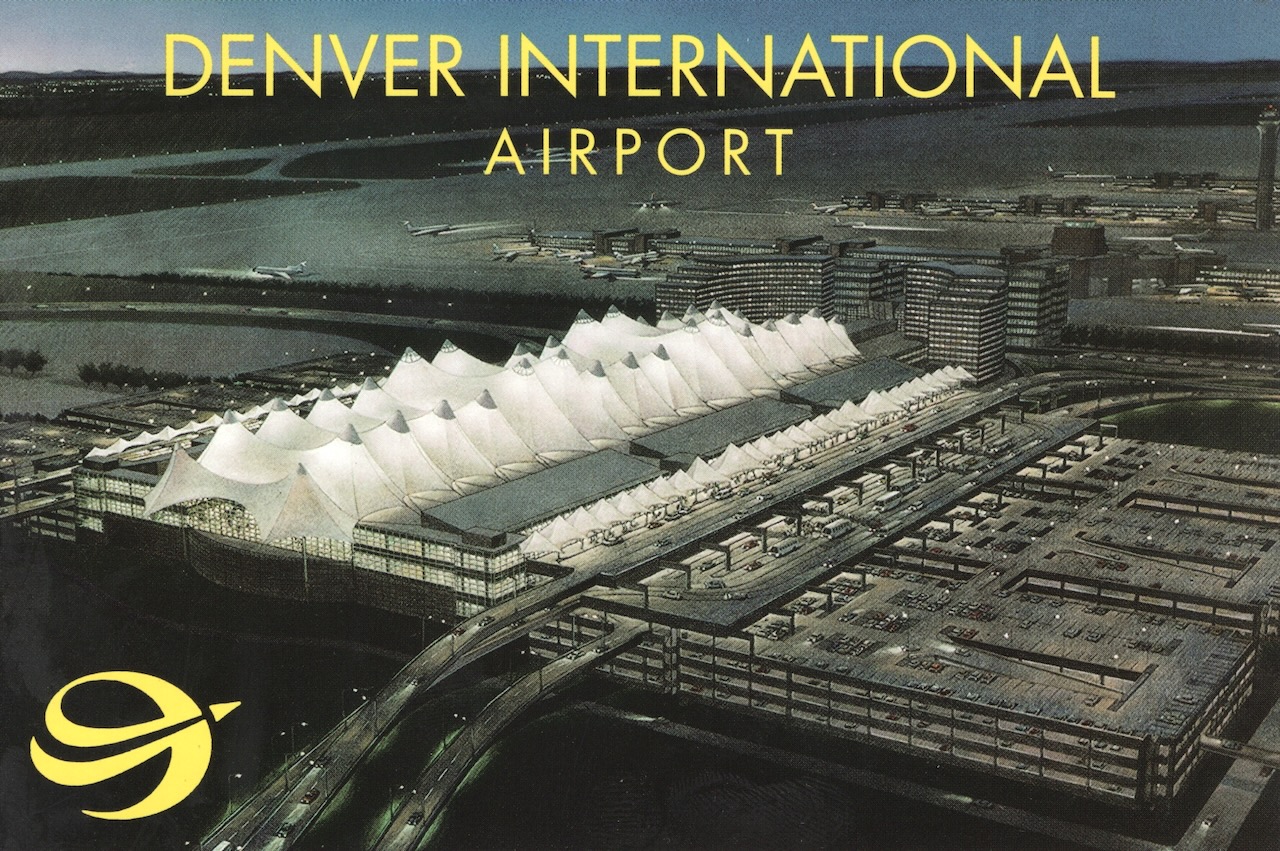
Denver International Airport at dusk. The translucent Teflon-covered fiberglass roof pinnacles of the Jeppesen Terminal create a lighted beacon effect at night. The airport logo appears in the lower left-hand corner. Pub’r Mountain States Specialties, Boulder, CO; Printer Mike Roberts, Oakland, CA, no. B20211.
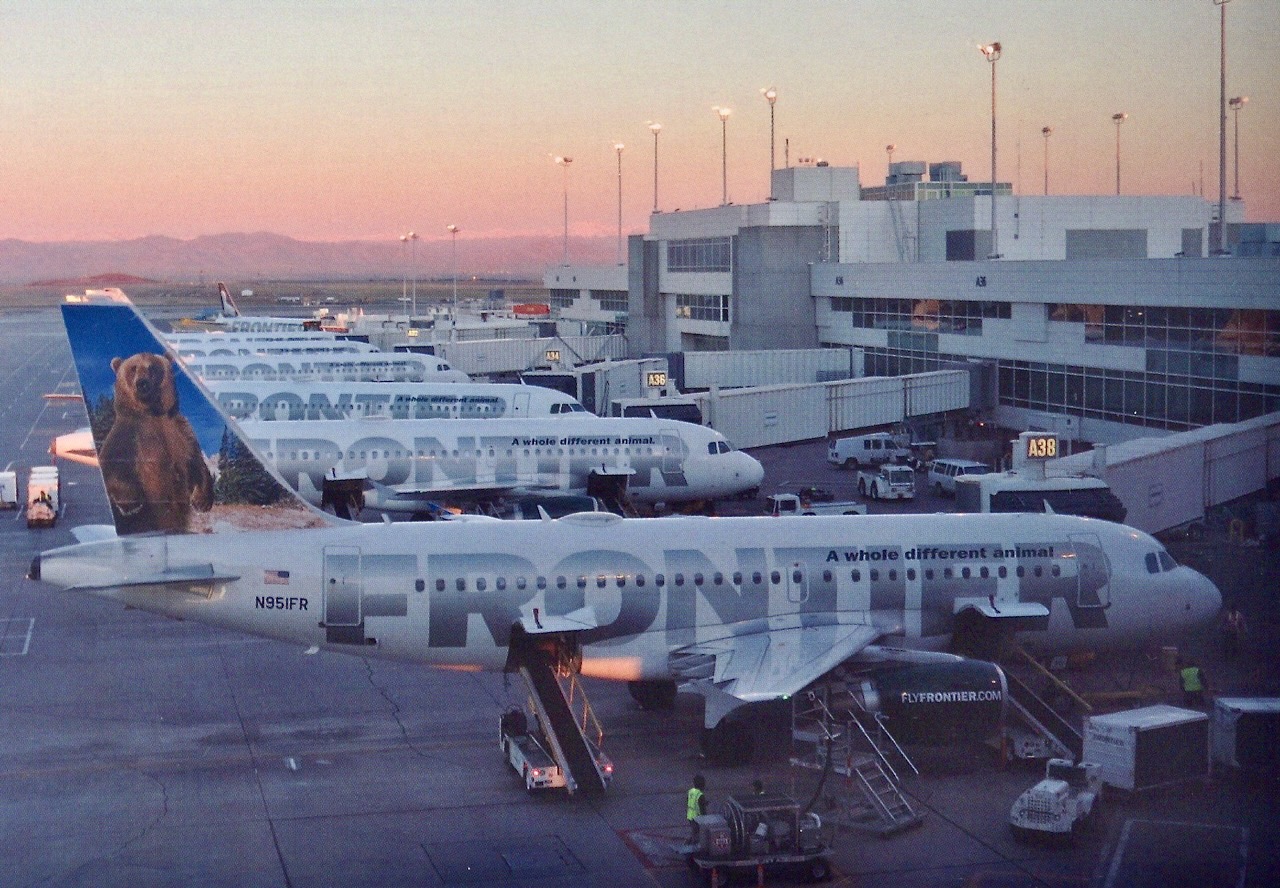
Frontier Airlines aircraft at the west portion of Concourse A at Denver International Airport at sunrise, October 14, 2014. In front is Frontier Airbus A319, N951FR. No. 1 of seven postcards issued for Airliners International 2017 Denver; pub’r jjpostcards, Bassendorf, Switzerland; photo via Aaron Mandolesi.
Denver International Airport at sunset. Pub’r Impact Colorado no. 40281; Photo by Bob von Normann.
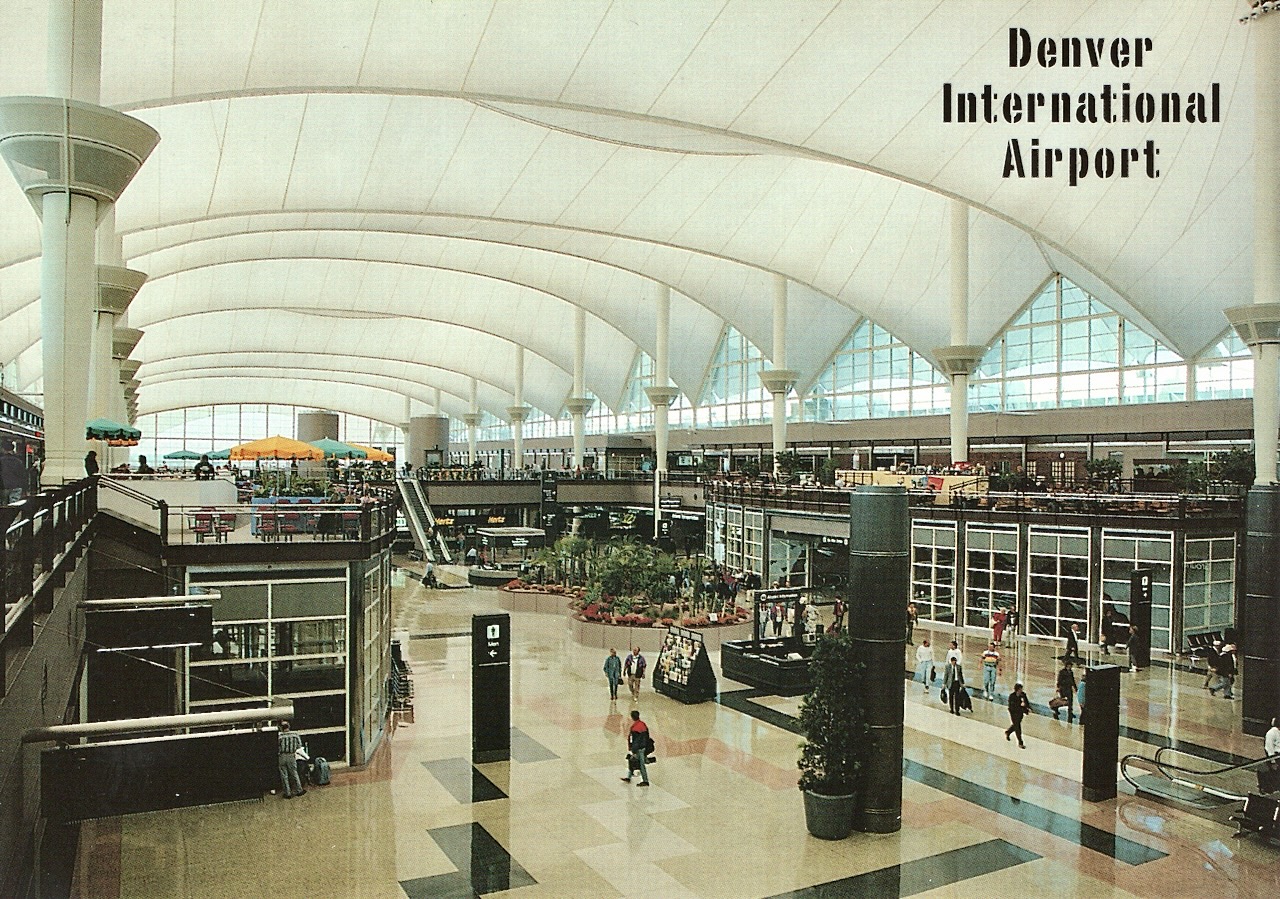
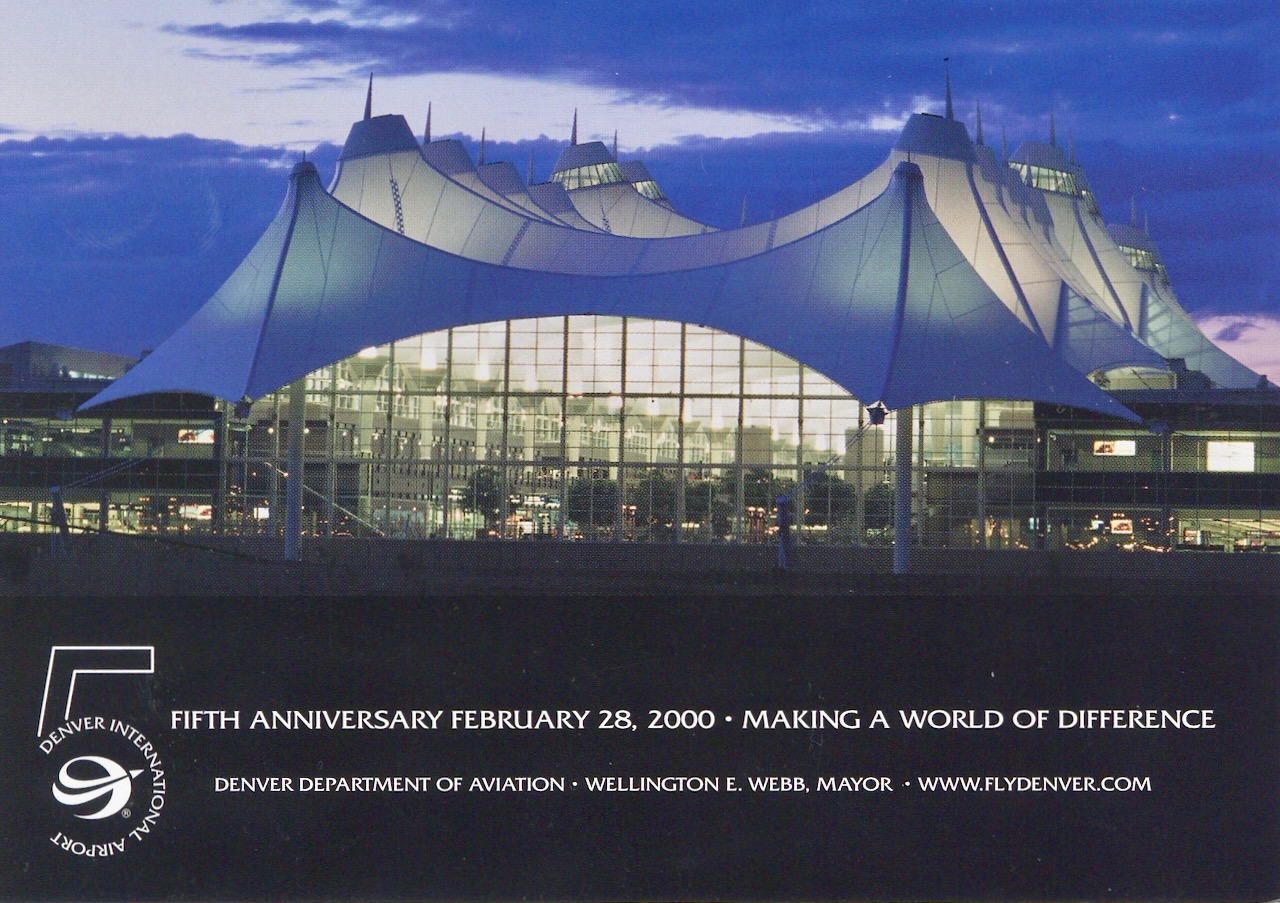
Postcard commemorating the 5th anniversary of Denver International Airport, February 28, 2000, showing the distinctive peaked Jeppesen Terminal illuminated by its spacious atrium. Issued by the Denver Department of Aviation.
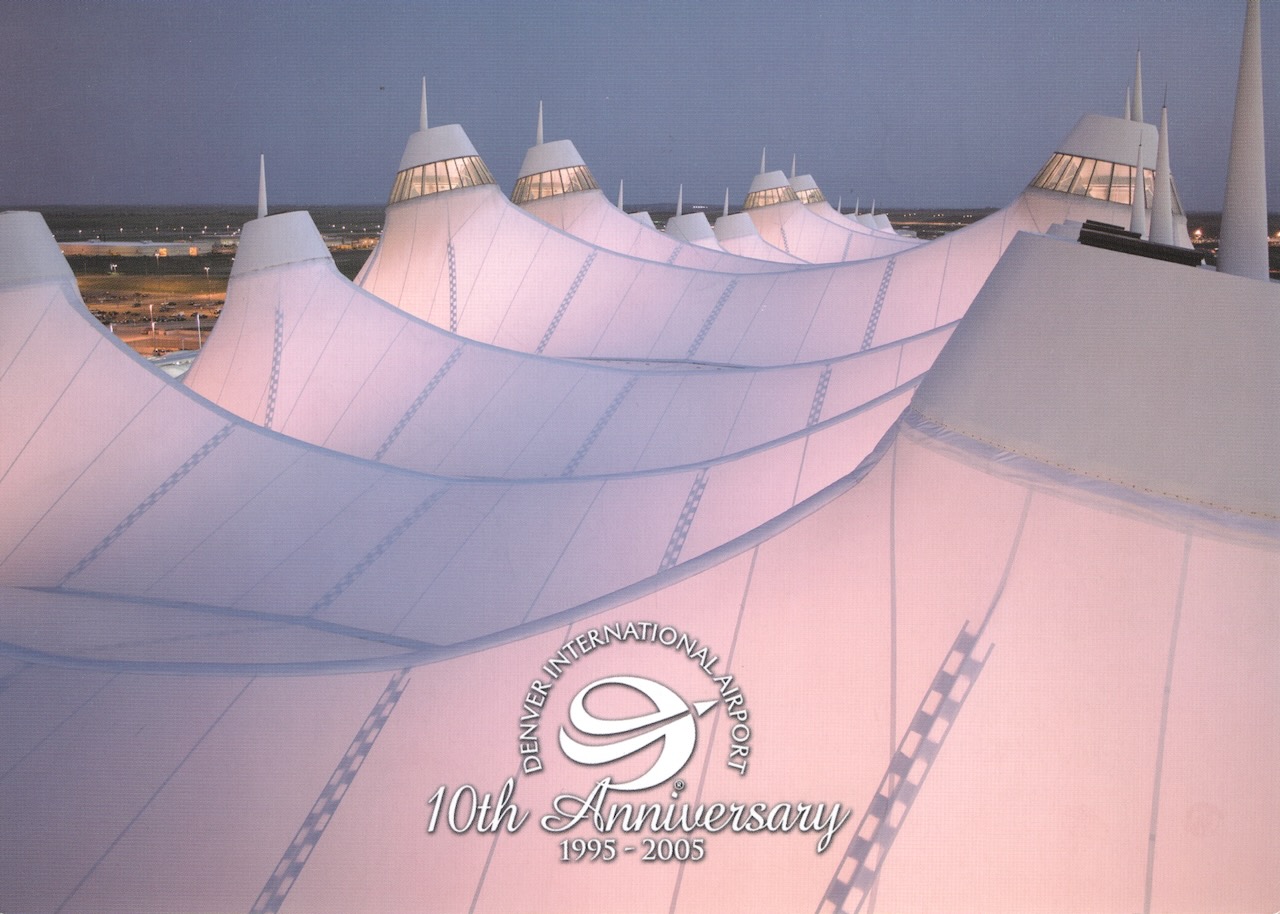
Denver International Airport Jeppesen Terminal “billowing sails” art postcard issued by Denver Airport on its 10th Anniversary in 2005. Oversize.
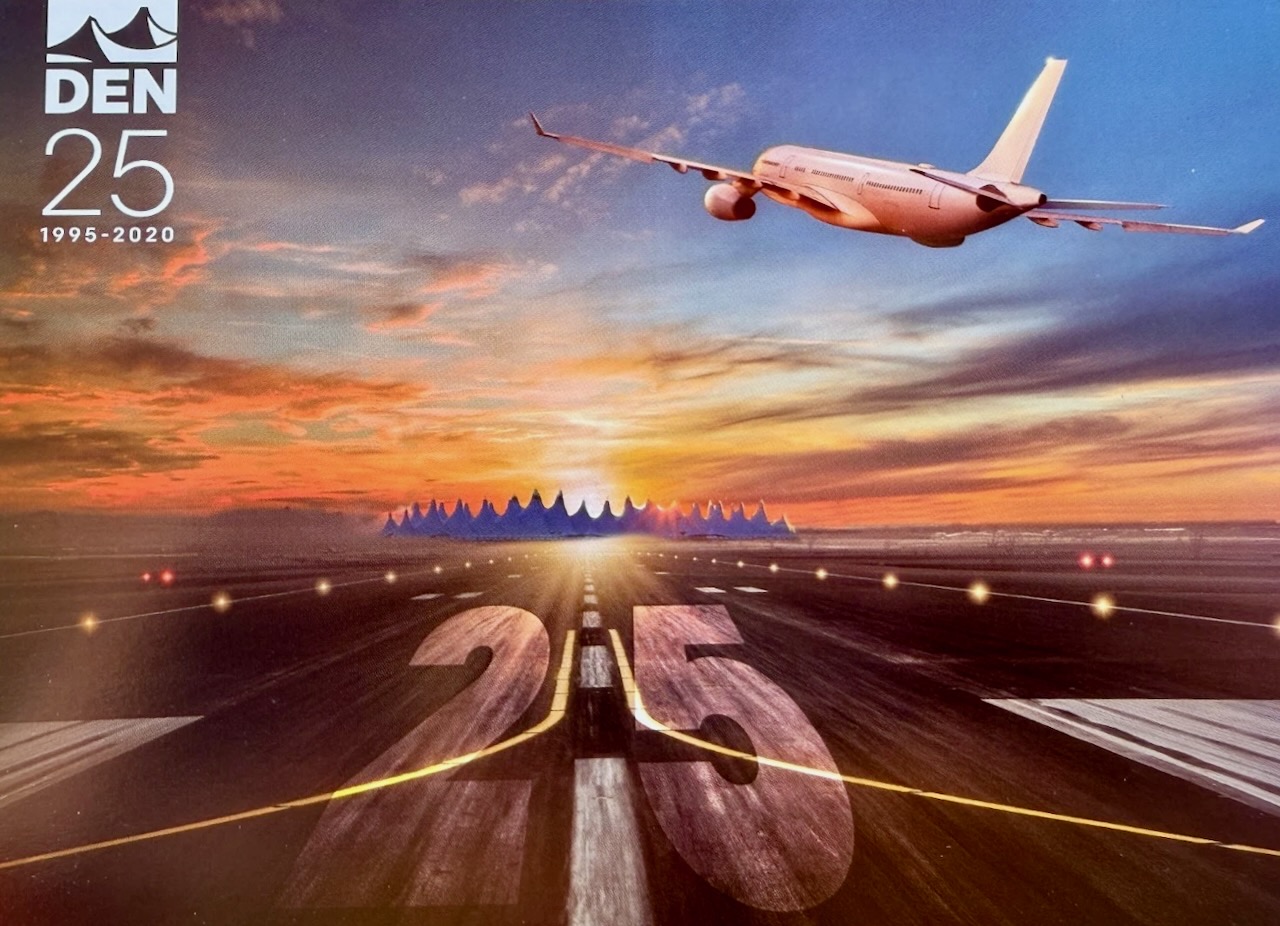
Denver International Airport 25th Anniversary postcard, issued by the Denver Department of Aviation in 2020 for the Airport’s “Don’t Stop Believing” Exhibit in the Jeppesen Terminal.
Note: All postcards shown are from the author’s collection except the last one. I estimate their rarity as follows: Uncommon: the United DC-4s at Stapleton postcard and the three Denver International Airport anniversary postcards.
References:
The Denver International Airport website: flydenver.com
Airliners International 50th Anniversary Show and Convention, 2026 Denver
June 24-27, 2026, at the Doubletree Hotel, Quebec St., Denver, CO:
Details found at airlinersinternational.org, the convention website. Registrants can submit airline and airport postcard exhibits for display at the show; see the Postcard Exhibit Rules posted on the convention website.
In 1925, the owner of Coca-Cola, Asa Candler, leased to the City of Atlanta his abandoned auto racetrack site for development into an airfield named Candler Field.
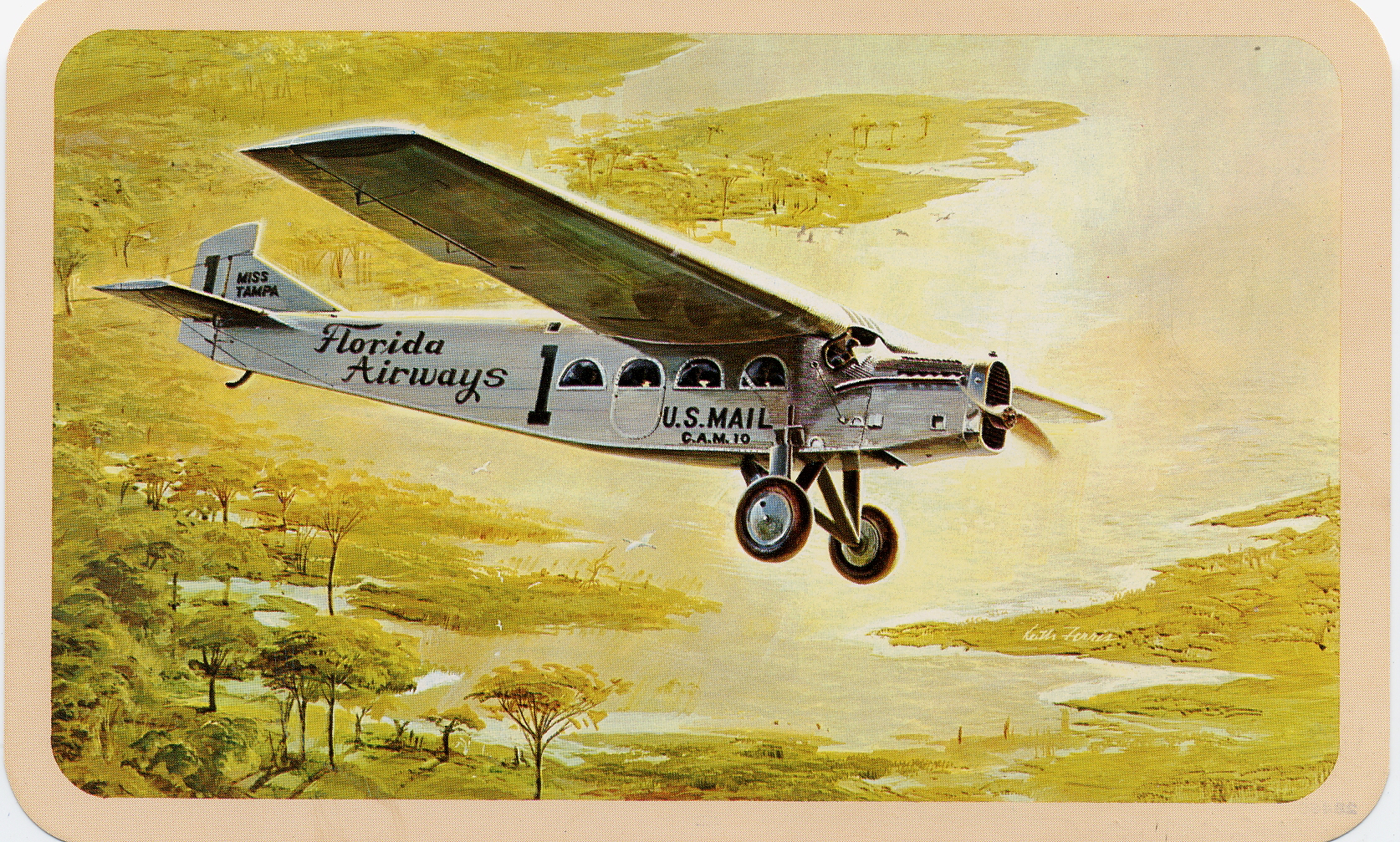
The first airlines to serve Atlanta were Florida Airways which operated from 1926 to 1927; St. Tammany Gulf Coast Airways, 1927, which became a division of Southern Air Transport System in 1929 and in turn part of American Airways in 1930; Pitcairn Aviation which started in 1927, was renamed Eastern Air Transport in 1930 and then became part of Eastern Air Lines in 1934; and Delta Air Service (later named Delta Air Lines) in 1930. During the 1930s, both Delta and Eastern expanded their routes into and out of Candler Field and became the main airlines serving Atlanta at the time.
In 1929, the City of Atlanta purchased the airfield from Asa Candler on favorable terms, and though the airport was officially renamed Atlanta Municipal Airport in 1942, it continued to be popularly referred to as Candler Field.
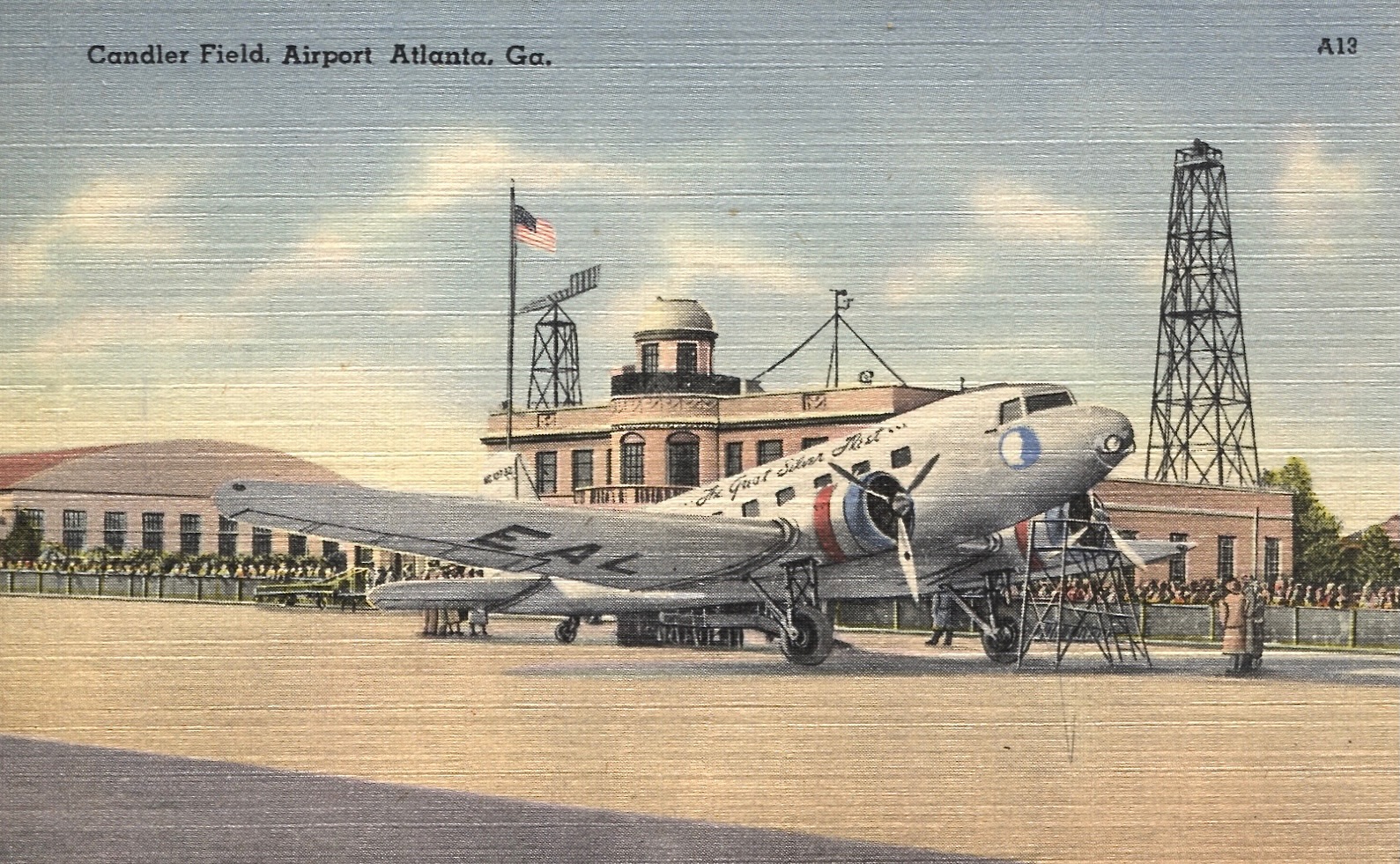
Here is my earliest postcard of Candler Field showing an airline:
Eastern Air Lines Douglas DC-2 at Atlanta’s Candler Field, mid-1930s. ‘Linen’ finish. Publisher Tichnor Bros., Boston, no. 65610. The airport’s terminal building, which opened in 1932, appears behind the center of the aircraft. The card back says “Twenty-six passenger and mail planes arrive and depart daily from this great modern airport…”(Today, those 26 planes have grown to more than 2,700 daily!)
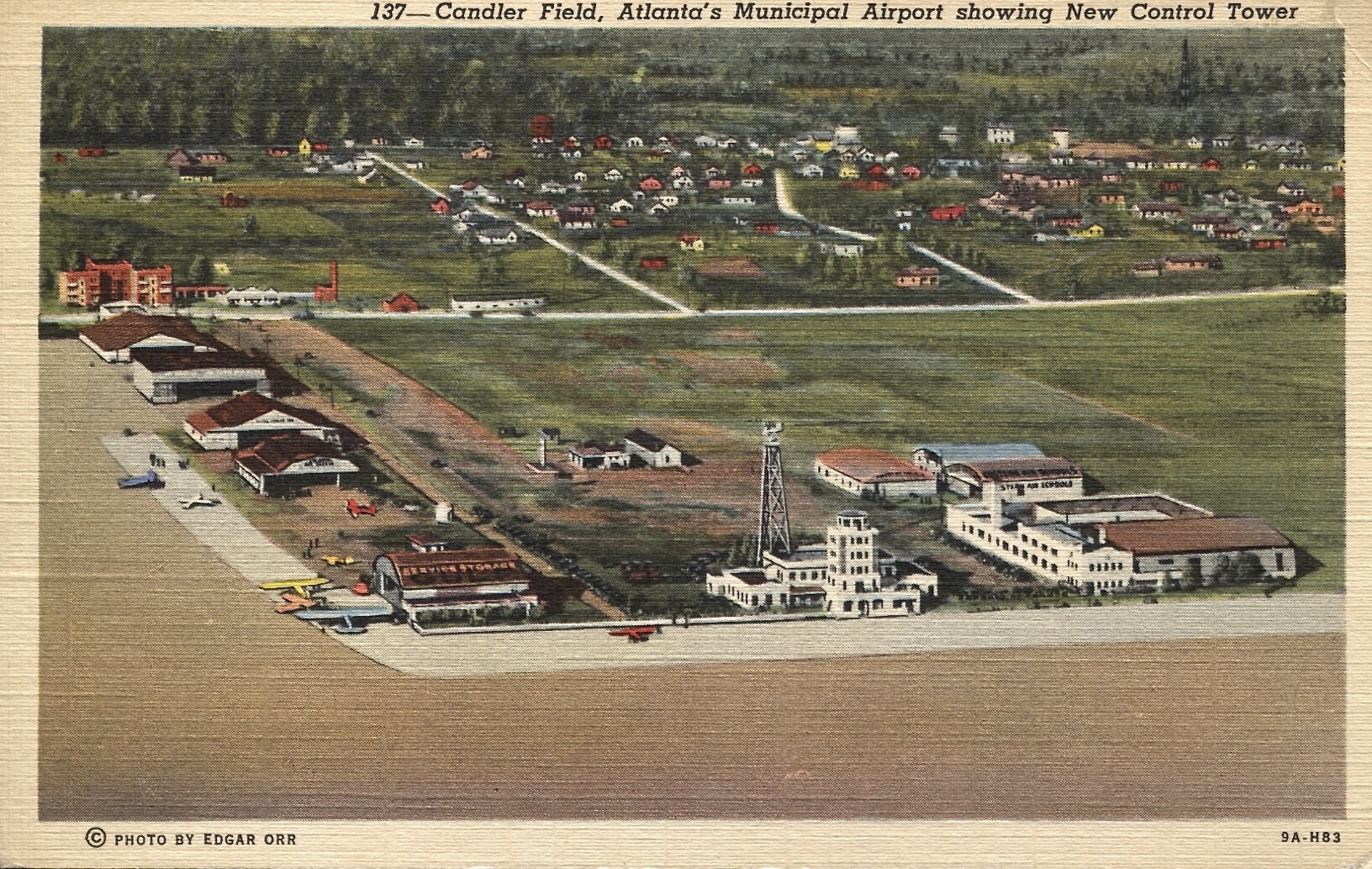
In March 1939, Candler Field built its first control tower in a six-story building with administrative facilities. The control tower can be seen in this next card:
Aerial view of Candler Field showing new control tower in center, 1939. Pub’r Curteich no. 9A-H83. ‘Linen’ finish. The back of the card now proudly claims 28 daily airline arrivals/departures (up from the previous card’s 26).
In 1940, Delta Air Lines acquired four DC-2s, but these were retained only until the end of that year, being replaced by DC-3s.
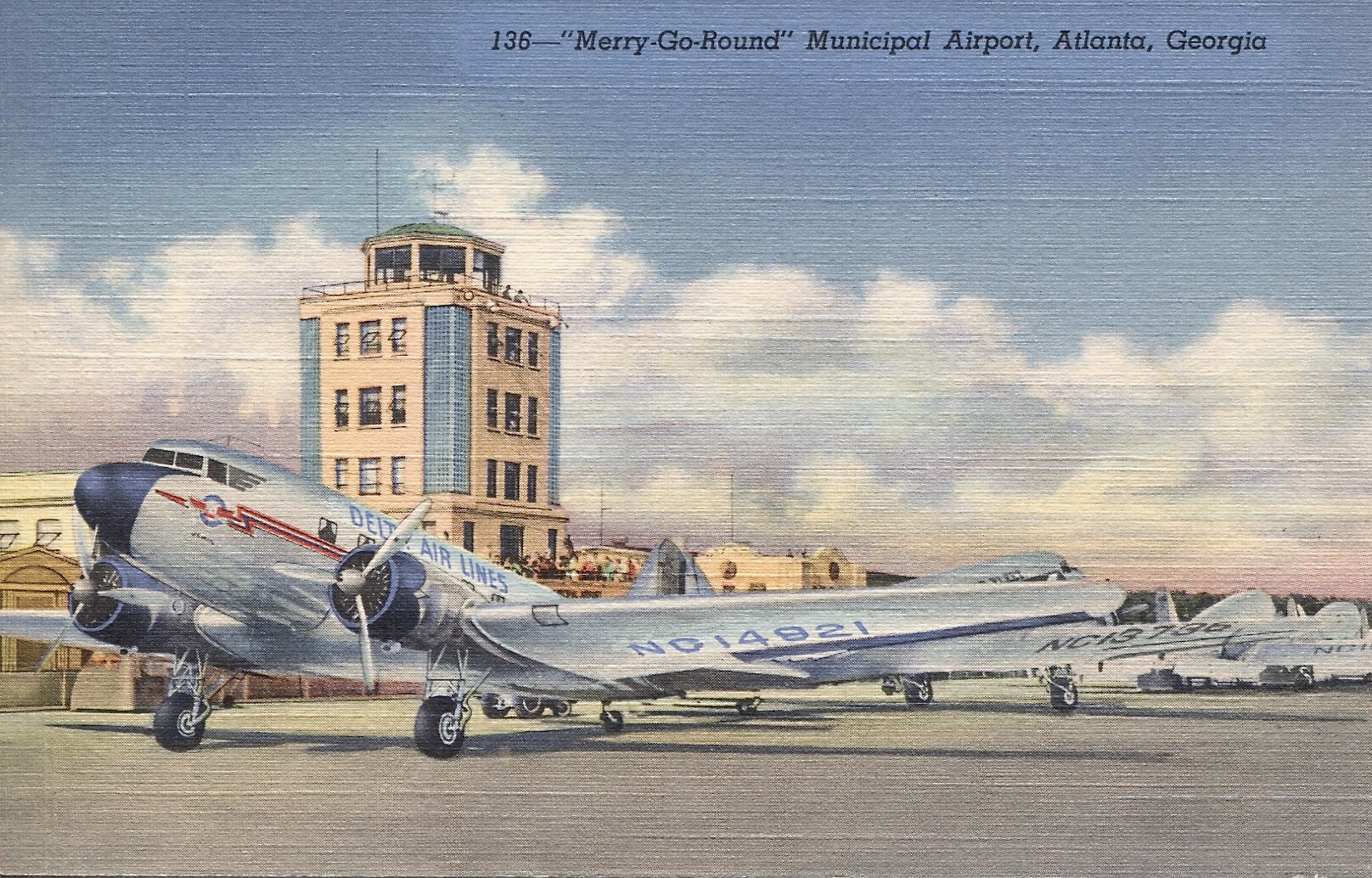
Delta Air Lines Douglas DC-2, NC14921, at Atlanta, 1940. ‘Linen’ finish. Pub’r Curteich no. 0B H1385. There are two versions of this card. This one refers to the “Merry-Go-Round” at the airport, stating on the back: “Large crowds gather twice a day to view the arrival and departure, within a space of only a few minutes time, of seven large passenger ships; and this spectacular sight is known as the famous Merry-Go-Round.” The other version lacks this reference.
During World War II, Candler Field also became a U.S. air base, and it doubled in size. In 1941, Delta moved its headquarters from Monroe, Louisiana, to Atlanta, and for decades it has been the dominant airline there.
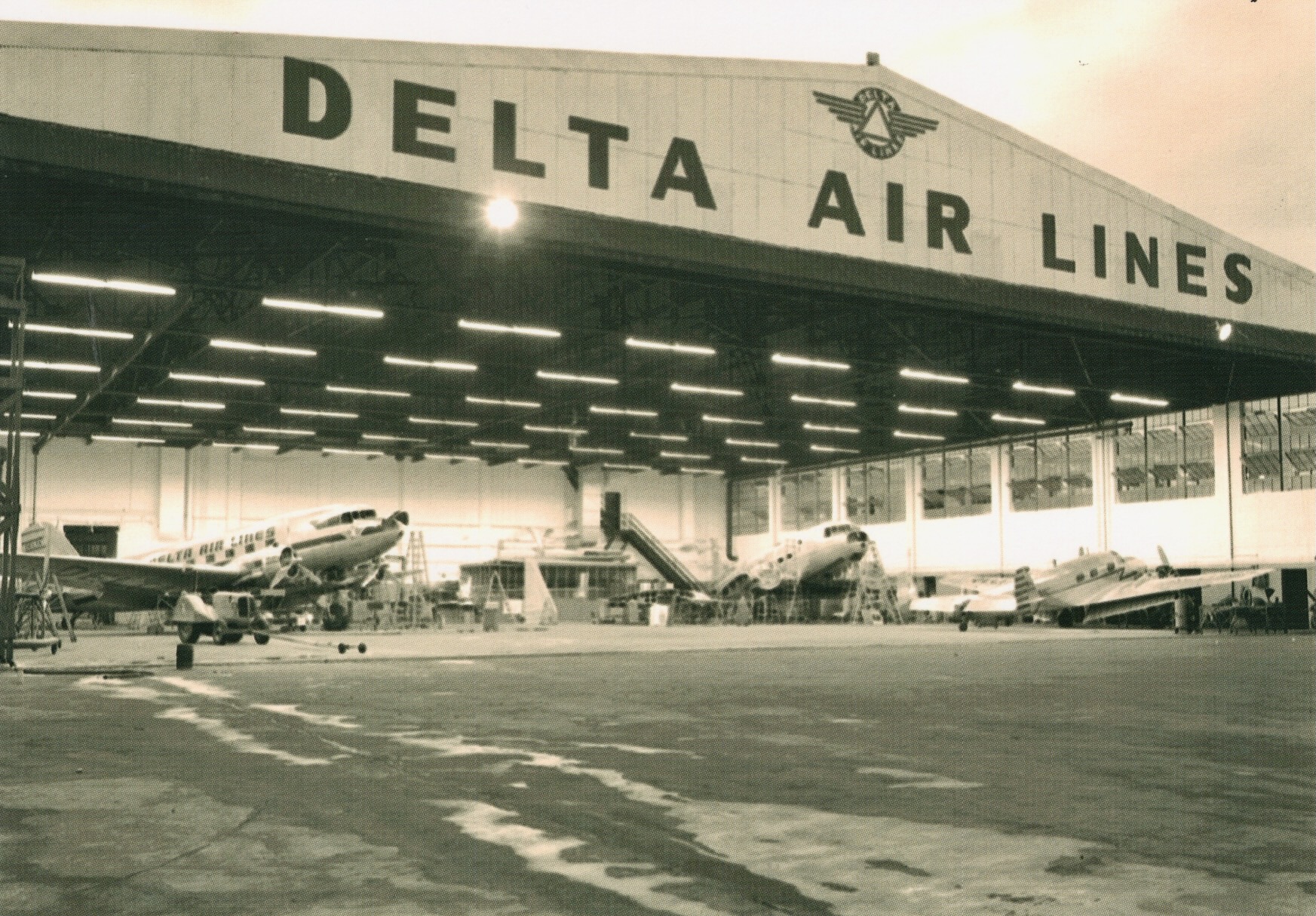
The Delta Air Lines hangar at Candler Field/Atlanta Municipal Airport with Douglas DC-3s and a Lockheed 12A Electra Junior, early 1940s. Postcard issued by Airliners International 2015 ATL. Pub’r jjPostcards. Photo courtesy of the Delta Flight Museum. Today, this hangar is part of the Delta Flight Museum, site of Airliners International ATL 2025.
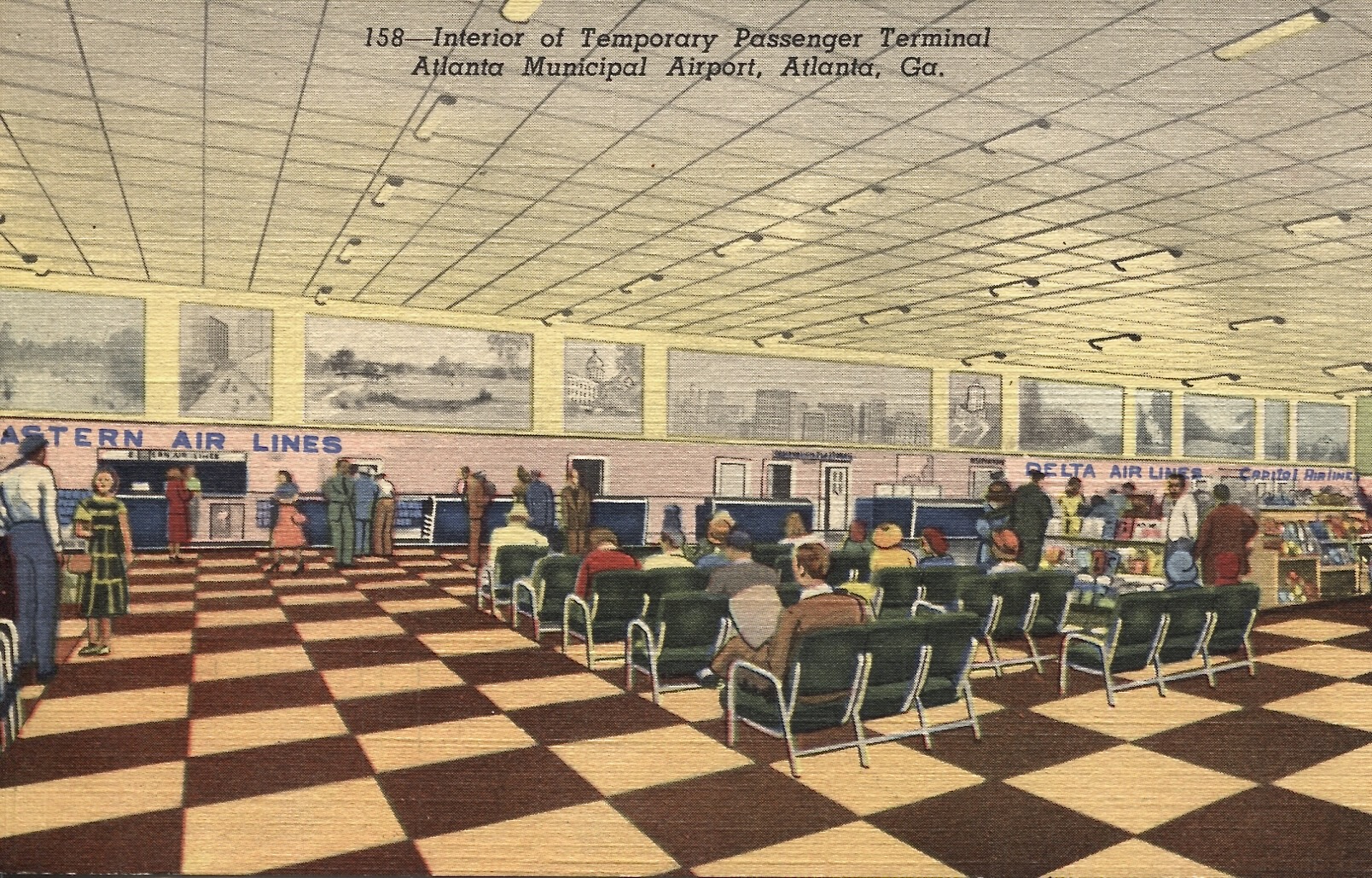
Passenger numbers continued to grow, and in 1948 the airport closed its old terminal building and moved operations into a Quonset hut war-surplus “temporary” terminal while it developed plans to build a larger permanent terminal. That year saw more than 1 million passengers pass through Atlanta airport.
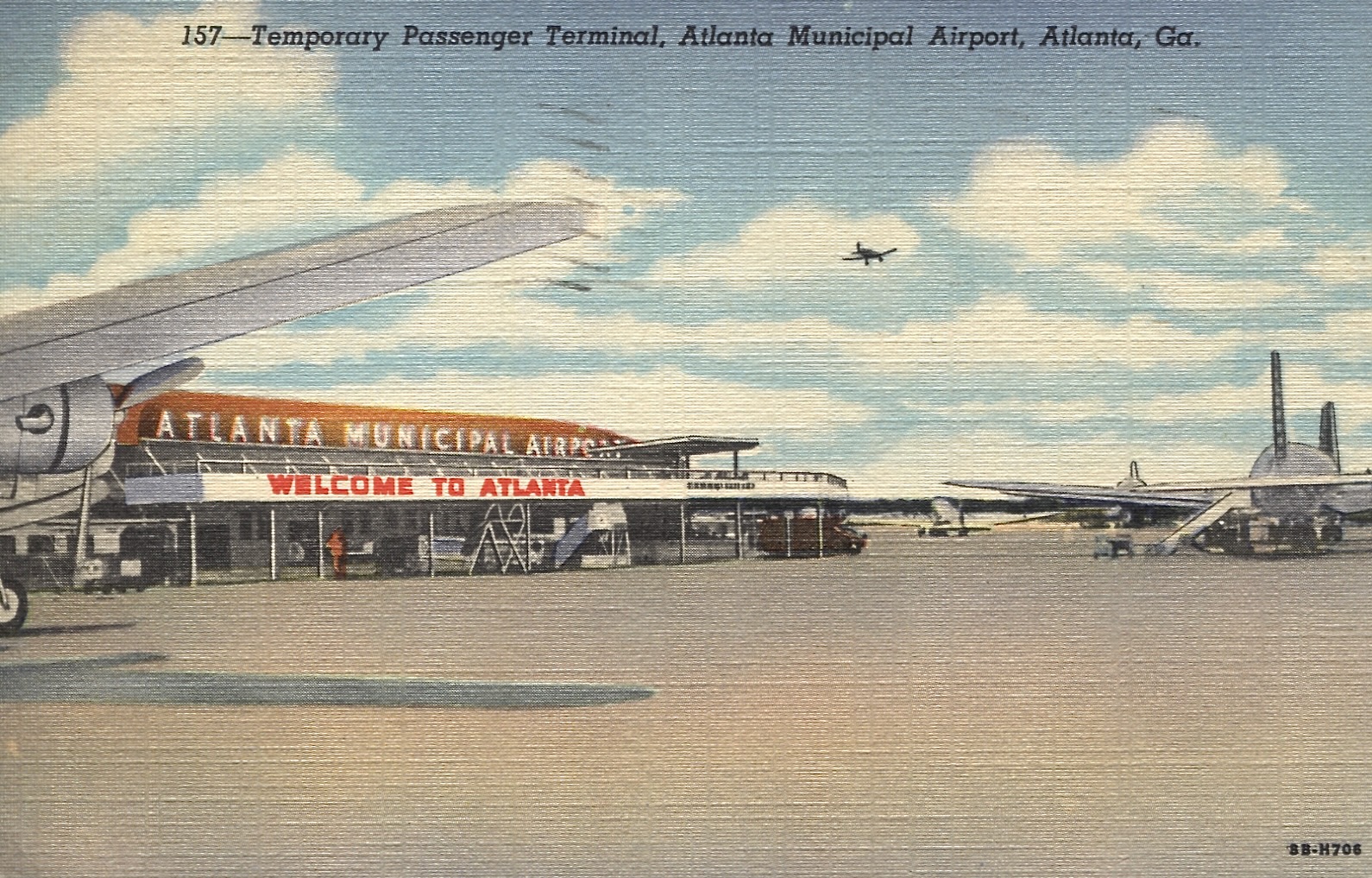
The “temporary” terminal proved to be not so temporary. It served until May 1961, when a new terminal designed to accommodate the jet age finally opened. Here are three postcards from the “temporary” terminal era (1948-1961) at Atlanta Municipal Airport.
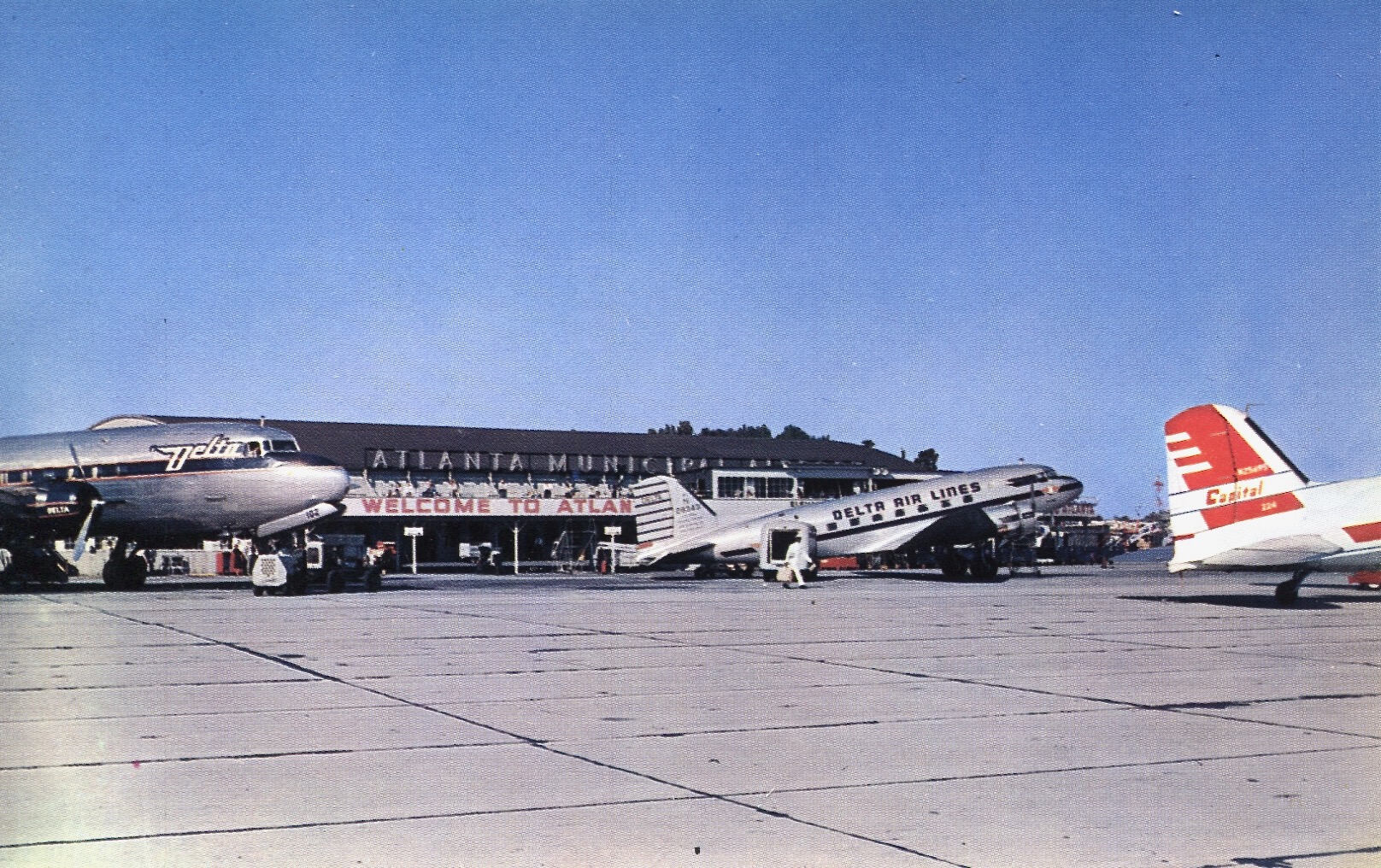
Delta Douglas DC-6, N1902M, Delta DC-3, NC28343 “City of Miami,” and Capital DC-3 in front of Atlanta Municipal Airport “temporary” terminal, about 1949. Pub’r Atlanta News Agency, Dexter Press 50317.
Interior of the “temporary” passenger terminal at Atlanta Municipal Airport, 1948. ‘Linen’ finish. Pub’r Curteich no. 8B-H1640. In this view, you can see ticket counters for Eastern, Delta and Capital Airlines. The back of the card says “The ticket counter, 200 feet in length, is the world’s longest.”
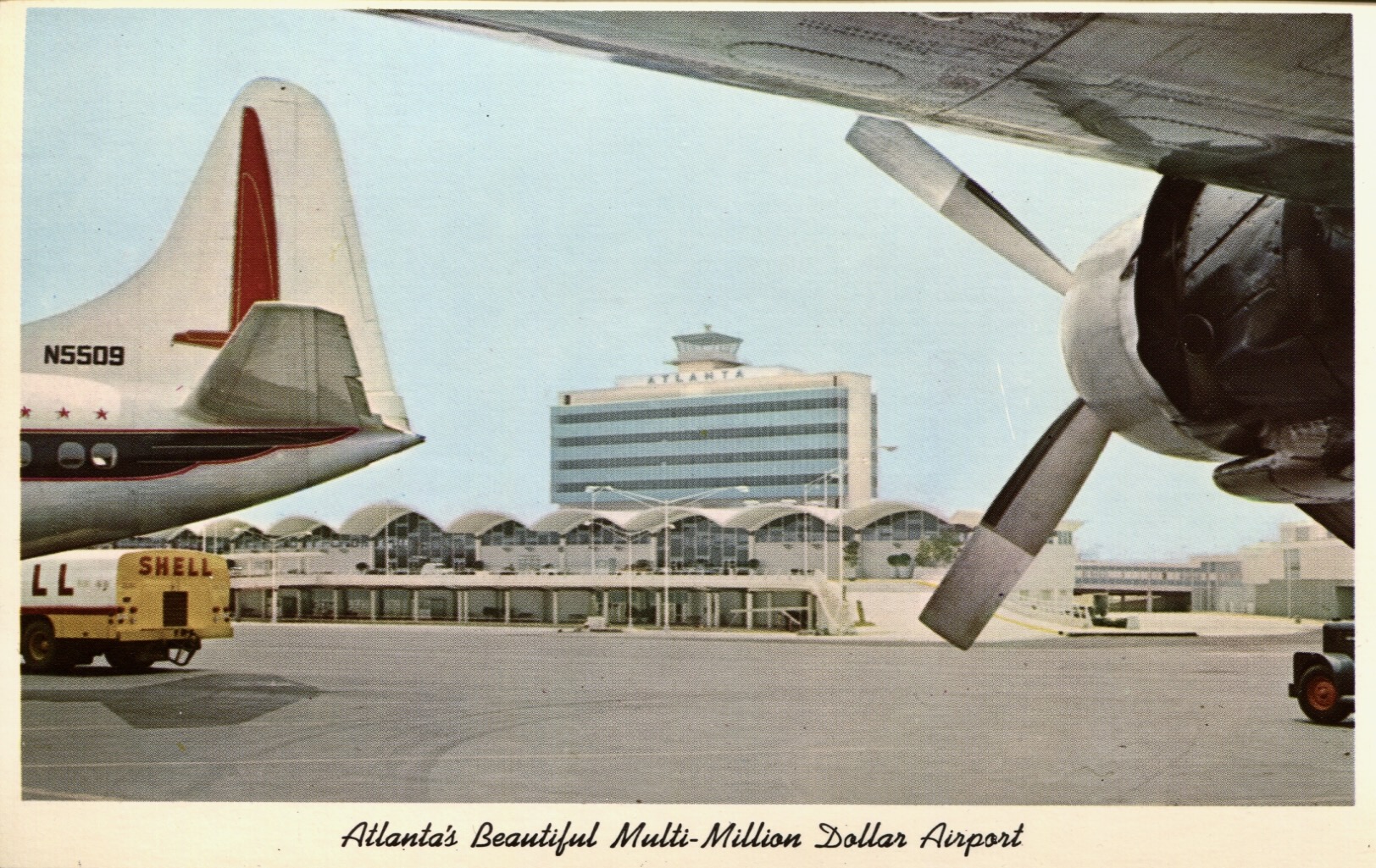
On May 3, 1961, Atlanta Municipal Airport finally opened its new Jet-Age terminal, publicizing it as the largest single terminal in the U.S. The terminal was designed to accommodate 6 million passengers a year, but in its first year, 9.5 million passengers utilized it!
New Jet-Age Terminal at Atlanta Municipal Airport, with tail of an Eastern Air Lines Lockheed L-188 Electra, N5509, 1961. Pub’r Curteich 1DK-777.
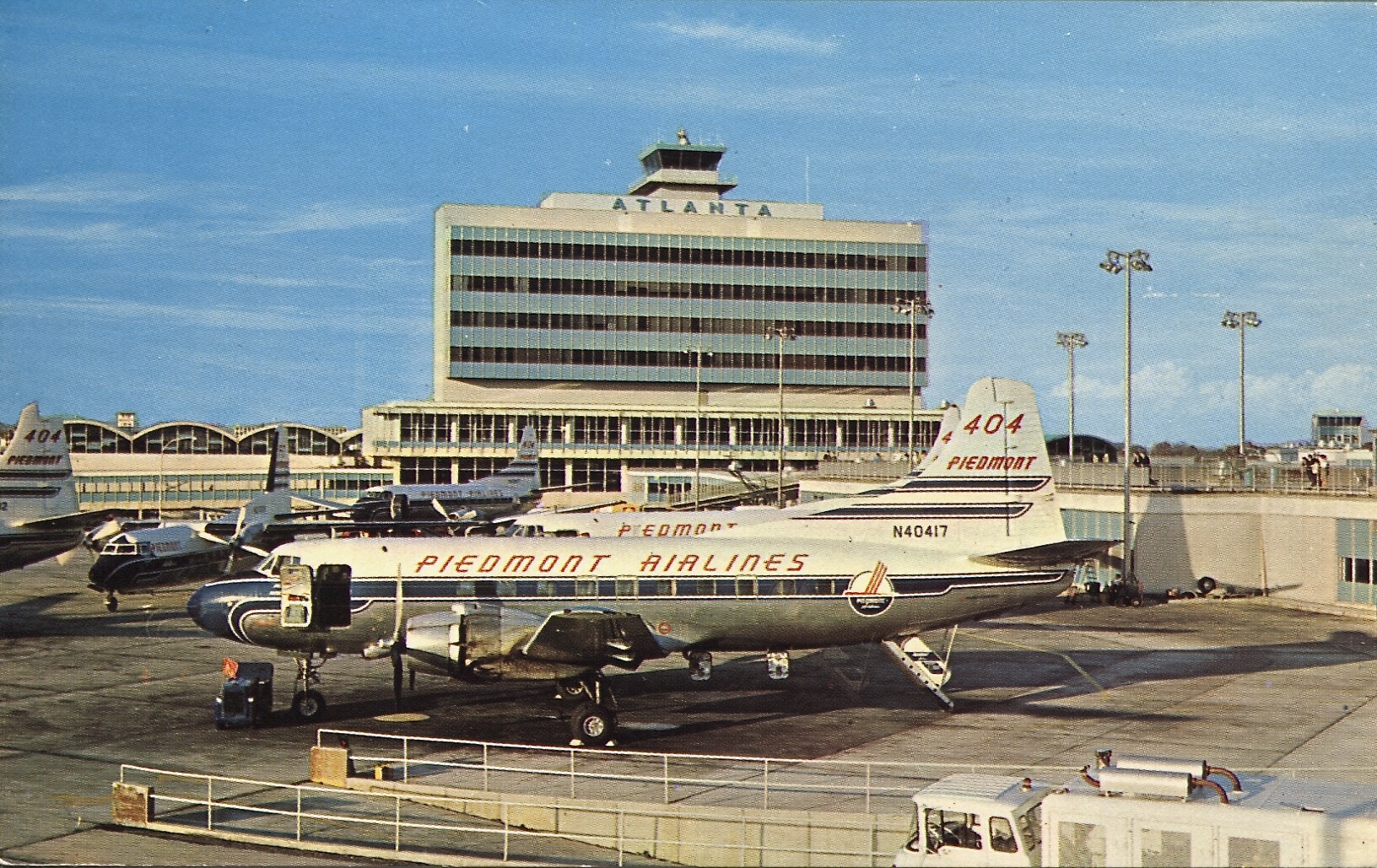
Piedmont Airlines Martin 404, N40417, at Atlanta Municipal Airport. Pub’r Nelson Jones, Lakewood, Ohio, no. K-16186. This aircraft served with Piedmont from 1962-68. Note on the right, the observation deck atop Concourse C/D.
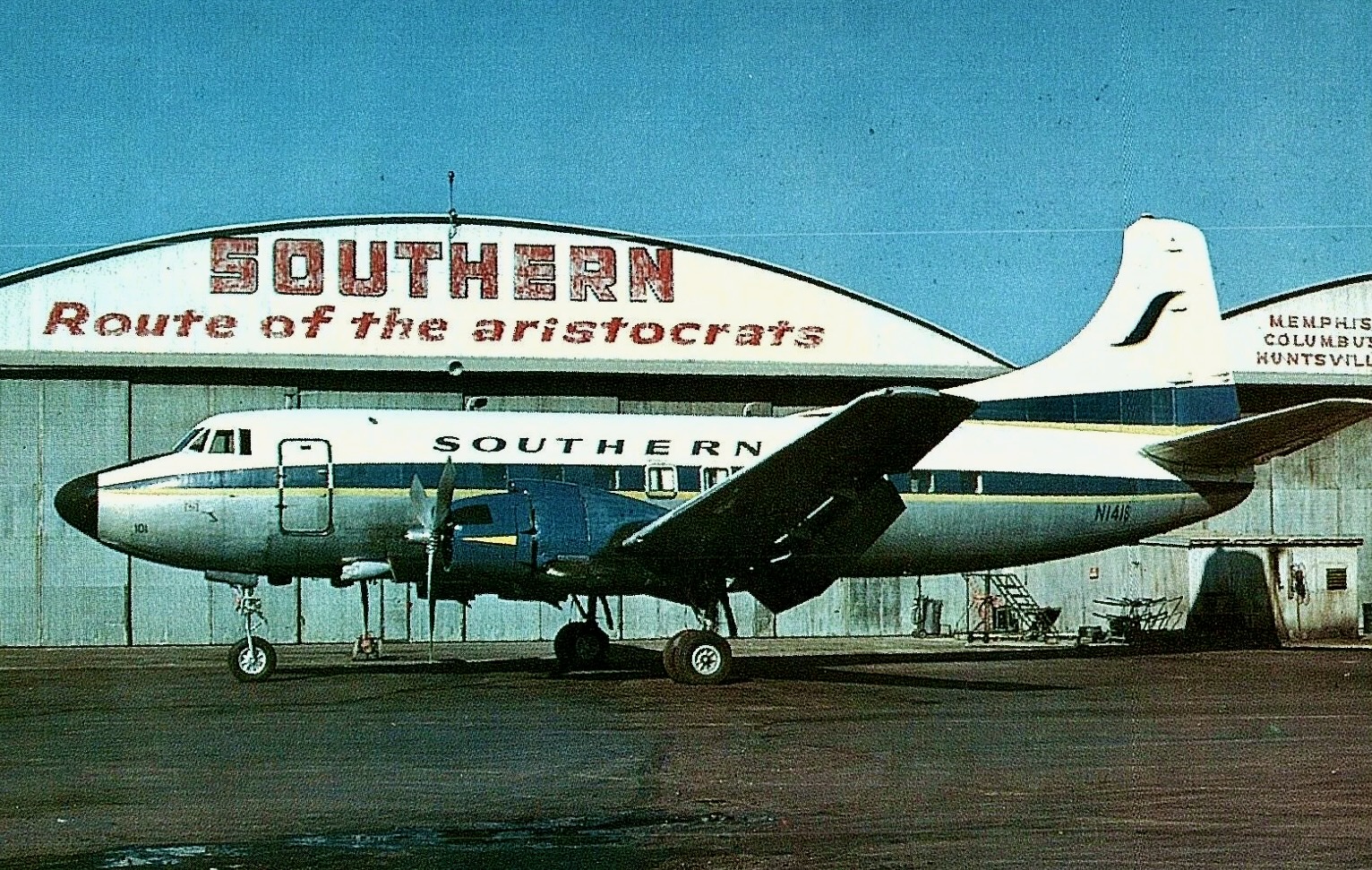
Southern Airways Martin 404, N141S, at Atlanta Airport, February 24, 1973. Pub’r AeroGem, photo by Bruce Drum. Southern became another significant airline serving Atlanta airport and eventually maintained its operational headquarters there. It introduced Martin 404s to its fleet in 1961. The airline merged with North Central in 1979 to become Republic Airlines, which became part of Northwest in 1986. Northwest merged with Delta in 2008.
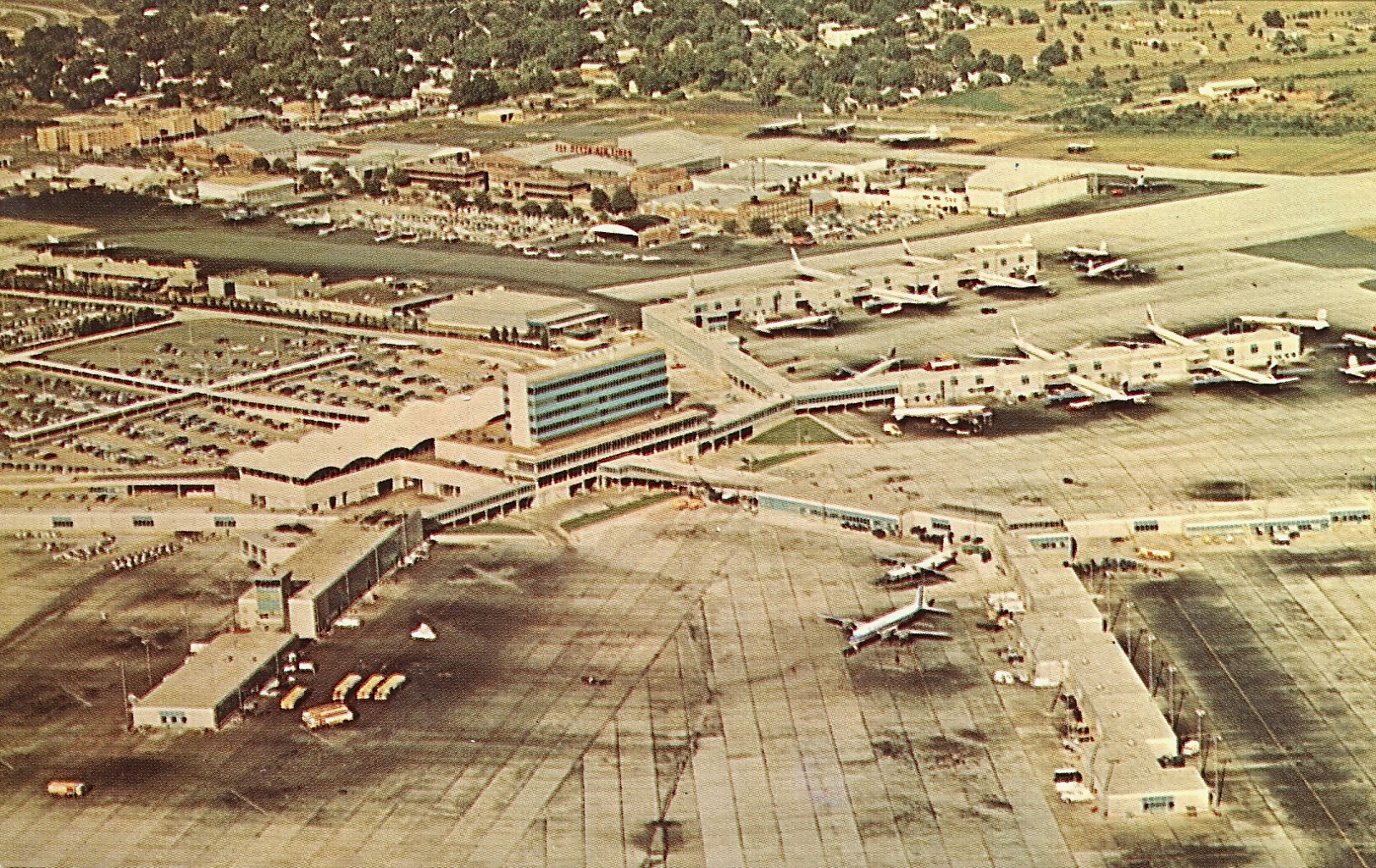
Aerial View of Atlanta Airport showing Concourses B, C and D in the foreground and Concourses E and F with Delta aircraft at the top, all with a mix of jet and prop aircraft. Probably 1961. Pub’r Atlanta News Agency, Chamblee, Georgia, Dexter Press 6255-C.
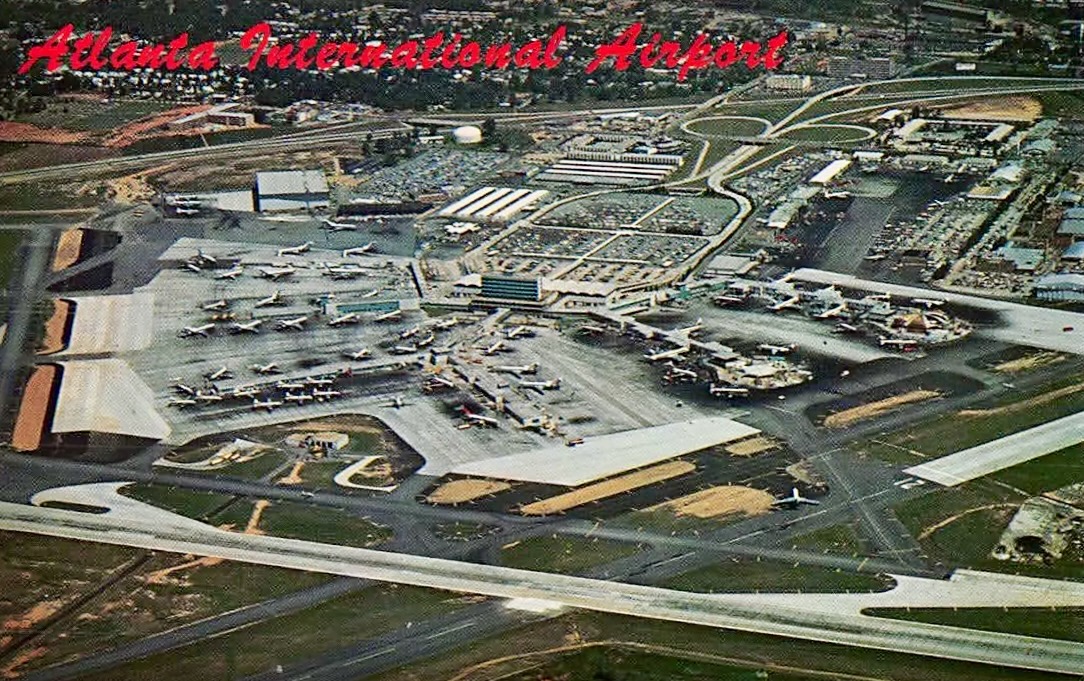
In 1962, a sixth concourse, A, was added, seen here as the top left concourse. It served Eastern Air Lines along with Concourse B next to it. Concourse C in the inverted Y served Piedmont, Southern and some Eastern; Concourse D in the inverted Y served Northwest, TWA and United; and Concourses E and F on the right in this view served Delta. Pub’r Scene South Card Co., Bessemer, Alabama, no. 106086.
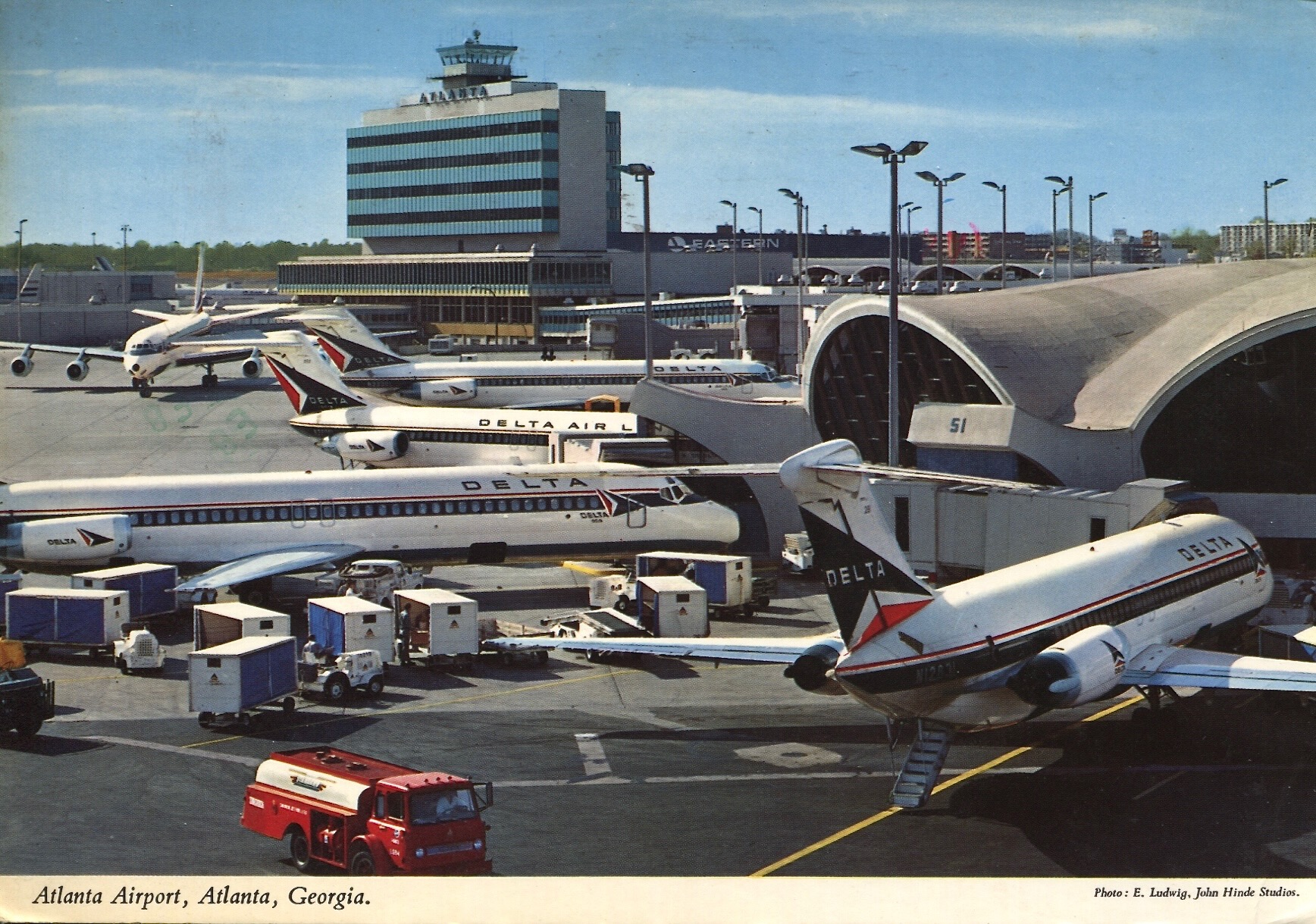
Delta Air Lines aircraft at Atlanta, showing rotundas and gates added in 1968 to Concourses E and F. Pub’r John Hinde, Dublin, no. 2GA13. The back of the card notes that the airport is the third busiest in the U.S., emplaning and deplaning tens of millions of passengers each year, and that between 11AM and 2PM, the airport is the world’s busiest. Airport postcard collector Chris Slimmer has called this card one of his favorites, noting “a wonderful composition. Printed by the best postcard printer in the world…John Hinde.”
Long-time Mayor William B. Hartsfield, the driving force behind the development of Atlanta Airport as a major airline hub, passed away on February 22, 1971, and on February 28, 1971, the airport name was changed to William B. Hartsfield Atlanta Airport. On July 1, 1971, following the launch by Eastern Air Lines of the airport’s first international service (to Mexico and Montego Bay), the airport was again renamed to William B. Hartsfield Atlanta International Airport.
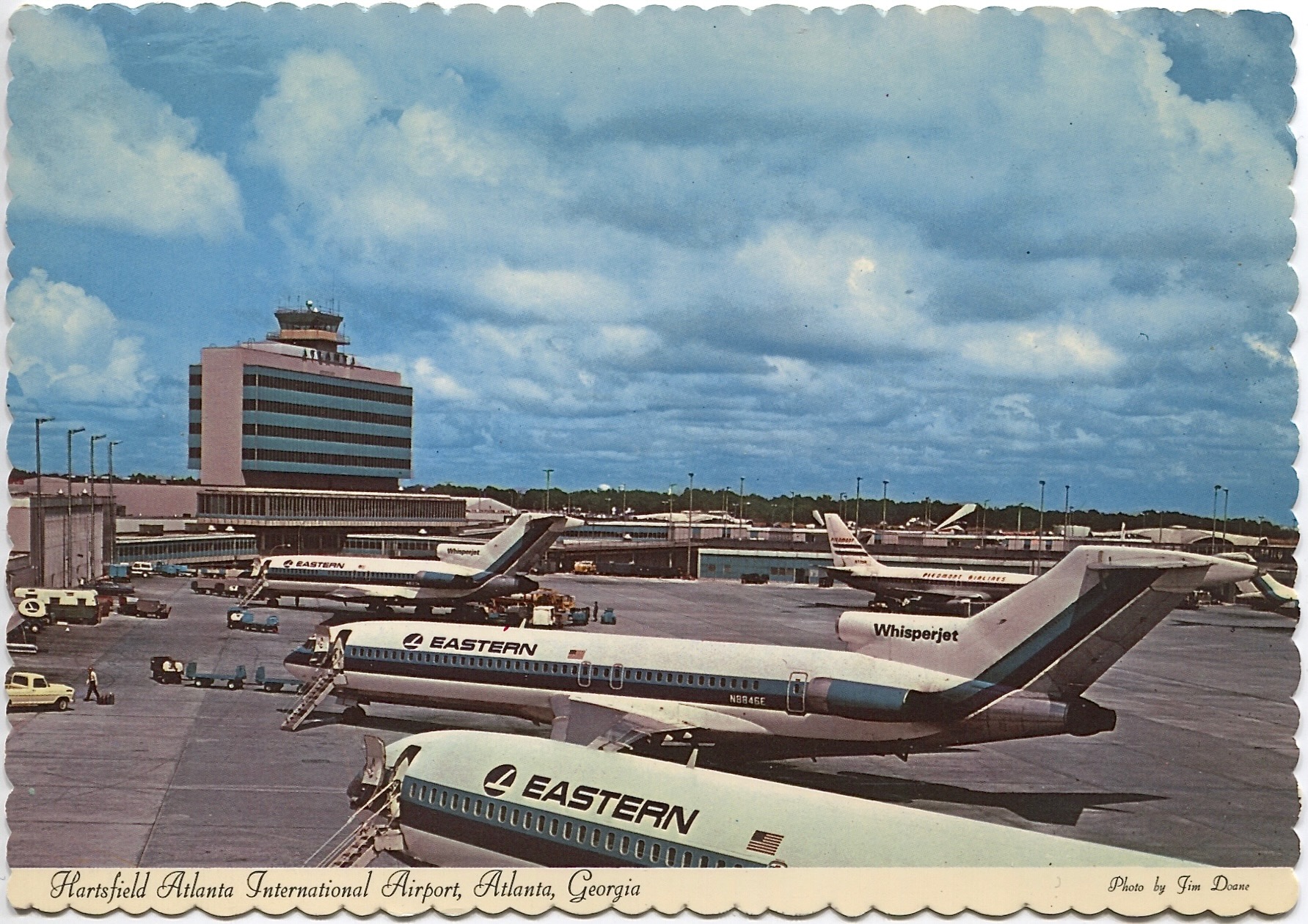
Eastern Air Lines Boeing 727s near Concourse B of Hartsfield Atlanta International Airport, mid 1970s. Pub’r Atlanta News Agency, Atlanta, Dexter Press no. DT-82467-C.
On September 21, 1980, Hartsfield Atlanta International Airport opened the Midfield Terminal. It was the world’s largest air passenger terminal complex at the time, designed to accommodate up to 55 million passengers each year. It replaced in stages the old terminal and its concourses A through F.
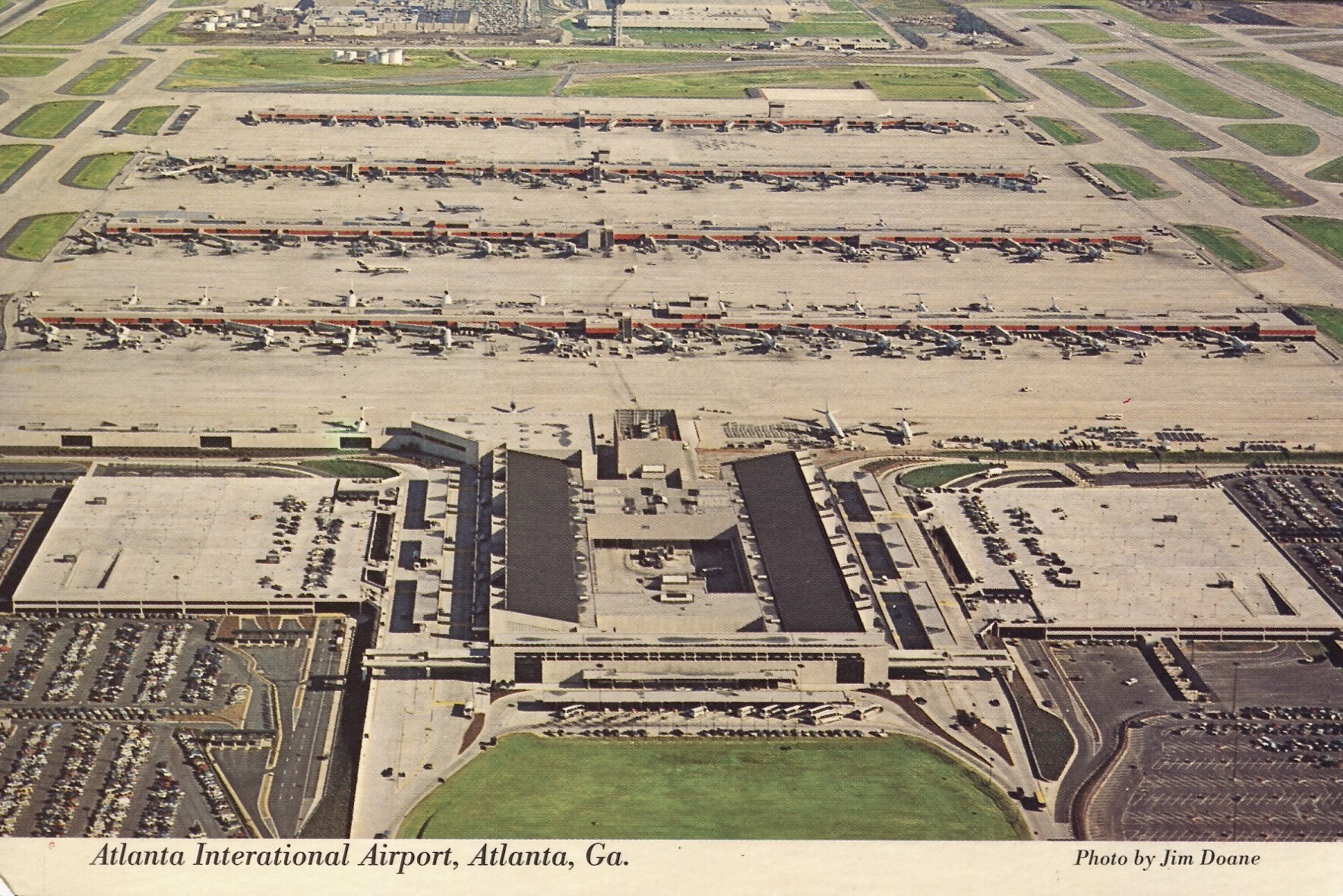
View of the new Midfield Terminal complex that opened in 1980, with parallel concourses containing over 125 gates. Pub’r Aerial Photography Services, Atlanta, Dexter Press 70990-D.
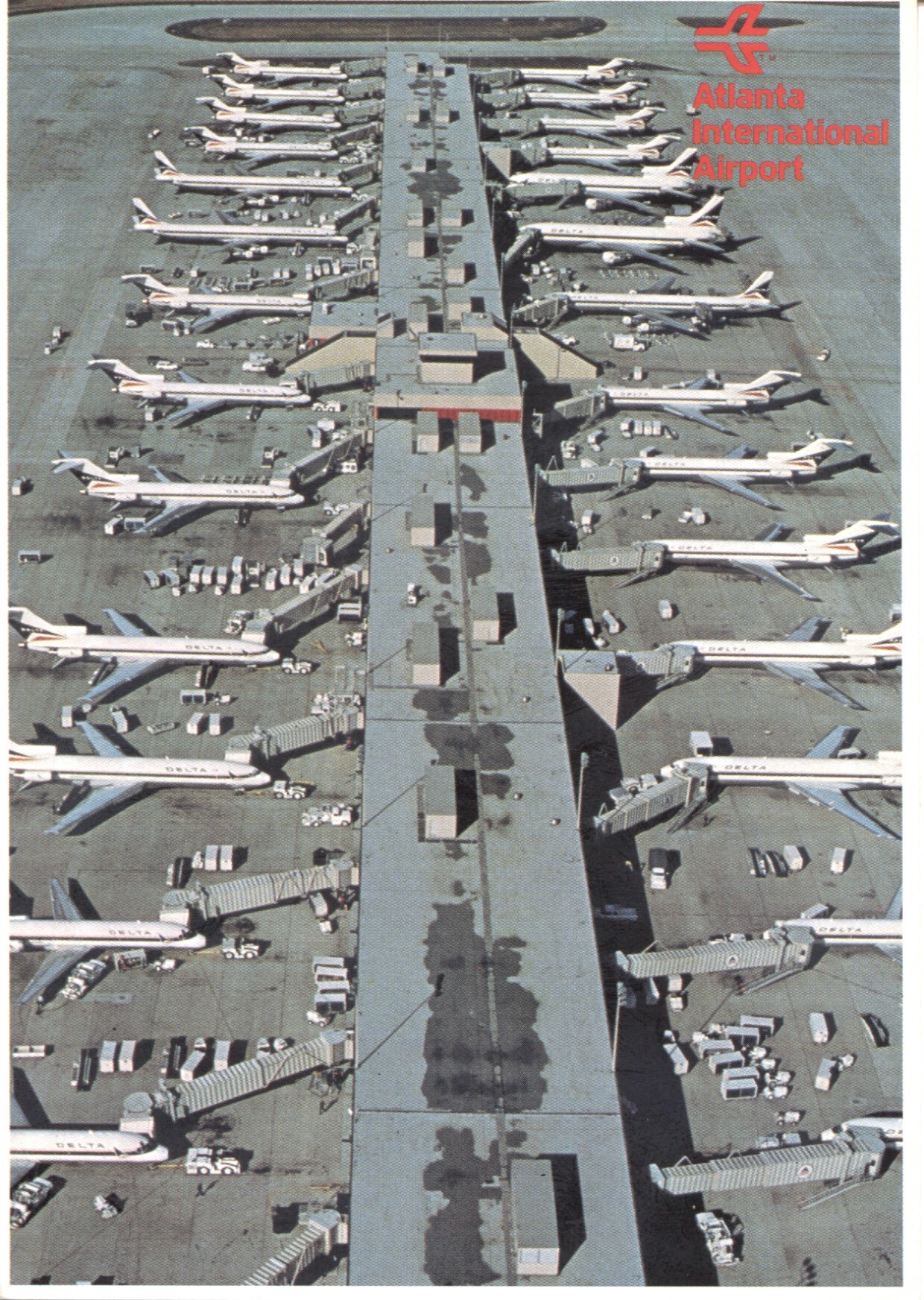
A striking view of Delta aircraft, including Boeing 727s, Lockheed L-1011s and Douglas DC-8-61s and DC-9s, taking on passengers at just one of Delta’s concourses at Hartsfield Atlanta International. Pub’r Thomas Warren, Atlanta, nos. 561109 and A-153.
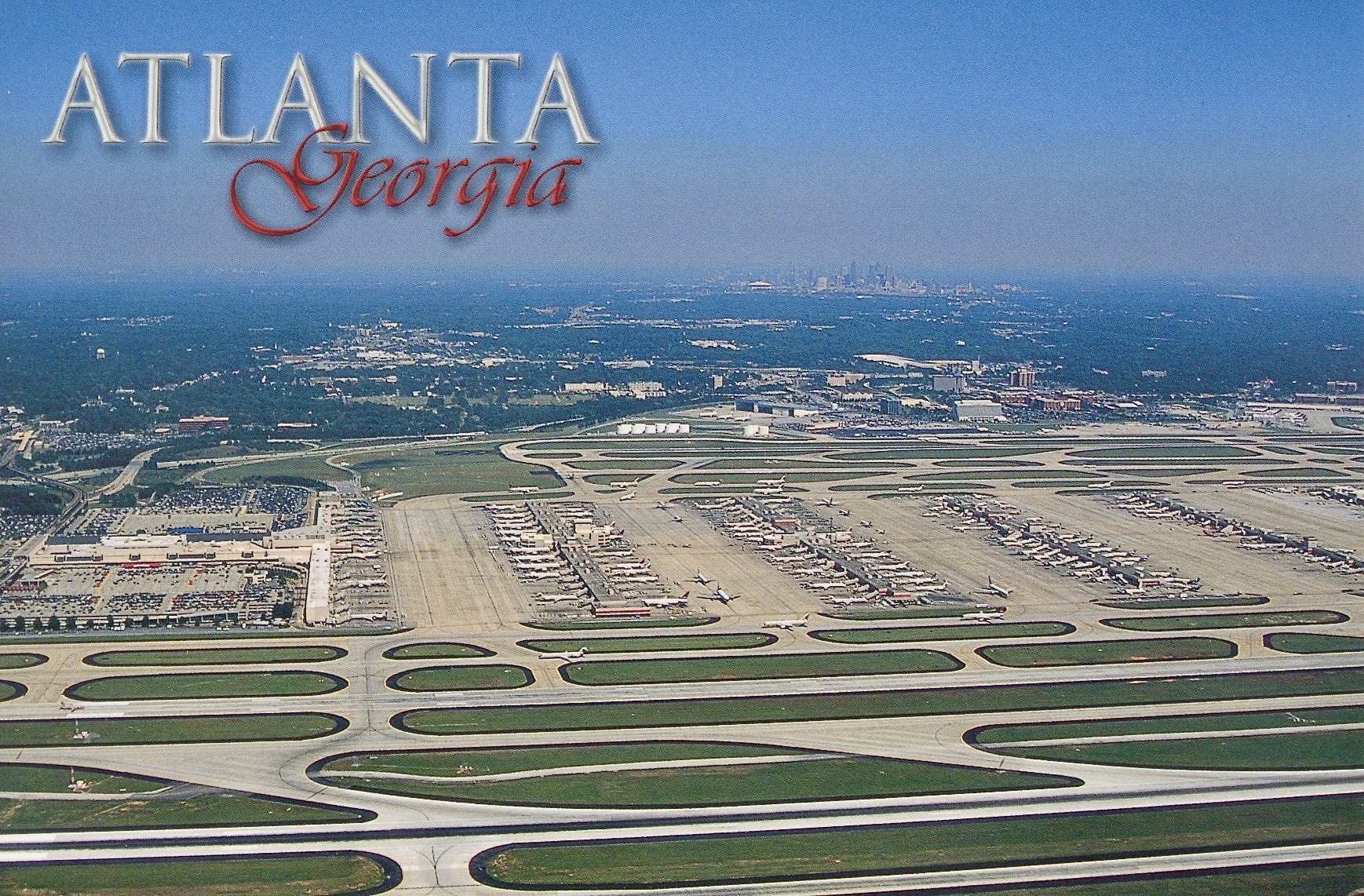
Aerial view of Atlanta airport, probably in the 1990s, showing the seven concourses of the Midfield Terminal, T and F for international flights and A through E primarily for domestic flights. Pub’r APS, Kennesaw, Georgia, nos. K41231 and KA-3-4856.
In October 2003, to honor former Atlanta Mayor Maynard Jackson, the Airport was again renamed, this time as Hartsfield-Jackson Atlanta International Airport.
Since 1998, Atlanta Airport has been the world’s busiest passenger airport. It serves on average 2,700 departures and arrivals daily by airlines operating nonstop to more than 150 U.S. destinations and over 70 international cities in 50 countries. In 2024, Atlanta airport handled 108.1 million passengers (an average of about 295,000 a day), the second-highest year in its history. This represents nearly a full recovery from the general decline in passenger traffic due to the COVID-19 pandemic, which began in 2020 and followed the airport’s record 110 million passengers in 2019.
Delta is by far the dominant airline in Atlanta, with about 73% of the passenger traffic. Southwest is second with 8%, followed by Spirit, Frontier, Endeavor Air (operating as Delta Connection), American and United.
Hartsfield-Jackson Atlanta International Airport is now engaged in a major 20-year capital improvement program, which includes modernizing its domestic terminal, expanding concourses and cargo operations, replacing parking facilities, and eventually developing a hotel and mixed-use facilities.
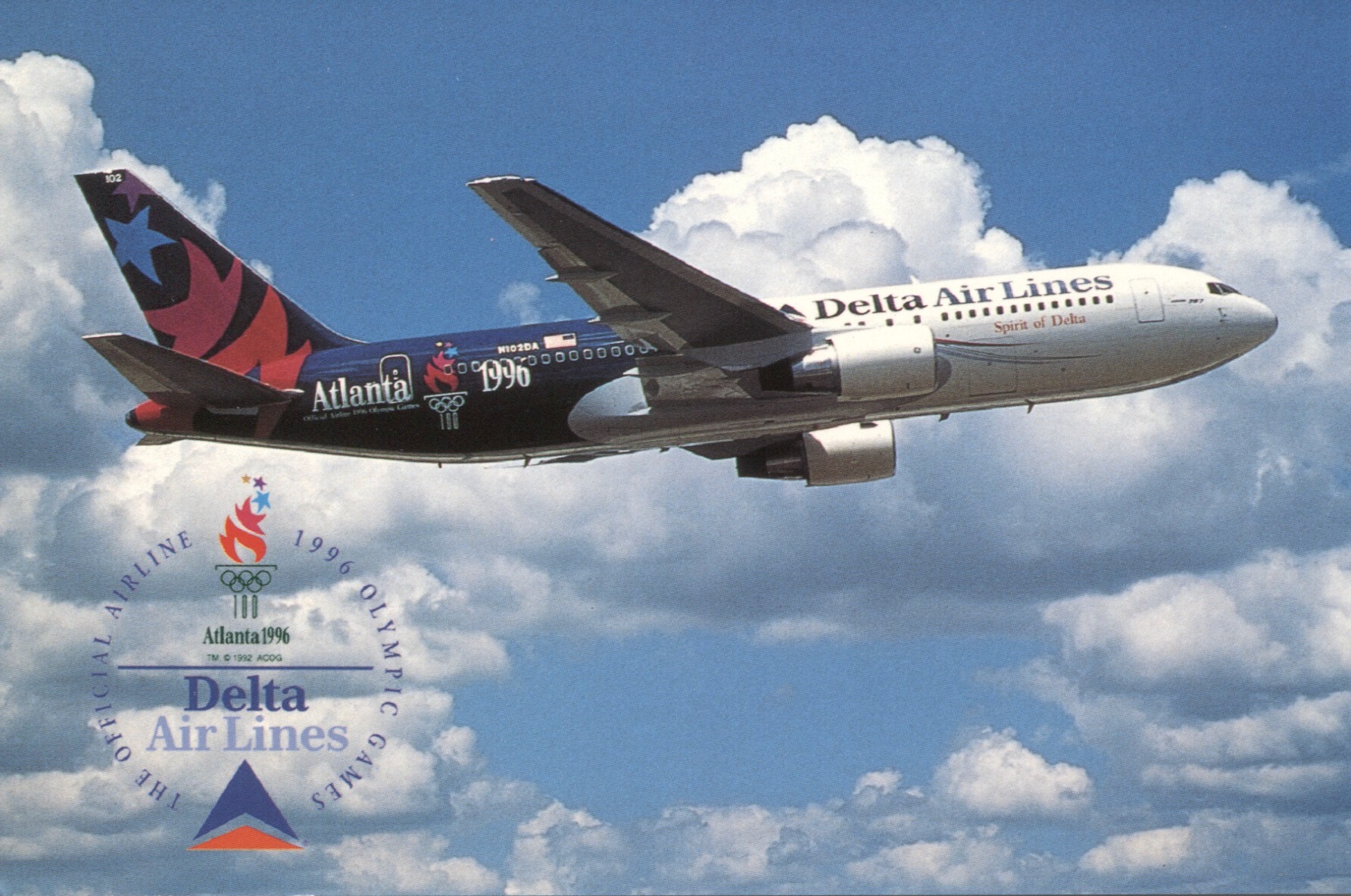
We close this Atlanta postcard article with a beautiful card showing the very aircraft that now resides in full splendor at the Delta Flight Museum, the site of Airliners International 2025 ATL, June 25-28, 2025, adjacent to Hartsfield-Jackson Atlanta International Airport.
Delta Air Lines Boeing 767-200, N102DA, Spirit of Delta, its first 767, with a special livery symbolizing Delta’s role as the Official Airline of the 1996 Olympic Games in Atlanta. Airline Issue, no. P98303. A variation of this card, no. P97977, exists with the aircraft closer up and lower, and with a smaller Delta Olympic logo stamp. The funds to acquire this aircraft were raised by Delta’s employees through payroll deductions. The aircraft is now on display in its original livery at the Delta Flight Museum, site of the Airliners International 2025 ATL show and convention, June 25-28, 2025.
Notes: The originals of all postcards shown are in color and from the author’s collection. All are in standard or continental size. I estimate their rarity as Uncommon: The Candler Field card with an Eastern DC-2; the ‘Temporary’ terminal card with a Delta DC-3 in the center; the Piedmont Airlines card; and the card showing Delta aircraft at the rotundas and gates added in 1968. The rest of the postcards are fairly common. This article is an update and revision of an earlier one by the author on Atlanta airport postcards published in the Spring 2015 issue of The Captain’s Log, vol. 39, no. 4.
Airliners International 2025 ATL Postcard Exhibits by Collectors: The AI 2025 show at the Delta Flight Museum, Atlanta airport, will again feature a display of airline and airport postcard exhibits. Whether you’re an experienced collector or a beginner, please consider submitting an exhibit. It’s a lot of fun, and the postcard displays stimulate greater interest in collecting airline and airport postcards. This year’s Postcard Exhibit Guidelines can be found at airlinersinternational.org under the tab Contest Information (even though it’s an exhibit, not a contest). I look forward to seeing you at Airliners International 2025, Atlanta, June 25-28.
References:
www.sunshineskies.com/atlanta.html. This is a great website with hundreds of pictures, many postcard views, and extensive information on the history of Atlanta airport.
www.atl.com. Official site of Hartsfield-Jackson Atlanta International Airport
www.deltamuseum.org. Official site of The Delta Flight Museum, Atlanta airport, where Airliners International 2025 will be held June 25-28, 2025.
golldiecat.tripod.com/atl.html. History of Hartsfield Atlanta International Airport from 1961 to 1980, illustrated with postcard views.
Cearley, Jr., George W., Atlanta (1991) and The Delta Family History (1985), each self-published.
Davies, R.E.G., Delta: An Airline and Its Aircraft. Paladwr Press (1990).
www.wahsonline.com. Official site of the World Airline Historical Society.
The first airport in the Kansas City, MO metropolitan area was Richards Field which opened in 1922 at the border between Kansas City and Raytown, MO. It had limited commercial airline passenger service and was mainly utilized for air mail and military purposes.
As Richards Field proved inadequate for expanding commercial airline passenger operations, Kansas City built in 1927 a new airport in a sharp bend along the Missouri River close to downtown. Initially called “New Richards Airport,” its name soon became “Kansas City Municipal Airport” and was sometimes referred to as the “Downtown Airport.” The new airport received airport code “MKC,” presumably taken from “Municipal Kansas City.” A modern passenger terminal opened at this new airport in December 1929.
Another airport, called Fairfax Airport, was also established in the 1920s, located across the river from the Kansas City Municipal Airport. Some commercial airline flights operated from Fairfax in the late 1920s and into the 1930s, but it was mainly used for industrial purposes.
Kansas City Municipal Airport (MKC)
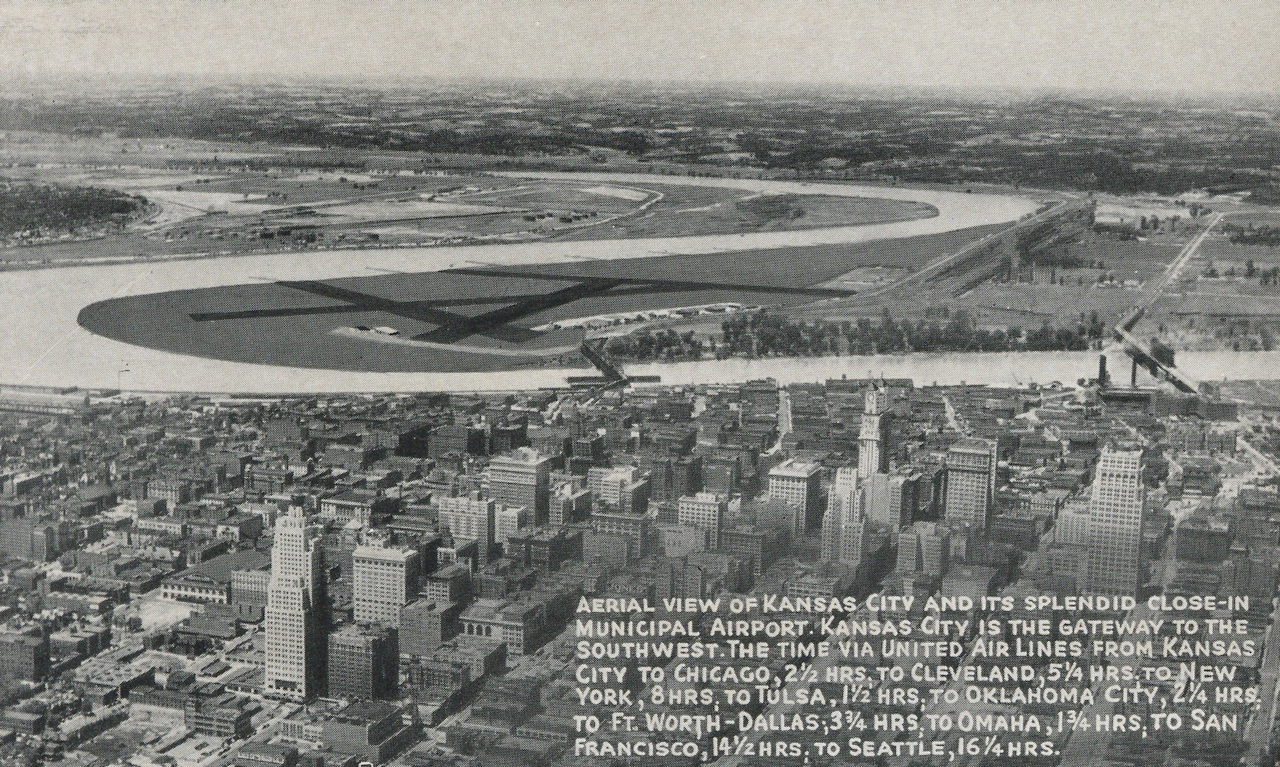
Aerial view showing Kansas City Municipal Airport (MKC) and its four runways at a sharp bend of the Missouri River with downtown Kansas City in the foreground. Fairfax Airport is on the other side of the river. Airline Issue by United Air Lines, no. 201, probably early 1930s. The scene on this postcard also appears in a colorized version published by Max Bernstein, Kansas City.
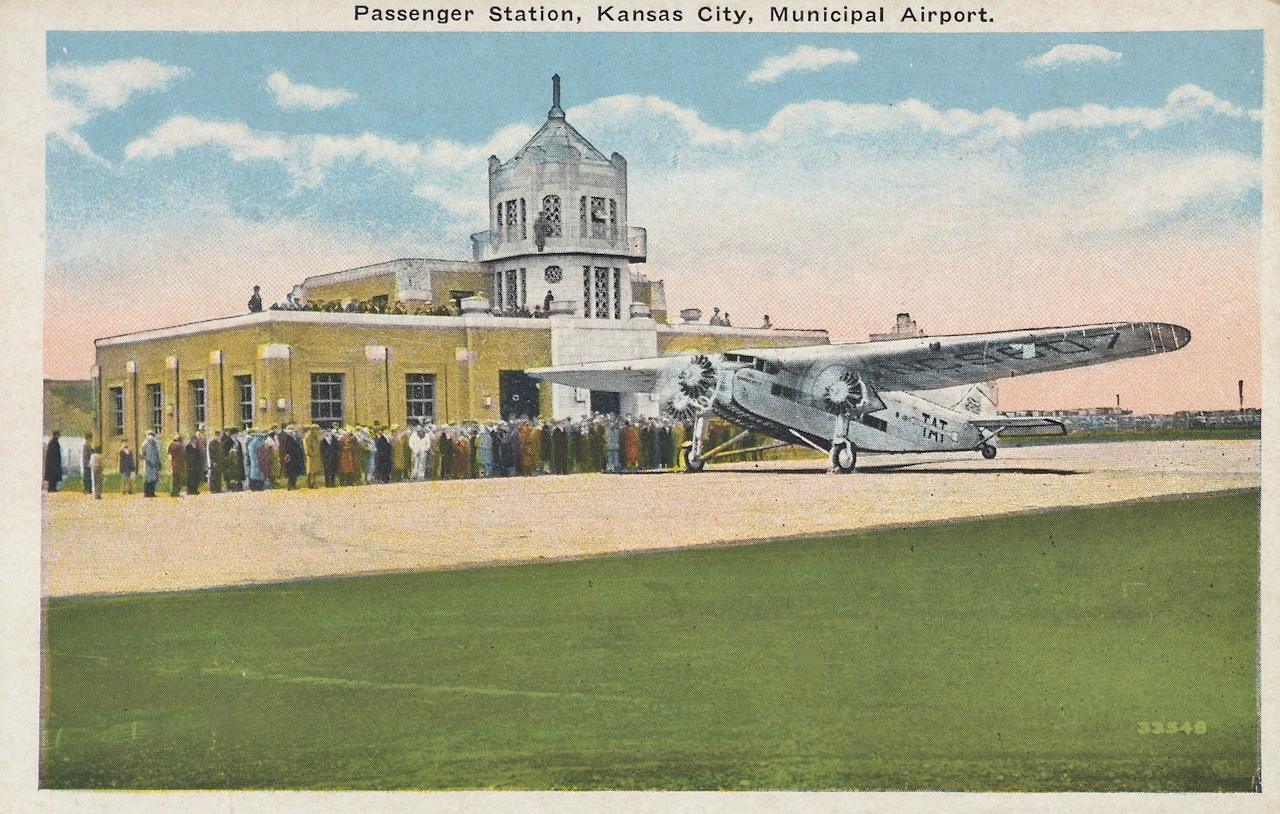
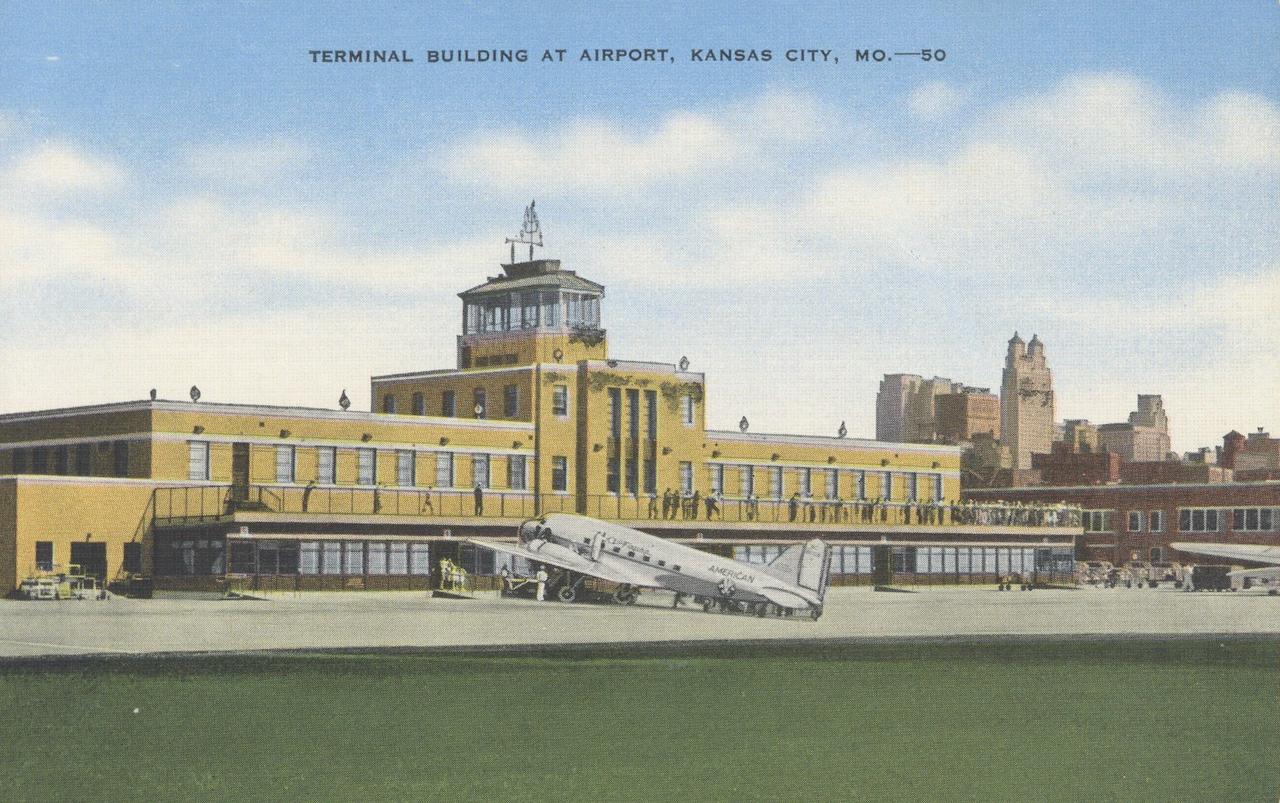
Passenger terminal at MKC that opened in December 1929, showing on the ramp Transcontinental Air Transport (T-A-T) Ford Trimotor 5-AT-5, NC9607. Publisher (‘Pub’r’) Max Bernstein, no. 33548.
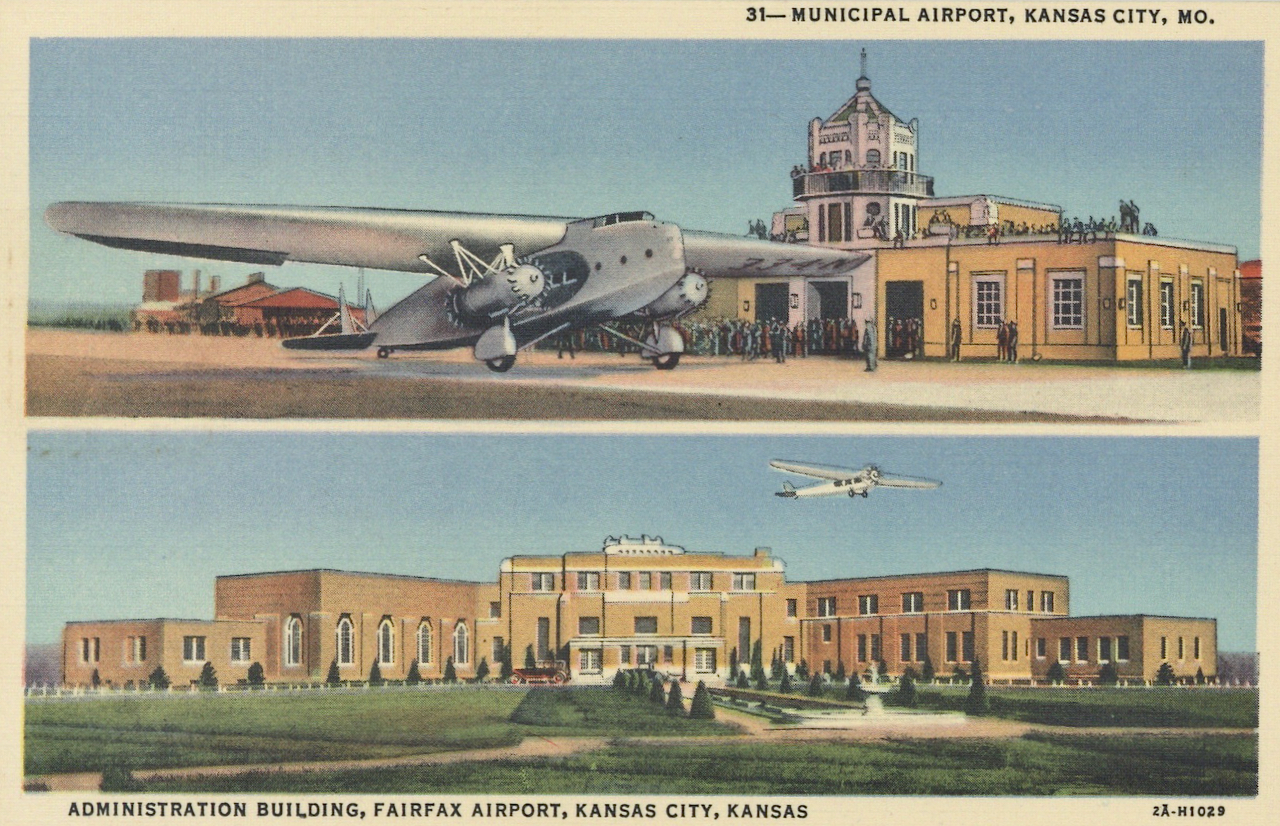
Upper view: Western Air Express Fokker F32, NC334N, at MKC; Lower view: Administration building at Fairfax Airport across the river from MKC. Linen finish card. Pub’r Max Bernstein, Curteich no. 2A-H1029, 1932.
In October 1930 Transcontinental Air Transport, Western Air Express, and three other airlines merged to form Transcontinental and Western Air, later named TWA (Trans World Airlines). TWA established its headquarters in Kansas City and became the most prominent airline at MKC. It also established its maintenance and overhaul base nearby across the river at Fairfax Airport.
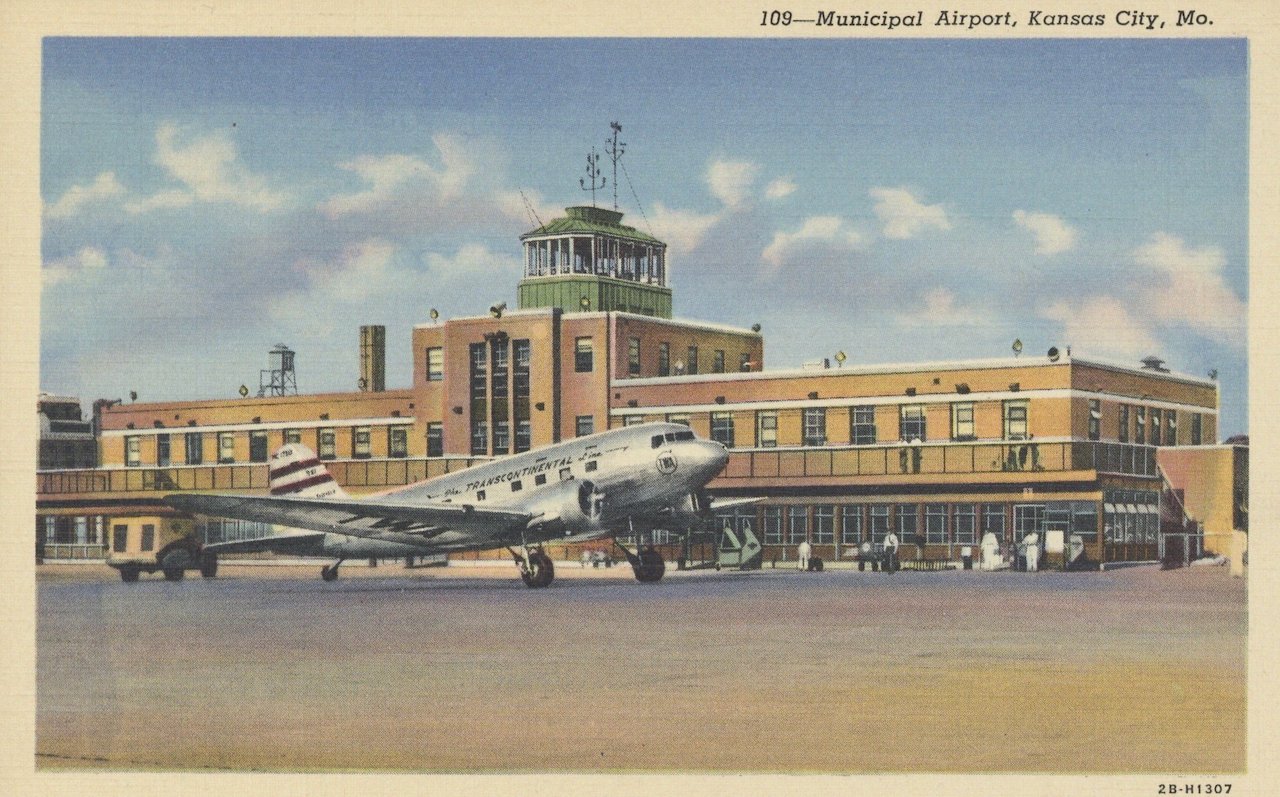
TWA Douglas DC-3 at MKC. Pub’r Max Bernstein, Curteich no. 2B-H1307, linen finish, 1942.
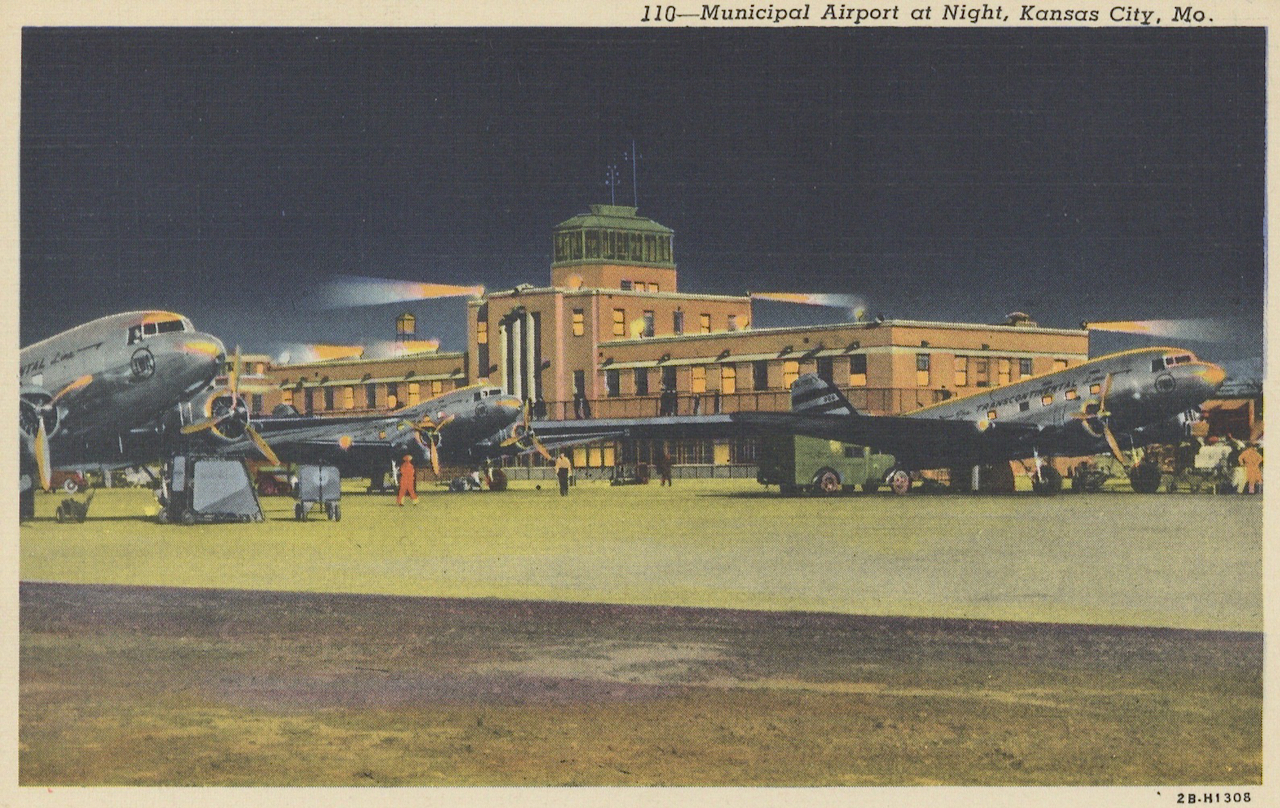
Night view at MKC with three TWA Douglas DC-3s. Pub’r Max Bernstein, Curteich no. 2B-H1308, linen finish, 1942.
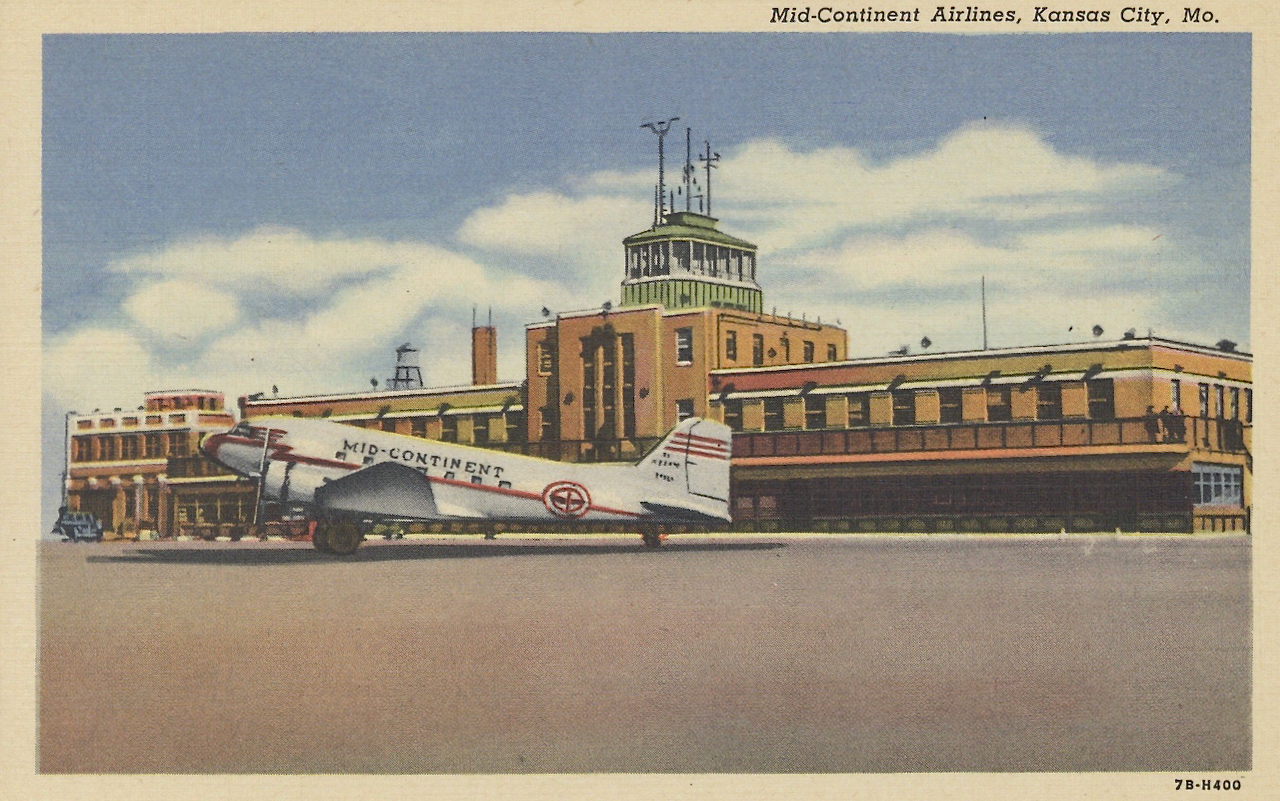
The next most prominent airline at MKC after TWA was Mid-Continent Airlines, originally formed under the name Hanford Airlines in 1936. In 1938 the airline changed its name to Mid-Continent and moved its company headquarters to Kansas City’s Fairfax Airport. Mid-Continent merged into Braniff International Airways in 1952.
Mid-Continent Airlines Douglas DC-3 at MKC. Pub’r Max Bernstein, Curteich no. 7B- H400, linen finish, 1947.
American Airlines DC-3 at MKC. Pub’r R. B. Harness Greeting Card Co., Kansas City, no. 31716N.
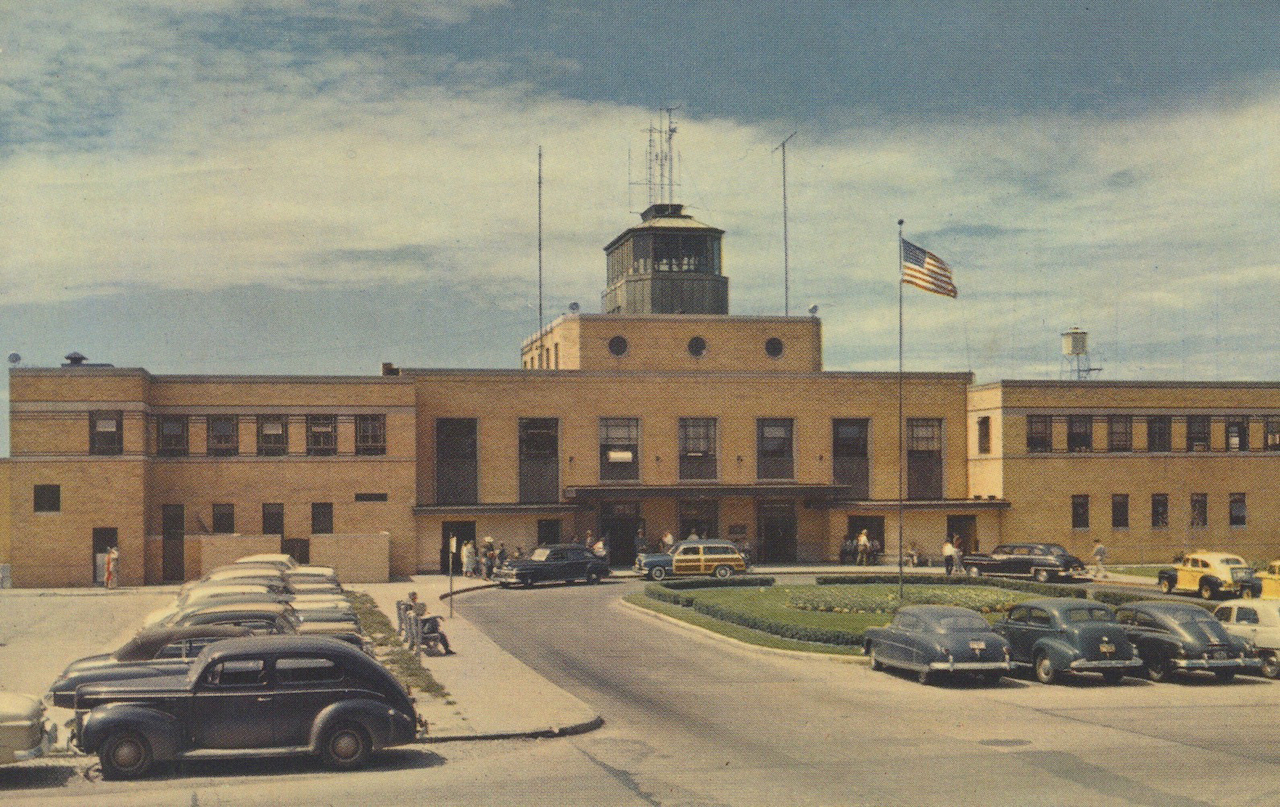
Entrance to passenger terminal at MKC, late 1940s. Pub’r J. E. Tetirick, Kansas City, no. JT-3, ‘Mirro-Krome’ Card by H. S. Crocker Co., San Francisco, CA.
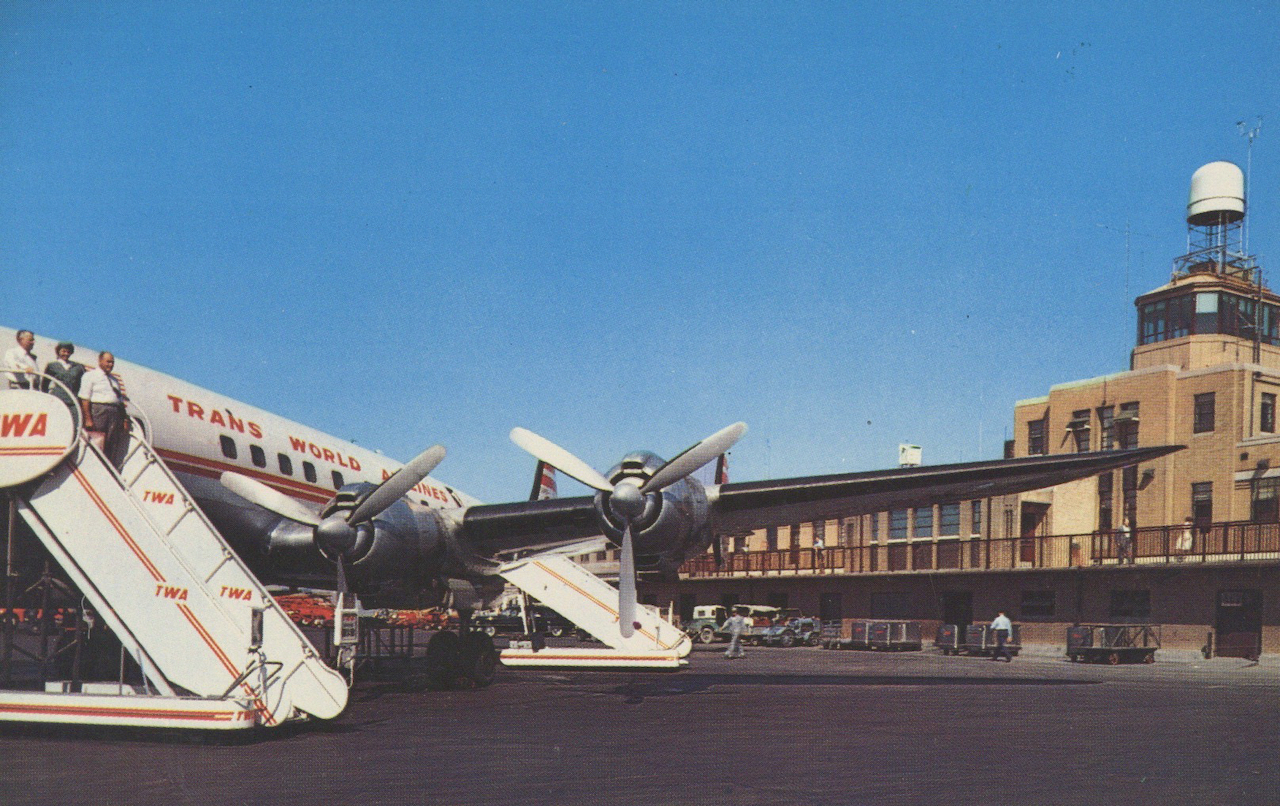
TWA Constellation at MKC, 1950s. Pub’r Smith Sales Co., Kansas City, no. 30384.
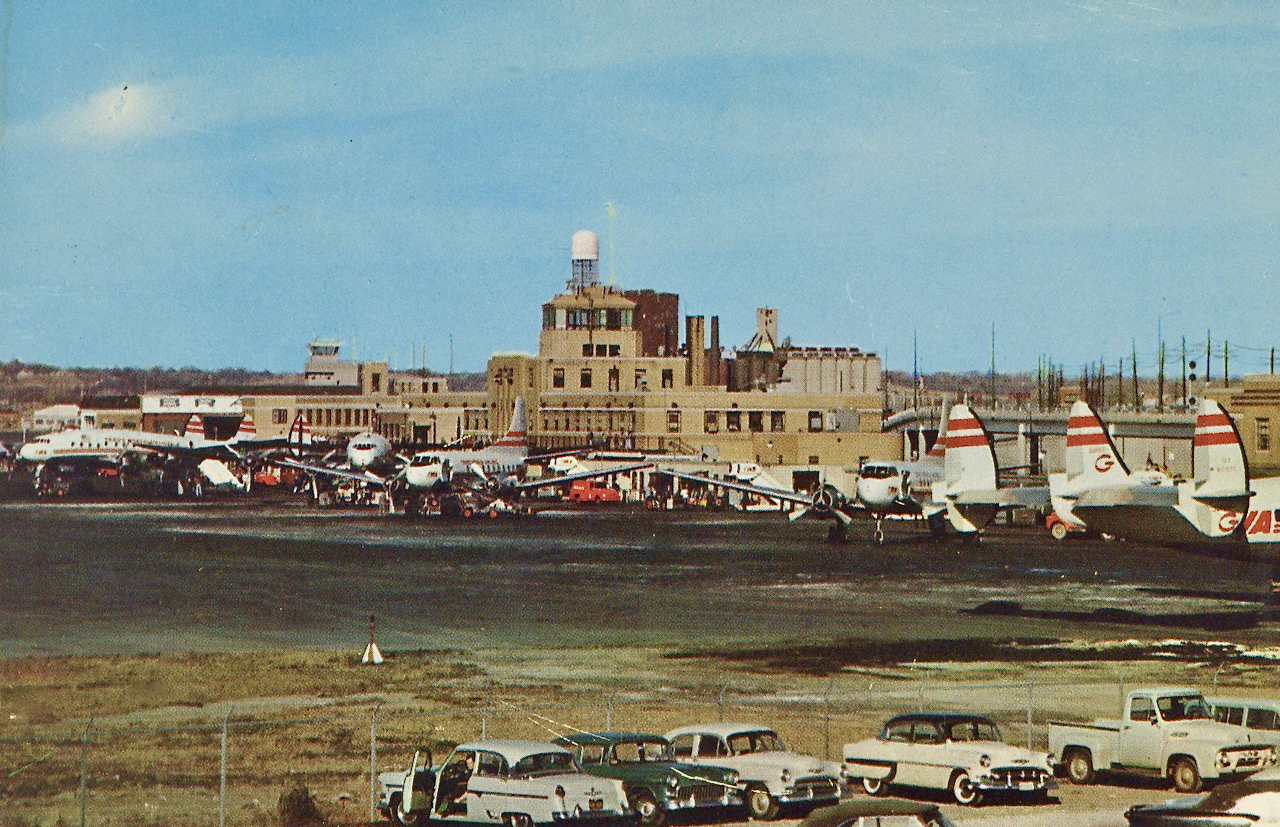
By 1955 TWA’s ramp area at MKC was crowded as seen in this group of TWA Lockheed Constellations and Martin aircraft. Pub’r Kansas Distributing Co., Junction City, Kansas, no. KC-8.
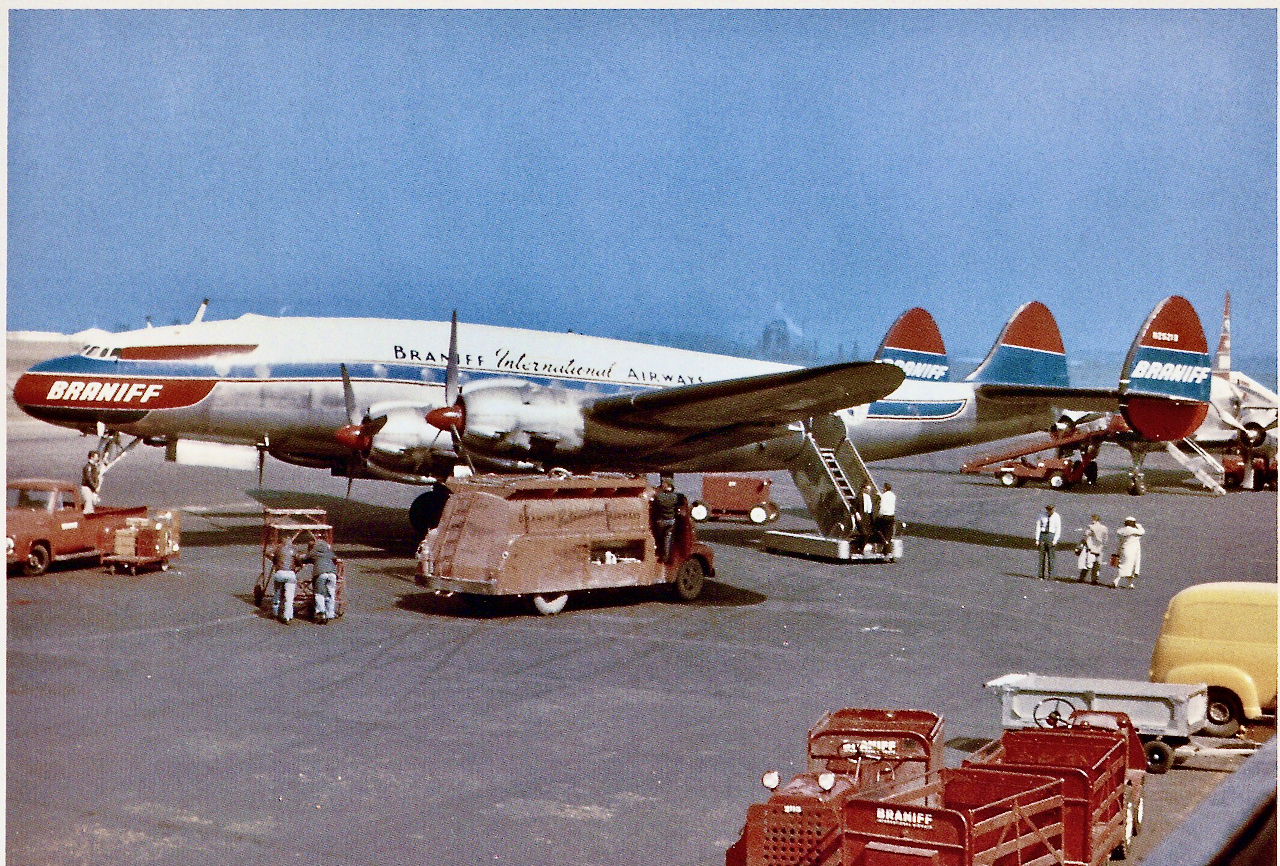
Braniff International Airways Lockheed L-049A Constellation, N2521B, at MKC, 1957. Pub’r Air Pictorial International, no. API 058. Braniff was another airline with a long history of service to Kansas City. The airline operated until 1982.
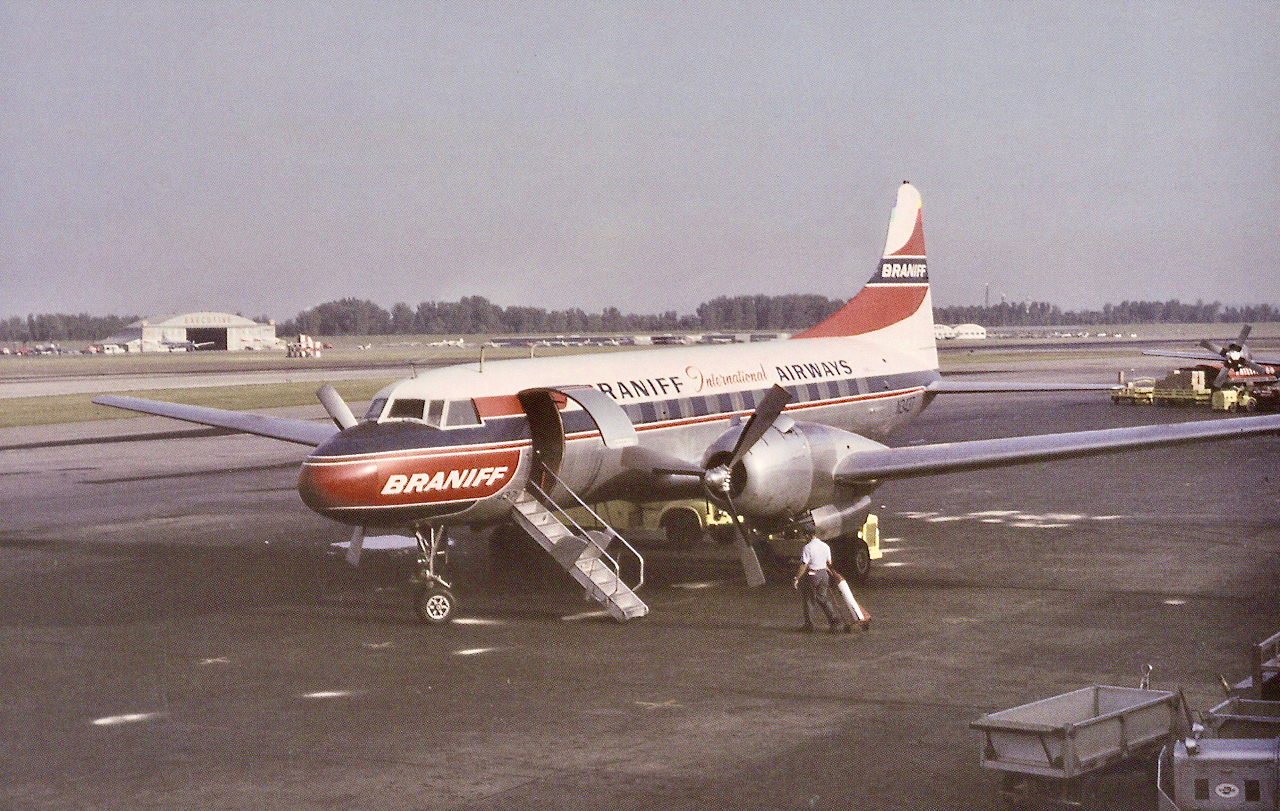
Braniff International Airways Convair 440-0, N3437, at MKC, October 1963. Pub’r j j Postcards for Airliners International 2007 MCI, no. 1; Bob Woodling photo.
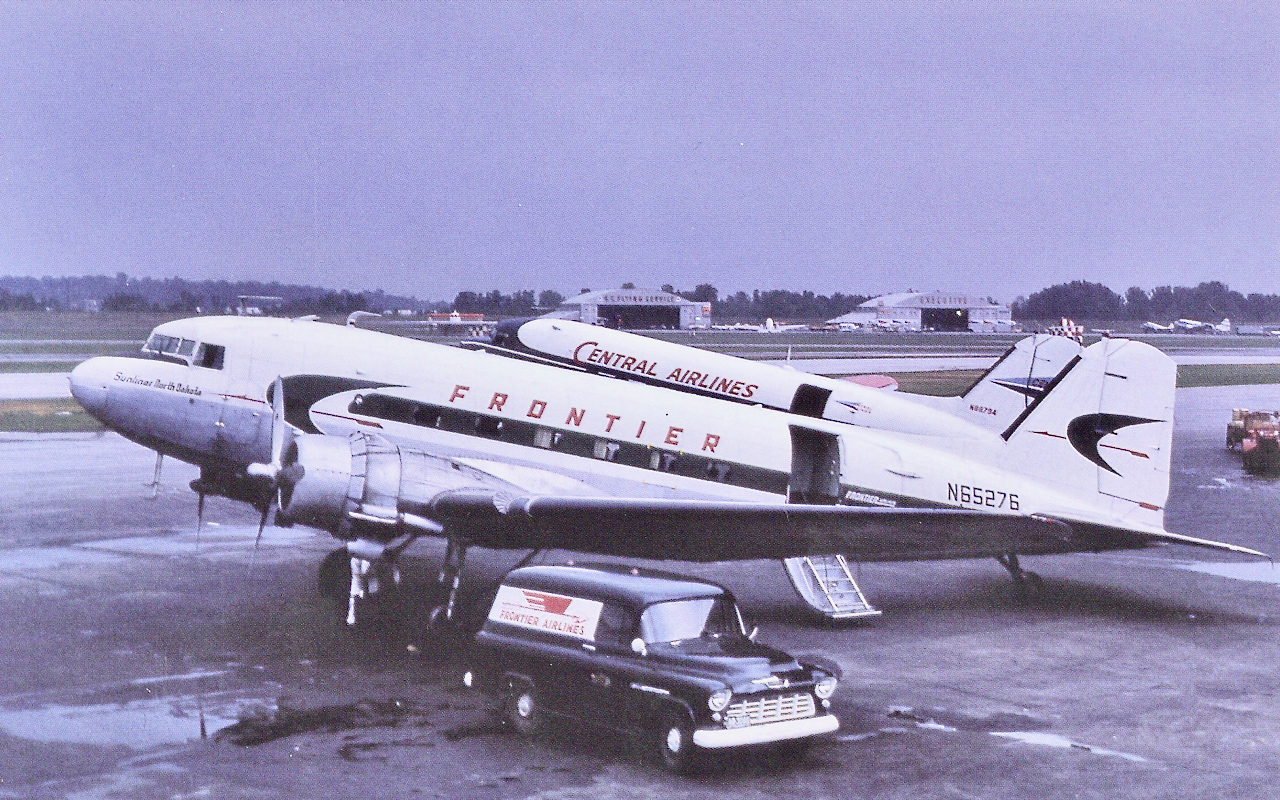
Frontier Airlines (the original Frontier) Douglas DC-3, N65276, and Central Airlines DC-3, N88794, at MKC, June 1962. Pub’r j j Postcards for Airliners International 2007 MCI, no. 5; Bob Woodling photo. The original Frontier Airlines and Central served Kansas City for many years. Frontier purchased Central in 1967 and ceased operations in 1986. A new airline using the same “Frontier Airlines” name was founded in 1994.
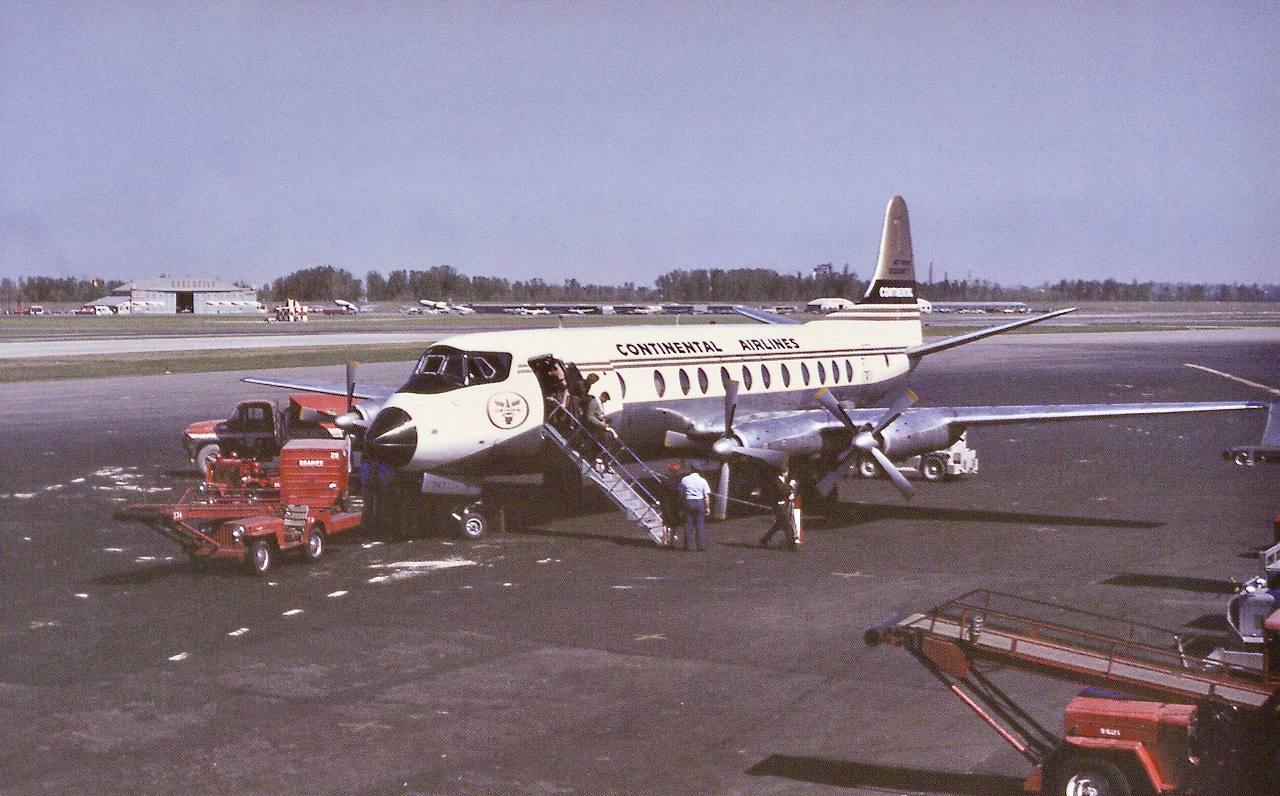
Continental Airlines Viscount 812 at MKC, April 1963. Pub’r j j Postcards for Airliners International 2007 MCI, no. 2; Bob Woodling photo. Continental operated from 1934 to 2012 when it merged into United Airlines. Its first regularly scheduled service to Kansas City was in 1946.
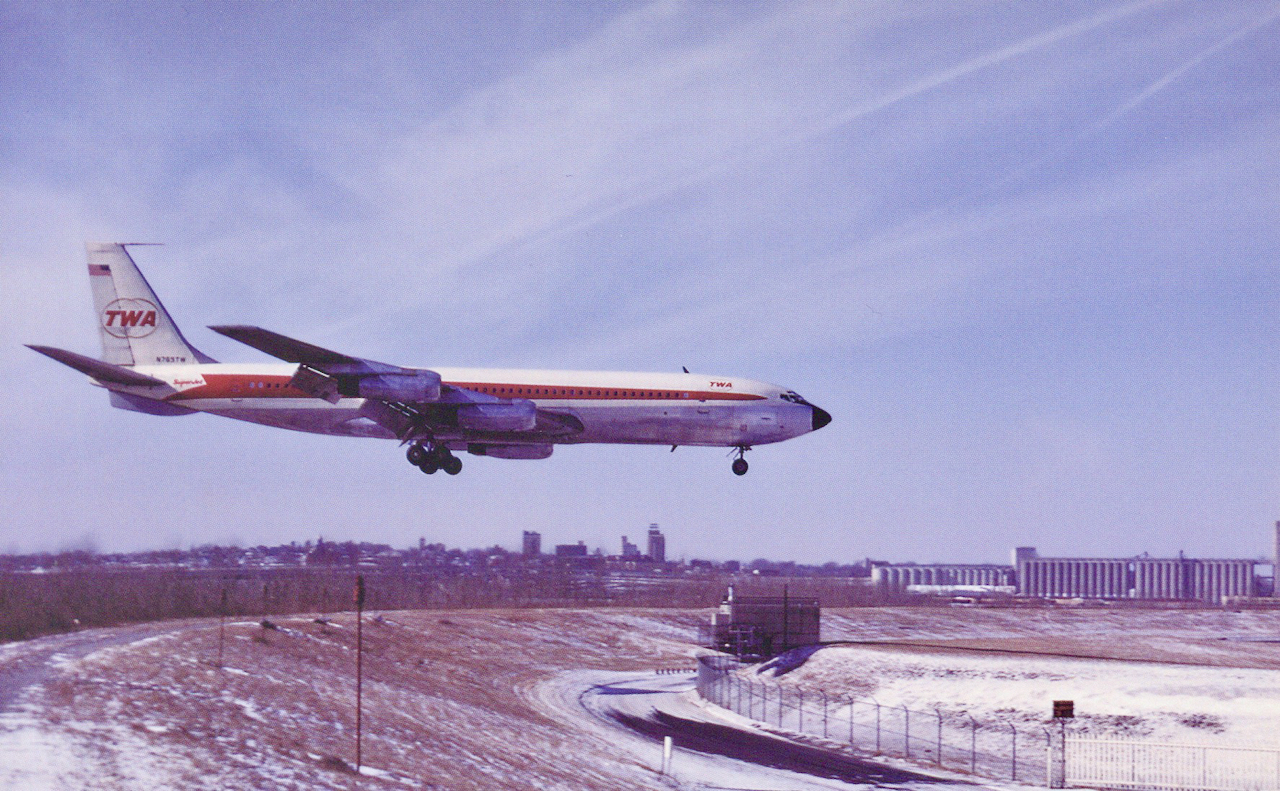
TWA Boeing 707-331, N765TW, landing at MKC, January 1963. Pub’r j j Postcards for Airliners International 2007 MCI, no. 7; Bob Woodling photo. TWA eventually was acquired by American Airlines in 2012.
The Original “MCI” – Mid-Continent International Airport
In 1951 Kansas City suffered a great flood that severely damaged TWA’s maintenance and overhaul base and many other facilities at Fairfax Airport across the Missouri River from the downtown Kansas City Municipal Airport (MKC). Some facilities at MKC were also damaged. Moreover, the Kansas City, Missouri Municipality recognized that there was little room for any expansion of airline activity at the two airports. The Municipality started planning a new airport facility 15 miles (24 km.) northwest of downtown Kansas City in Platte County, MO, away from the Missouri River.
The new airport opened in 1956. It was named Mid-Continent International Airport and received the IATA airport code MCI.
TWA moved its main overhaul base there, and Braniff established a hub at the new airport. However, the runways and terminals at each of MKC and MCI were too small to serve in the future as Kansas City’s main airport.
Most passengers still preferred to travel out of MKC because of its proximity to downtown. However, once jet aircraft started flying in and out of MKC, the jets had difficulty landing on the short runways, and taking off presented challenges because of the downtown skyscrapers. MKC was also congested. A 1963 report by the Federal Aviation Administration (FAA) described MKC as “one of the poorest major airports in the country for large jet aircraft” and asked that no more federal funds be disbursed for it.
The New MCI – Kansas City International Airport
As a result, Kansas City, with the encouragement of TWA, decided to convert the MCI site into a major, modern airport. This new airport, built on the MCI site and named Kansas City International Airport, was dedicated October 23, 1972 and officially opened for commercial service on November 11, 1973. The original IATA airport code MCI was retained for the new airport, so that’s how Kansas City International is MCI (rather than KCI).
After the new MCI opened, all airlines serving Kansas City moved their operations there, and Kansas City Municipal Airport (MKC) was converted to serve only general aviation. In October 1977 the name of Kansas City Municipal Airport was changed to Kansas City Downtown Airport, and the name was changed again in August 2002 to Charles B. Wheeler Downtown Airport (Wheeler was Kansas City’s mayor 1971- 1979).
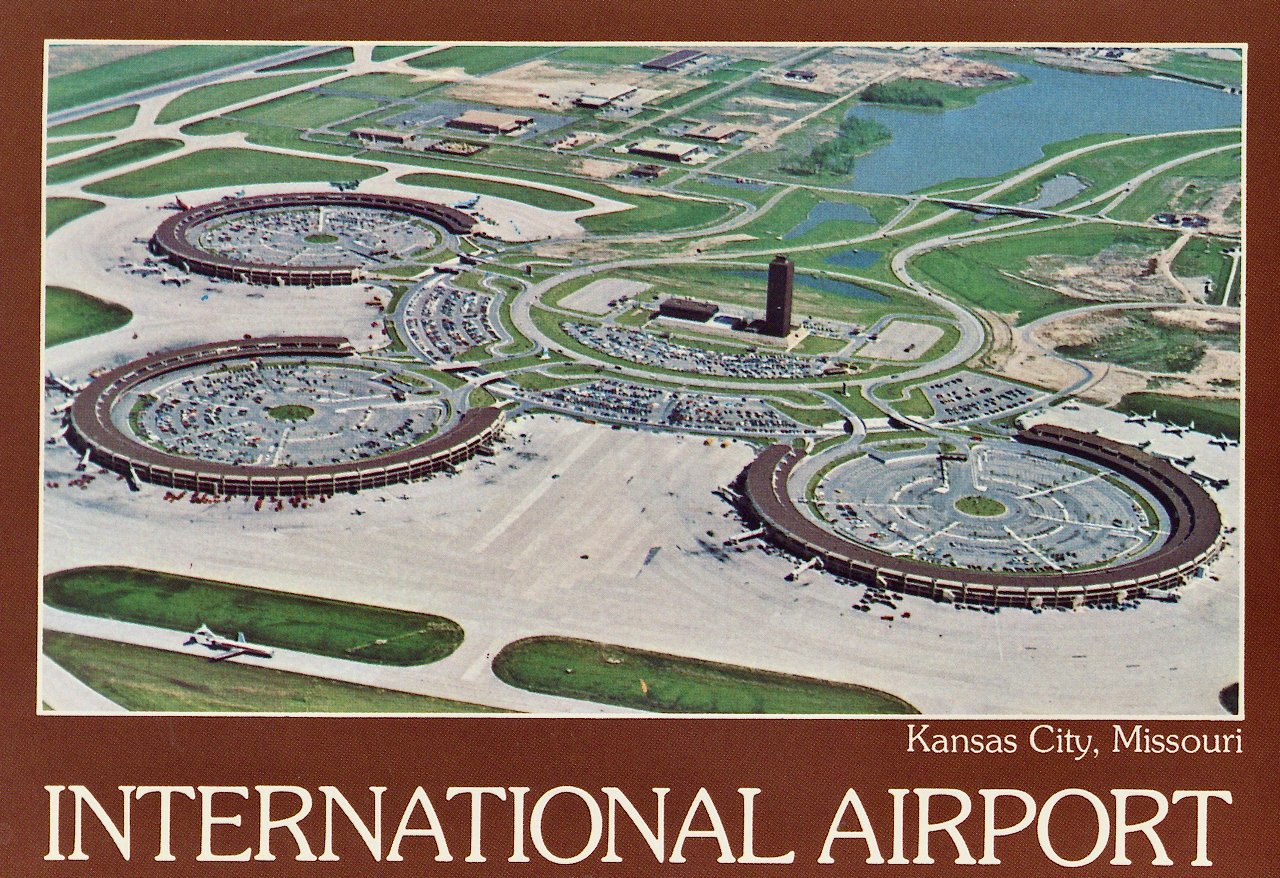
Kansas City International Airport (MCI) aerial view, probably in the 1980s, showing its three novel circular terminals with openings adjacent to car parking areas for easy passenger access. MCI opened for commercial flights in November 1973, replacing MKC (Kansas City Municipal Airport) as Kansas City’s main airport. Pub’r Paragon Products, Kansas City, no. 881784; Bob Cunningham photo.
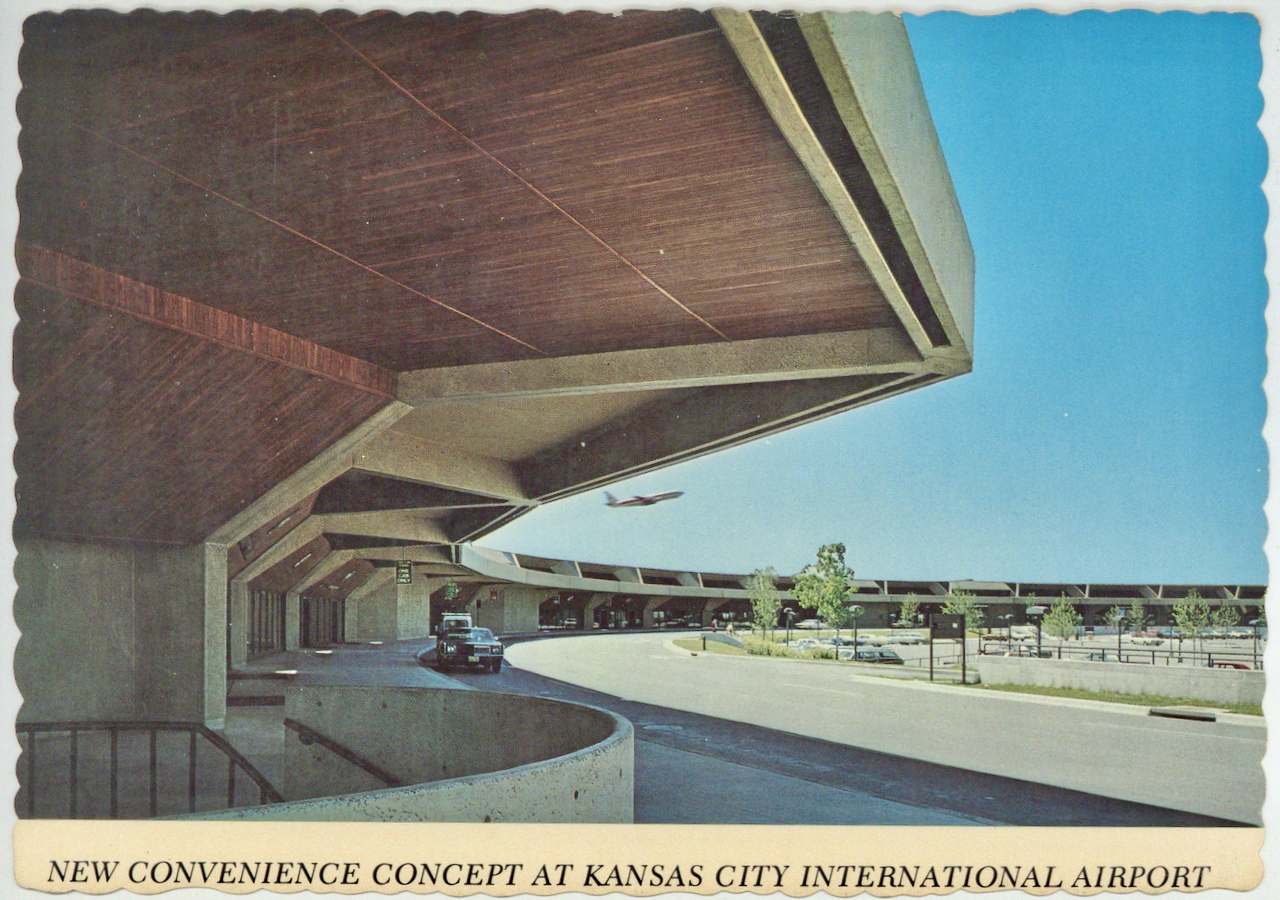
Curbside entrance to one of the circular terminals of MCI, showing the proximity of the car parking area. From each entrance, it was only a very short walk to check-in and the desired gate. Pub’r J. Tetirick, Kansas City, no. 621143; Bob Cunningham photo.
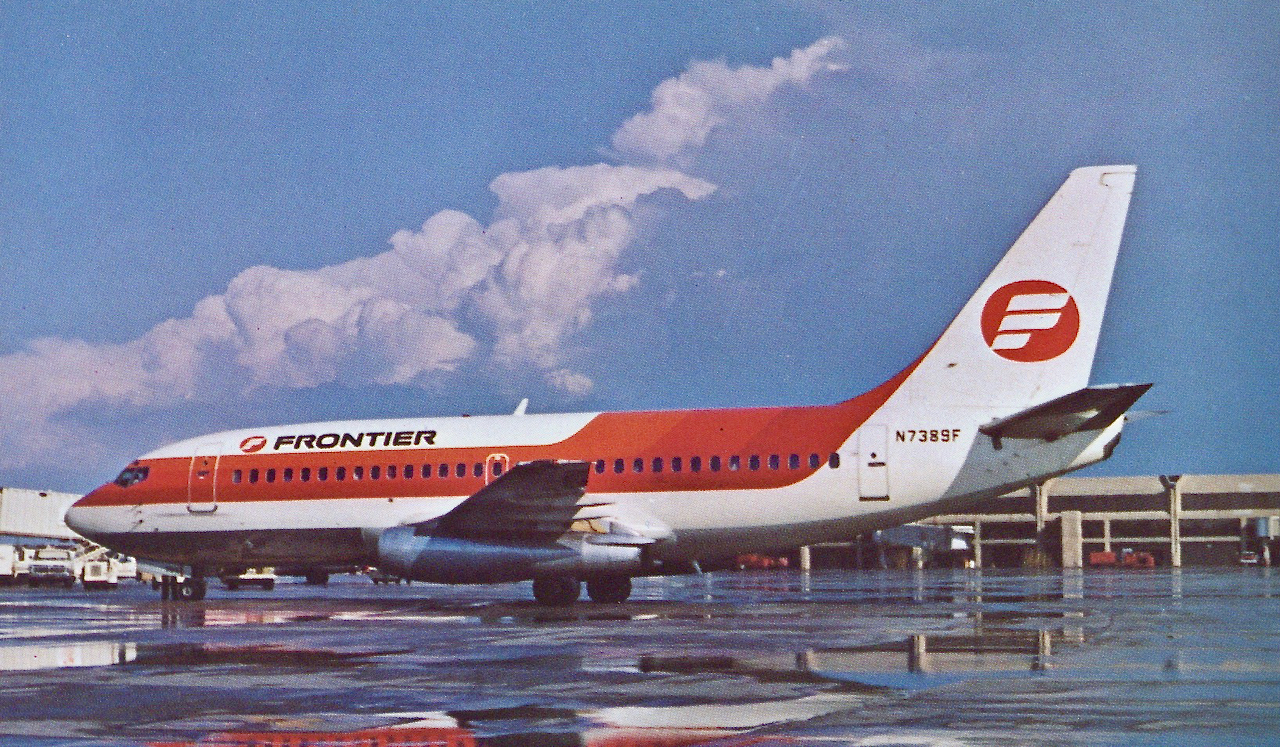
Frontier Airlines (the original Frontier in a later livery) Boeing 737-200, N7389F, at MCI on May 26, 1979, with the gate side of one of the circular terminals in the background. Pub’r LeAllan Henneberg, Platte City, Missouri; Dan Donovan photo. Ex Allan Van Wickler collection.
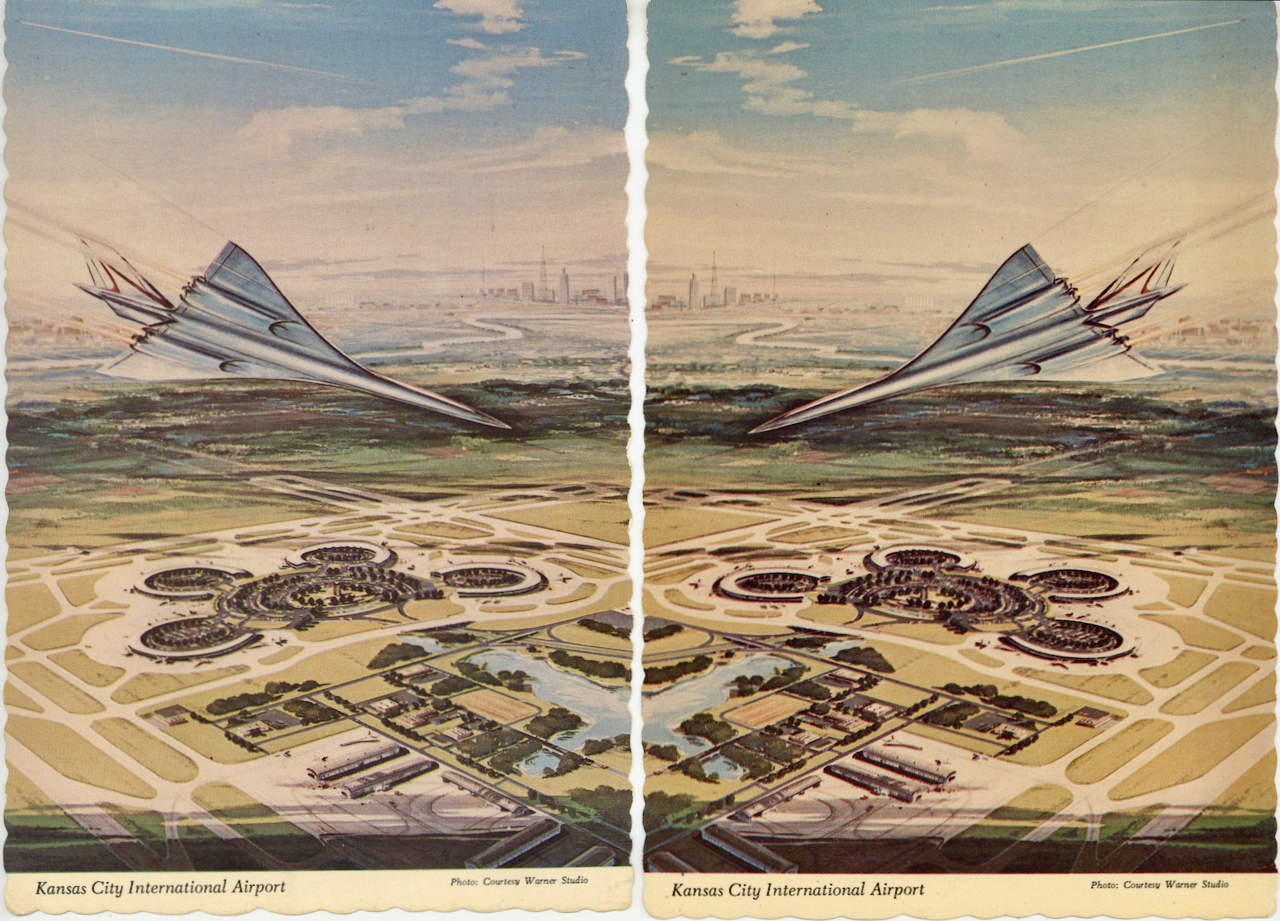
Aerial view of MCI, in two similar but different postcards. When the airport opened with three terminals, a fourth was contemplated as drawn here, but it was never built. The airport authorities also envisioned that SST supersonic aircraft would regularly use its mid-continent location, but that did not happen either. Here the postcard publisher apparently couldn’t decide the direction in which the ‘SST’ would land, so both directions were printed, each having the same postcard number. Pub’r Holiday Productions, Independence, Missouri; printed by Dexter Press no. 60505-C.
New Terminal at MCI, 2023
With mandated new airport security procedures following the 9/11/2001 terror attacks, the design of MCI’s three circular terminals became increasingly inefficient because there was inadequate room and separation areas available for passenger security screening. Moreover, the other terminal facilities were becoming crowded and outdated.
In 2017 it was decided to build a single modern terminal to replace the three old terminals. The City broke ground on the project in March 2019. Old Terminal A was demolished to build the new terminal in its place. Terminals B and C continued in operation only until the opening of the new single terminal.
On February 28, 2023, the new $1.5 billion single terminal opened. Its spacious interior is filled with natural light, and features upgraded technology and amenities, beautiful local artwork, and convenient gate access. Security checkpoints have been consolidated into one area with flexible features. There are 40 gates and two concourses. Passageways and glass passenger boarding bridges provide expansive views of the surrounding airfield. I do not have any postcards yet of the new MCI terminal, but it is featured in many photos, videos, and articles on the internet. For example, follow this link for photos by the architect.
NOTES: All postcards in this article are from the author’s collection. I estimate their rarity as follows: Uncommon: United Airlines aerial view of MKC; T-A-T Ford Trimotor at MKC; Mid-Continent Airlines DC-3 at MKC; group of TWA Constellations and Martins at MKC; and Frontier 737-200 at MCI. The rest are fairly common.
I hope to see you at Airliners International™ 2024 MCI, 26-29 June 2024, at the Hilton Kansas City Airport Hotel. You can see the outstanding new MCI terminal in person while attending the world’s largest airline history and collectibles show and convention, with nearly 200 vendor tables for buying, selling, and trading airline memorabilia (including postcards, of course), seminars, the annual meeting of the World Airline Historical Society, annual banquet, tours and more. Follow this link for more information: airlinersinternational.org.
Airliners International™ 2024 MCI will include an airline/airport postcard exhibit area. Please consider submitting an exhibit entry. Follow this this link for postcard entry guidelines.
Airliners International,airlines,American Airlines,Central Airlines,Continental,CR Smith Museum,Delta,DFW,Eastern Air Lines,Fort Worth,Frontier,Houston,Houston Hobby,Jefferson County Airlport,Love Field,Meacham Field,postcards,Rio Airways,Southwest,Spirit,Texas,Trans-Texas
A warm welcome to Texas. I hope you enjoy our postcard trip through the skies of the Lone Star State as well as the Airliners International™ 2023 show and convention at Dallas/Fort Worth International Airport.
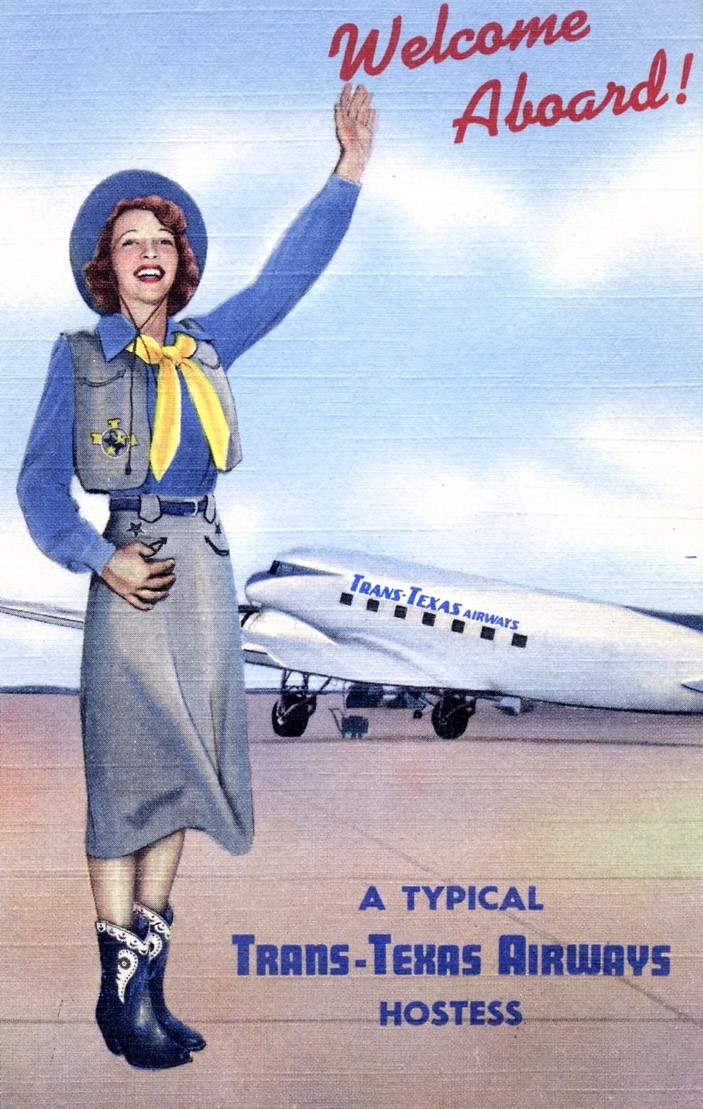
This postcard shows a Trans-Texas Airways Douglas DC-3, airline issue late 1940s, with ‘linen’ finish.
Let’s start with postcards of airlines that served Texas and are now history, followed by leading airlines that continue to operate in Texas skies.
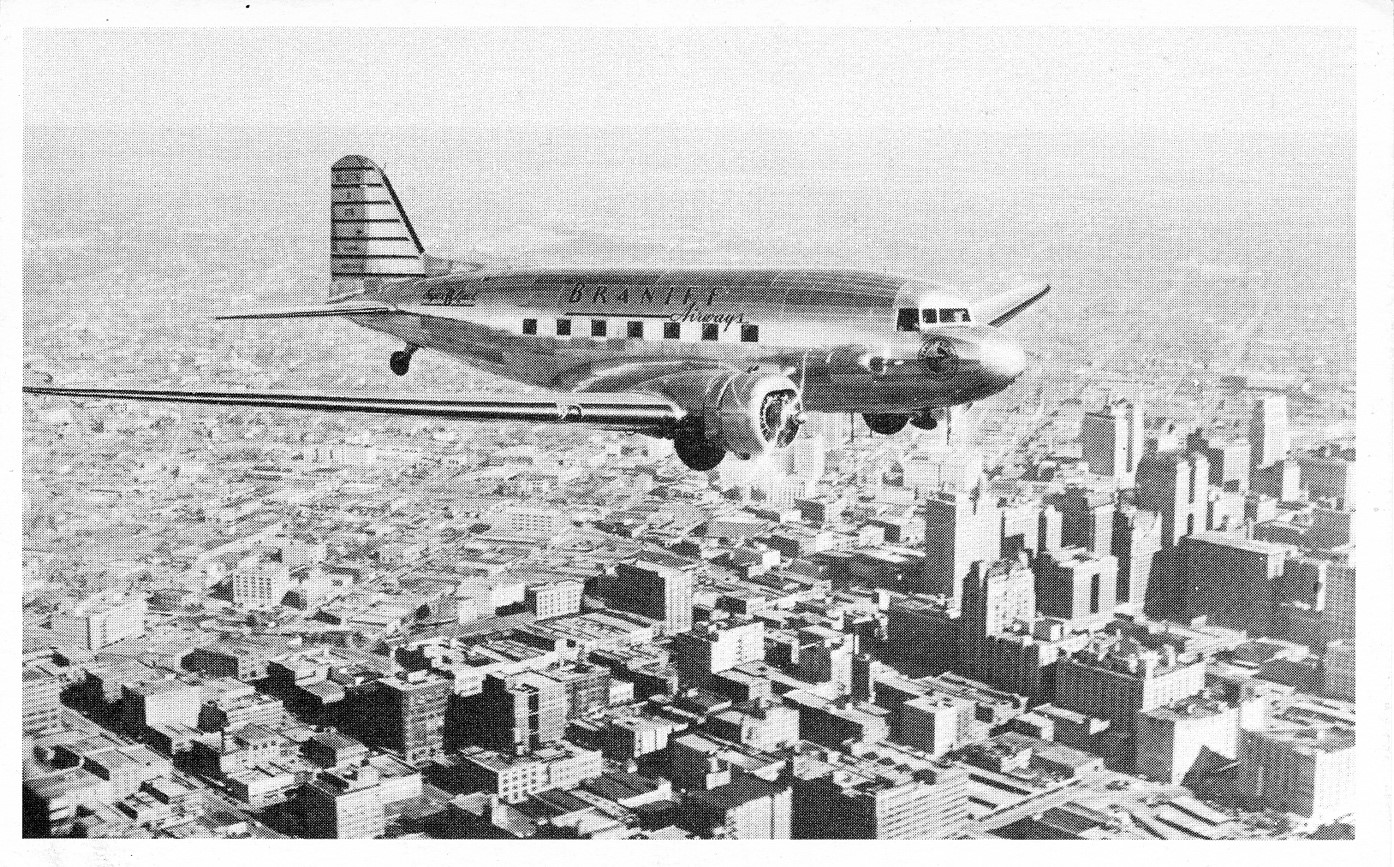
Braniff Airways Douglas DC-3 over Dallas, early 1940s, airline issue. Braniff Airways was incorporated in 1930. Originally based in Oklahoma, it moved its operation and maintenance base to Dallas Love Field in 1934 and its administrative headquarters to Dallas in 1942.
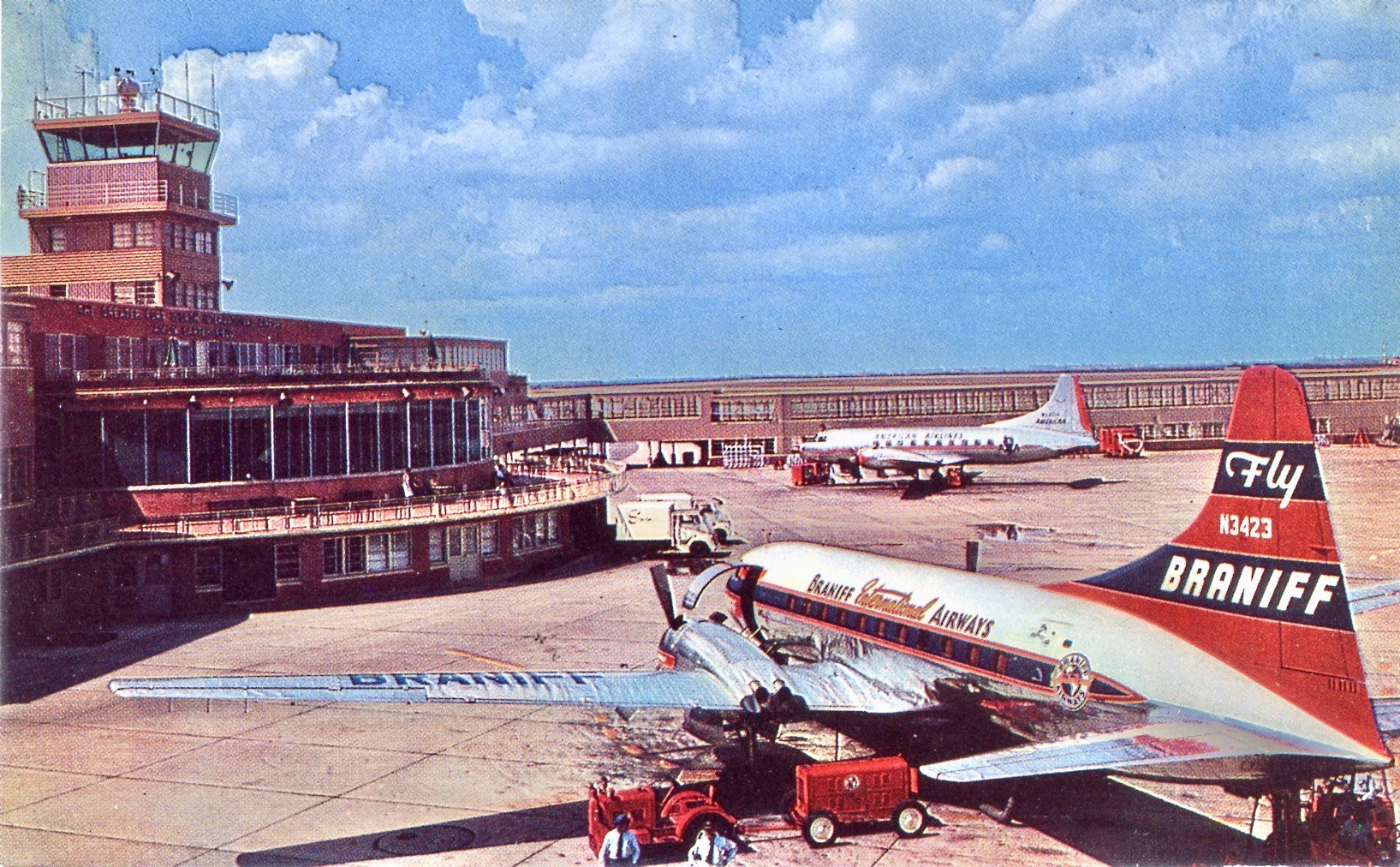
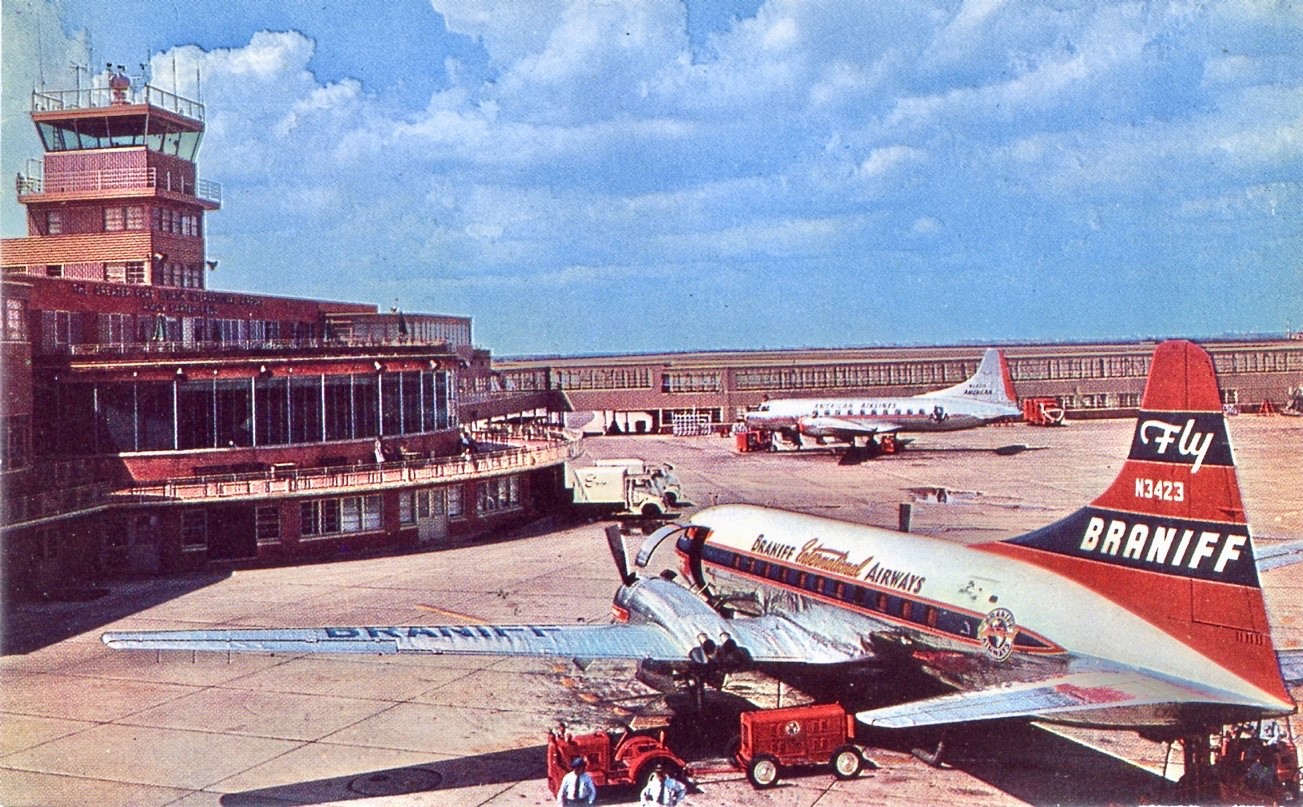
Braniff International Airways Convair 340, N3423, in service with Braniff during 1953-1967 (with an American Airlines Convair in the background), at Greater Fort Worth International Airport, Amon Carter Field. Braniff Airways changed its name to Braniff International Airways in 1948 and to Braniff International in 1965.
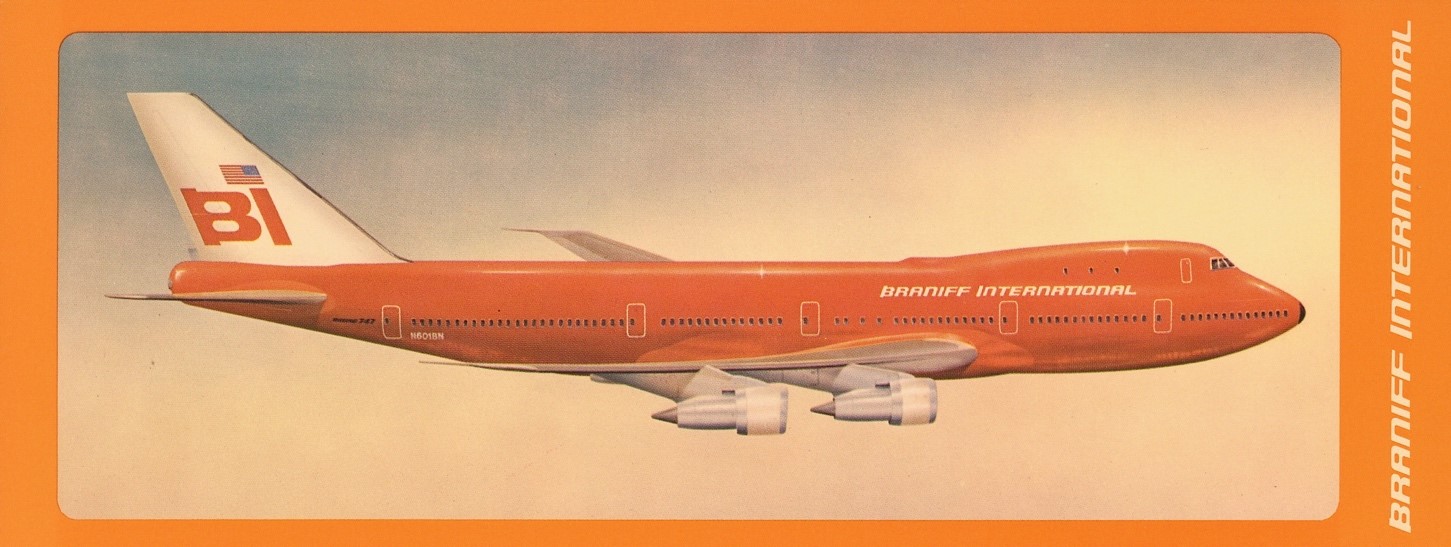
Of course, we cannot leave Braniff without noting one of its iconic “Flying Colors” aircraft. Here is Braniff International’s famous “747 Braniff Place,” Boeing 747-100, N601BN, airline-issued oversize postcard, 9 x 23 mm. The aircraft, based at Dallas/Fort Worth airport, served in Braniff’s fleet from 1971 until the airline’s demise in 1982.
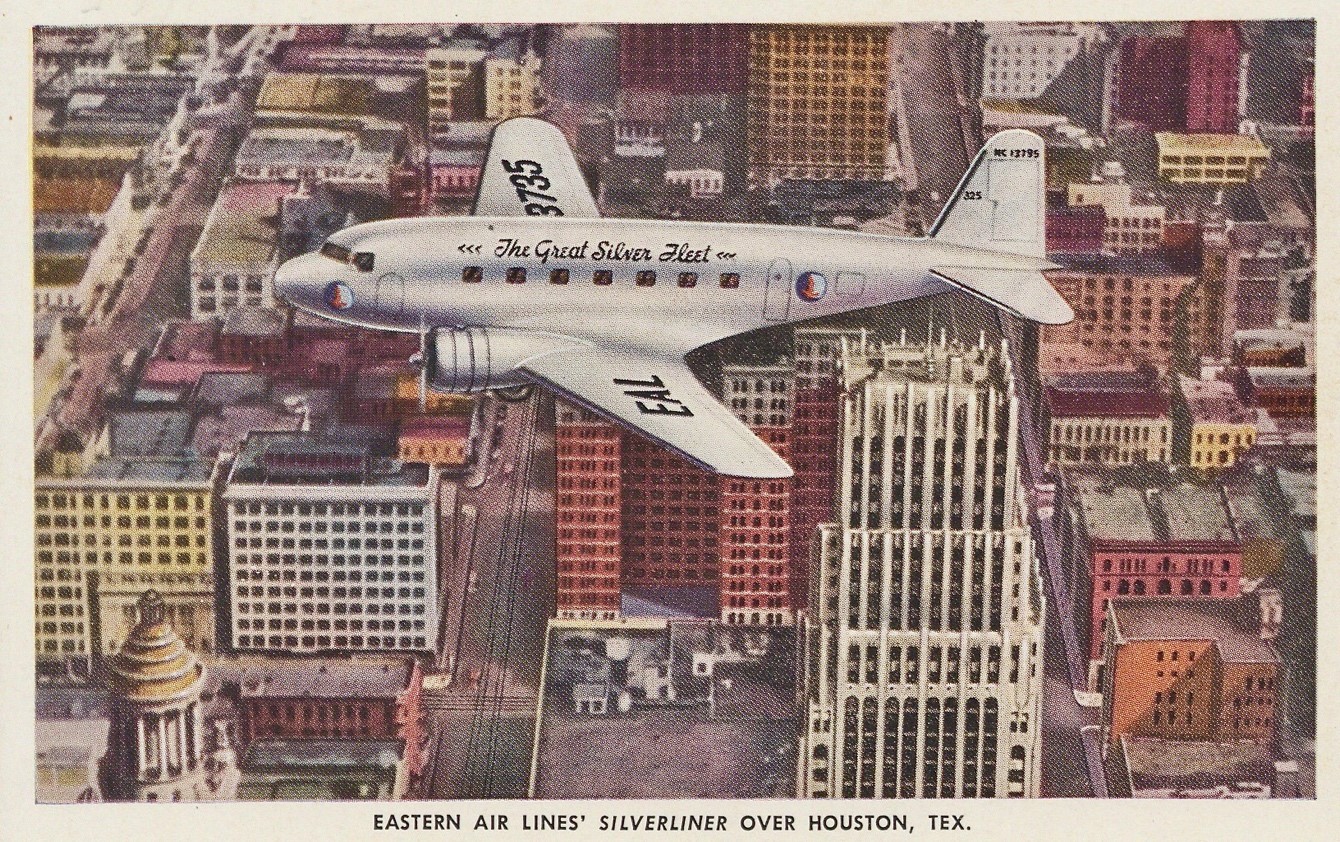
Eastern Air Lines Douglas DC-2, NC13735, over Houston, Texas. Airline issue, 1936-37. This postcard was republished in slightly different colors by Curteich in 1937 as no. 7A-H1739. Eastern’s predecessors started service in 1926, adopting the Eastern Air Lines name in 1934. In 1936 Eastern extended its route network to Texas by acquiring Wedell-Williams Air Service. Eastern continued as an airline until 1991.
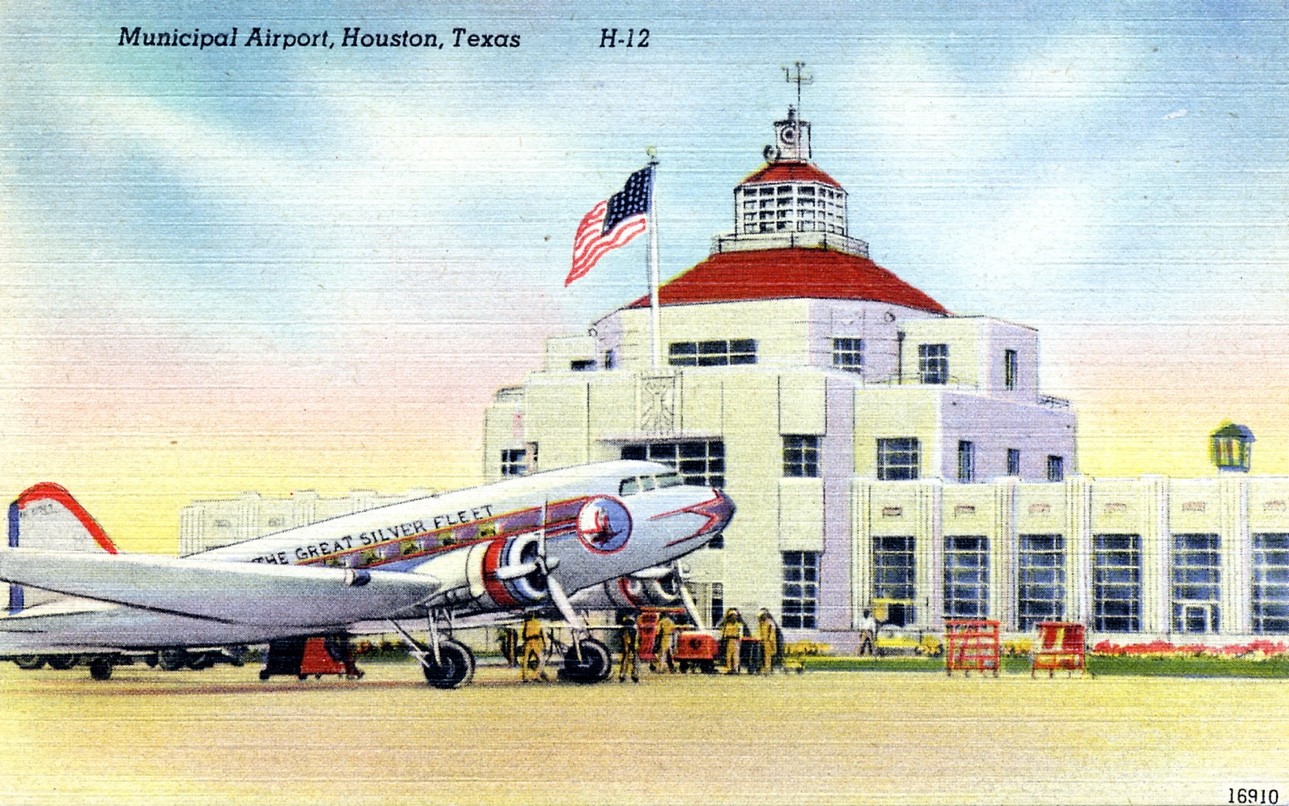
Eastern Air Lines Douglas DC-3 at Houston Municipal Airport (renamed Hobby Airport in 1967), probably in 1940s. Pub’r Bluebonnet News, Houston; printer Colourpicture H-12, 16910.
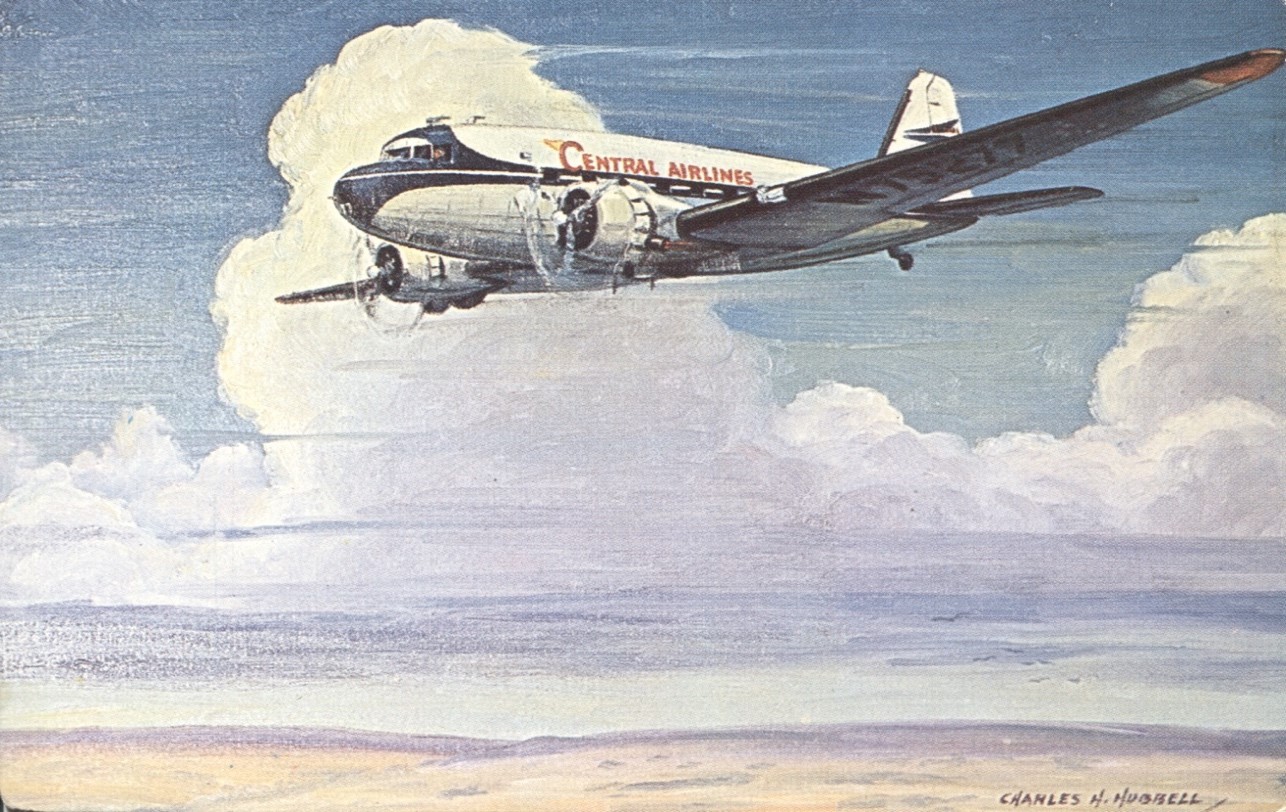
Central Airlines was a local service airline headquartered in Fort Worth, Texas, and operated in Texas and nearby states from 1949 until 1967 when it was acquired by the original Frontier Airlines. This postcard shows a Central DC-3 in a 1959 painting by Charles Hubbell to commemorate the 10th anniversary of the airline. Publisher John Stryker, Western Fotocolor, Fort Worth, Texas, no. 29462.
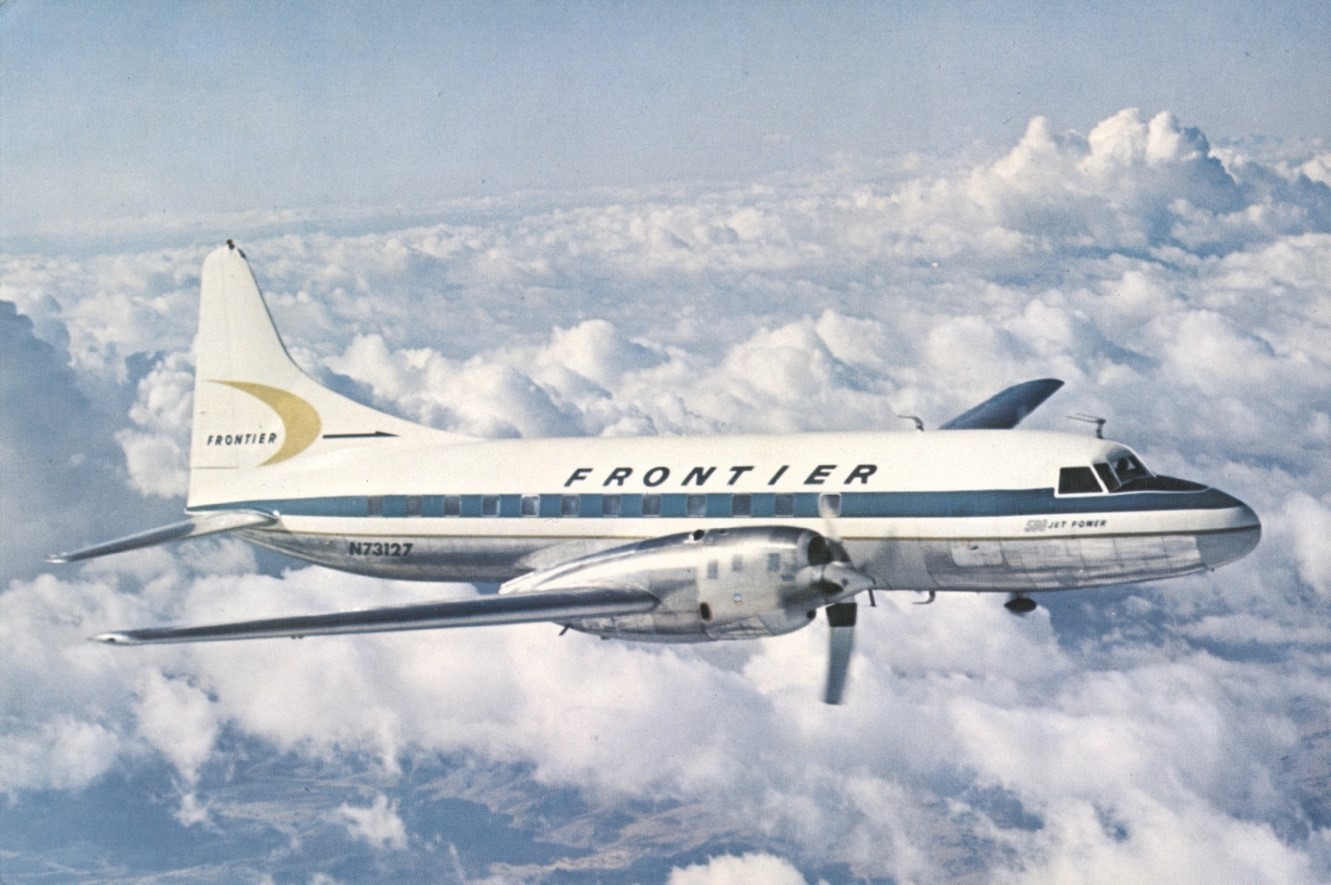
Frontier Airlines Convair 580, airline issue. On June 1, 1964, Frontier became the first airline to fly the Convair 580. This is the original Frontier Airlines that operated from 1950 to 1986.
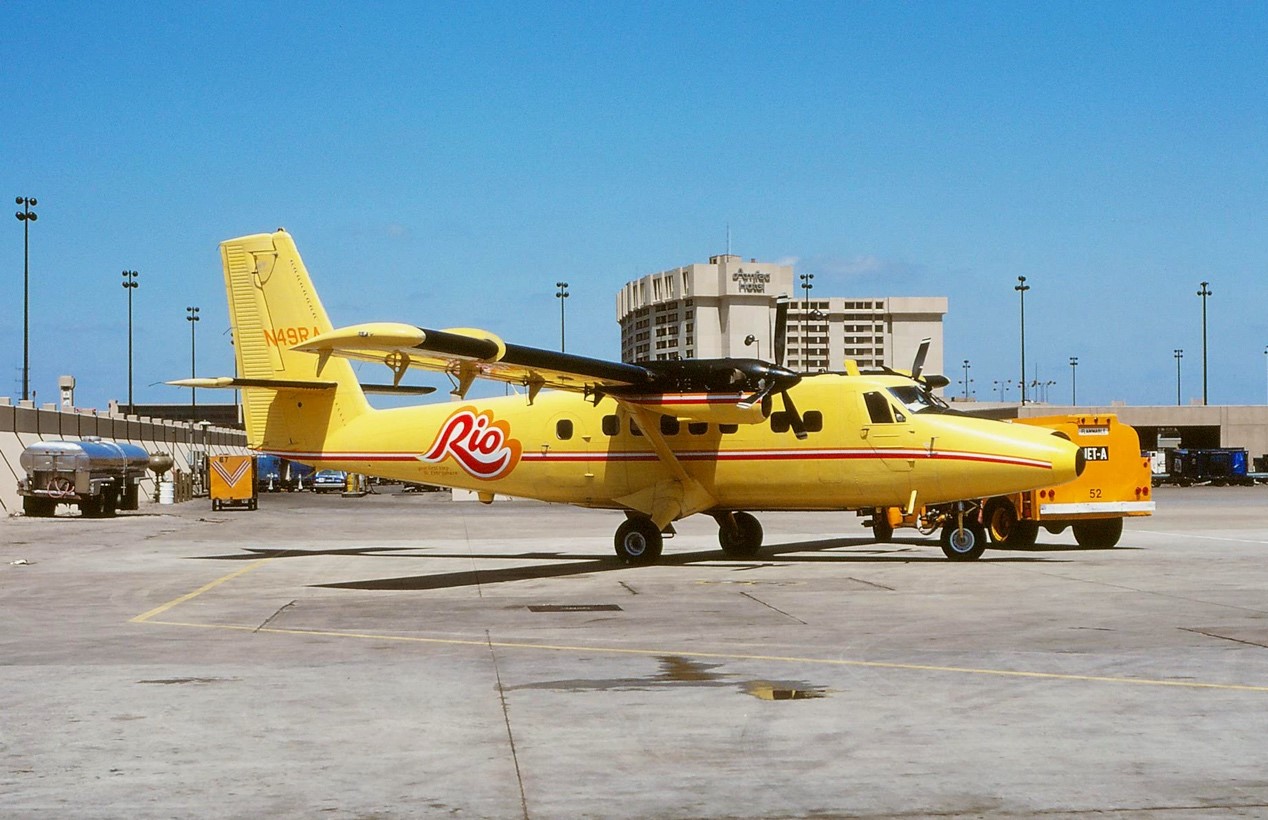
Rio Airways de Havilland Canada DHC-6-300 Twin Otter at Dallas/Fort Worth airport. Published by jjPostcards as part of a set of eight new postcards of aircraft at DFW presented to full convention registrants at Airliners International 2023 DFW. Rio Airways was a regional airline headquartered in Killeen, Texas, that operated from 1967 to 1987 in several Texas cities and eventually in neighboring states. At times it served at DFW under the Delta Connection brand and then as Braniff Express.
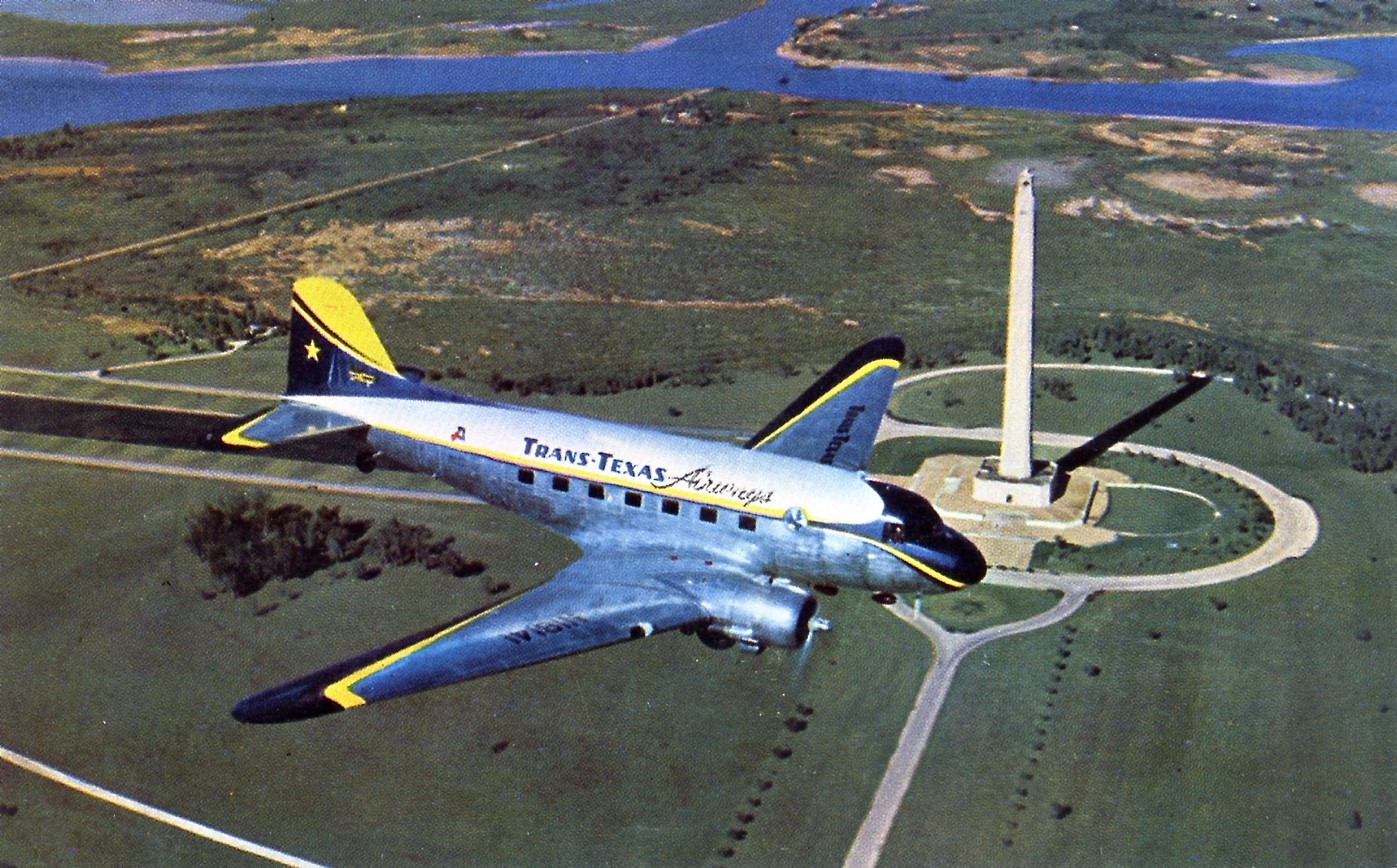
Trans-Texas Airways Douglas DC-3 “Starliner” flying over San Jacinto Monument, located about 16 miles east of Houston, Texas. A/I about 1949, printer Colourpicture, Boston, no. P1496, photo by Jim Thomas, Houston. Founded in the early 1940s, Trans-Texas changed its name to Texas International Airlines in 1969, and in 1982 it merged with Continental Airlines.
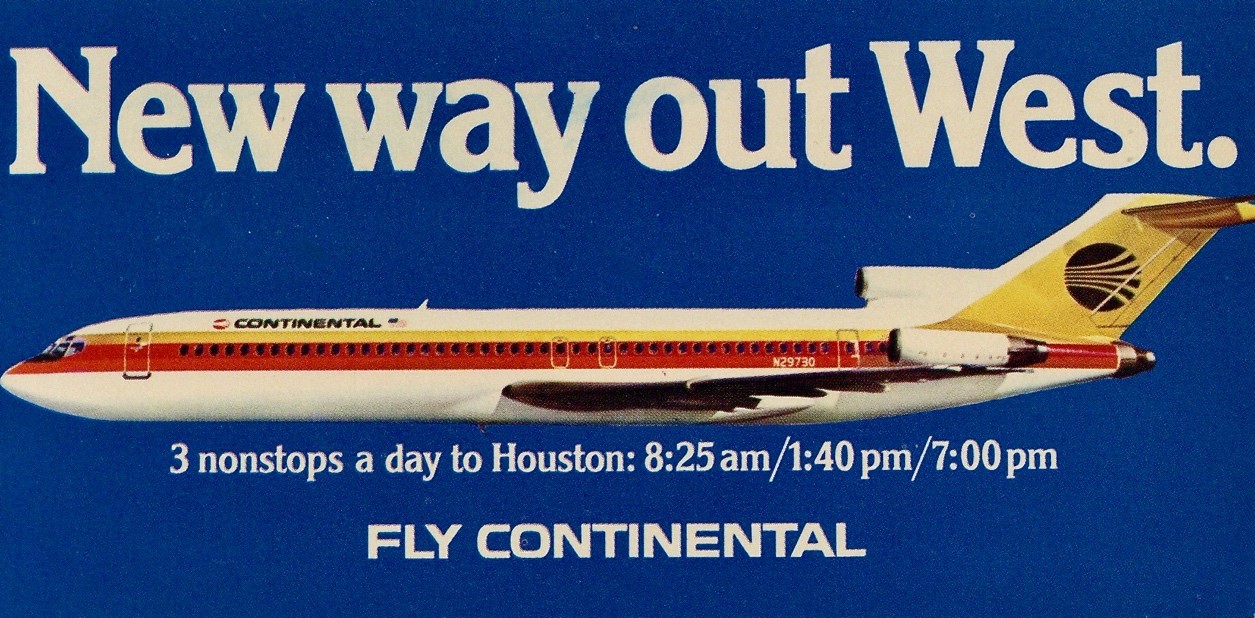
Continental Airlines Boeing 727-200, N29730, in service with Continental 1973 – 1995, airline-issued postcard featuring nonstop service to Houston, one of its major airport hubs.
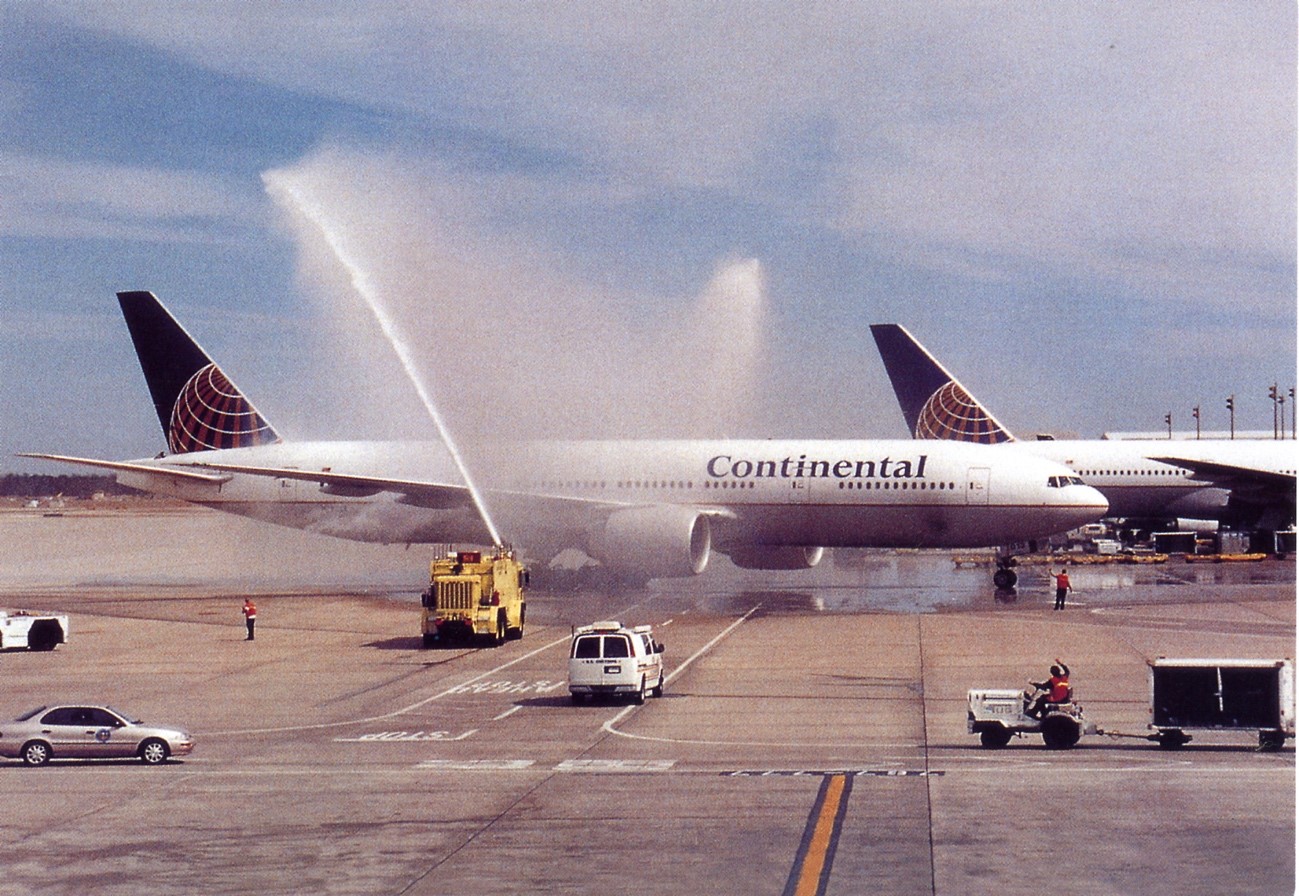
Continental Airlines Boeing 777-200 at Houston International Airport, issued for the Airliners International show in 2002. Photo by Duane L. Young, and sponsored by jjPostcards—The World of Aviation Postcards. Continental merged with United in 2010.
Now let’s turn to some of the leading airlines currently serving Texas. We start with American Airlines which has the longest continuous operating history in Texas and maintains its headquarters in Fort Worth near Dallas-Fort Worth International Airport.
American Airlines Douglas DC-3 at Fort Worth’s municipal airport, Meacham Field, probably in early 1937. Airline issue A-245-C. Predecessor airlines of American started operations in Texas in the 1920s, and American has grown its hub at Dallas-Fort Worth International Airport to be the second largest in the U.S. (after Delta’s Atlanta hub). At DFW airport American has had a market share of up to 86% of all passengers.
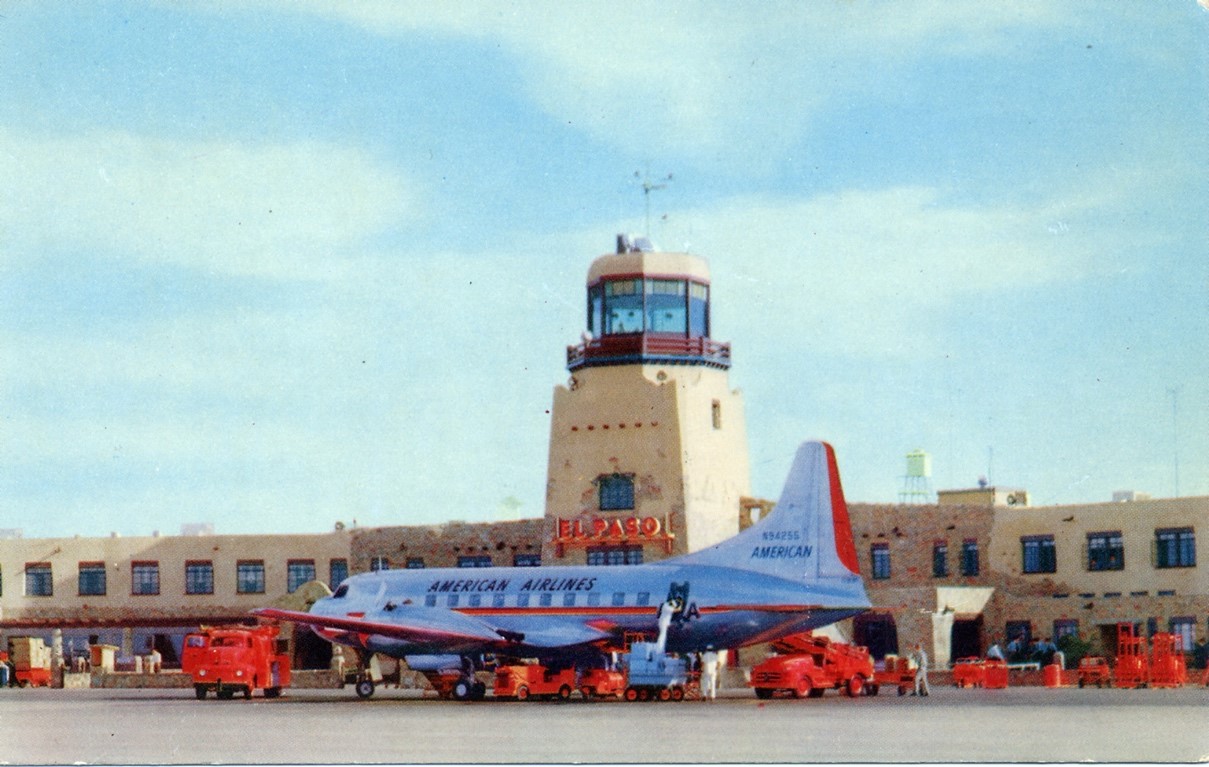
American Airlines Convair 240 at El Paso International Airport, 1948 to 1950s. Publisher Petley 653.
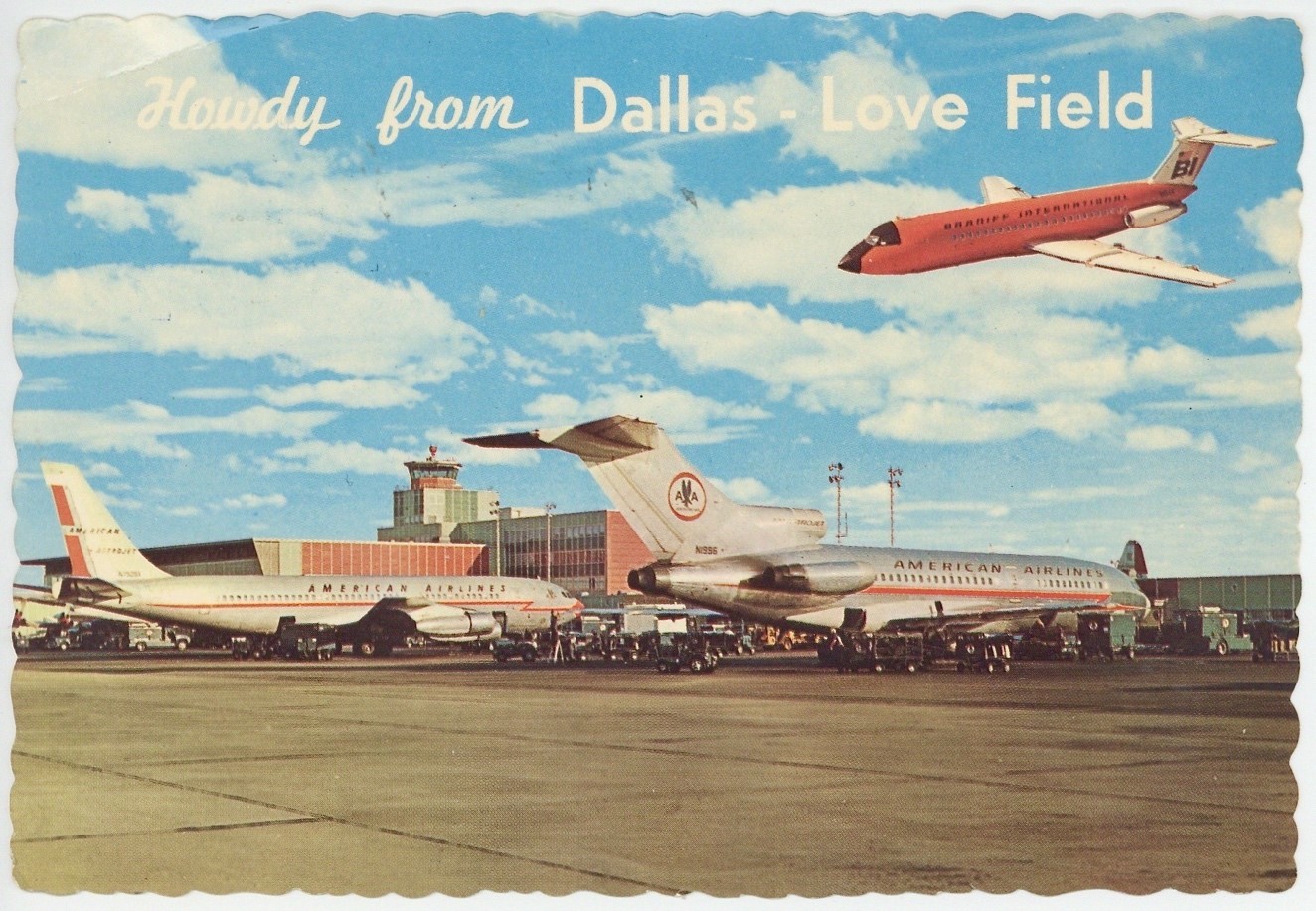
American Airlines Boeing 707 and 727-100 at Dallas Love Field, probably in the 1970s. Pub’r All-Tom Corporation, Arlington TX, Dexter Press D-21998-C. (I hope that Braniff BAC-1-11 knows where it’s headed.)
American Airlines MD-80s converging on its DFW airport hub, 1990s. Pub’r The Texas Postcard Co., Plano TX D-150, 711.
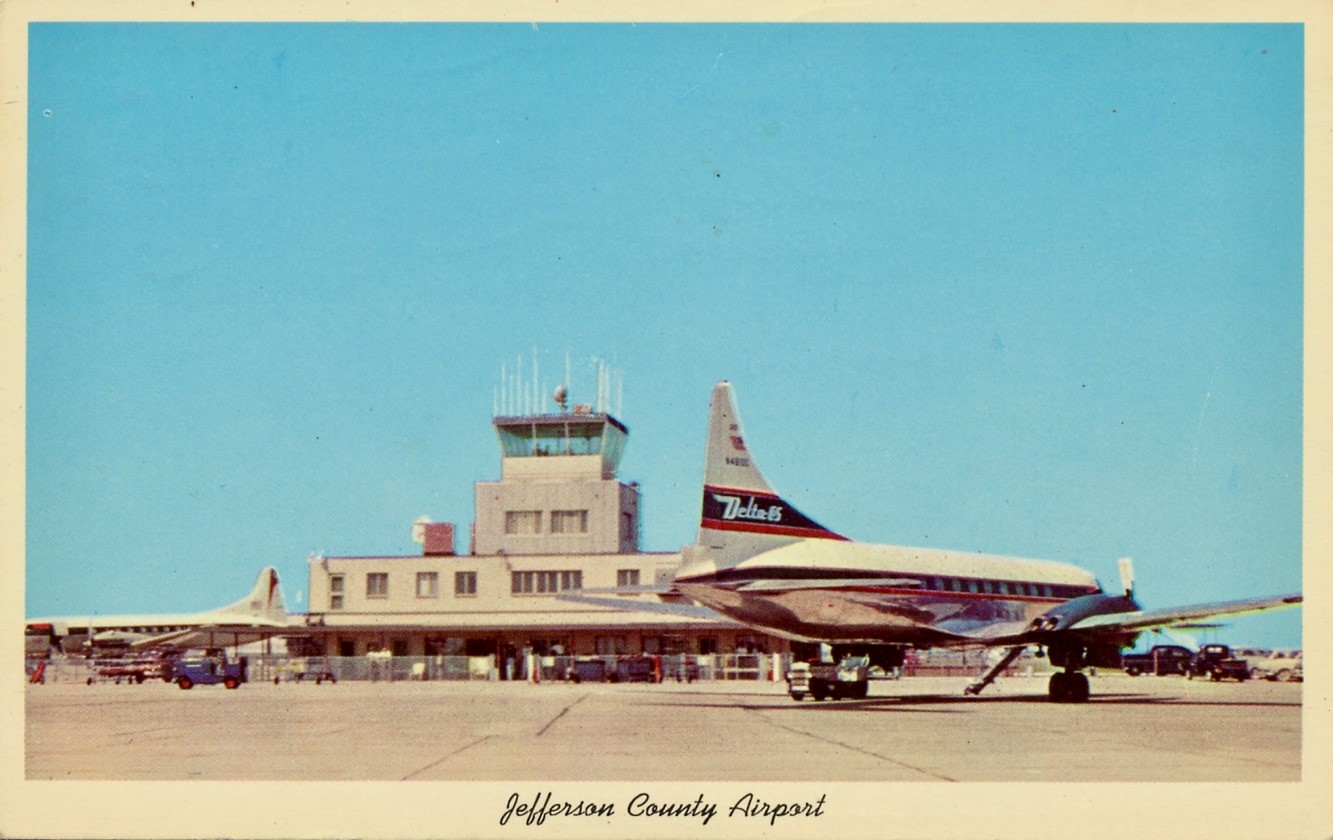
Delta Air Lines started operating in Texas, from Dallas, in 1929. This postcard shows a Delta Convair at Jefferson County Airport serving Beaumont and Port Arthur, Texas, in the 1960s. Pub’r Edwards News Co., Port Arthur & Beaumont, printer Curteichcolor.
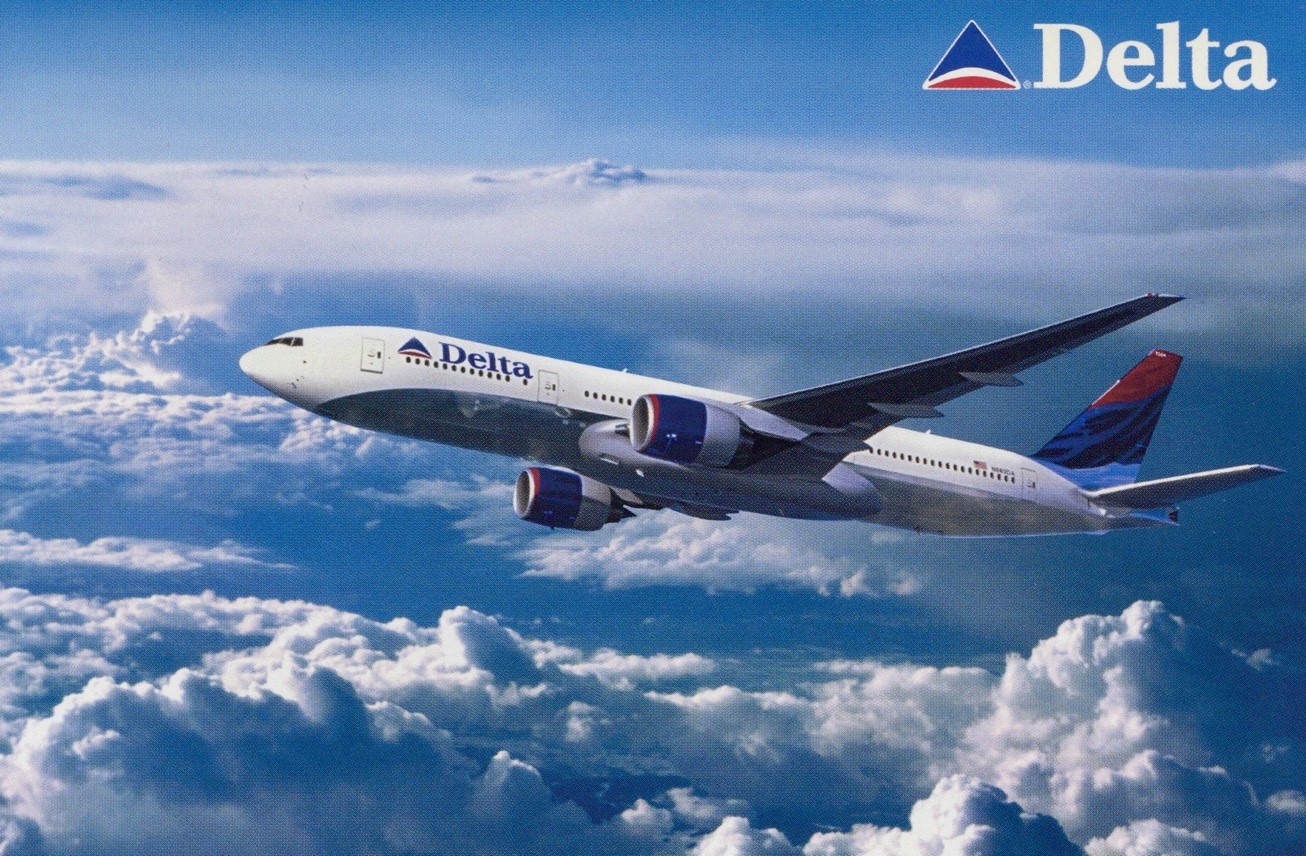
Delta Air Lines Boeing 777-200, introduced in 1995. Airline issue, 2000.
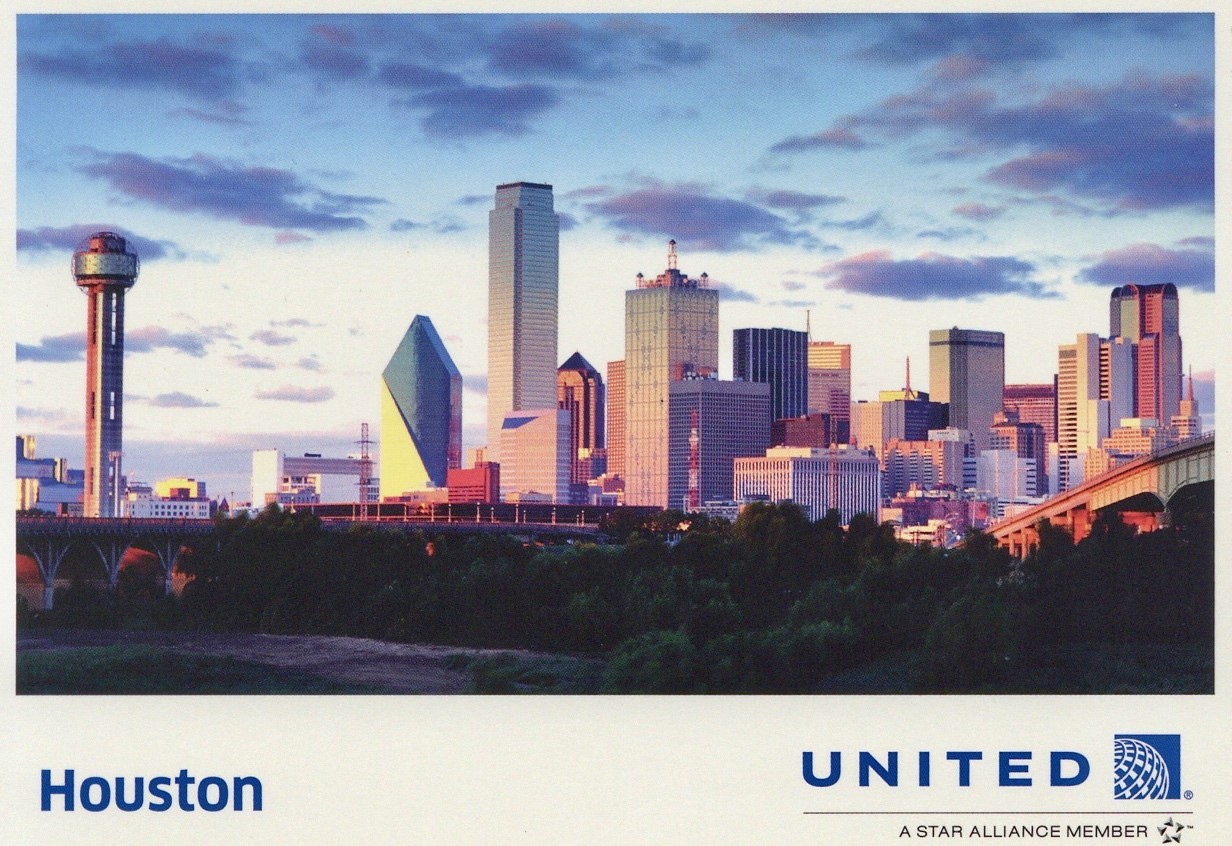
United Airlines “Houston” destination postcard. When Continental Airlines merged with United in 2010, United acquired Continental’s huge hub in Houston and then expanded it further. United is the largest airline at Houston, carrying over 70% of its passenger traffic. Note: skyline pictured is actually Dallas, not Houston, TX.
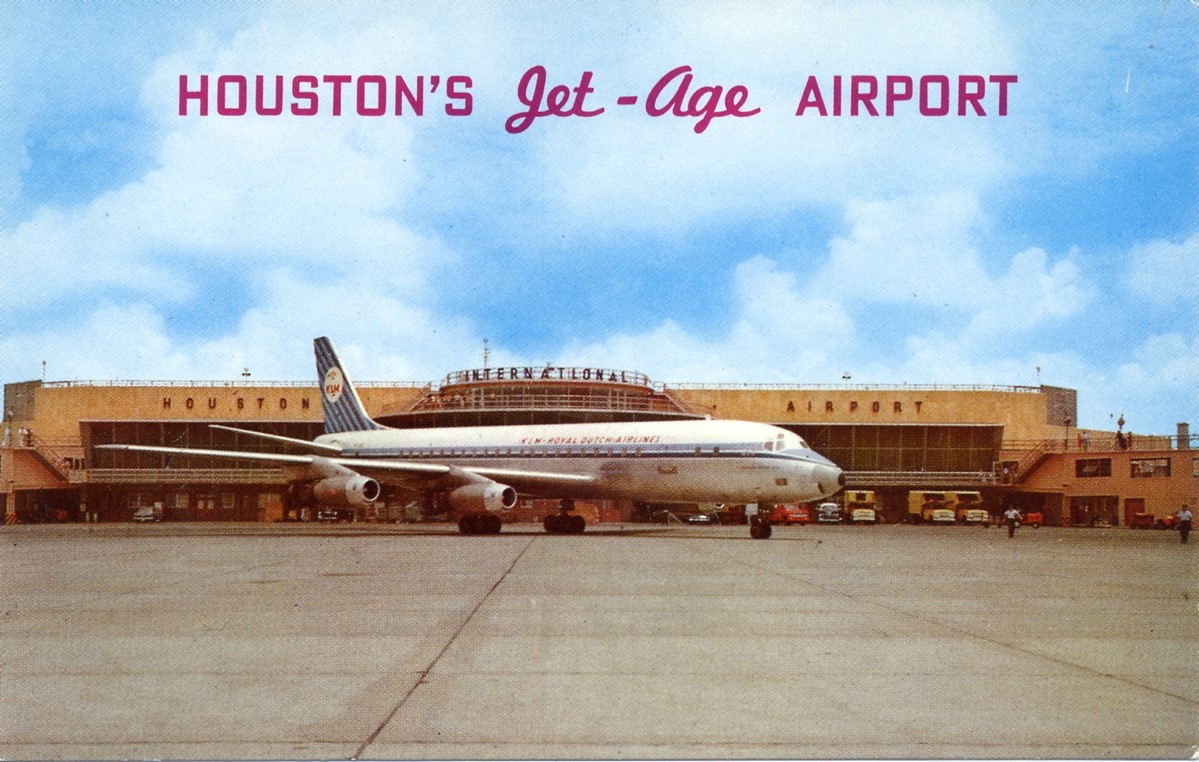
Dallas, Houston, and other Texas airports are also served, of course, by many non-U.S. airlines. One of the earlier international entrants was KLM Royal Dutch Airlines. Here is a KLM Douglas DC-8 at Houston (Hobby) International, 1960s. Pub’r H.S. Crocker MW-6.
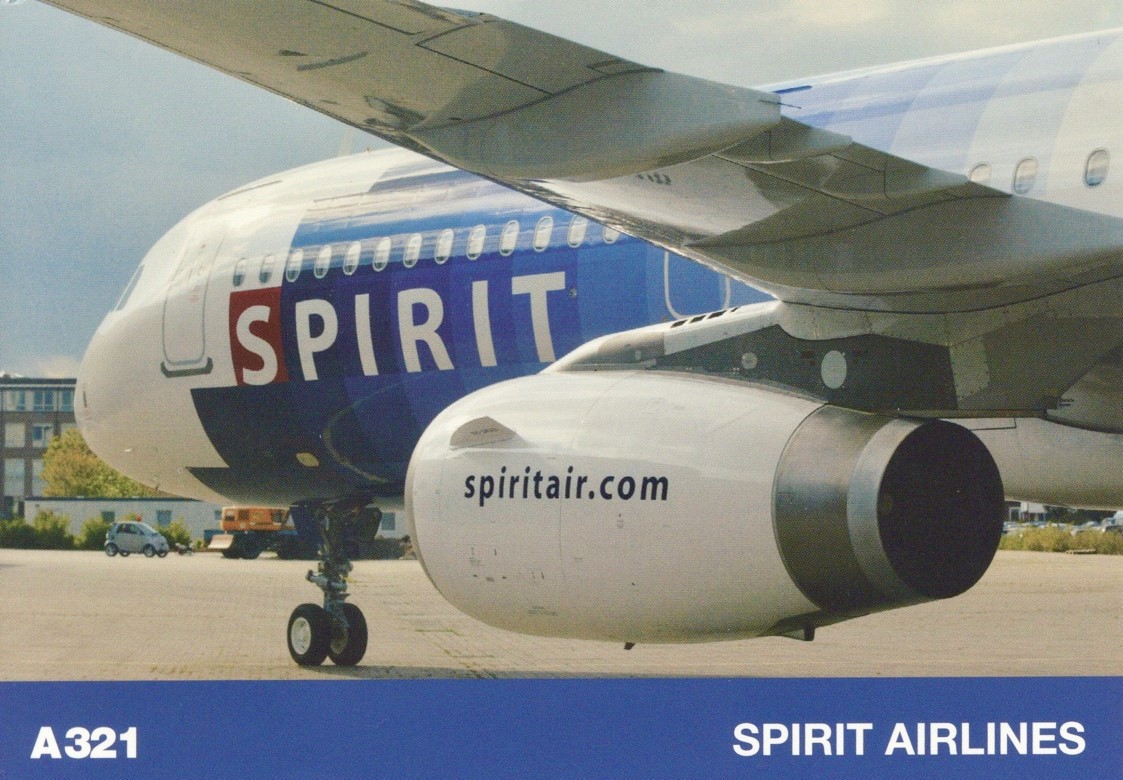
Spirit Airlines Airbus A321, issued by Airbus Deutschland GmbH, no. 148. Low-cost Spirit serves over 20 destinations from Dallas/Fort Worth airport alone.
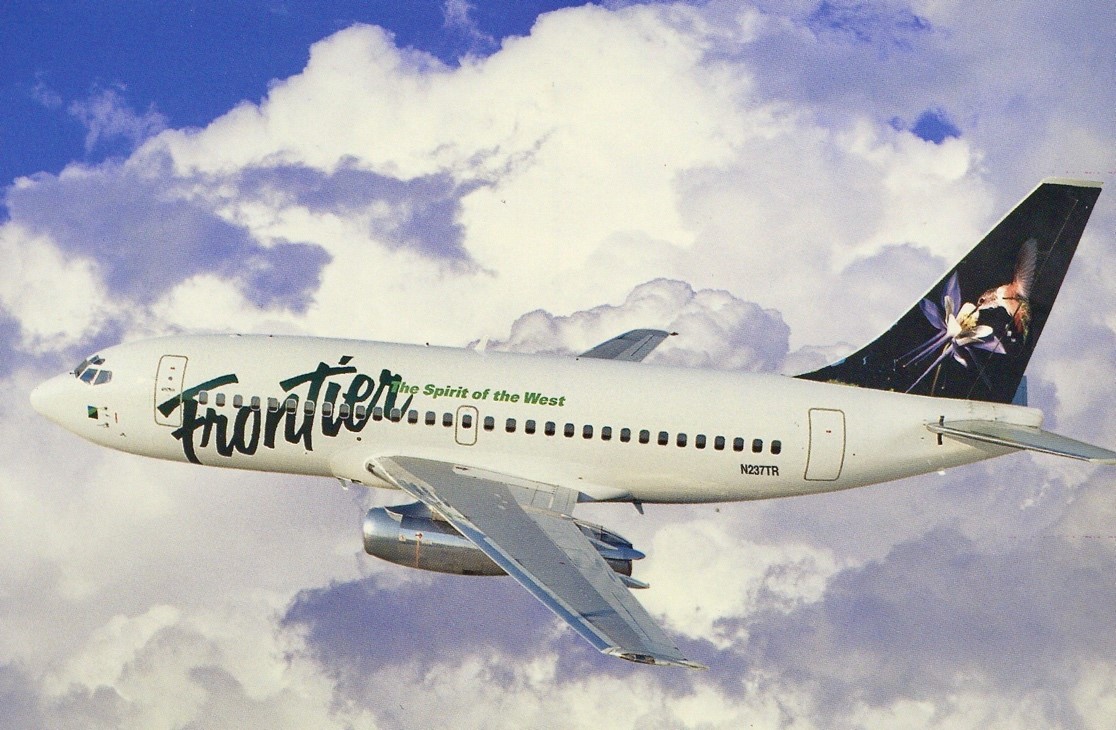
Frontier Airlines 737-200, N237TR, which entered service from Dallas-Fort Worth to Denver on September 24, 1999. Airline issue. The current low-cost Frontier Airlines started service in 1994 and now flies to some 20 destinations from Dallas alone.
We close with the airline that, along with American, is most associated with Texas skies – Southwest Airlines, also headquartered in Dallas. Southwest commenced operations in 1971 from its base at Love Field, Dallas. At first, it was an intrastate Texas airline, but in 1979 it started expanding to other states and eventually to international destinations as well. Today Southwest is the third largest airline in the U.S. (behind American and Delta) in terms of passengers carried.
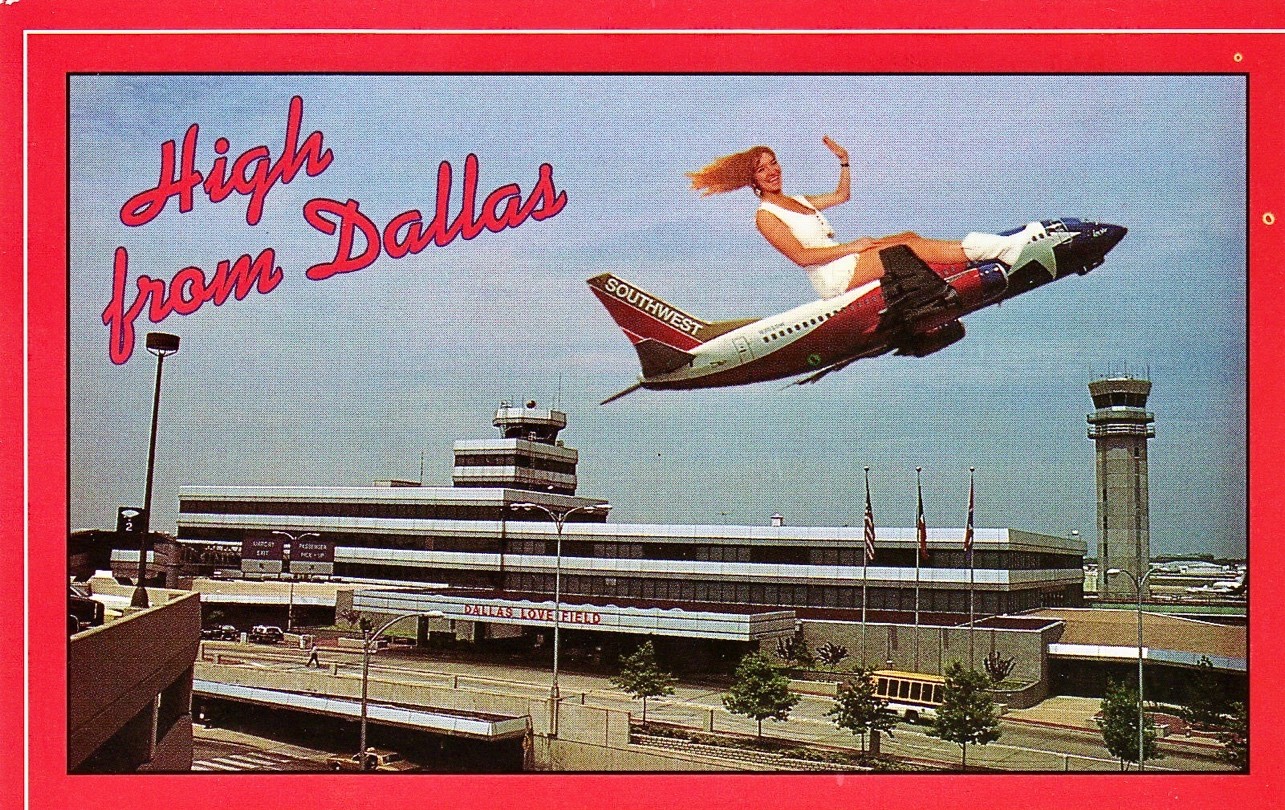
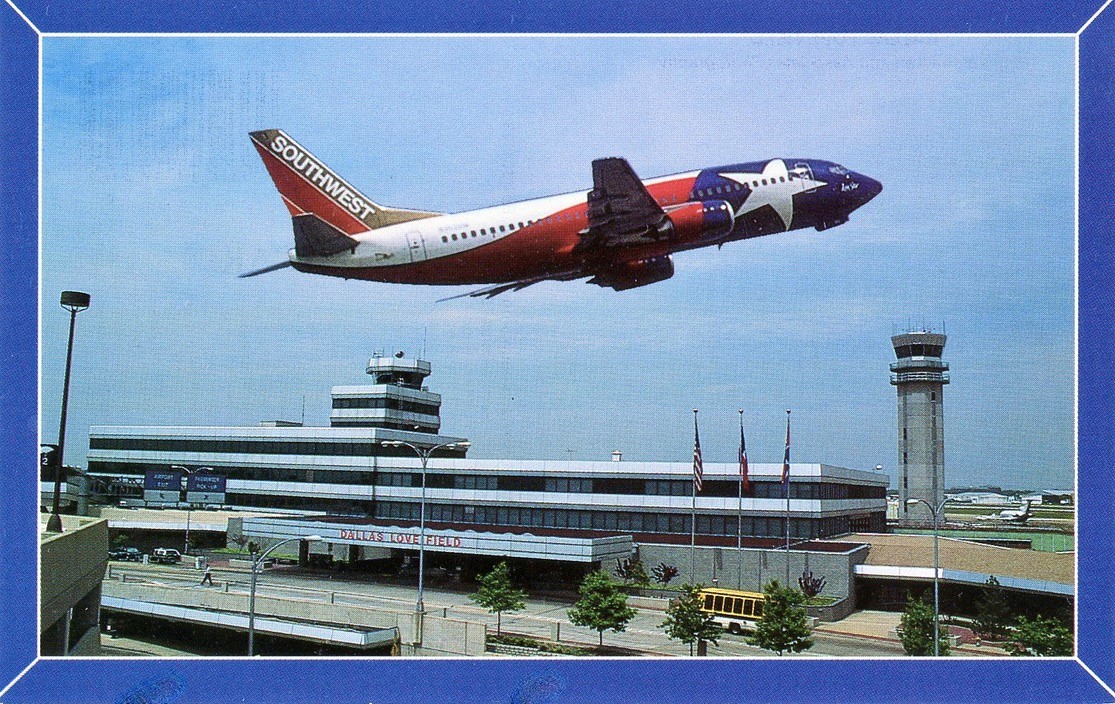
Southwest Airlines 737-300, N352SW, in special “Lone Star One” livery designed in 1990 for Southwest’s 20th anniversary, here with a special passenger. Al Canales collection.
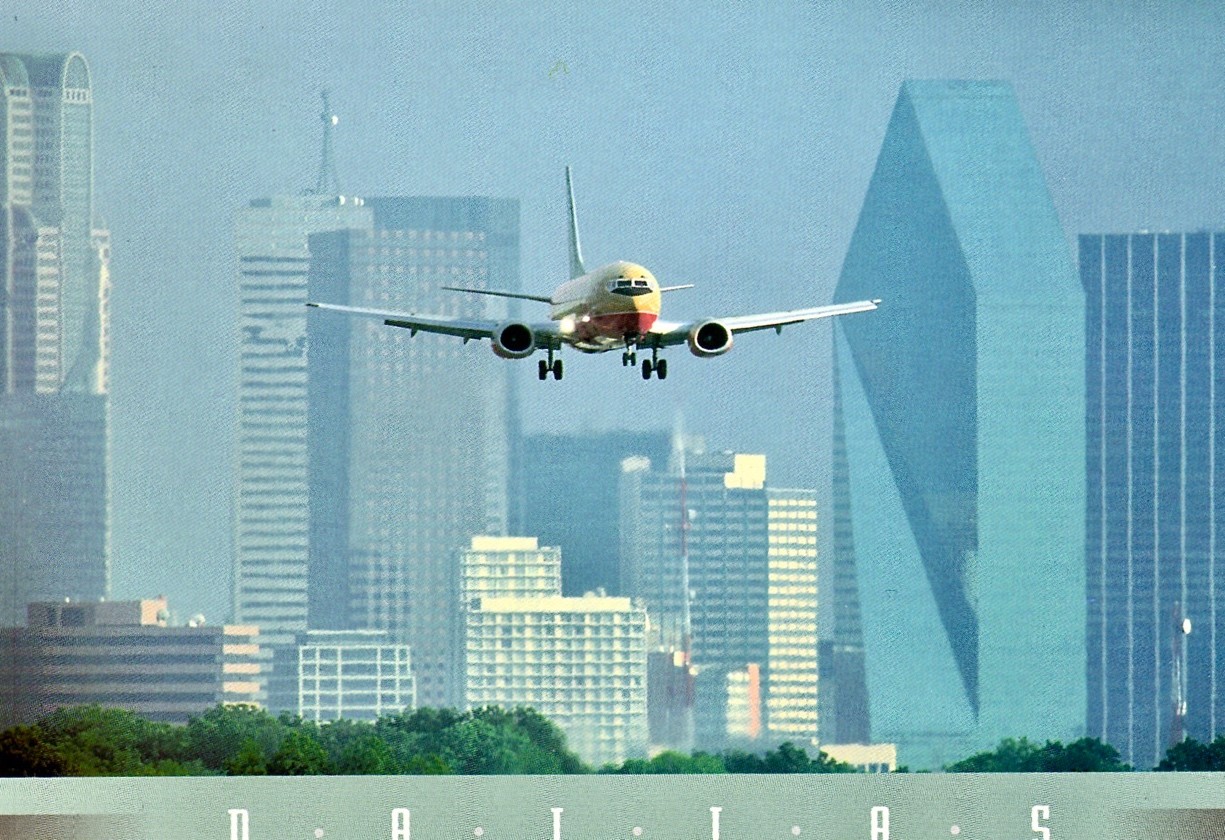
Southwest Airlines Boeing 737-300 on final approach to Dallas Love Field. Al Canales collection.
NOTES: All postcards in this article are from the author’s collection unless otherwise noted.
Below is my estimate of the rarity of the above postcards:
Rare: Trans-Texas DC-3 with hostess, Braniff DC-3 over Dallas, and Eastern DC-2 over Houston;
Uncommon: Central Airlines, Trans-Texas DC-3 over San Jacinto Monument, Continental 727-200 Houston, American DC-3 at Meacham Field, American Convair 240 at El Paso, Delta Convair at Jefferson County Airport, and KLM DC-8 at Houston;
The rest are fairly common.
I hope to see you at Airliners International™ 2023 DFW, June 22-24, 2023, at the Hyatt Regency Hotel, next to Terminal C at Dallas/Fort Worth International Airport. This is the world’s largest airline history and collectibles show and convention, with more than 200 vendor tables for buying, selling, and trading airline memorabilia (including, of course, airline and airport postcards), seminars, the annual meeting of the World Airline Historical Society, annual banquet, tours and more.
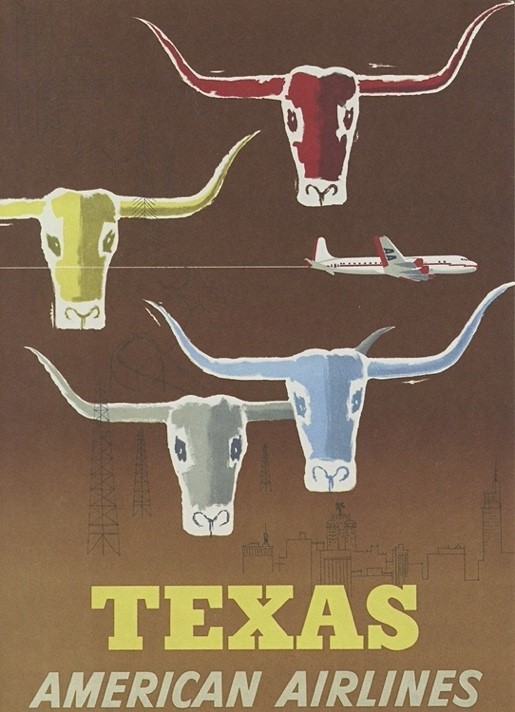
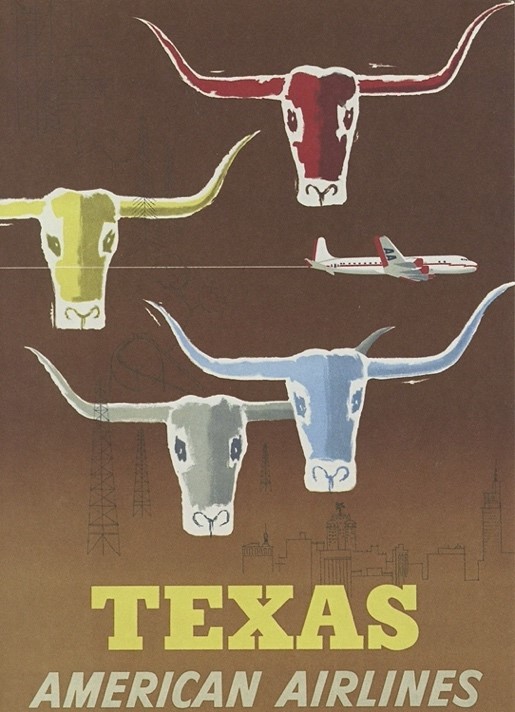
American Airlines postcard, artist Joseph Charles Parker, 5 x 7 in (12.7 x 17.8 cm). Part of a set of historic posters in postcard form believed to have been issued several years ago by American Airlines’ C. R. Smith Museum, Dallas.
Airliners International 2023,American Airlines,Amon Carter Field,Dallas,Delta Air Lines,DFW,Fort Worth,GSW,Love Field,Meacham Field,postcard contest,Southwest Airlines
In view of Airliners InternationalTM, the world’s largest airline history convention and airline collectibles show, to be held June 21-24, 2023, at Dallas/Fort Worth International Airport (DFW), this Captain’s Log “Postcard Corner” article describes the background and development of the major airports in Dallas/Fort Worth, illustrated by historic postcards.
The large cities of Dallas and Fort Worth, Texas, are located only slightly more than 30 miles (50 km) apart. Economically, it made sense to develop one major airport to serve both cities. However, numerous proposals from the 1920s on for such a combination all came to naught until 1968 when, at the insistence of the U.S. Federal Aviation Agency (FAA), the two cities agreed to jointly build a single major airport to serve the area encompassing both Dallas and Fort Worth. That airport became Dallas/Fort Worth International Airport (DFW), located equidistant between Dallas and Fort Worth, and today the second-busiest airport in the world by passenger numbers.
Prior to the agreement to build DFW, Fort Worth and Dallas both competed to develop the dominant airport in the area for scheduled commercial flights.
Fort Worth – Meacham Field
In 1925 the City of Fort Worth purchased Barron Field, a World War I-era aviation training field, and named it “Fort Worth Municipal Airport.” In 1927 the airport was renamed Meacham Field after former Fort Worth Mayor Henry C. Meacham. American Airways (later to become American Airlines) established its base at Meacham Field in 1927, and the airport became the main airport for commercial airlines in the Fort Worth-Dallas area.
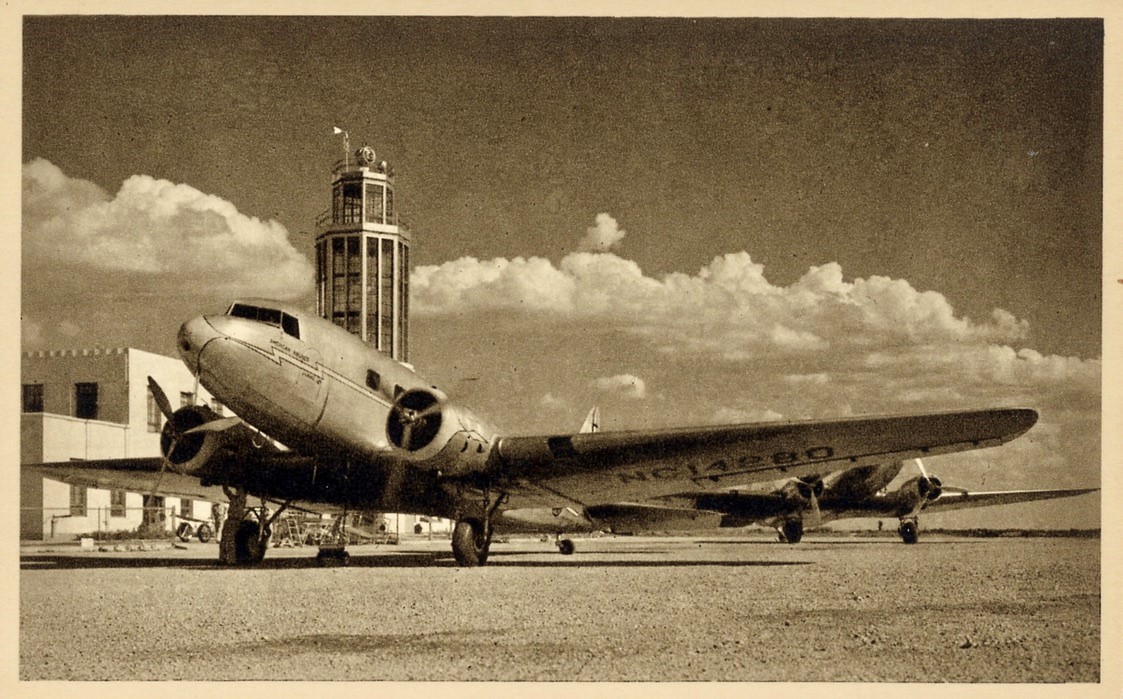
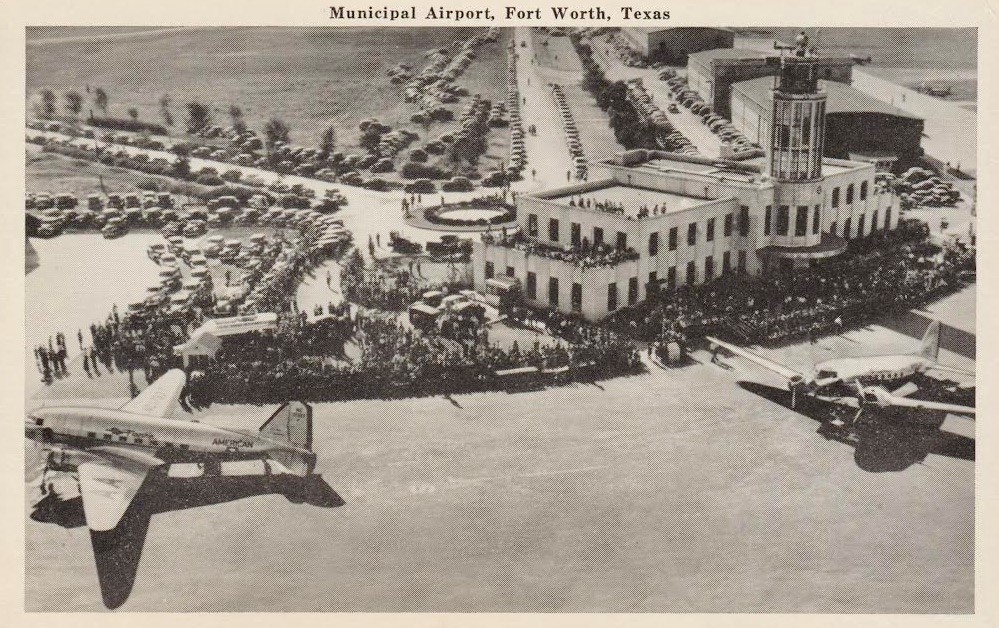
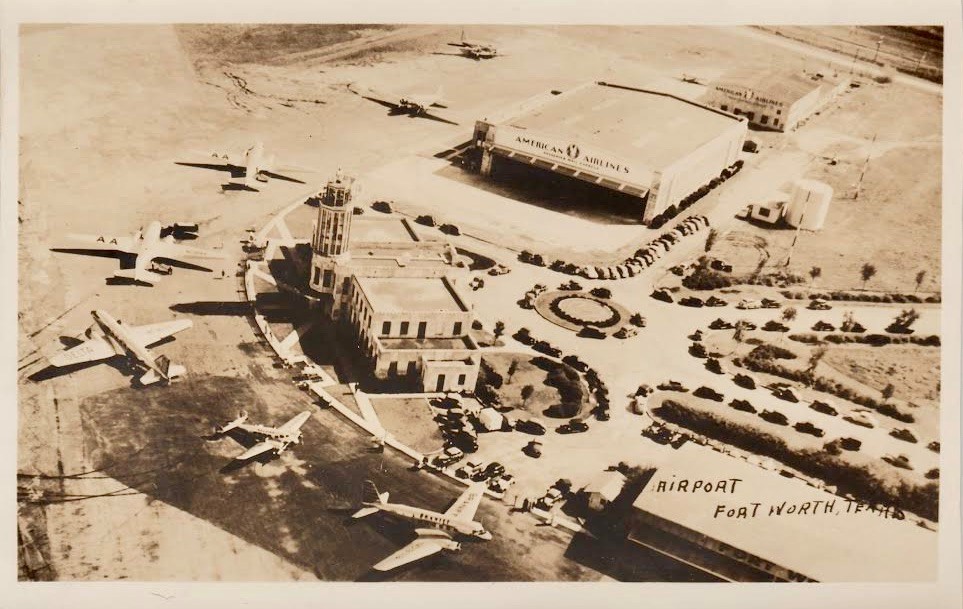
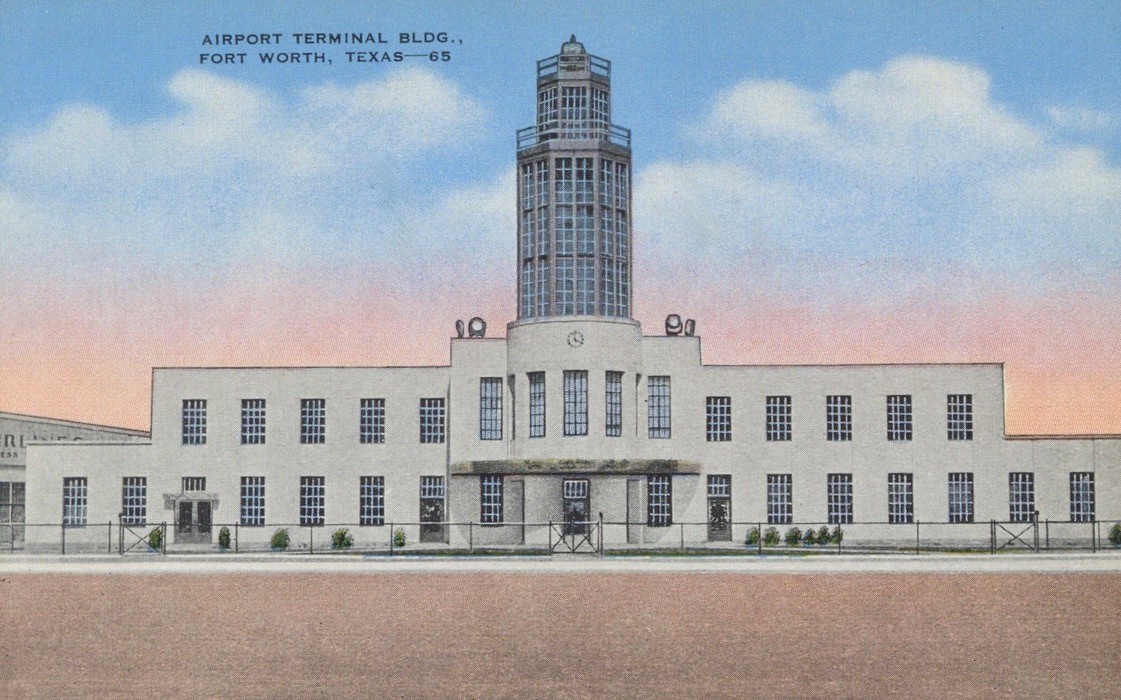
On April 4, 1937, Meacham Field dedicated a new terminal and control tower. The terminal was designed in the “Art Moderne” or new streamlined style, and it was the first air-conditioned passenger terminal in the U.S. Here is a selection of postcards showing Meacham Field and its new terminal.
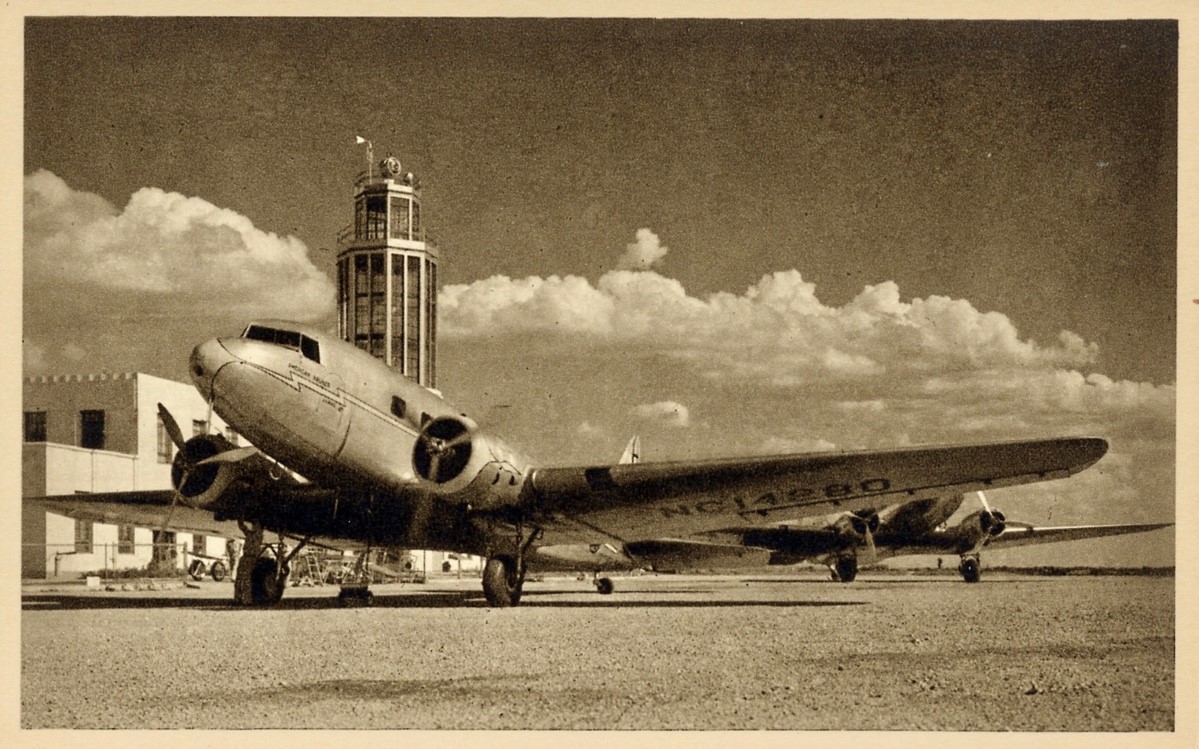
American Airlines Douglas DC-2, NC14280, at Meacham Field, Fort Worth, Texas’ municipal airport, with the newly built terminal and control tower in the background, probably in early 1937 before their completion. Airline issue A-245-C.
Meacham Field, Fort Worth, Texas, probably in April 1937 when its new terminal and control tower were inaugurated. On the ramp are two American Airlines Douglas DC-3s. Publisher Graycraft Card Co., Danville VA, no. F-156. Al Canales collection.
Aerial View of Meacham Field, Fort Worth, Texas, showing American Airlines and Braniff Airways aircraft, the terminal building and control tower that opened in 1937, and the large American Airlines hangar. Other airlines utilizing Meacham were Central, Pioneer and Trans-Texas. Real photo postcard. Al Canales collection.
Closeup of the 1937 terminal building and control tower at Meacham Field, Fort Worth. The terminal was designed in the “Art Moderne” style, also known as “Streamline Moderne,” an austere outgrowth of the earlier Art Deco architectural style. This was the first airport terminal in the U.S. with air conditioning. Pub’r Atlas News Shop, Fort Worth; Printer E. C. Kropp Co., Milwaukee, nos. 65, 6945.
Greater Fort Worth Airport (Amon Carter Field; Greater Southwest Airport)
During the early 1940s, Fort Worth decided to develop a larger airport to handle rising air traffic and allow future expansion that was not possible at Meacham Field. The site selected for reconstruction was that of Arlington Municipal Airport. It was located at the eastern edge of Fort Worth and was almost equidistant between the centers of Fort Worth and Dallas. Fort Worth invited Dallas to jointly develop the site to serve both cities. However, as Dallas was developing its close-in airport Love Field and that airport was preferred by its residents, Dallas declined to participate. Ironically, this new Fort Worth site was located almost adjacent to what later became today’s Dallas/Fort Worth International Airport.
The new Fort Worth airport finally opened on April 25, 1953, and was named Greater Fort Worth International Airport at Amon Carter Field (Amon Carter was the Mayor of Fort Worth). Airlines then transferred from Meacham Field to the new airport, Since 1953, Meacham has been used by corporate aircraft, commuter flights, and for student pilot training.
In 1962 Fort Worth changed the name of its new airport to “Greater Southwest International Airport” as part of an effort to again entice the city of Dallas to join in further development of the airport. However, that overture was turned down as well.
Here are some postcards of Greater Fort Worth International Airport, also known as Amon Carter Field and, from 1962, as Greater Southwest International Airport.
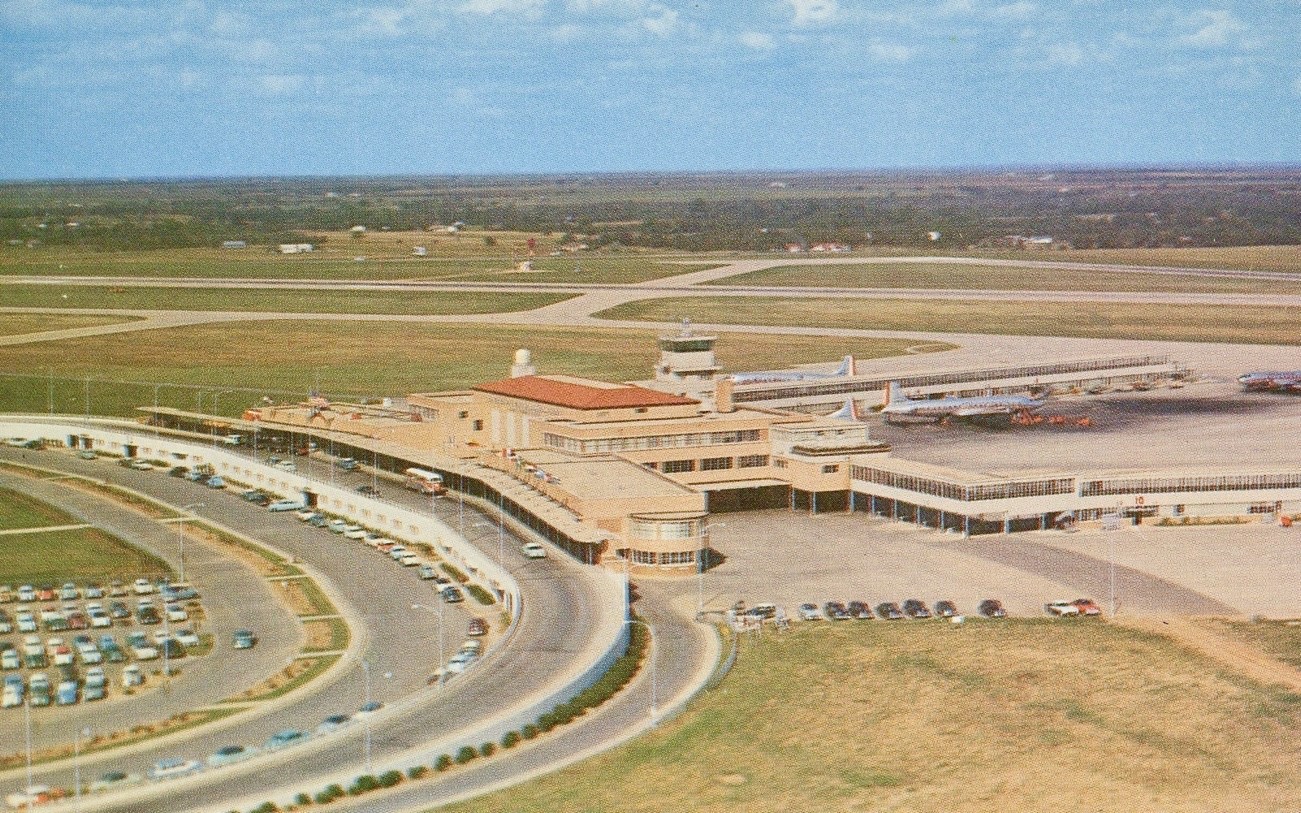
“Copter-view” of Greater Fort Worth International Airport at Amon Carter Field, about 1956. Postmarked July 9, 1958. Photographed and published by John A. Stryker, Fort Worth, no. ART-6293-2.
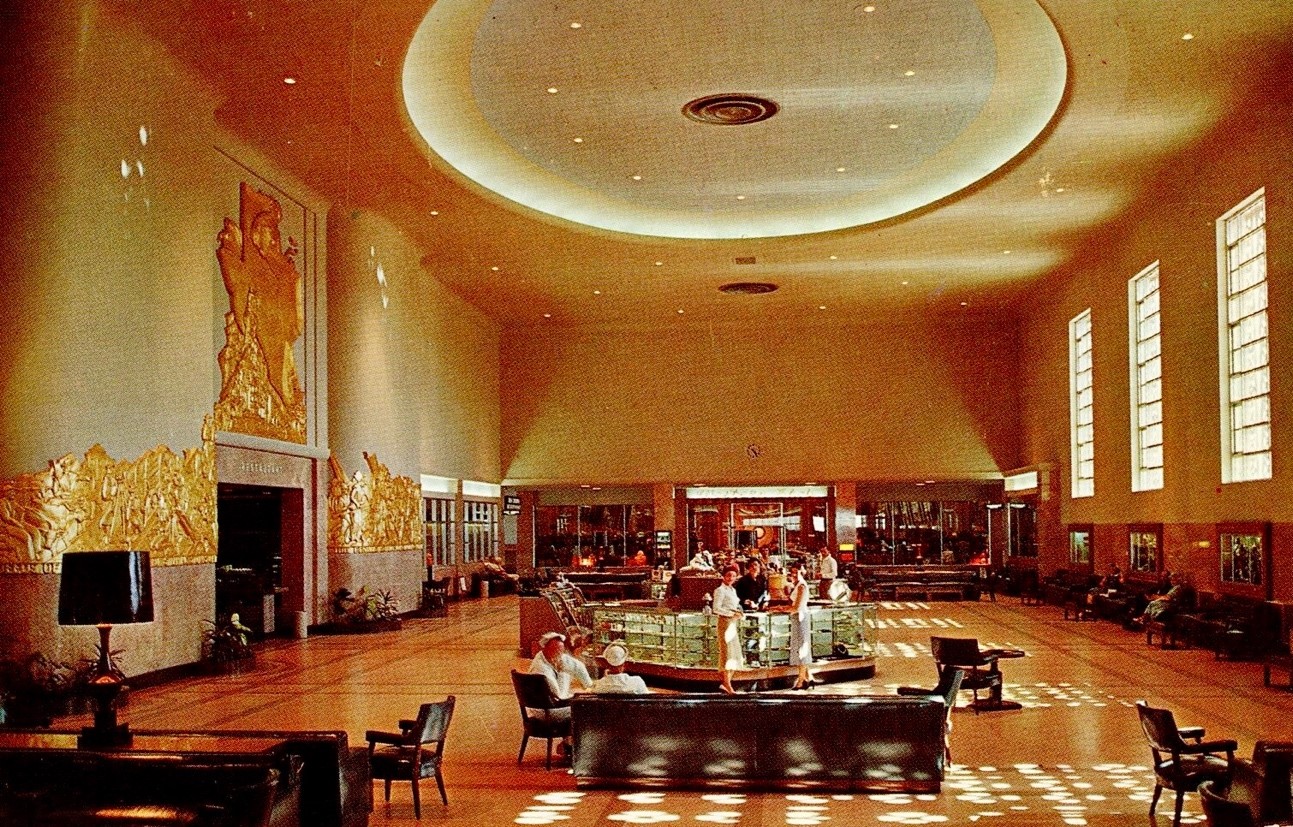
Main lobby of the terminal building at Greater Fort Worth International Airport at Amon Carter Field. It was furnished in “modern western style” and finished in fine marble from Portugal. The bas-relief murals on the left wall depicted early Texas history and were covered with 18-karat gold leaf. Photographed and published by John A. Stryker, Fort Worth; printer Colourpicture, Boston, no. P5928. Postcard image from the internet.
Braniff International Airways Convair 340, N3423 (in service with Braniff during 1953-1967), and American Airlines Convair, at Greater Fort Worth International Airport, Amon Carter Field. The reverse side states: “Looking from the south passenger loading concourse, one sees the east side of the main Airport Building and the north loading concourse….The main dining room of the terminal building and observation deck are on the left side with the air traffic control tower.” Photographed and published by John A. Stryker, Fort Worth; printed by Colourpicture, Boston, no. P6166.
Greater Fort Worth International Airport, Amon Carter Field, with American Airlines Convair 240, N94211, in the foreground. I have seen one of these postcards postmarked January 1954. Photographed and published by John A. Stryker, Fort Worth; printed by Colourpicture, no. P6167.
Love Field Municipal Airport, Dallas, Texas
While scheduled airline service and facilities at Fort Worth’s Meacham and then Amon Carter Fields grew relatively slowly, its neighboring larger city, Dallas, developed Love Field which grew faster because more passengers preferred its proximity to downtown Dallas.
Love Field originated in 1917 as the site of an aviation training base established by the U.S. Army Air Service during World War I. It was named after Lieutenant Moses L. Love, an early Army pilot who was killed during flight training at another site. In 1927 the City of Dallas purchased Love Field from the military to serve as its site for commercial air service which developed during the 1930s. After the end of World War II in 1945, Love Field grew expansively, reflecting significant increases in passenger traffic. By 1965 Love Field featured new terminals and a second parallel runway, effectively doubling its capacity, and its passenger numbers that year were, astoundingly, nearly 50 times those of Fort Worth’s airport.
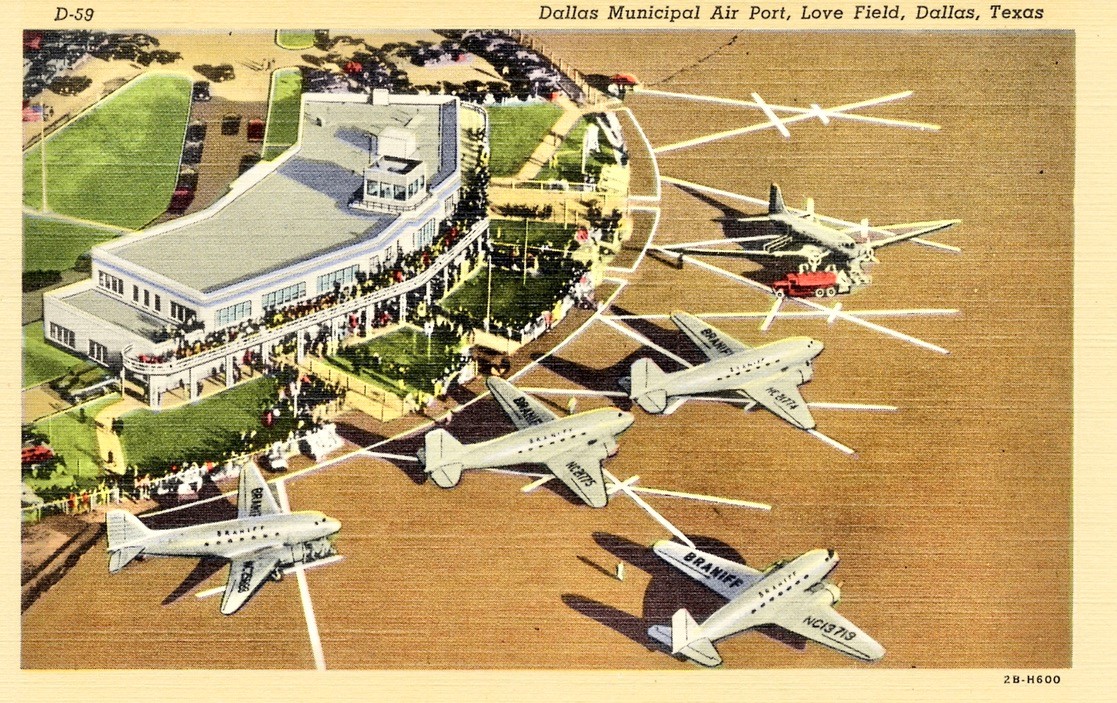
Here is a selection of postcards featuring Dallas Love Field.
Dedication of Love Field Lemmon Ave. Terminal, October 1940. Printer Curteich, Chicago.
Love Field Municipal Airport, Dallas, Texas, with a Trans-Texas Airways Douglas DC-3 at left and an American Airlines Douglas DC-6 aircraft at right, probably late 1940s. Pub’r Stellmacher & Son, Dallas, no. SC1900.
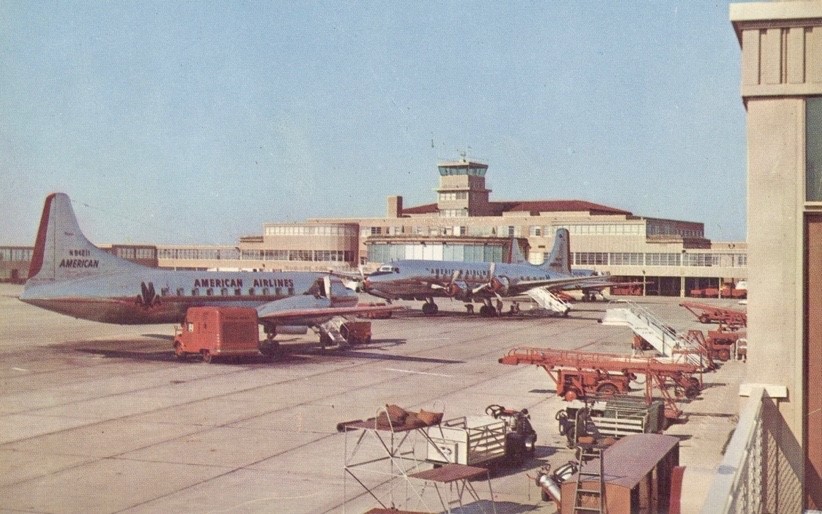
Love Field, Dallas, with American Airlines Douglas DC-7s. In the background is the newer terminal at Love Field which opened for airline service on January 20, 1958. The terminal had three one-story concourses, 26 ramp-level gates, and the world’s first airport moving walkways. Airlines serving Love Field at that time included American, Braniff, Central, Continental, Delta, and Trans-Texas. Airline and airport postcard collector Al Canales remarked in the Spring 2016 40th anniversary issue of the Captain’s Log, “[This is my] favorite postcard [of about 11,000 cards in my collection]. [It’s] not a rare one but one that brings back many happy memories of hours spent on that observation deck visible under the wing of the DC-7 doing what I truly enjoyed”. Pub’r H.S. Crocker Co., Los Angeles, no, TPC-166; distributor Texas Post Card Co., Dallas.
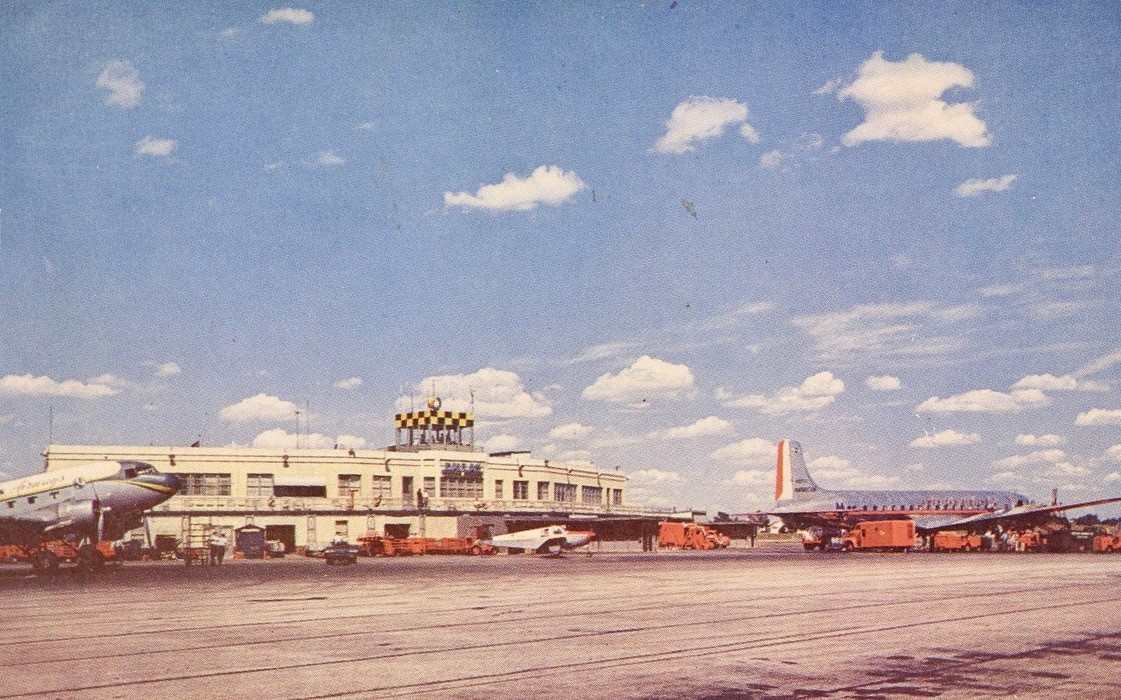
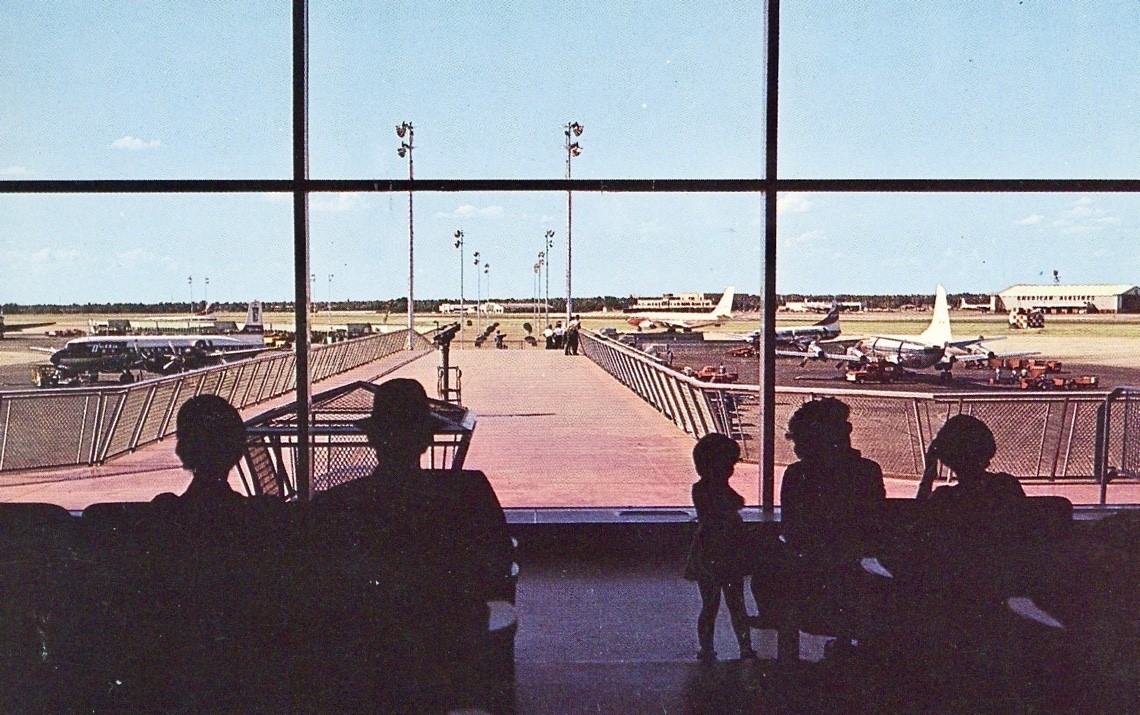
View towards observation balcony of Love Field, Dallas, probably about 1960. Ex-Allan Van Wickler collection. Pub’r All-Tom Corp., Dallas-Ft. Worth; printer Colourpicture no. P44211.
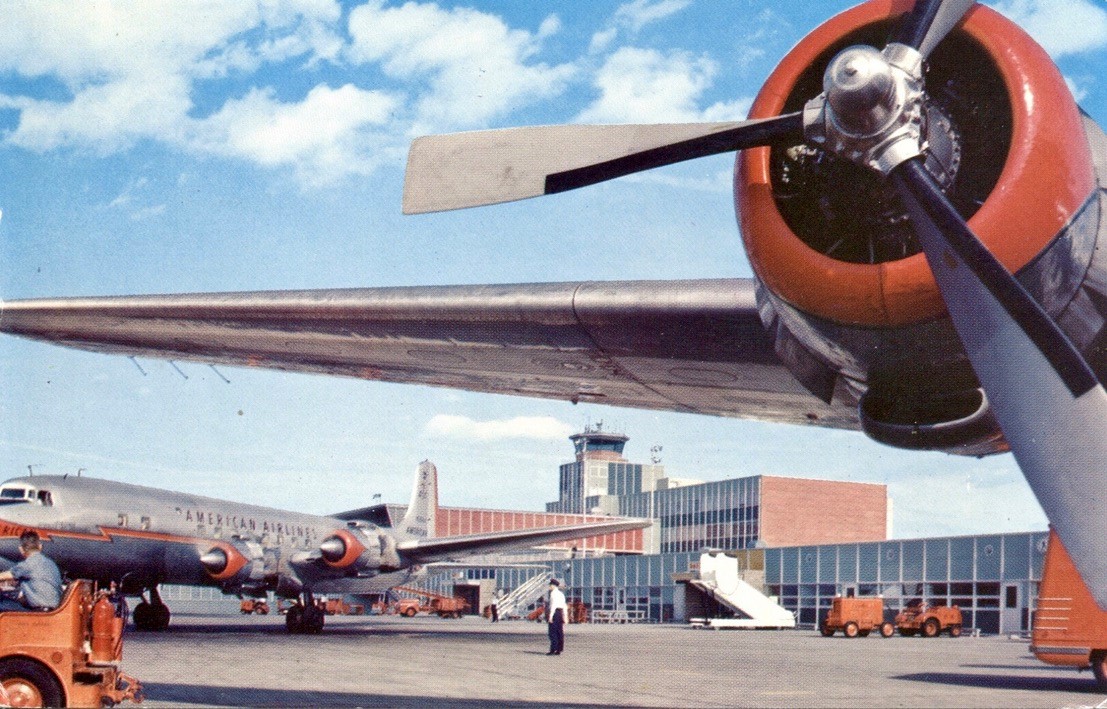
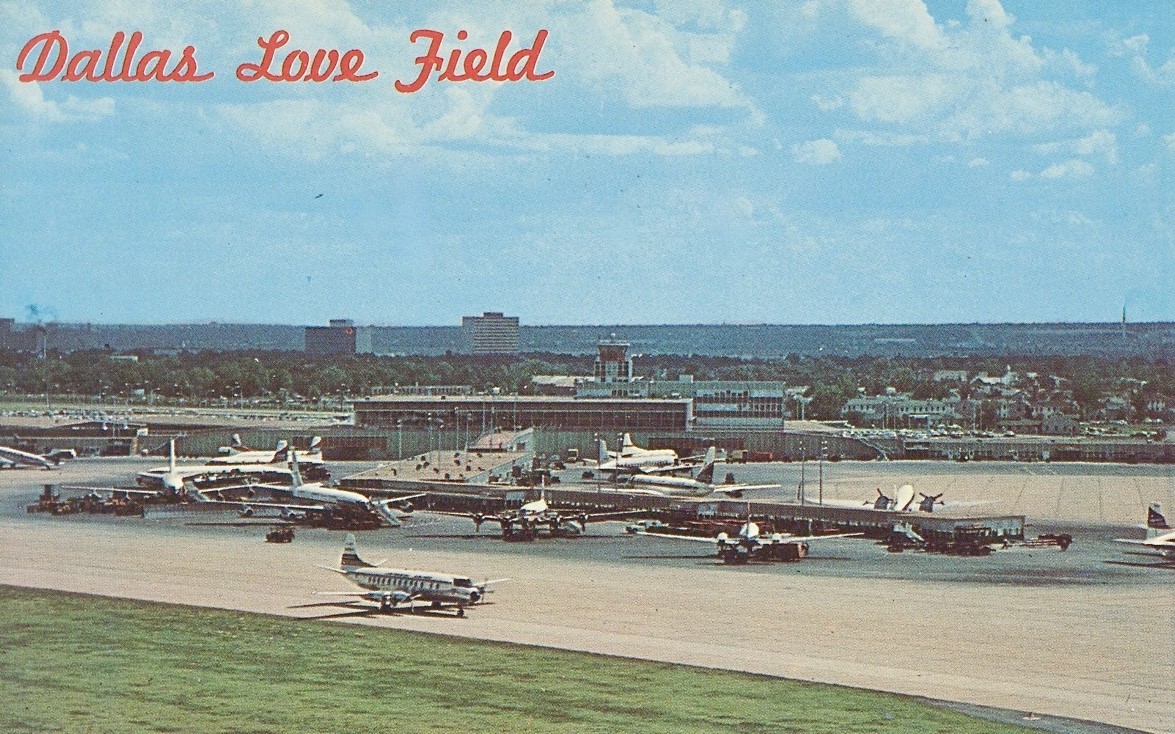
View of the ramp and a taxiway at Dallas Love Field, probably in 1961. Note the mix of propeller and jet aircraft types, and a Continental Airlines Viscount turboprop on the taxiway. Pub’r Texas Post Card & Novelty Co., Dallas; printed by Dexter Press, West Nyack NY, in 1961, as no. 43446-B.
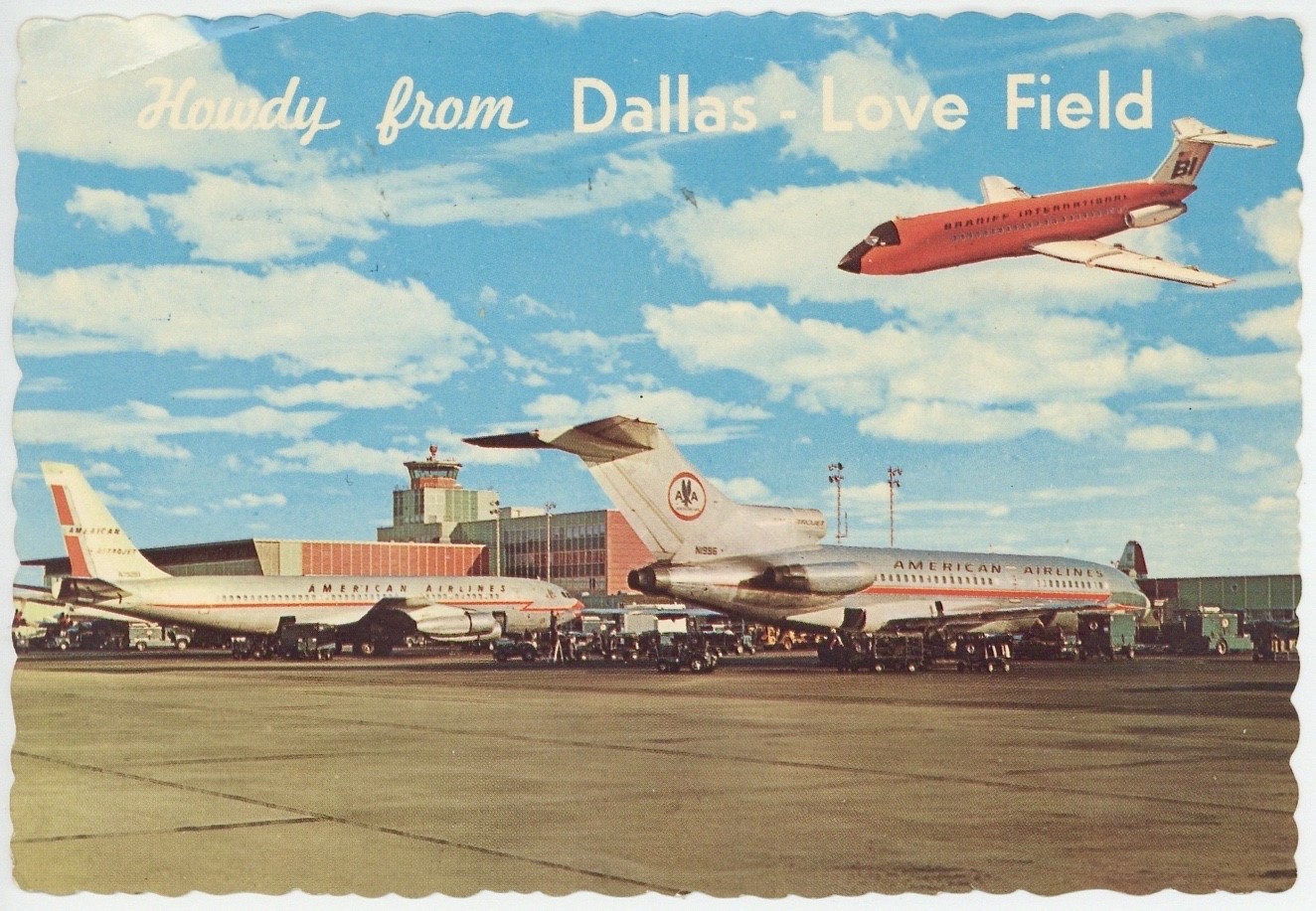
American Airlines 707 and 727 at Dallas Love Field. That Braniff BAC 1-11 in the upper right looks headed for a nosedive – an example of how some publishers add some pizzazz to their postcards. Pub’r All-Tom Corporation, Arlington, Texas; printed by Dexter Press in 1967, no. D-21998-C.
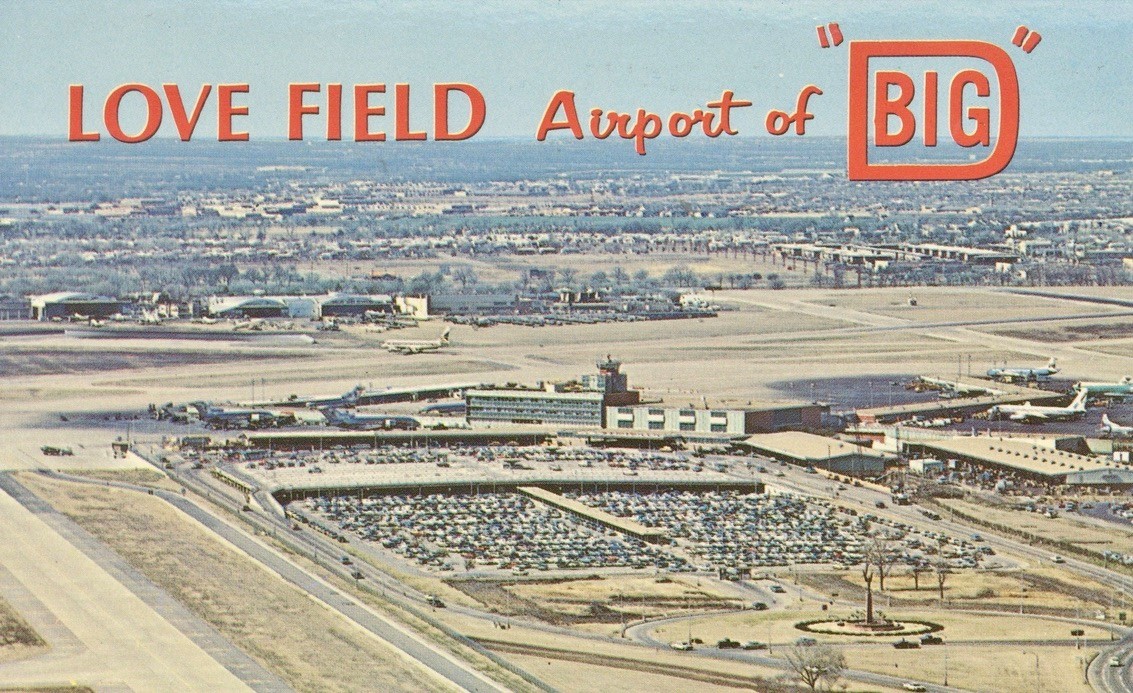
Love Field Airport of “BIG D” refers to Dallas, probably in late 1960s. The back of this postcard states: “A spectacular view of one of the nation’s ten busiest airports and one of the world’s most modern airport facilities.” Pub’r Mission Card Co., Dallas; printer Colourpicture, Boston, no. P74205.
Southwest Airlines started flying from Love Field in 1971, eventually becoming the dominant airline there. The aircraft image on this postcard is Southwest’s 737-300, N352SW, which entered its fleet in late 1990 and was painted in the “Lone Star One” livery, Southwest’s homage to its home state of Texas. Photo by Sackett and Associates; pub’r A-W, Dallas, no. D-132; printer John Hinde Curteich.
Transition to Dallas/Fort Worth International Airport (DFW)
By 1965 Fort Worth’s Greater Southwest Airport at Amon Carter Field (GSW) was severely underutilized, while passengers and airline scheduled service flocked to Dallas Love Field which was bursting at the seams with air traffic and had insufficient room for expansion. The U.S. Federal Aviation Administration (FAA) decided it would no longer assist in funding improvements at two separate airports so close together. At the insistence of the FAA and the Civil Aeronautics Board, the two cities agreed to set aside their rivalry and jointly develop and operate a single larger and more modern airport equidistant between them. The agreement also provided that all airlines would have to move from GSW and Love Field to the new airport. The site chosen was a huge swath of undeveloped land just north of the Greater Southwest Airport. This is the site that became Dallas/Fort Worth International Airport – DFW. Ground was broken for the construction of DFW airport in 1968, and scheduled flights at DFW commenced on January 13, 1974.
Meanwhile, passenger traffic continued to sharply decline at GSW, and by 1969 all scheduled flights there had ceased. GSW continued in use for general aviation, some charter flights, commuter and air taxi traffic, and crew training, while also serving as a diversionary airport for Love Field. However, upon the opening of DFW in January 1974, GSW was closed. In 1979 GSW was sold for redevelopment as an industrial and office park, and its airport facilities were soon demolished. Today the headquarters of American Airlines’ parent company, AMR Corporation, is located where GSW’s terminal once stood, and American Airlines’ C. R. Smith Museum is opposite the GSW site.
Love Field continued its prominence while DFW was under construction. However, when DFW opened in 1974, all airlines – with one notable exception – moved their operations to DFW. The exception was Southwest Airlines which refused to move and prevailed on that issue in a lawsuit brought by the cities of Dallas and Fort Worth and the DFW Airport Board. Subsequently, Southwest fought several legal battles to lift restrictions imposed by the “Wright Amendment” on its ability to fly to destinations outside Texas. Full success was achieved in 2006 by a federal law that served to repeal the Wright restrictions. Since then, Southwest has financed several expansions of its facilities at Love Field, and it remains the dominant airline by far at Love Field. Other airlines currently operating scheduled flights there include Alaska Airlines and Delta Air Lines.
Dallas/Fort Worth International Airport – DFW
As mentioned above, DFW Airport opened to scheduled airline service on January 13, 1974, and all airlines except Southwest moved there from Love Field. With 27 square miles of land, DFW is the second largest airport in the U.S. by area (next to Denver); and with 72 million passengers in 2022, it is the second busiest airport in the world by passenger numbers (behind Hartsfield-Jackson Atlanta International Airport – ATL). Presently, 28 airlines serve a total of about 260 destinations from DFW.
Commensurate with its growth in passenger numbers, DFW airport is continuously expanding its facilities. Most recently, DFW approved in 2021 a $2 billion project, to be completed by 2026, including the renovation and expansion of Terminal C serving American Airlines and the addition of gates at other terminals.
Here is a sampling of postcards showing DFW.
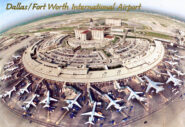
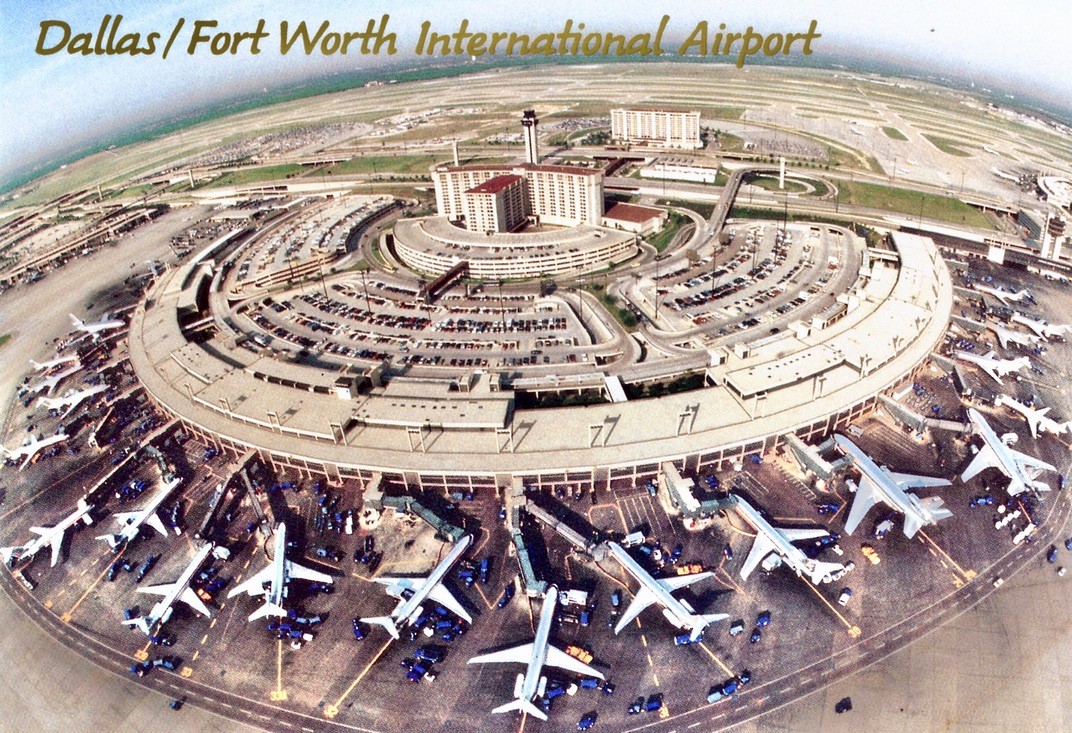
Aerial view of Terminal C at DFW with its many gates filled by American Airlines aircraft. Pub’r The Texas Postcard Co., Plano, Texas, no. D-150, 711; photo by Raff Frano.
American Airlines utilizes DFW as its primary hub and its corporate headquarters and aviation museum are nearby. In the upper center of this postcard, close to the control tower, is the Hyatt Regency Hotel, site of the Airliners InternationalTM airline history convention and airline collectibles show, June 21-24, 2023.
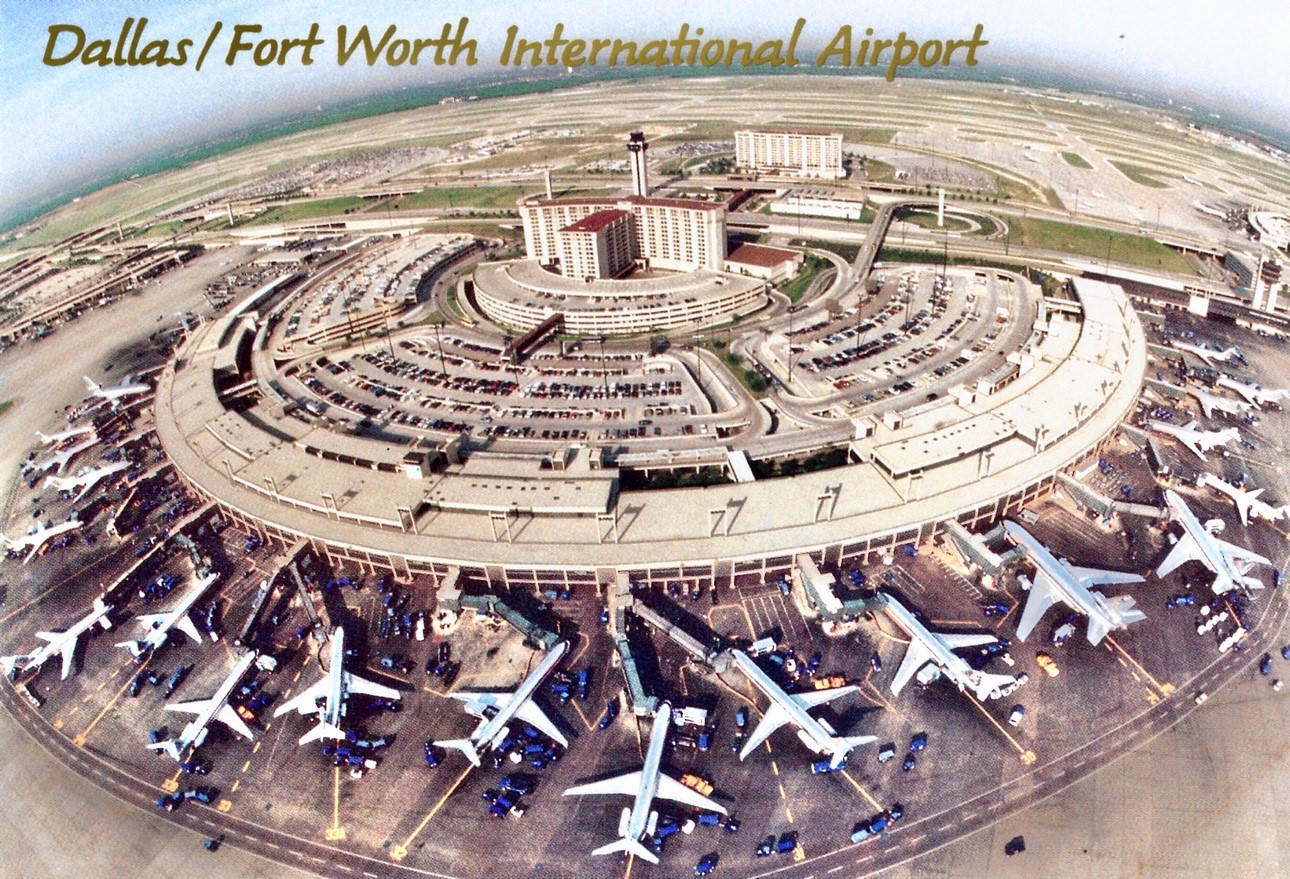
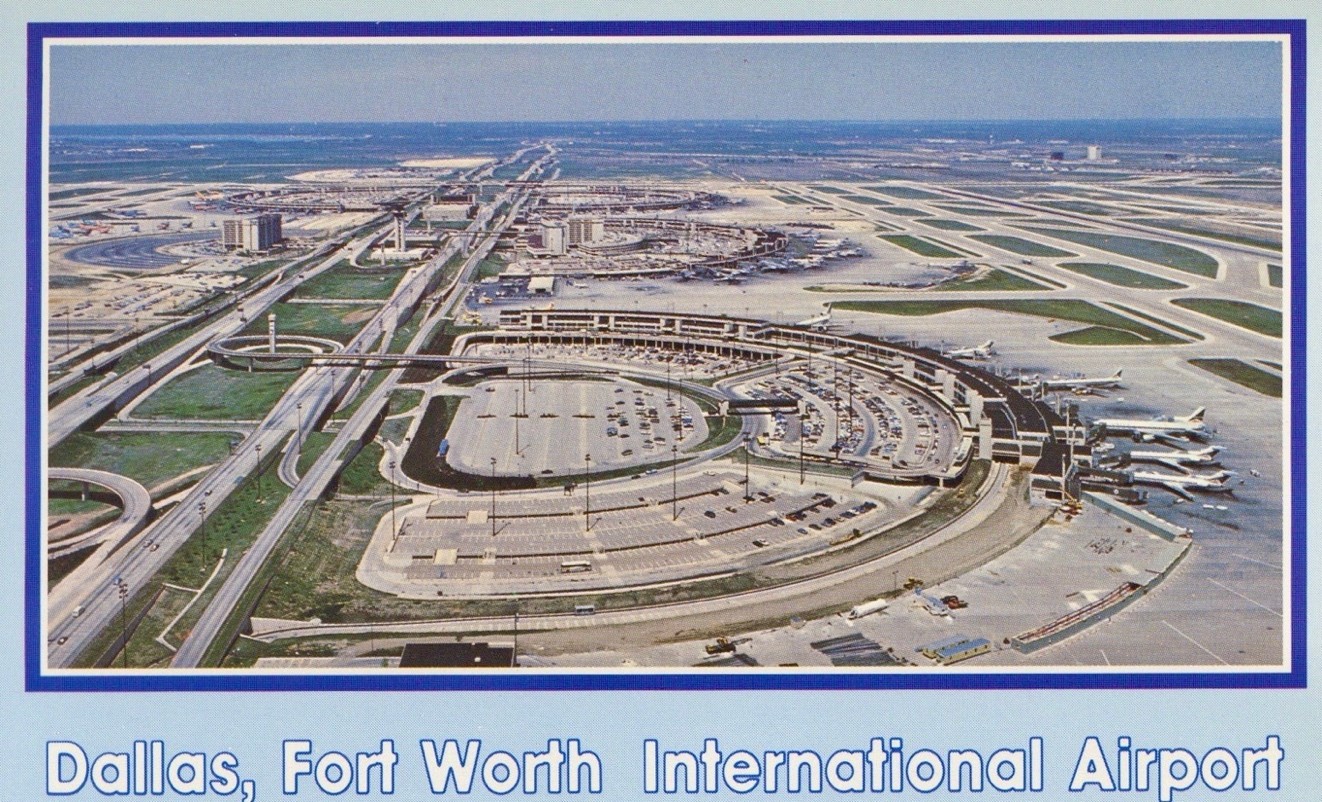
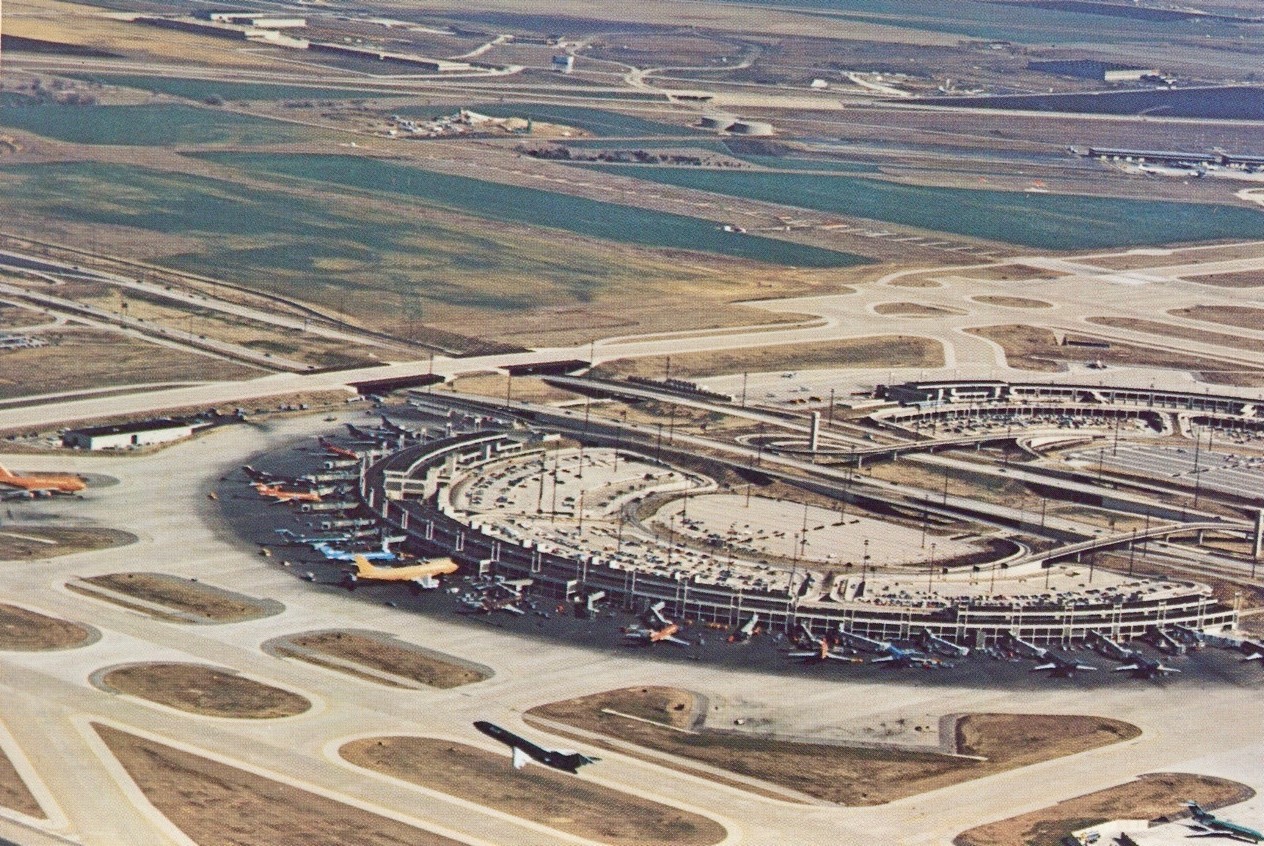
Aerial view of the vast expanse, half-moon terminals, and runways at DFW, with the Delta Air Lines’ gates in the foreground. Published in 1981. Pub’r A.W. Distributors, Irving, Texas.
Braniff International Airways terminal at DFW, probably in the late 1970s. Note the standout orange Boeing 747 of Braniff, nicknamed the “Great Pumpkin” or “Fat Albert.” DFW was Braniff’s main hub until the demise of the airline in May 1982. Pub’r Texas Postcard Co., Plano, Texas, no. /d-111; printer MCG, Kansas City, Missouri; photo by Gordon Smith.
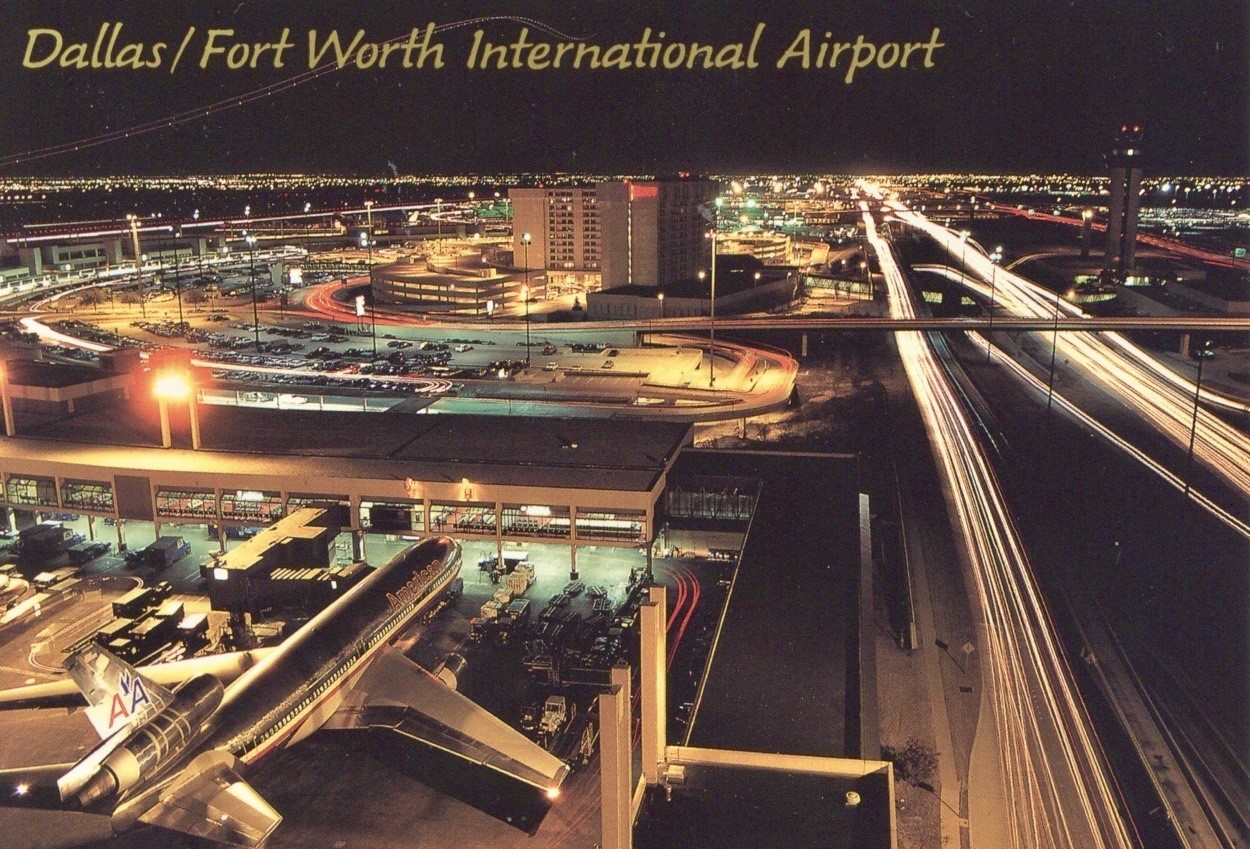
DFW at night, with an American Airlines Douglas DC-10 at Terminal C, probably in the 1980s. Pub’r Texas Postcard Co., Plano, Texas, no. D-102; Joe Towers photo.
Notes
All the postcards shown in this article are from the author’s collection unless otherwise noted. My estimate of rarity: Rare: the two aerial views of Meacham Field; Uncommon; American Airlines at Meacham Field; Love Field with Trans-Texas and American aircraft; Love Field with Continental Viscount; and DFW Braniff terminal. The rest are fairly common.
References
Cearley, Jr., George W. A Pictorial History of Airline Service at Dallas Love Field, 200 pp. (1989).
Friedenzohn, Daniel. “DFW: The Texas-Size Airport,” Airways (Oct. 2003, pp. 32-37).
http://www.airfields-freeman.com/tx/airfields_tx_ftworth_ne.htm (on Greater Fort Worth Airport).
Texas State Historical Association websites: tshaonline.org/handbook/entries/love field and tshaonline.org/handbook/entries/dallas-fort-worth-international airport.
Wikipedia articles on “Fort Worth Meacham International Airport,” “Greater Southwest International Airport,” “Dallas Love Field,” and “Dallas Fort Worth International Airport.”
Airliners International 2023 DFW
I hope to see you at Airliners International™ 2023 DFW, June 21-24, 2023, at the Hyatt Regency Hotel, next to Terminal C at Dallas/Fort Worth International Airport. This is the world’s largest airline history and airline collectibles show and convention, with more than 200 vendor tables for buying, selling, and swapping airline memorabilia (including, of course, airline and airport postcards), seminars, the annual meeting of the World Airline Historical Society, annual banquet, tours and more. I hope you’ll consider entering the Postcard Contest at the AI 2023 show. More information and contest rules are available by clicking this link: airlinersinternational.org.
Until then, Happy collecting. Marvin
American Airlines poster, artist Joseph Charles Parker, 5 x 7 in (12.7 x 17.8 cm). Part of a set of historic posters in postcard form believed to have been issued several years ago by American Airlines’ C. R. Smith Museum, Dallas.
Chicago’s Midway Airport, originally named “Chicago Municipal Airport,” opened in 1927 at Cicero Avenue between 55th and 63rd Streets, about nine miles from the center of downtown Chicago. The site was owned by the Chicago Board of Education through a 19th-century federal government land grant that allocated one square mile of every 365 for a school. So, at the time the City of Chicago acquired use of the site in 1926, it was one square mile in size, with only a small grammar school in one corner, and the rest was devoted to growing onions. Because of housing development outside the perimeter of the field, Midway Airport today remains on that same one square mile (plus only a small extension with a few structures).
By the end of 1927, six airlines operated from Chicago Municipal Airport, including predecessor airlines of Braniff, Chicago and Southern, Eastern, Northwest, TWA, and United, and in the mid-1930s American joined them. Amazingly, by 1932 Chicago Municipal claimed the title of “busiest airport in the world,” and it remained so until 1961 when airlines moved to the new suburban Chicago O’Hare Airport.
Postcards of Chicago Municipal Airport through the years
The 1930s
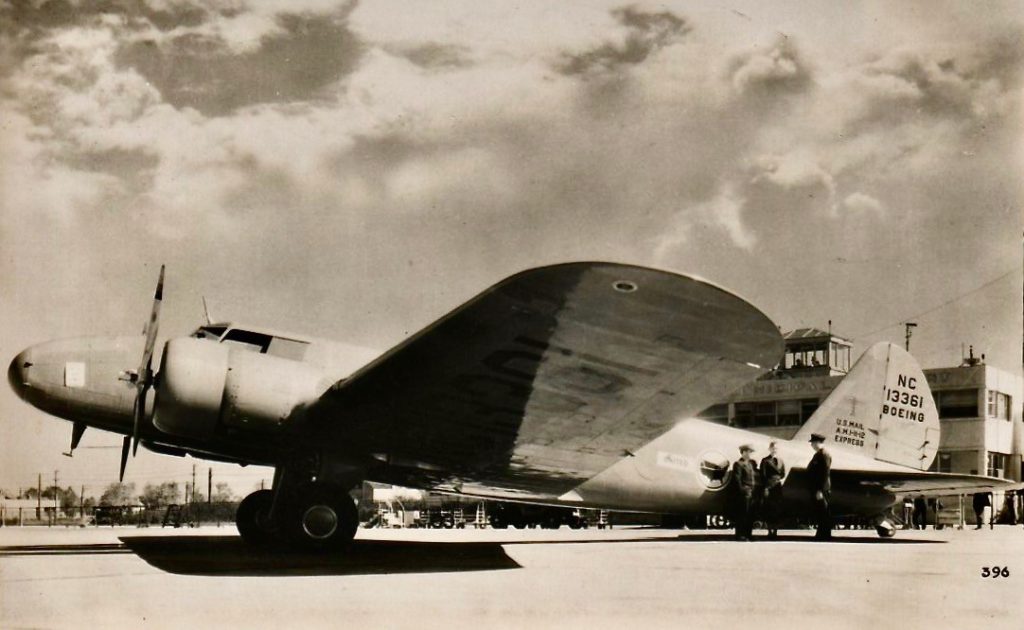
United Air Lines Boeing 247D, NC13361, at Chicago Municipal Airport, 1933. Publisher Real Photographs Co., Liverpool, England, no. 396. Chris Slimmer collection.
The Boeing 247 entered service in March 1933, immediately becoming the most modern aircraft at the time, with all-metal construction and much higher speed. United Air Lines received the first production models and placed 30 in service by June 1933. Chicago Municipal became a major hub in United’s coast-to-coast east-west service.
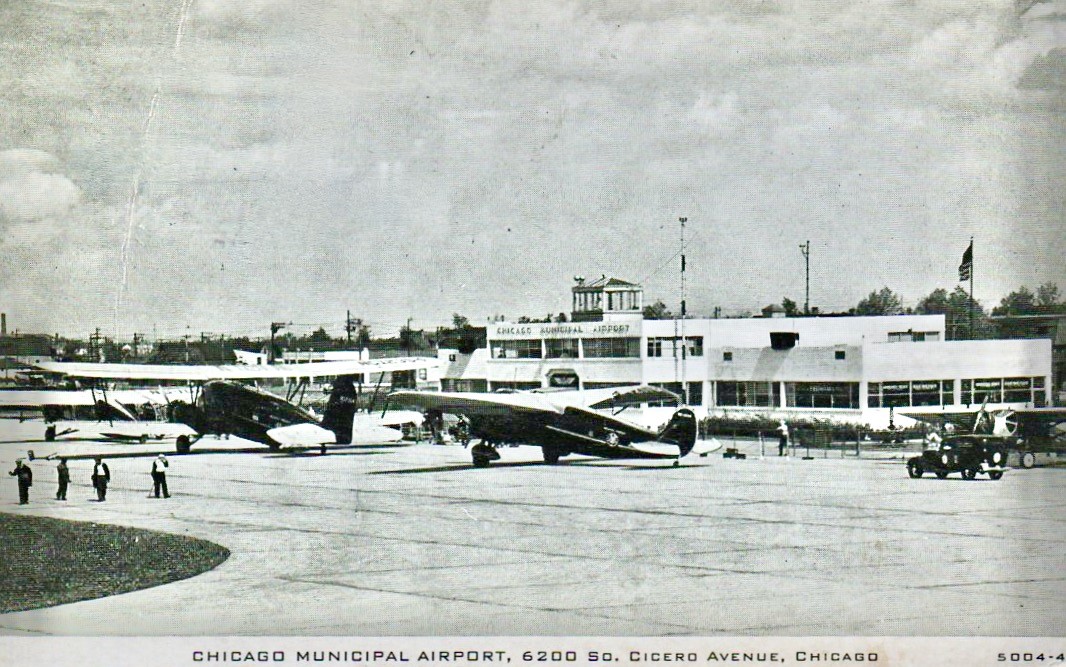
American Airlines Curtiss Condor and Stinson aircraft at Chicago Municipal Airport, about 1935. Part of a set of at least four different Chicago Municipal Airport postcards. Pub’r C. R. Childs Co., Chicago, no. 5004-4. Chris Slimmer collection.
Originally, United had a monopoly on the first Boeing 247s being produced, leaving other airlines, such as American, to rely on older types such as those shown.
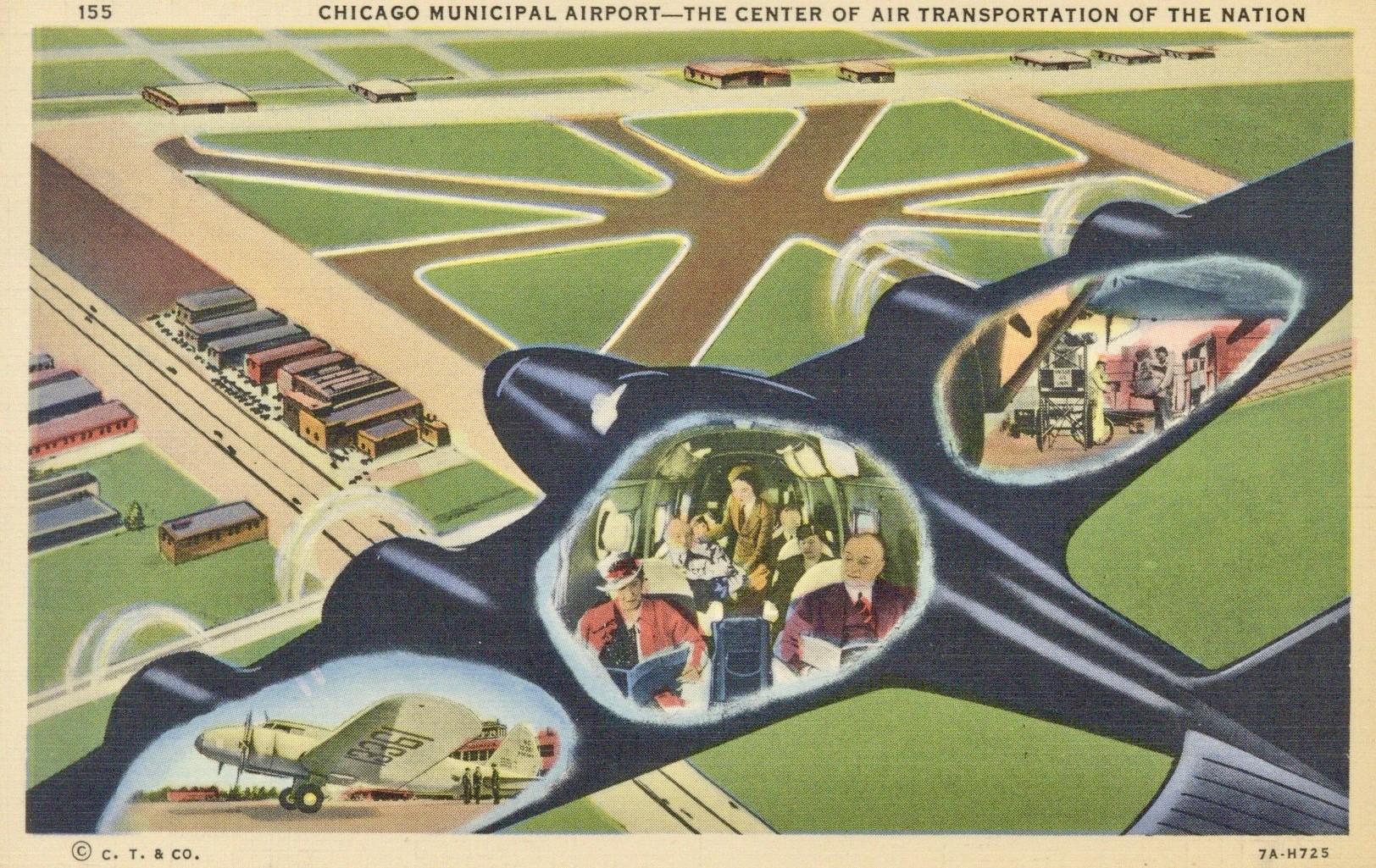
Chicago Municipal Airport postcard with inset drawings of a United Air Lines Boeing 247D, NC13661, its interior and baggage handling, and a drawing of the airport’s runways, 1937. Printed by Curteich, no. 7A-H725, and distributed by J.O. Stoll Co., no. 155, each of Chicago.
Amusingly, the dark larger stylized aircraft drawing on this card shows four engines, but the Boeing 247 only had two.
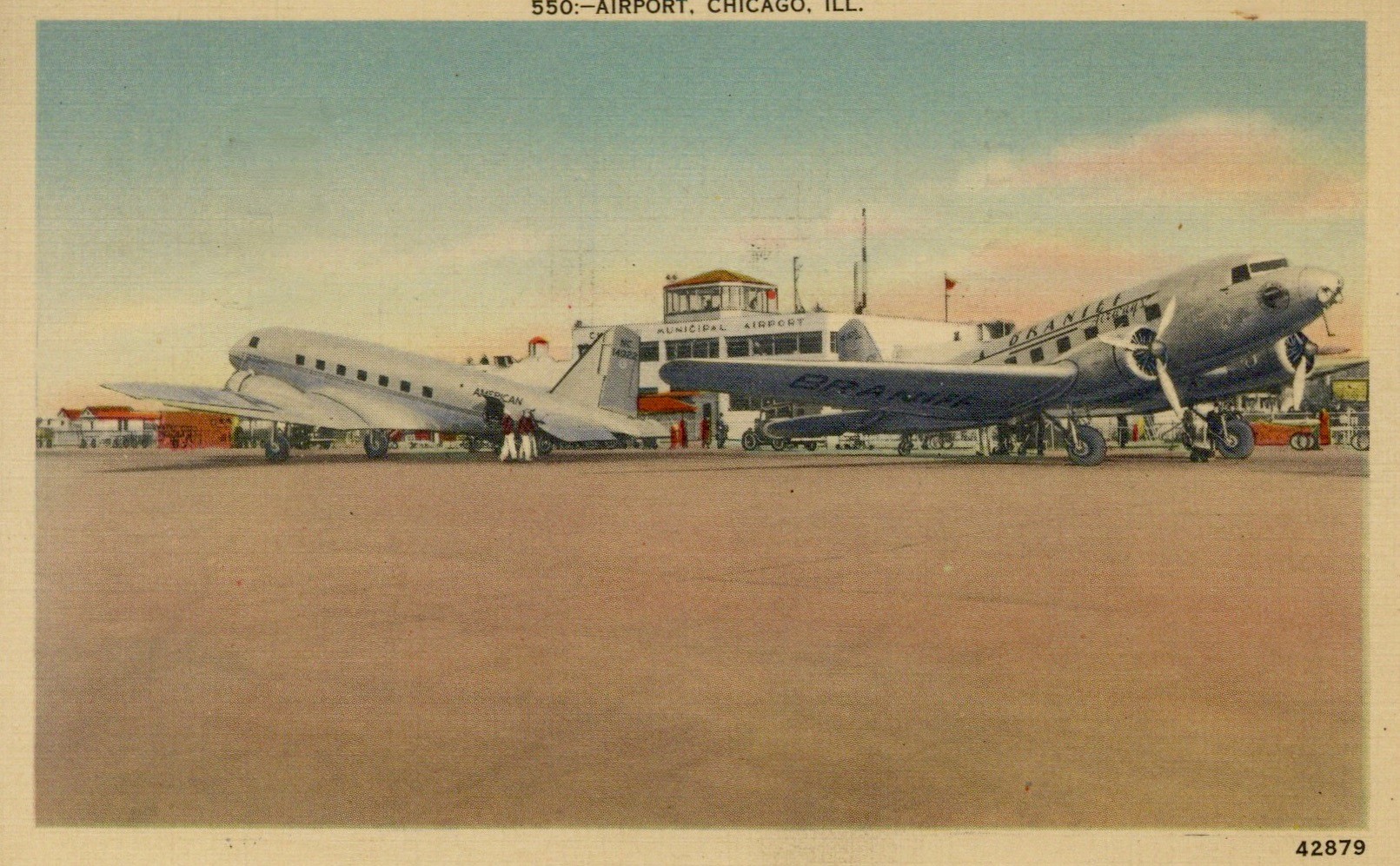
American Airlines Douglas DC-2, NC14922, and Braniff Airways DC-2 at Chicago Municipal Airport. Pub’r Gerson Bros., Chicago; Printed by Metrocraft, Everett, Massachusetts. Postmarked 27 September 1938.
The Boeing 247 remained the top airliner for only a very short time. By mid-1934 Douglas Aircraft introduced the DC-2 which was superior to the 247. TWA was the first to operate the DC-2, and other airlines serving Chicago soon followed.
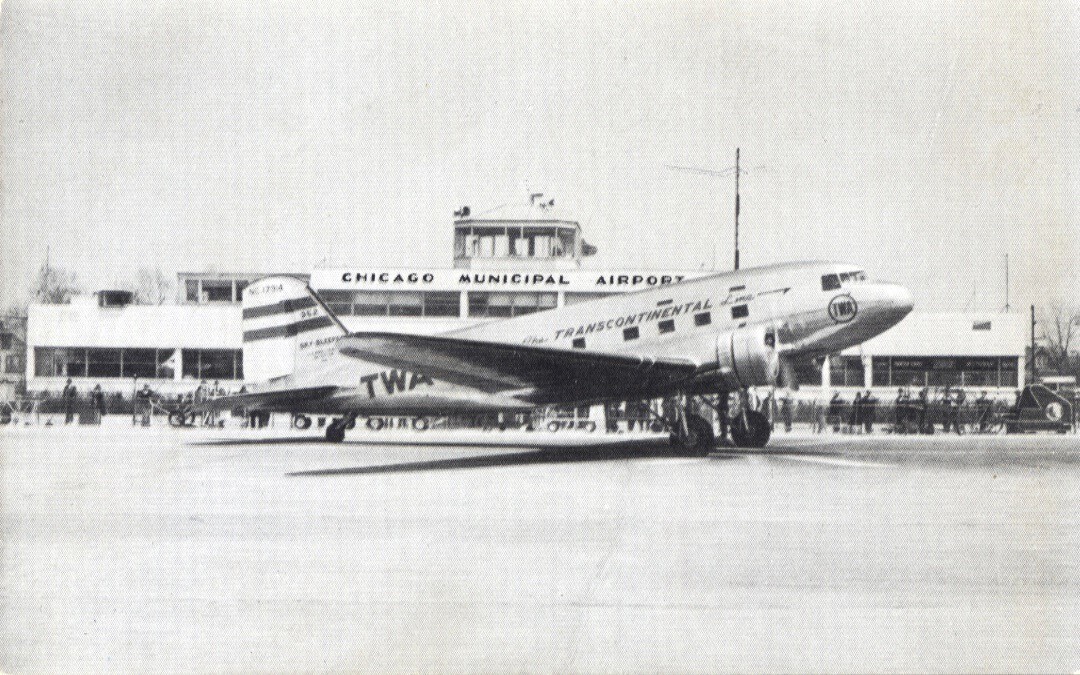
TWA Douglas DC-3 DST, NC17314, at Chicago Municipal Airport. Pub’r Ferris, no. 106-1. Ex-Deke Billings collection.
The DC-3, introduced in 1936, improved on the DC-2 and became a classic success. The DST version included sleeping berths. TWA acquired the pictured aircraft in January 1937.
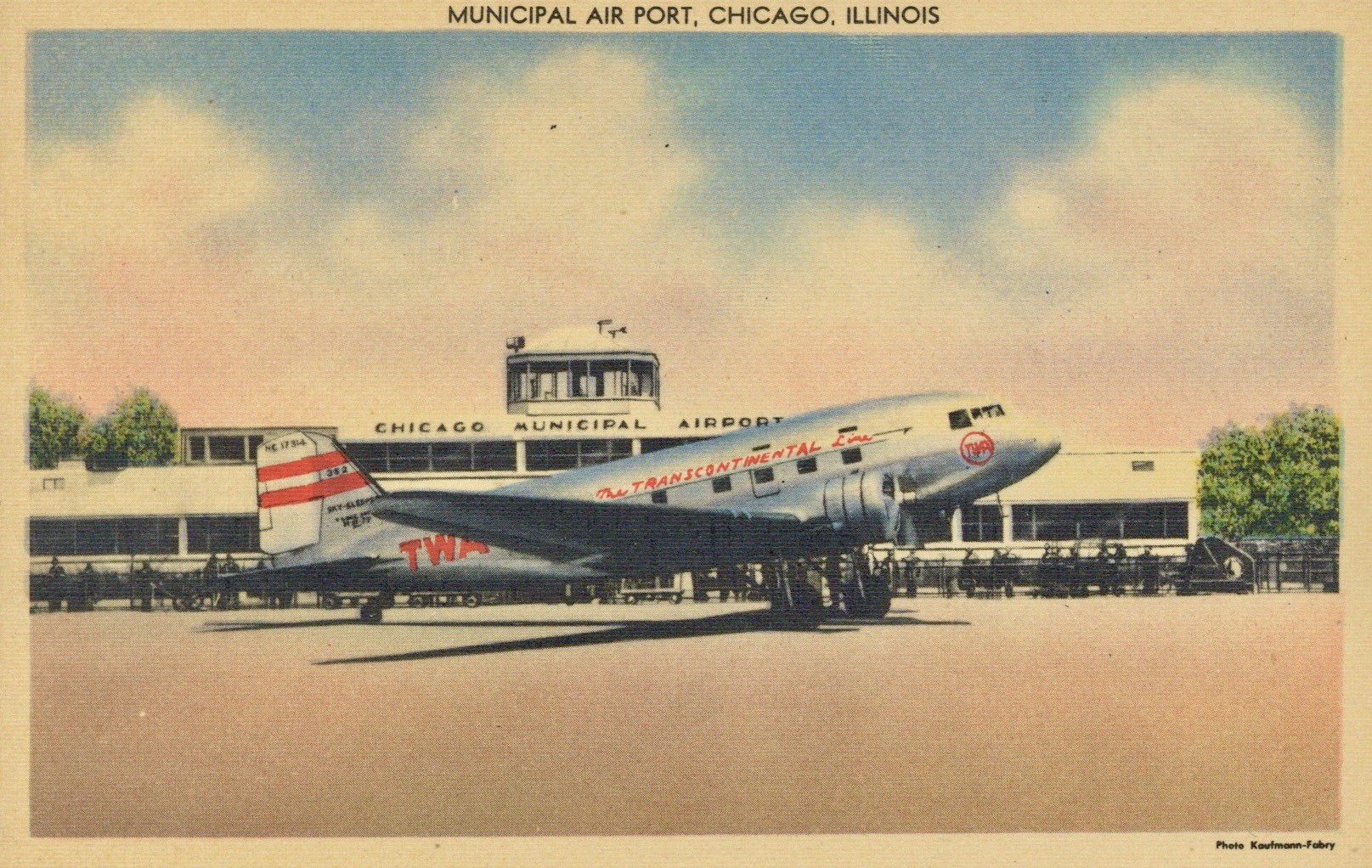
Some postcard publishers would take black and white photos and colorize them. Here is the same view as the preceding, but colorized and with added blue sky, puffy white clouds, and trees! Pub’r A. C. McClurg & Co., Chicago, no. 5467.
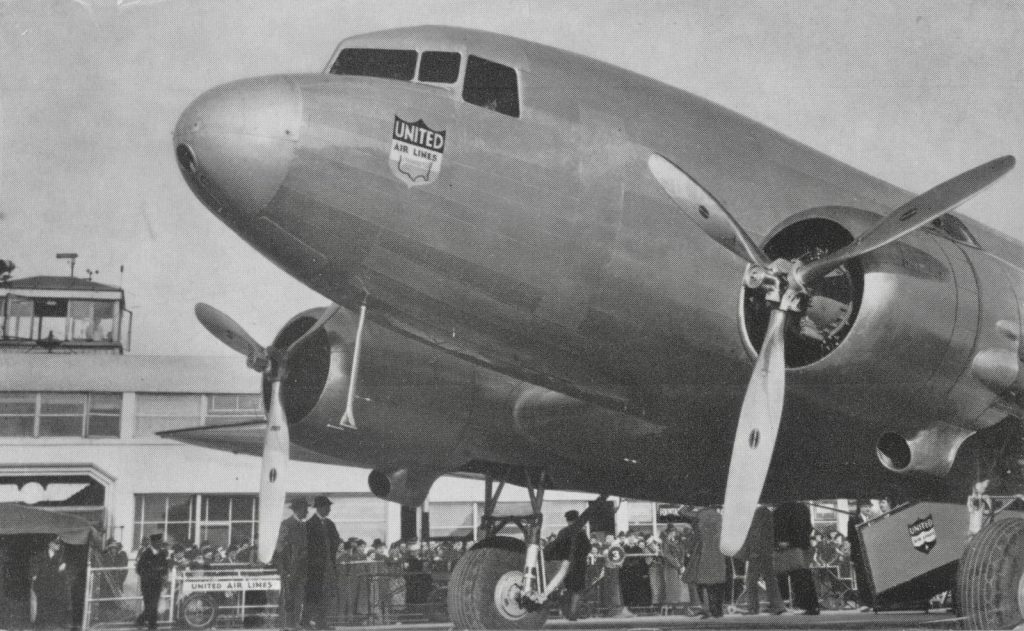
United Air Lines Douglas DC-3 at Chicago Municipal Airport. Airline issue, about 1937.
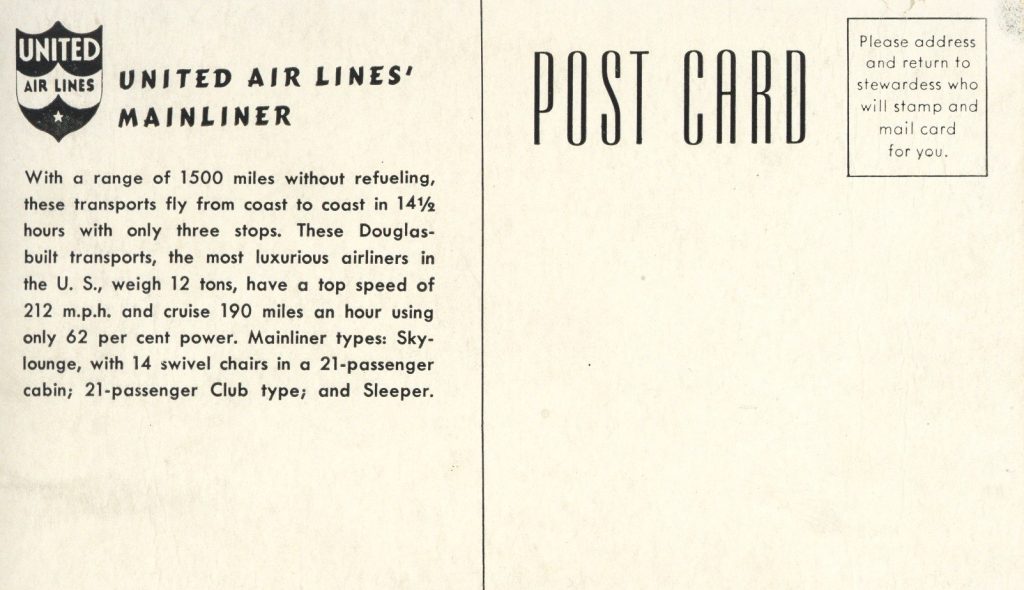
Back of the preceding card. The text shows how United embraced the DC-3 following the short reign of its Boeing 247s.
The 1940s
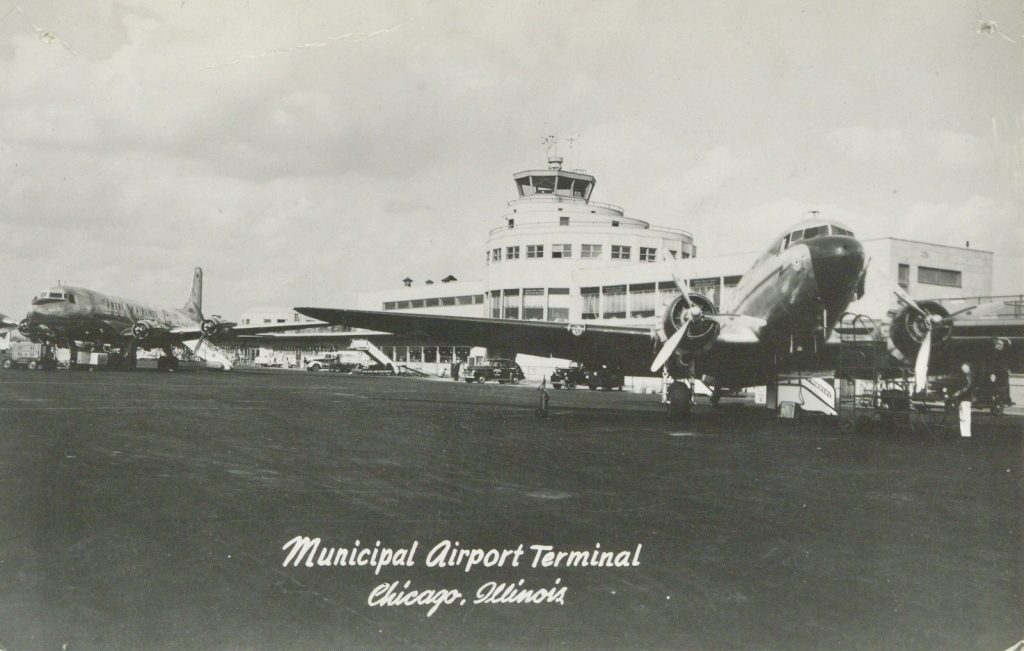
Following the end of World War II in 1945, Chicago Municipal Airport became busier than ever. To cope with the high volume of passengers, it opened a new larger terminal in 1947-1948, with distinctive rounded upper floors in the center, including the noted “Cloud Room” restaurant.
American Airlines Douglas DC-4 and DC-3 at Chicago Municipal Airport about 1948, with the newly built terminal in the background. Real Photo Postcard, Groganphoto, Danville IL.
In June 1949 the Chicago City Council changed the airport’s name to “Midway Airport” in honor of World War II’s Battle of Midway in the Pacific Ocean.
The 1950s-1960s
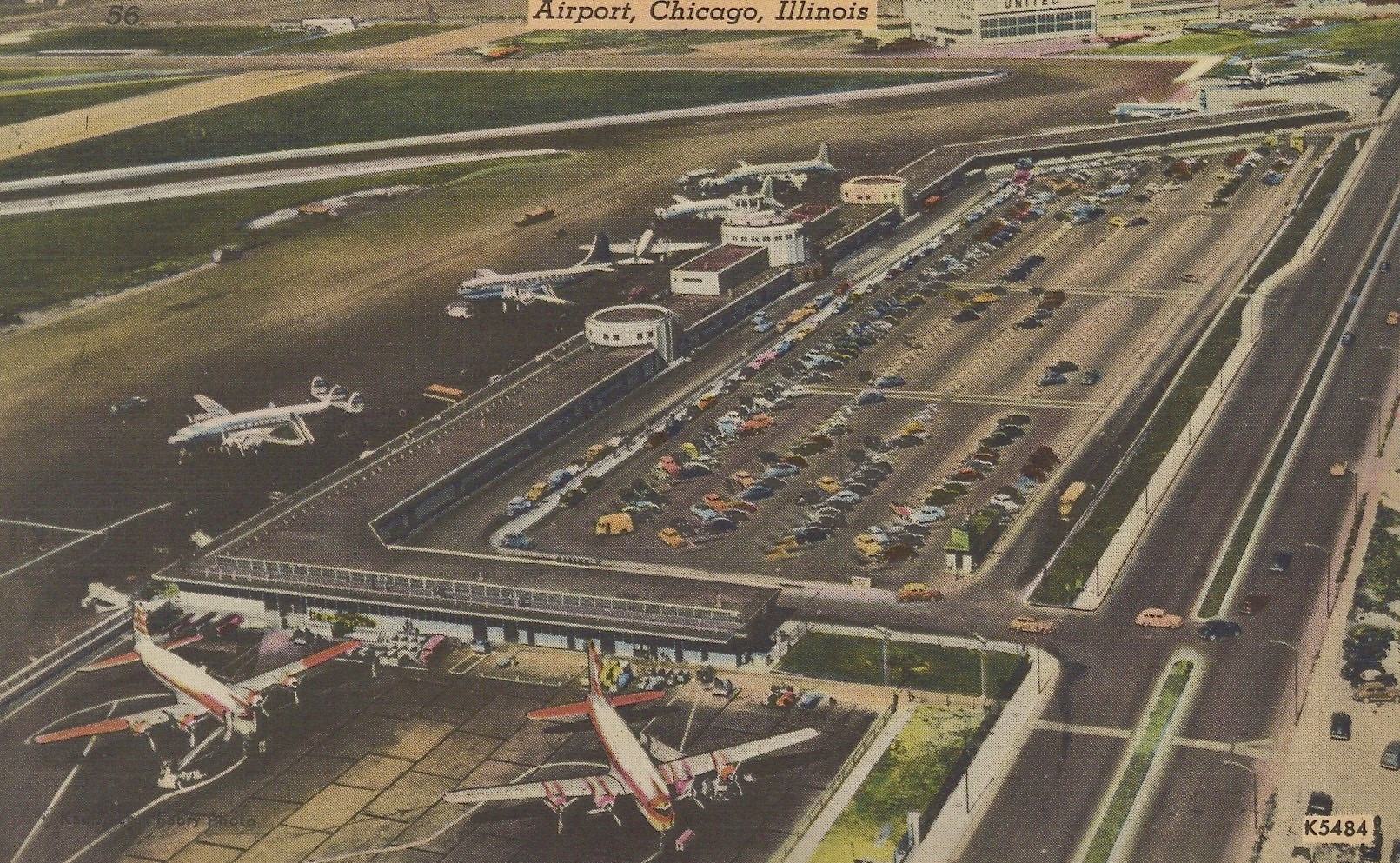
By 1950 fifteen scheduled airlines, as well as several nonscheduled ones, served Midway Airport. By 1952 passenger volume reached 5 milliion, and passenger numbers peaked at 10 million in 1959. Continuing throughout the 1950s and until 1961, Midway remained a beehive of activity on its one square mile – the busiest airport in the world.
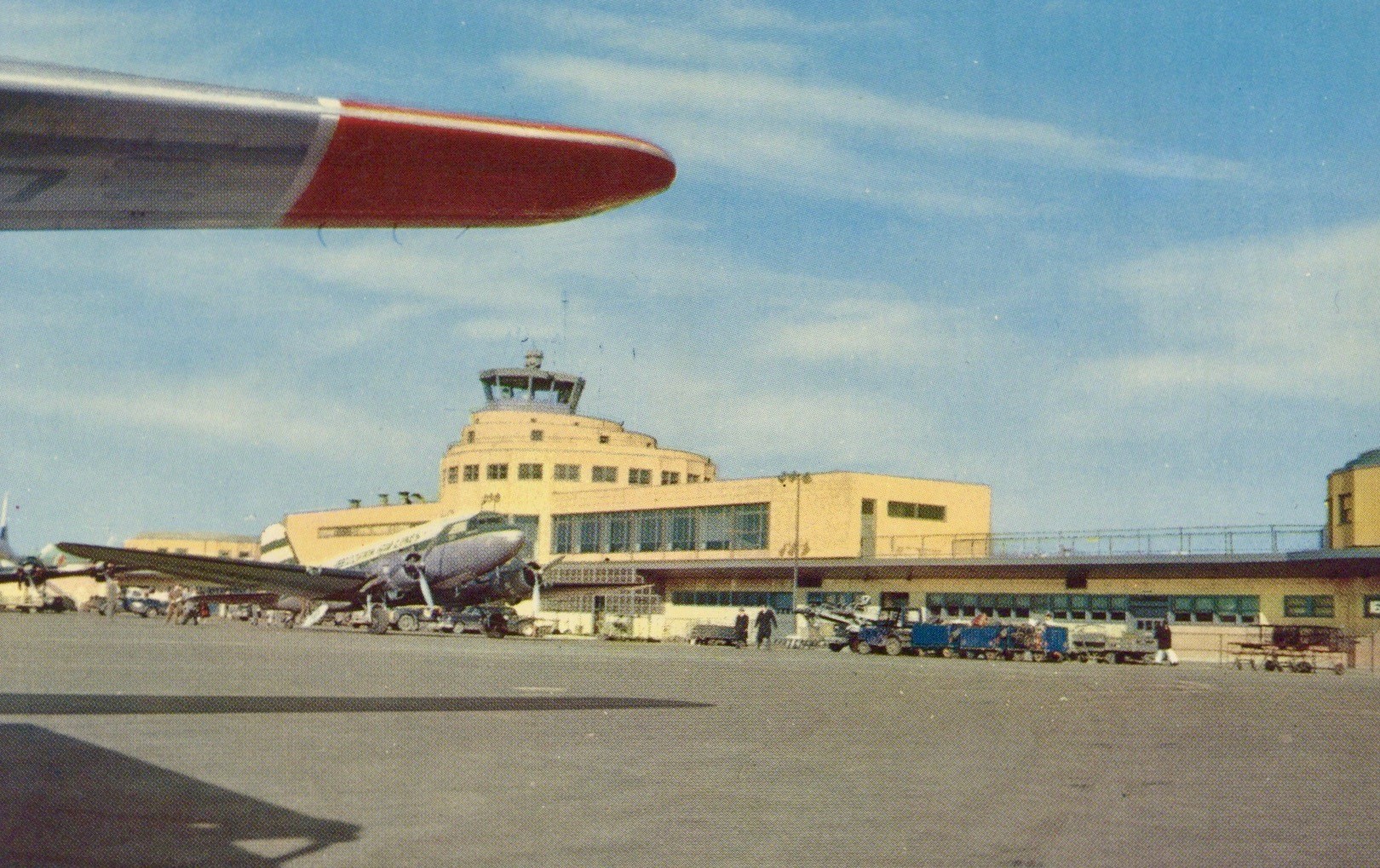
Ramp side of Midway’s new terminal building, with a Delta Air Lines Douglas DC-3. 1950s. Pub’r H. S. Crocker Co., Chicago, no. CGO39, William Nawodylo photo.
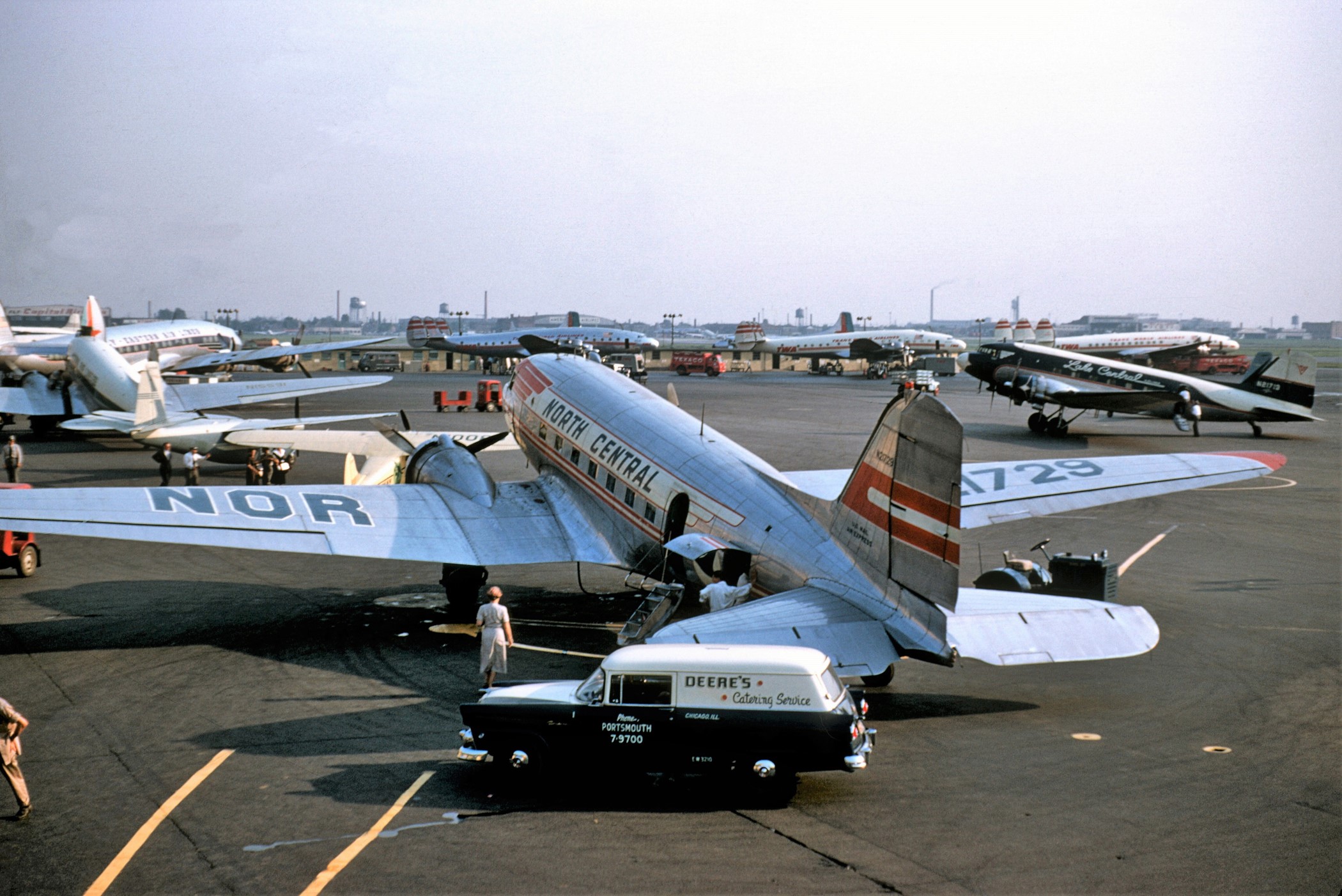
Midway Airport’s crowded ramp space in the 1950s, showing North Central DC-3, N21729; Lake Central DC-3, N21713; TWA and Eastern Constellations; and an Ozark DC-3. Published by jjpostcards.com, and issued by Airliners InternationalTM 2022 Chicago as postcard no. 1 of a 12 postcard set available at that show. Photo by Steve Pinnow.
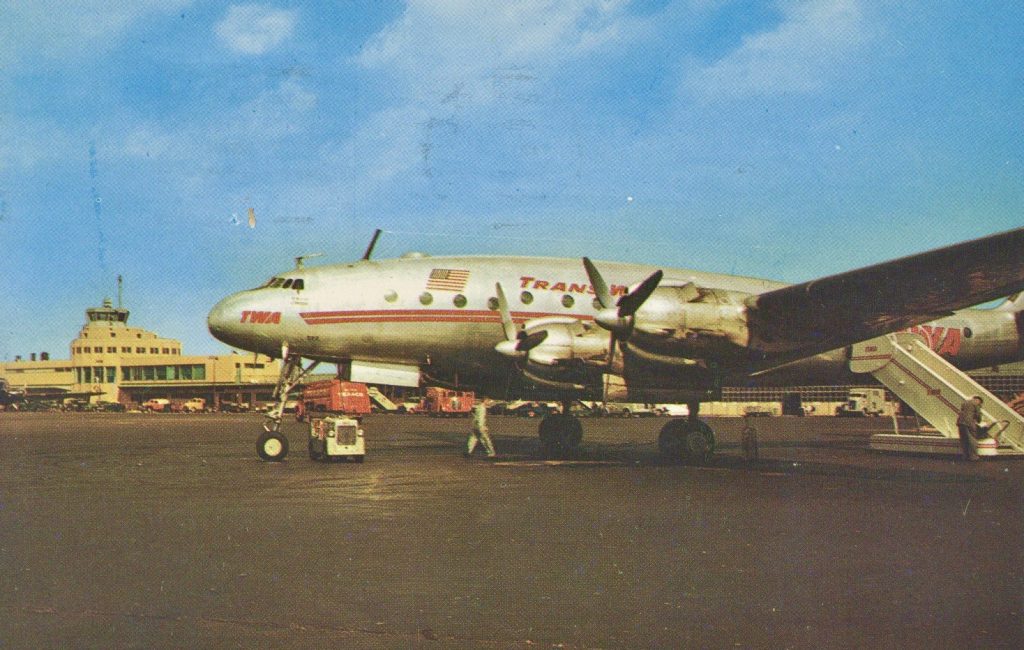
TWA Lockheed 049 Constellation at Chicago Midway, 1950s. Pub’r Buss Bros., Chicago, no. 71839, Jack Taylor photo, printer Dexter Press.
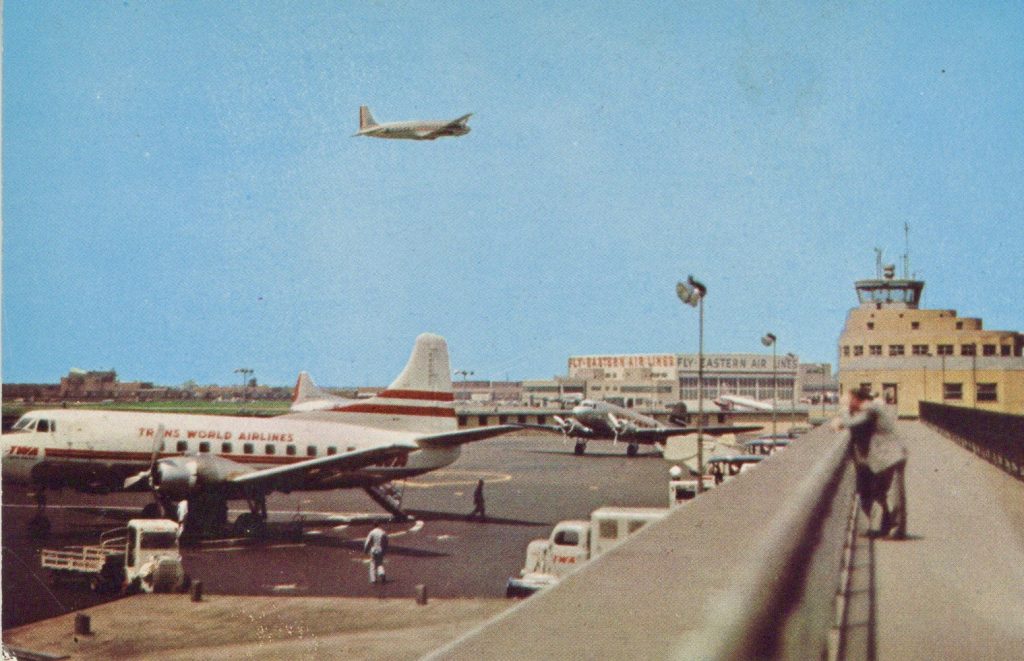
TWA Martin 4-0-4 and other propliners viewed from the observation deck, Chicago Midway. 1954. Pub’r Aero Dist’g CK-153, Curteichcolor 4C-K776.
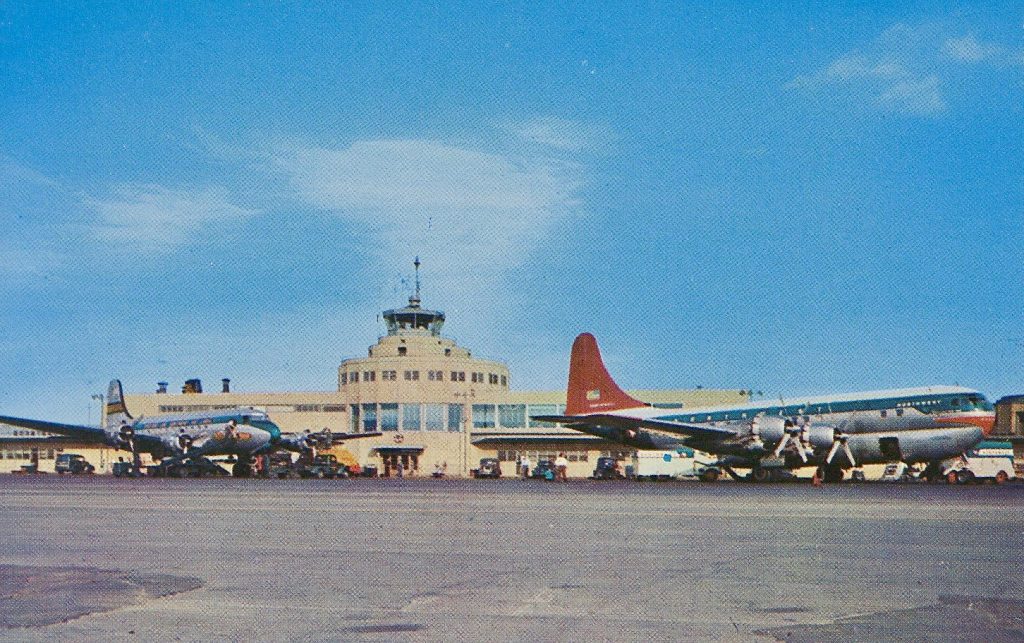
Chicago & Southern DC-4 and Northwest B377 Stratocruiser at Chicago Midway, 1950s. Pub’r Dexter Press no. 50098.
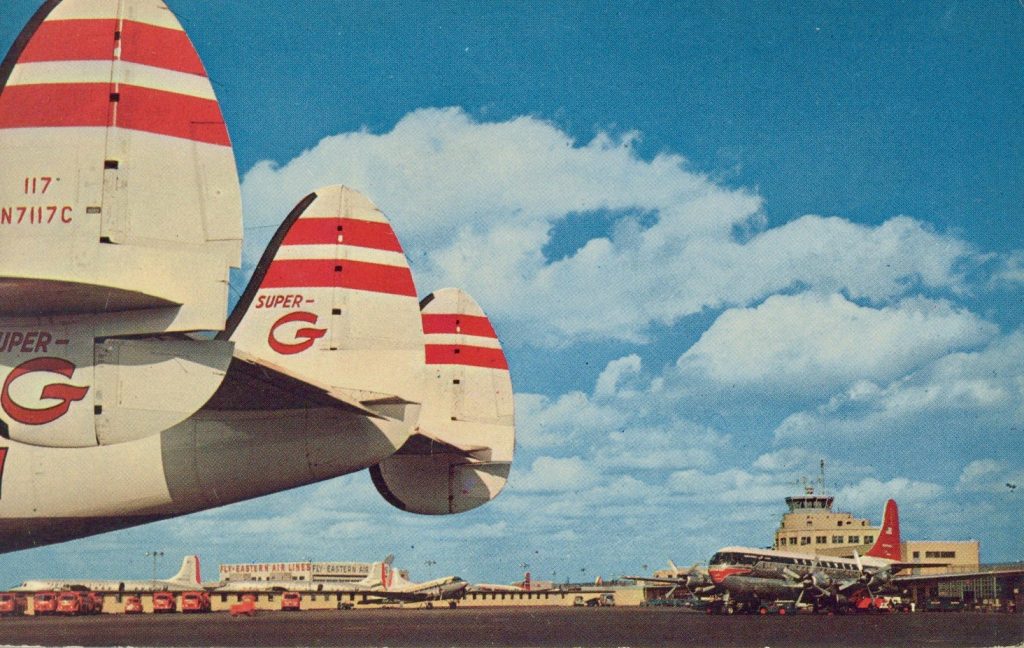
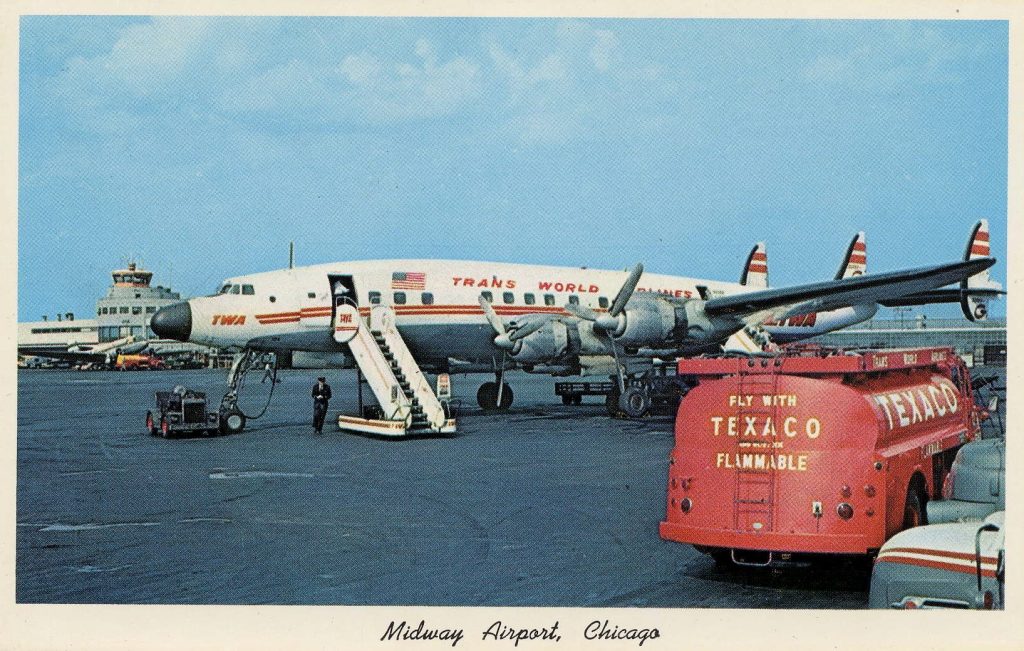
TWA Lockheed 1049G Super Constellation Tail, N7117C, Northwest B377 Stratocruiser and other propliners at Chicago Midway, late 1950s. Pub’r Cameo; Plastichrome no, P13985.
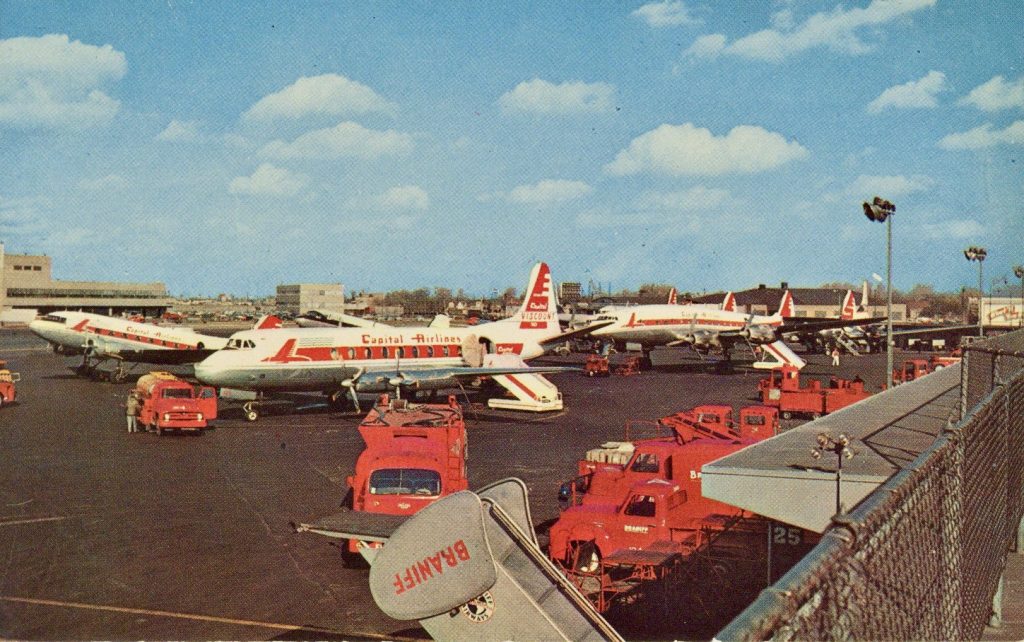
Capital Airlines DC-3, Vickers Viscount, and Constellation at Chicago Midway, between 1955 and 1960. Pub’r Cameo; Plastichrome no. P13986.
TWA Lockheed Constellation at Midway Airport, 1959.Pub’r Aero Dist’g, Chicago, no. CK.267, Curteichcolor no. 9C-1476. One of the most beautiful airport postcards.
By the late 1950s, some foreign airlines started flying into Midway Airport, including Air France, Lufthansa, and Brazil’s REAL. Soon the airport was renamed “Midway International Airport.”
Meanwhile, the burgeoning number of daily flights and passengers at Midway in the 1950s, the increased use of larger, four-engine aircraft, and the lack of room for expansion, compelled the City of Chicago to develop another airport, which became O’Hare, to handle future air traffic as well as the new generation of pure jet aircraft arriving in 1959 and thereafter. Expansive O’Hare Airport, 31 miles from Midway, opened in 1955. By 1961 almost all the major airlines consolidated their Chicago operations at O’Hare, in July 1962 United was the last to move, and O’Hare took off on its path to becoming America’s busiest airport. Midway became a shadow of its former self, with only a little over 400,000 passengers being handled during all of 1963.
The 1970s-1990s
By the late 1970s, O’Hare Airport began experiencing its own growing pains and air traffic congestion. With the passage of the U.S. airline deregulation act of 1978, low-cost carriers developed. They found it difficult to get slots to operate at O’Hare, but noticed that Midway was largely empty, much closer to downtown Chicago, able to accommodate smaller, two-engine jets, and available. A startup airline, named Midway Airlines, launched operations in 1979 with Douglas DC-9 jets and made Midway Airport its home base. This was the beginning of Midway Airport’s revival.
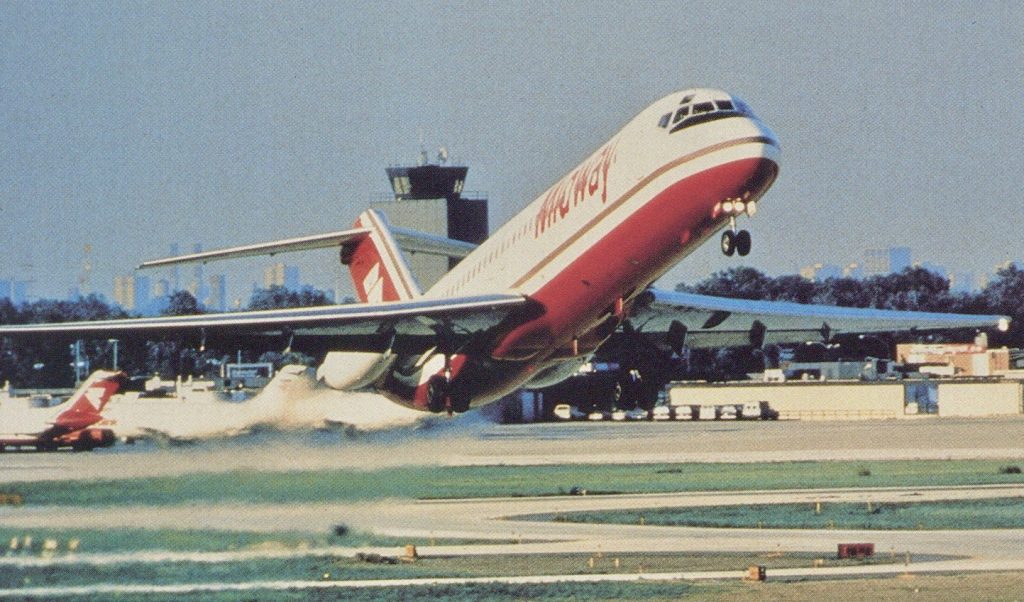
Midway Airlines Douglas DC-9 Departing Chicago Midway Airport, 1980s. Published by the then Midway Chapter of the World Airline Historical Society and printed by McGrew Color Graphics.
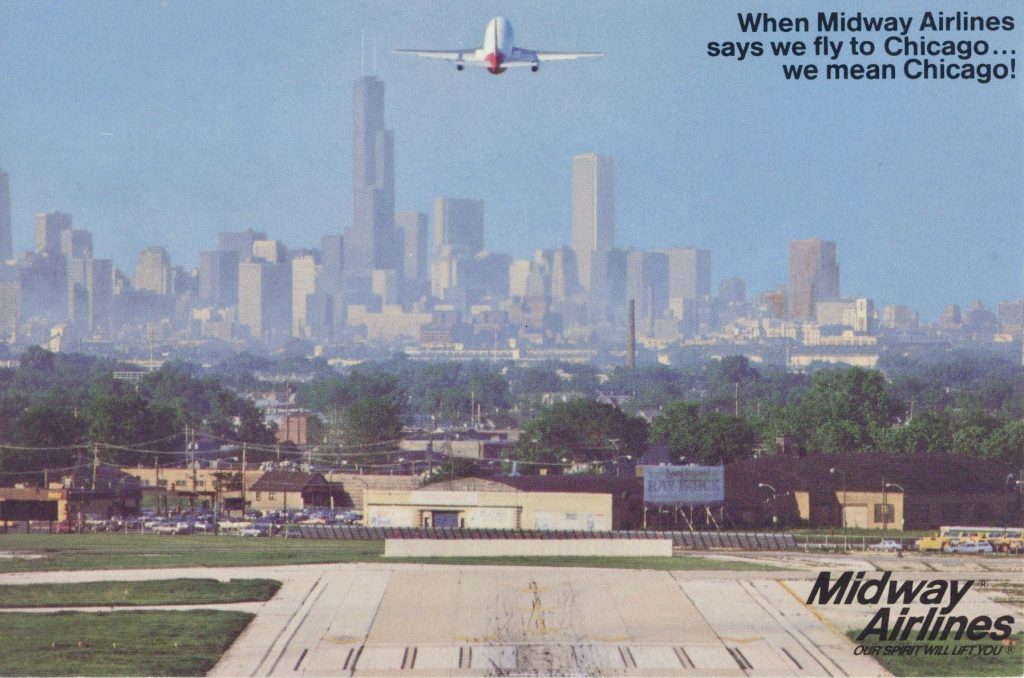
Midway Airlines Takeoff from Chicago Midway Airport, airline issue, 1980s. The airline’s advertising emphasized the closeness of Midway Airport to downtown Chicago, appealing to businessmen and tourists alike.
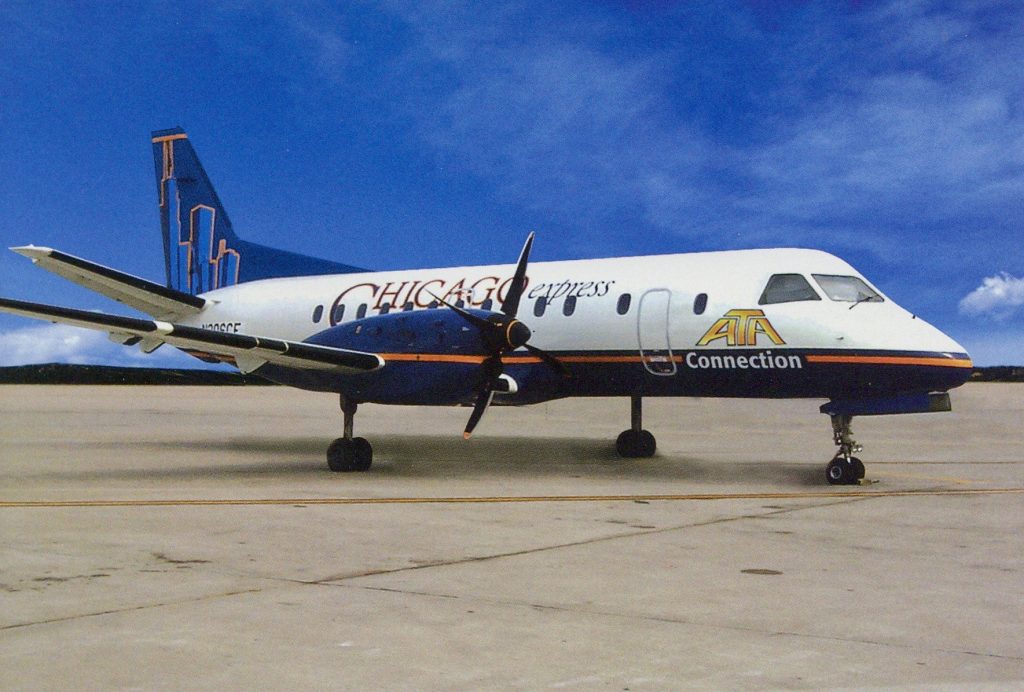
Chicago Express Airlines, ATA Connection, Saab 340B, N306CE, airline issue by American Trans Air, between 2000 and 2005.
ATA, based in Indianapolis, IN, opened a hub at Chicago Midway in 1992. It set up “ATA Connection,” operated by its subsidiary Chicago Express Airlines, based at Midway, to provide commuter service from Chicago Midway to surrounding Midwest cities using Saab 340B aircraft.
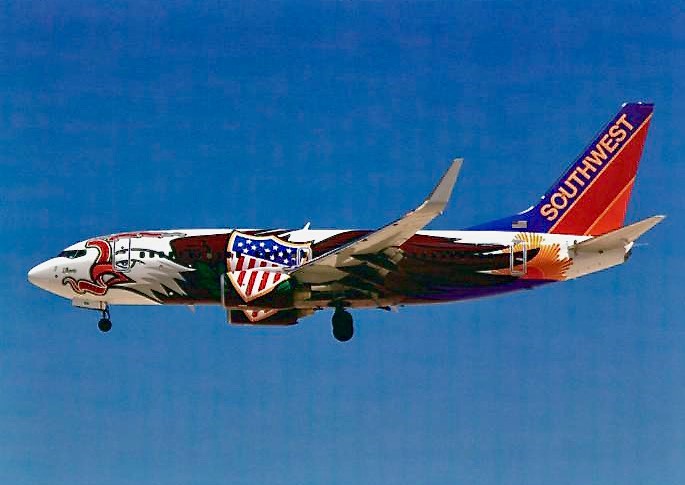
Most significantly, Southwest Airlines started serving Midway Airport in 1985 and became, by far, its leading air carrier. By 2001 Southwest was operating 121 daily flights to Chicago Midway.
Southwest Airlines Boeing 737-700, N918WN, in Southwest’s special ‘Illinois One’ livery, honoring the State of Illinois, home of Chicago Midway. Pub’r World Collectors Cards no. 1002. Joerg Jaeggin collection, and available from jjpostcards.com.
In 1997, with air traffic at Midway rapidly increasing, the City of Chicago announced the Midway Terminal Development Program, and a new, modern terminal was opened in March 2001. I have not seen any postcards showing this new terminal at Chicago Midway; if you know of any, please let me know.
The 21st Century
Over 10 million passengers utilized Midway Airport each year from 2014 to 2019, marking a return to its prior peak year of 10 million passengers in 1959. As of May 2022, 10 airlines were serving Chicago Midway. Southwest is by far the largest airline at Midway, operating 73 of 123 routes. The other airlines presently serving Midway, in order of activity, are Frontier, Delta, Volaris, United, Sun Country, Allegiant, J-Air, Tradewind Aviation, and Kalitta Charters.
Notes
All postcards shown are in the author’s collection except as noted. I estimate their rarity as follows:
Rare: the American Airlines card in black and white;
Uncommon: the United B247 and DC-3, and TWA DC-3, cards in black and white; and the cards showing a Delta DC-3, Ozark DC-3, Lockheed Super G Constellation with fuel truck, and Chicago Express/ATA Connection Saab 340.
The rest of the postcards are fairly common.
A new set of 12 postcards related to O’Hare and Midway Airports, issued by Airliners International 2022 ORD and published by jjpostcards.com, will be available at Airliners International’s 2022 show and convention described at the end of this article.
For collectors interested in aviation trading cards, 60 airports in the U.S. and Canada that are members of the Airports Council International—North America, have been periodically issuing airport trading cards as part of a North American Airport Collectors Series. The cards are 2-1/2” x 3-1/2” in size (about 6 x 9 cm.). Ken Bateman advised me that one of these airports issuing such trading cards in recent years is Midway Airport.
References
Lynch, Christopher. Chicago’s Midway Airport. Lake Claremont Press, 2002.
Author(s). “Title of Article.” Title of Periodical, Day Month Year, pages.
Lee, Chris. “Midway.” Airways Magazine, September 2018, pp. 32-43.
I hope to see you at Airliners International™ 2022 Chicago, June 23-25, 2022, at the Hilton Rosemont/Chicago O’Hare Hotel. This is the world’s largest airline history and airline collectibles show and convention, with over 200 vendor tables for buying, selling, and swapping airline memorabilia (including, of course, airline postcards), seminars, the annual meeting of the World Airline Historical Society, annual banquet, tours and more. The show. will have available a new set of 12 postcards published by jjpostcards.com related to Midway and O’Hare Airports.
By the end of World War II in 1945, Chicago’s main airport, Midway, was barely coping with accelerating passenger numbers and no significant room for facility expansion. The City had no alternative but to select an entirely new location to meet future needs for additional capacity. In 1945 it selected Orchard Field, northwest of downtown Chicago. The site had been home to a Douglas Aircraft C-54 assembly plant during the war and had four intersecting runways.
In 1949 the Chicago City Council renamed Orchard Field as “Chicago-O’Hare Field,” in honor of naval aviator Lt. Cmdr. Edward H. “Butch” O’Hare, a Chicago native and Medal of Honor recipient. The original airport code “ORD,” taken from the Orchard Field name, was retained.
O’Hare became the first major airport in the U.S. to be planned and constructed after World War II. Development took several years, and it was only in 1955 that O’Hare officially opened to scheduled commercial airline service. Growth was slow at first, as Midway Airport, being close to downtown Chicago, was much more popular at that time. However, with the arrival of the “jet age” in 1958-1959, and the resultant need for longer runways that Midway Airport didn’t have and lacked room to build, O’Hare took off on its path to becoming America’s busiest airport.
I am aware of only two postcards of O’Hare issued prior to 1959:
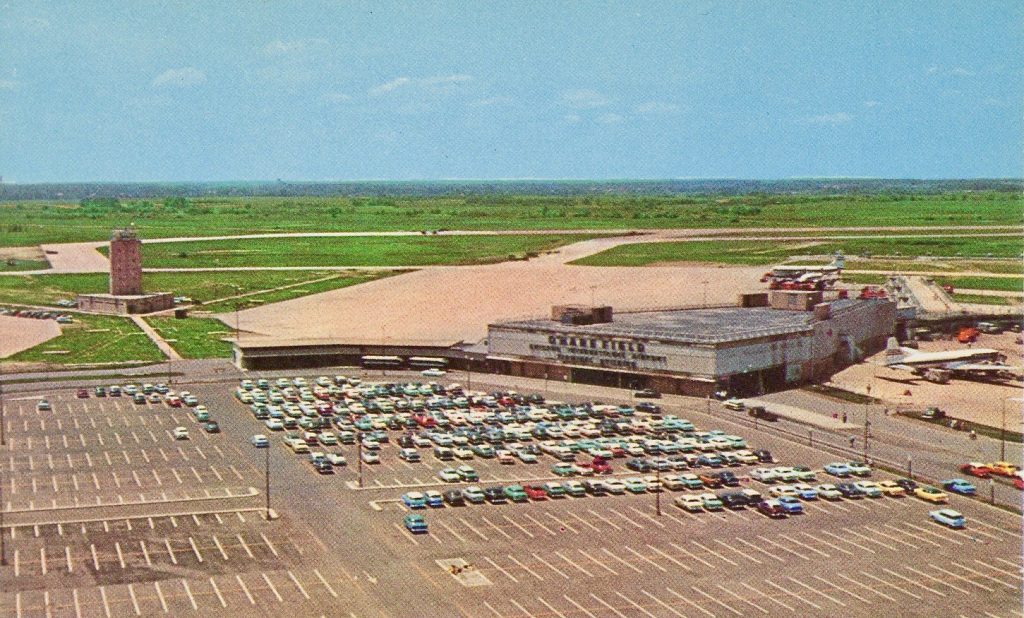
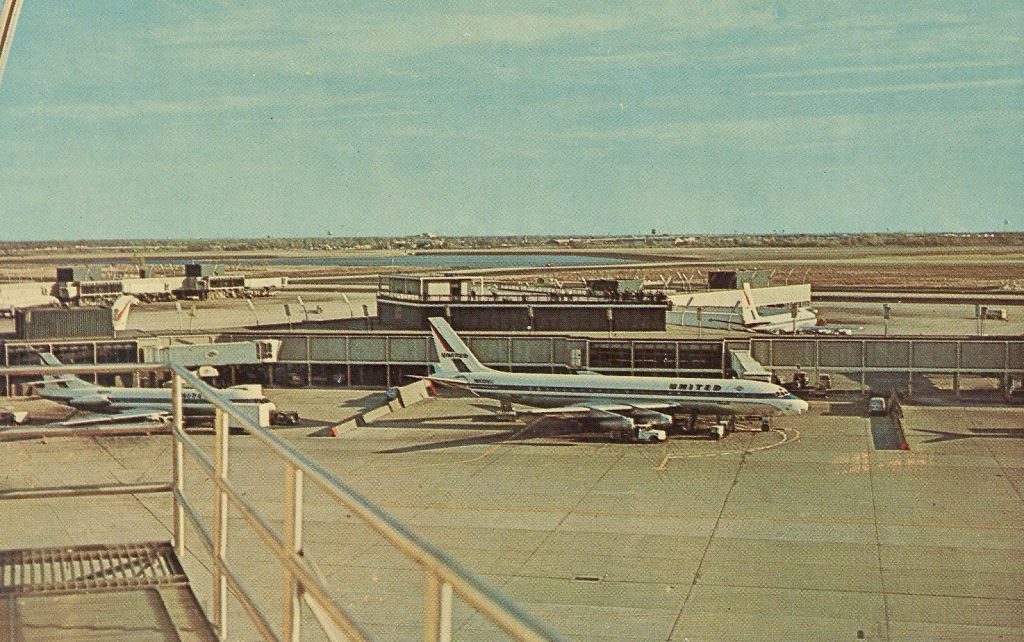
1956-issued postcard of O’Hare. Publisher Aero Distributing, Chicago, no. CK211, Curteichcolor no. 6C-K1430. This shows the original terminal building and control tower. The word “International” on the front has already been added to the airport’s name. Three propliner aircraft are on the right side. The back of this card states that O’Hare is the “world’s largest airport” – an interesting claim because even a year later O’Hare only handled 36–weekday departures versus Midway’s 414.
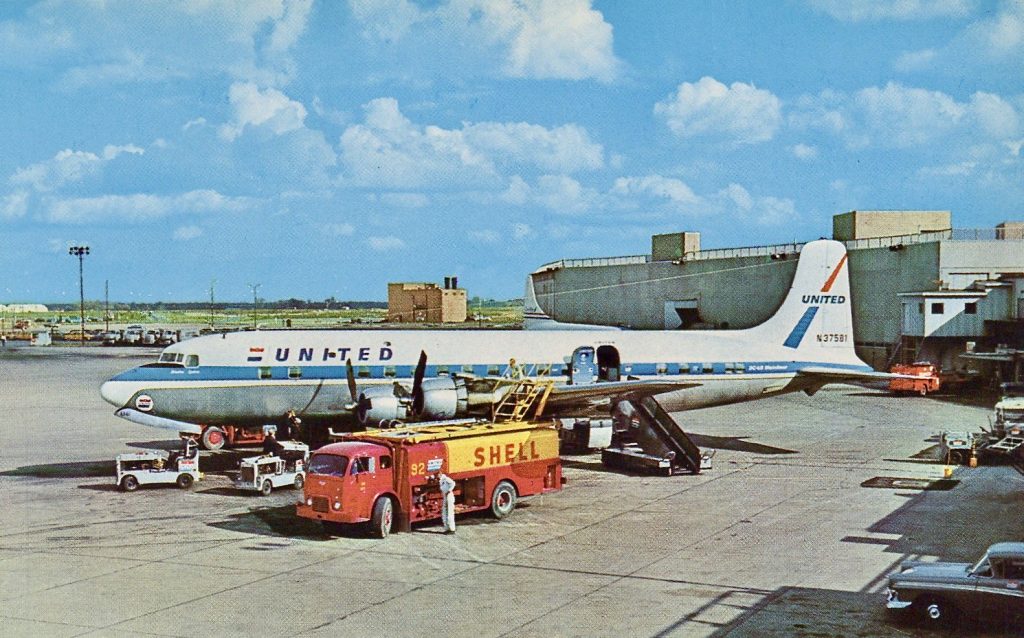
United Airlines Douglas DC-6B, N37581, at Chicago O’Hare Far North West Side, Pub’r Aero Dist’g no. CK-249, Curteichcolor no. 7C-K2639, issued 1957. Later versions of this postcard were issued, one with a border and another in a dual view with Chicago’s skyline. United established its presence at O’Hare early on, and developed a major hub there.
In 1959 pure jets started flying into O’Hare. The early model pure jets, Boeing 707s and Douglas DC-8s, could not fly into Midway Airport because of Midway’s shorter runways. My own first flight, on 17 December 1959, was aboard a new Continental Airlines 707 which flew from Los Angeles to Chicago O’Hare with a stop in Denver.
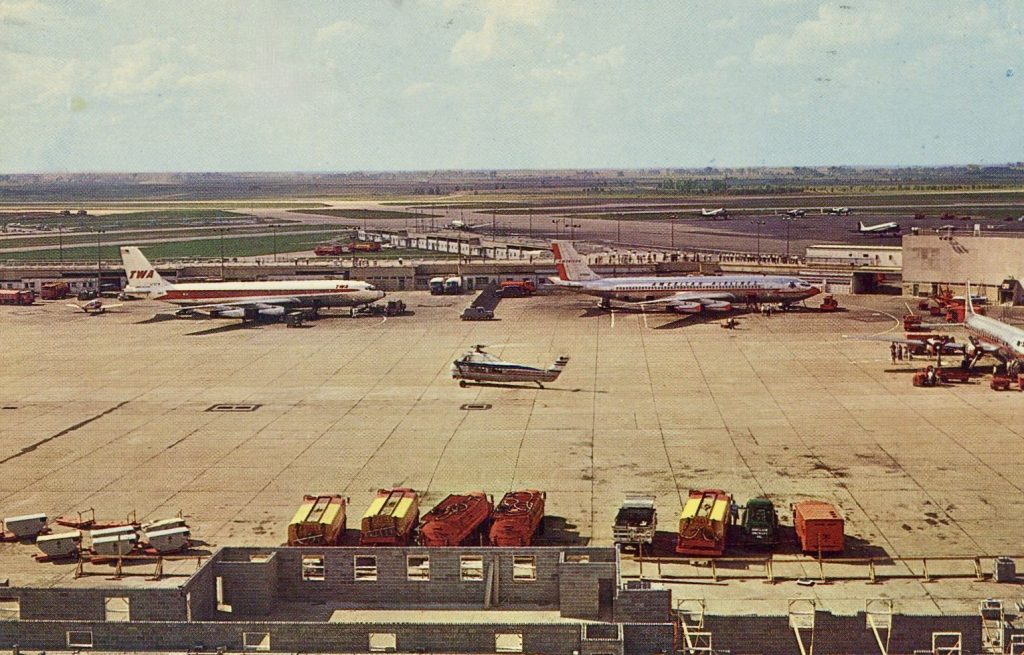
TWA and American Airlines 707s parked at O’Hare, in 1959 or 1960 (my card is postmarked September 10, 1960). Also on the ramp is a helicopter of Chicago Helicopter Airways. Behind the aircraft, you can see the observation deck with spectators enjoying the panoramic view of the airport. Pub’r Cameo Greeting Cards, Chicago, no. P30884.
Most postcards of O’Hare were issued during the 1960s, the early jet-age years. By July 1962 all scheduled operations at Midway airport were transferred to O’Hare. In that year O’Hare served 10 million passengers and claimed to be the “World’s Busiest Airport.” By 1965 that number doubled to 20 million, and by 1968 it rose to 30 million. Here is a selection of postcards from that decade:
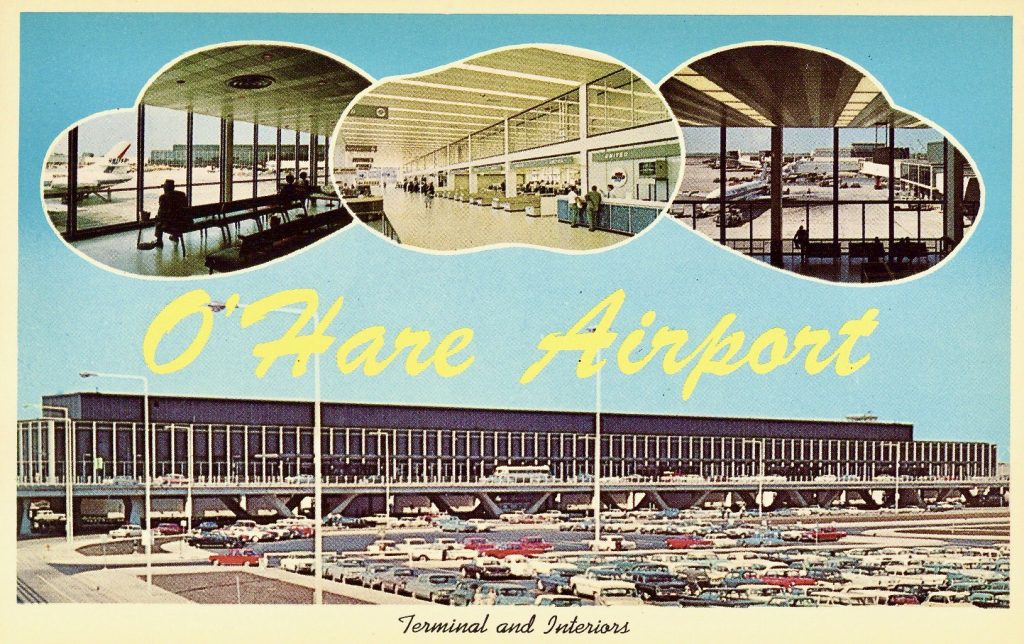
In January 1962 O’Hare Airport completed a major construction project with the opening of new Terminals 2 and 3. This postcard shows one of those terminals and interior views. Pub’r Aero Dist’g, Curteich no. 2DK-1176, 1962. Each terminal included separate levels for arrivals and departures, innovative at the time. In the small images on this card, you can see two United Airlines Sud-Est Caravelle aircraft, introduced in July 1961.
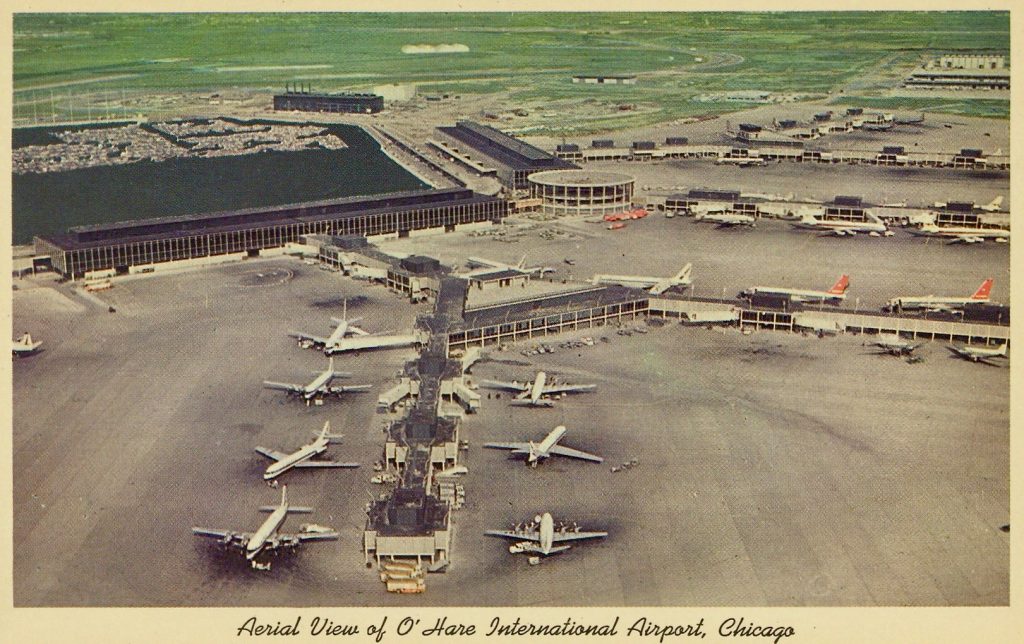
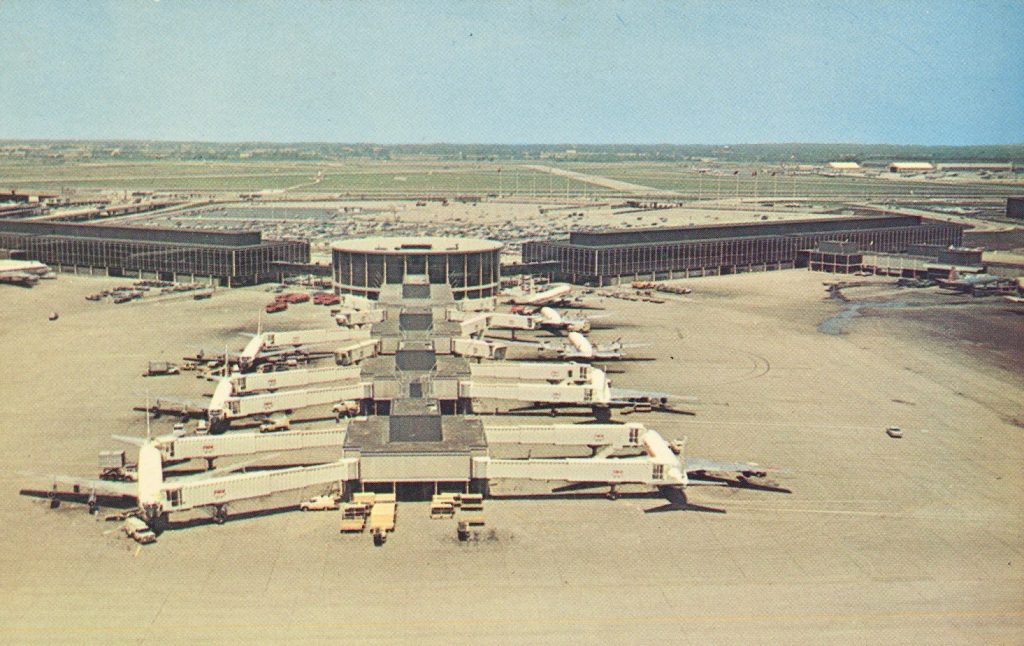
Aerial view of O’Hare, 1962. Pub’r Aero Distr’g no. CK-294, Curteichcolor 2-DK-1176. Here you can see Terminals 2 and 3 in the background, separated by a round building under construction that would become a restaurant rotunda upon its opening in 1963. The ramp features a mix of prop and jet aircraft, and several jetways are already in use.
O’Hare (through United Airlines) and San Francisco International (through Pan Am) each claim to have been the first airport to use jetways.
Close-up of jetways, completed rotunda restaurant, and Terminals 2 and 3 at O’Hare, probably 1963. Pub’rHandleman Co., Chicago, no. P59106.
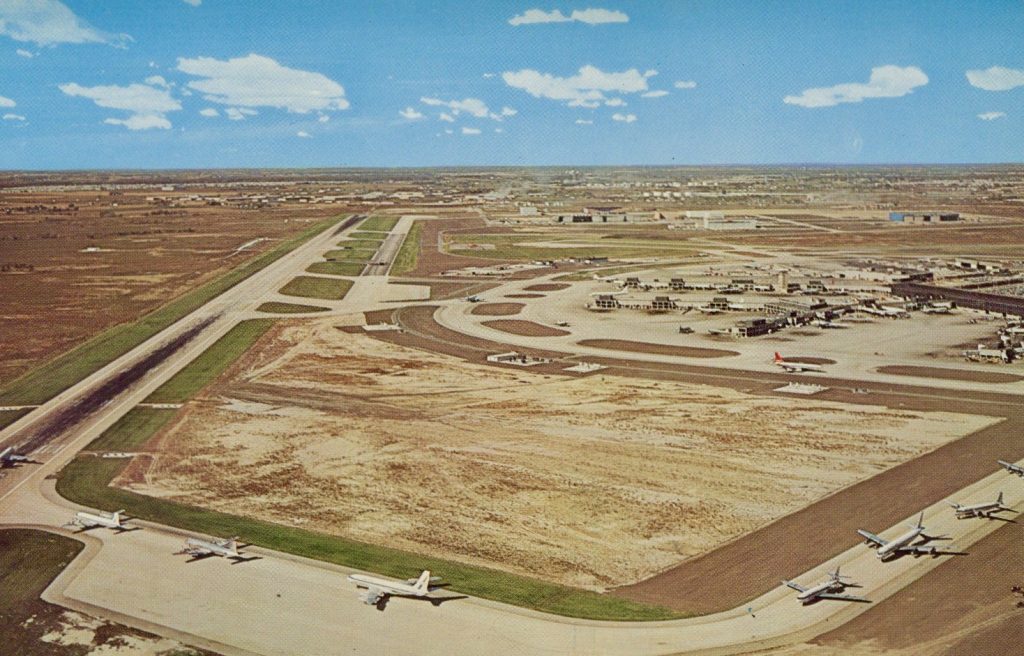
Aerial view of O’Hare, now called “The Aviation Crossroads of the World,” showing aircraft lining up for takeoff on its 11,600 ft. runway that opened in August 1960 – the longest civilian aircraft runway in the U.S. at the time. Pub’rCameo Greeting Cards, Chicago, Dexter Press no. 67044-B, Penrod Studio photo, about 1963.
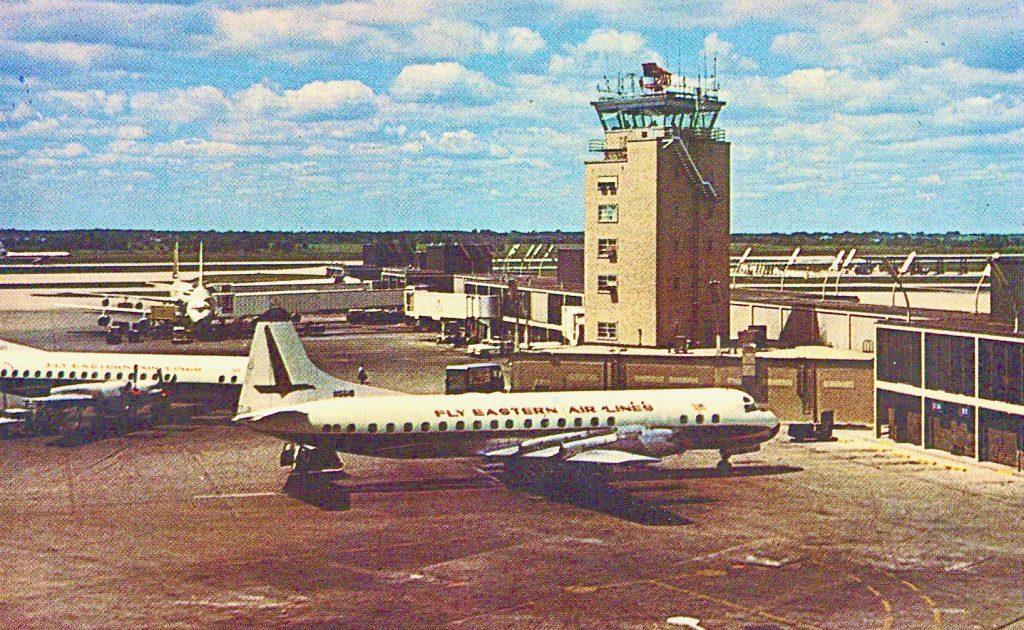
Eastern Air Lines Lockheed L-188 Electras parked near the control tower at O’Hare. Pub’r Standard Map Dist., Chicago, no. SM-134.
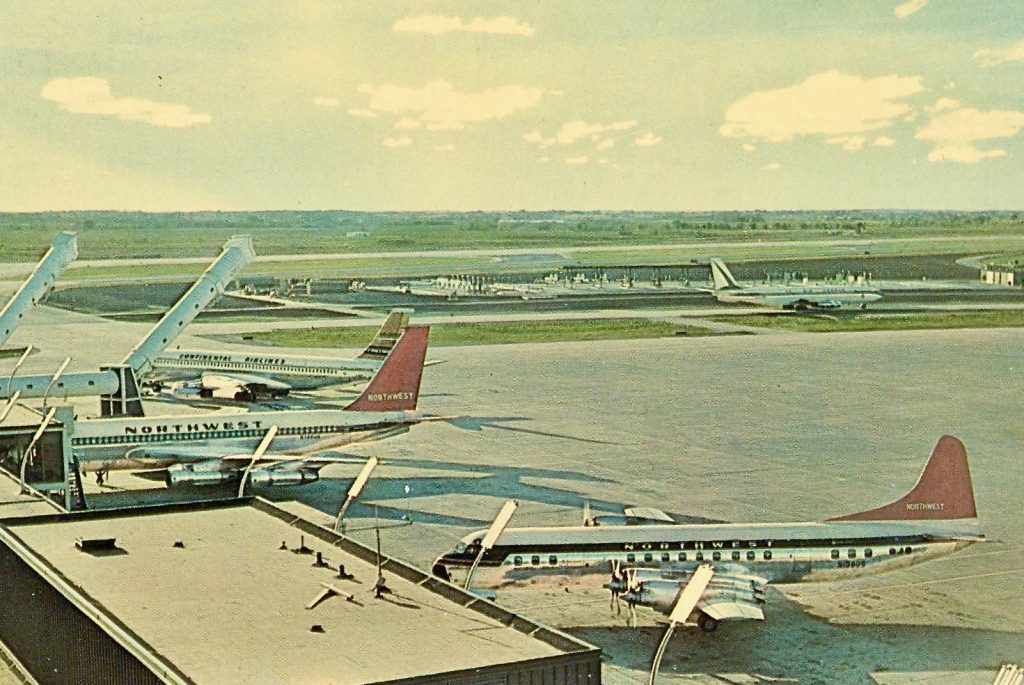
Northwest Airlines L-188 Electra and Boeing 707, Continental Airlines707, and in the background an Air France 707, at Chicago O’Hare, Pub’r Cameo, Dexter Press no. DT-67051-B, Penrod Studio photo. In the background are 16 fuel tanks connected to hydrants at the aircraft parking stations, eliminating the need to transport fuel to airplanes by truck – another innovation at O’Hare.
United Airlines Sud-Est Caravelle and Douglas DC-8 at Chicago O’Hare. Pub’r Cameo, Dexter Press no. DT-67054-B. Penrod Studio photo.
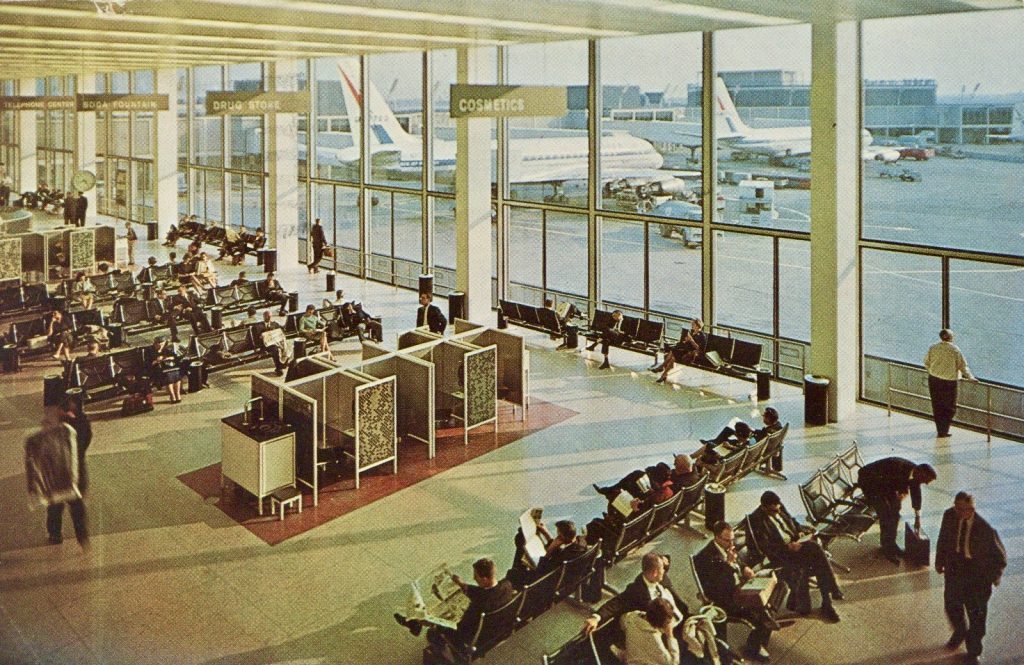
Waiting Room Lobby, Terminal 2, Chicago O’Hare, postmarked 24 January 1964. Pub’r Cameo, Dexter Press no. 67043-B, Penrod Studio Photo. Note the many telephone booths. The seats, “Tandem Sling Seats” designed by Charles and Ray Eames in 1962, were first introduced at O’Hare and became an iconic standard at numerous airports.
Very few postcards on Chicago O’Hare have been published from the 1970s to date. Here are some examples:
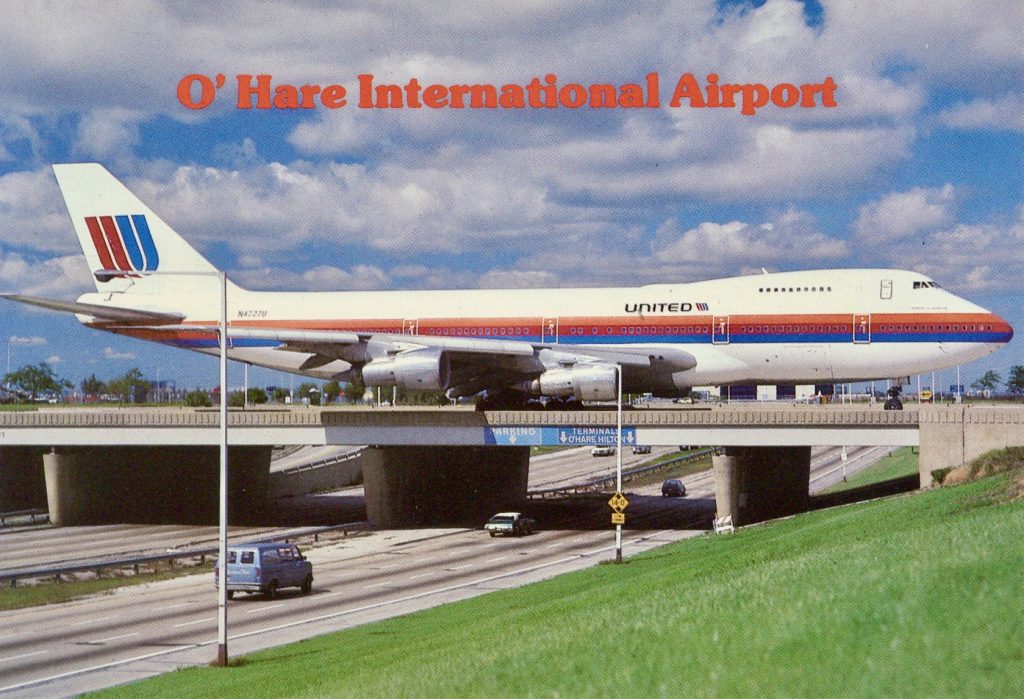
United Boeing 747-100, N4727U, taxiing on the bridge over expressway at Chicago O’Hare, about 1972. Pub’r Illinois Dist., Aurora IL, no. J12199, Phil Valdez photo. This bridge, which opened in December 1966 to improve aircraft maneuvering efficiency, was the first airport taxiway bridge spanning a public roadway.
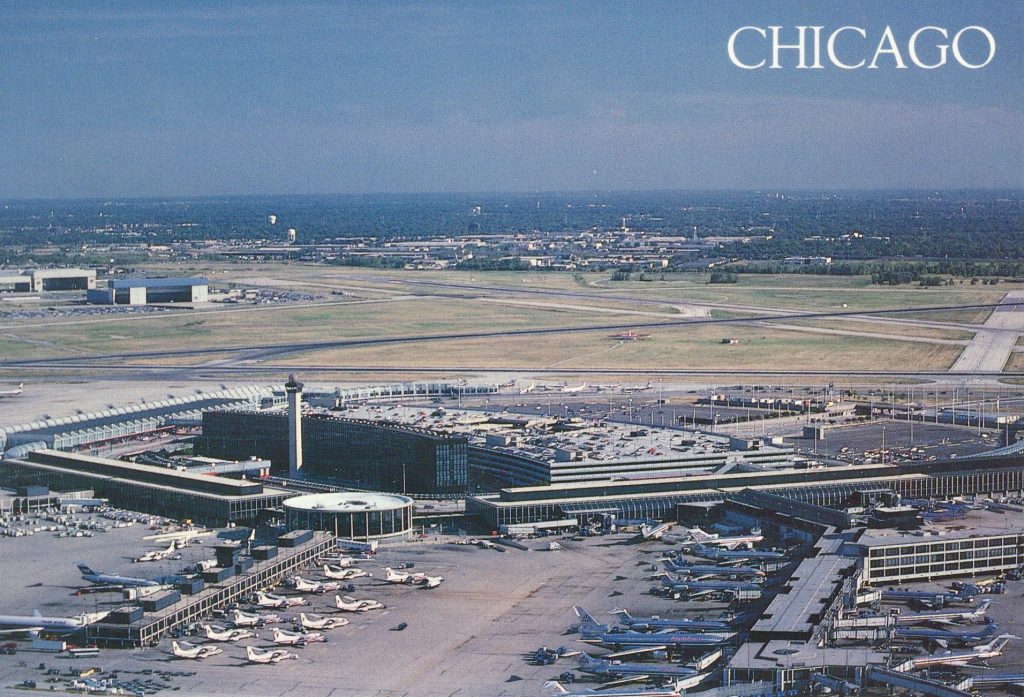
Aerial view of Chicago O’Hare showing its newer control tower that opened in May 1971 and behind it the airport hotel that debuted in February 1973. At right is an American Airlines concourse. Oversize card, 4-1/2” x 6-1/2”. Pub’r Photoscapes, Glencoe IL no. CHI 284, Kanna Wang photo.
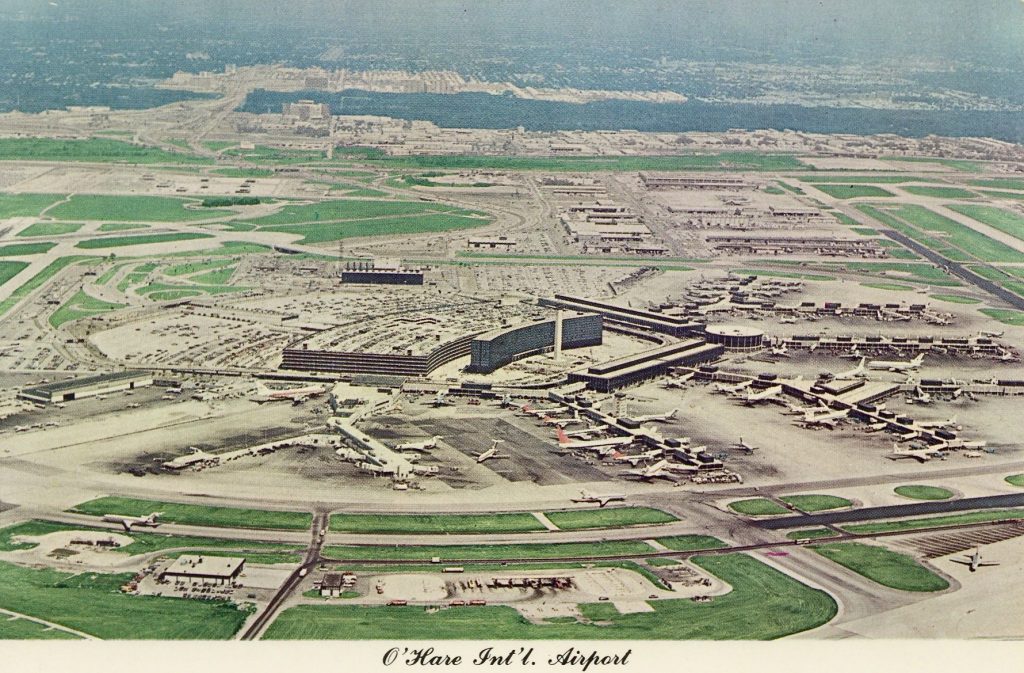
The expansion of O’Hare in the 1960s and early 1970s can be seen in this 1975 aerial view postcard. Note the numerous concourses and vast land area. Pub’r Aero Dist’g, Evanston IL, no. E-48, Curteichcolor no. 5ED-373.
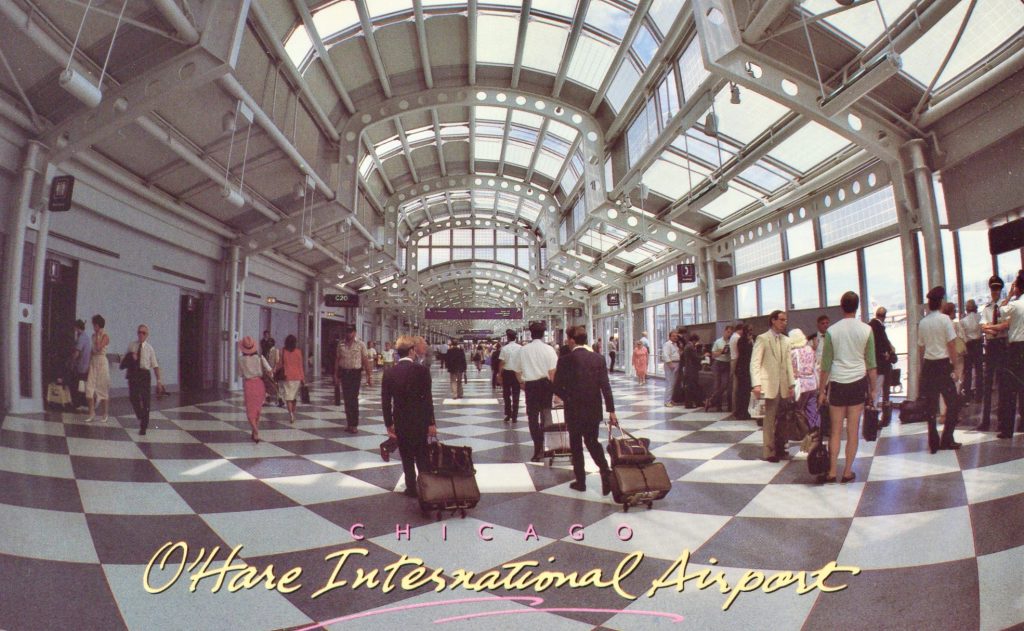
United Airlines’ new Terminal 1 concourse at Chicago O’Hare that opened in 1987. Pub’r Postcard Factory, Markham, Ontario, Canada, no. 643925, P. Pearson photo. The new Terminal 1 was built on the site of the original O’Hare Terminal 1 and was dubbed “The Terminal for Tomorrow.”
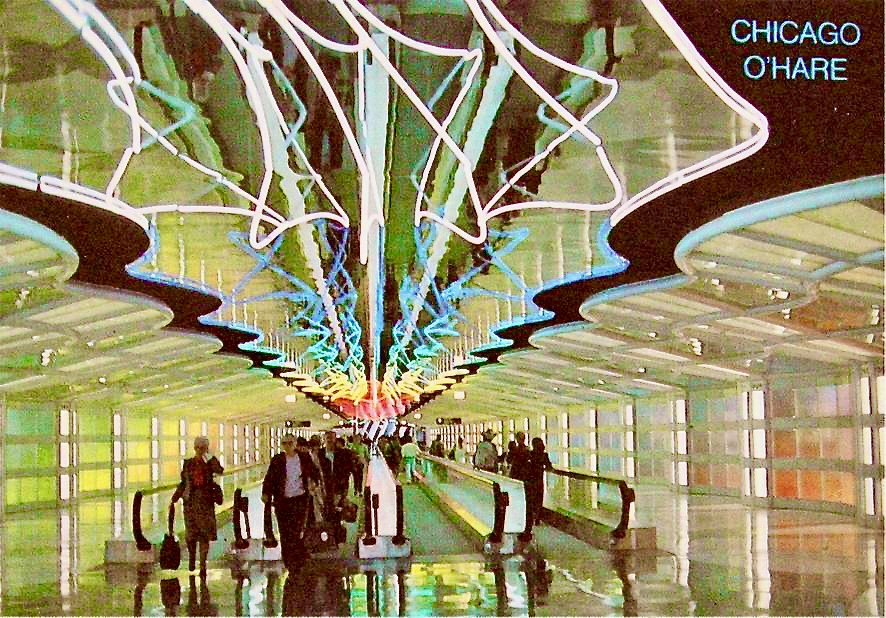
United Airlines’ new Terminal 1 underground walkway that opened in 1987. It was created by artist Michael Hayden and called ‘The Sky’s the Limit’. Pub’r Pitt Souvenirs, Northbrook IL, no. PSK 3019, photo by Daryl R. Doulder.
Note: All the postcards shown are in the author’s collection. They are all fairly common.
Since 1990, Chicago O’Hare International Airport has continuously been expanding to meet the demands of growing passenger volume. In 1990 American Airlines, the second-largest carrier at O’Hare next to United, completed a large renovation and expansion of its facilities in Terminal 3; and in 1993 a newer international terminal, Terminal 5, opened.
In 2005 the airport embarked on an “O’Hare Modernization Plan,” a $6 billion airfield reconfiguration designed to transform O’Hare from an air traffic bottleneck into a more modern airport with fewer ‘”system-impact delays.”. Sixteen years later, in September 2021, O’Hare celebrated the completion of this project which included four new runways, the extension of two other runways, two new air traffic control towers (South and North), and the replacement of intersecting runways with parallel runways.
Yet more plans are underway at O’Hare. In 2018, a year when O’Hare handled over 84 million passengers, with about 2,400 daily flights to over 200 scheduled destinations, the airport adopted its latest master plan, called “O’Hare 21.” This plan includes, most significantly, a Terminal Area Plan whose centerpiece is a new O’Hare Global Terminal, to replace Terminal 2 and be a gateway to the airport. The Plan also intends to integrate domestic and international terminal operations, allowing airlines in each of the three major airline alliances (Oneworld, Skyteam, and Star Alliance) to consolidate operations in one terminal. Other features include increasing gate capacity by 25%, improving baggage and security services, and near-term expansion of Terminals 3 and 5.
References
flychicago.com. Chicago Department of Aviation site, tab “O’Hare History.”
wikipedia.org. “O’Hare International Airport.”
chicagotribune.com/news. “O’Hare International Airport timeline: From farm to global terminal,” by Kori Rumore (September 9, 2021).
Spiselman, Anne, “Chicago O’Hare and Its Next 25 Years,” Airways Magazine, March/April 2019, pp. 78-87.
With all the new developments and activity at Chicago O’Hare International Airport, I hope to see you at Airliners International™ 2022 Chicago, June 23-25, 2022, at the Hilton Rosemount/Chicago O’Hare Hotel. This is the world’s largest airline history and airline collectibles show and convention, with nearly 200 vendor tables for buying, selling, and swapping airline memorabilia (including, of course, airline postcards), seminars, the annual meeting of the World Airline Historical Society, annual banquet, tours and more. You might want to enter the Postcard Contest at the show. More information on AI2022 is available at airlinersinternational.org. Follow this link for Postcard Contest Rules.
‘Sky Harbor’ Airport, named by the owner of the original Scenic Airways, opened in Phoenix, Arizona, in early 1929 with one modest runway. It was soon nicknamed ‘The Farm’ because of its rural, isolated location. Its first scheduled passenger flight was operated by Maddux Air Lines on 23 February 1929. The City of Phoenix acquired the airport from its developer six years later, on 16 July 1935.
The airport’s first modern terminal was Terminal 1 which opened, together with the first control tower, in 1952. The control tower became an iconic symbol of the airport at that time.
‘Phoenix Sky Harbor Municipal Airport’ soon after its opening in 1952. Curteich no. 3C-H898, distributed by Lollesgard Specialty, Phoenix. On the ramp you can see two American Airlines DC-6s, a TWA Constellation, and a DC-3. The postcard back says “Its unique Control Tower, one of the world’s tallest, over 125 ft. in height and built of a steel tube 9 ft. in diameter, is the first of its kind in the world”.
Closeup of the Terminal 1 Control Tower, 1950s. Pub’r Petley Studios, Phoenix, no. C10786.
Beechcraft Queen Air 65, N110Q, with passengers arriving at Phoenix Sky Harbor, 1960. Promotional postcard issued by Beechcraft.
In 1962 Terminal 2 opened, a major and modern addition with 19 gates. That same year Sky Harbor handled one million passengers for the first time. In 2019 more than 46 million passengers utilized the airport.
Ramp view showing Terminal 2 which opened in 1962, with a mix of jet and prop aircraft at the gates, including TWA and American 707s. Terminal 1 is in the background. Pub’r Petley Studios, no. C15570, color photo by Mike Roberts.
Parking and entrance view showing Terminal 1 in foreground and Terminal 2 in background. Pub’r Petley Studios, Mike Roberts photo, no. B847. Ex Allan Van Wickler collection.
Interior waiting room at Terminal 2. The back wall features a 3-panel, 3-dimensional mural by Paul Coze, a Phoenix artist, with the center panel displaying a mythological ‘Phoenix’ bird. Pub’r Petley Studios, no. 66283.
American Airlines Boeing 737-200, N459AC, at Phoenix Sky Harbor International Airport. Pub’r Terrell Pub. Co., nos. 1699 and 02890042, photo by Ken Raveill.
Terminal 1 was demolished in 1991 (except the iconic control tower was relocated to Cutter Aviation in the general aviation section of the airport), and Terminal 2 was closed on 4 February 2020. The airport’s website states that the noted Coze mural of Terminal 2 was saved for display in the Rental Car Center in 2021.
Terminal 3 with an additional concourse of 23 gates, and a new control tower and large parking garage, all opened in 1979. Since then portions have been modernized, and an additional concourse opened in 2019. In that year Terminal 3 was officially named the ‘John S. McCain III Terminal’.
Aerial view of Terminal 3, its concourses, the parking garage, and the control tower that opened in 1979. Downtown Phoenix can be seen in the distance. Pub’r Petley Studios, no. X115599, photo by Don Ceppi. The 1979 control tower has since been replaced by a more modern one that opened in 2006.
Terminal 4, the largest of the airport’s terminals, opened in November 1990. Originally having 44 gates, it now has 86, with several concourses. It is also known as the ‘Barry M. Goldwater Terminal’.
United Airlines 737-500, N957UA at Phoenix Sky Harbor International Airport. Pub’r: Mary Jayne’s no. MJ1226, issued in 1994 with photo sourced from Ken Bateman.
Southwest Airlines 737-300, N383SW, in special ‘Arizona’ livery, at Phoenix Sky Harbor International Airport. Pub’r ljm 15, no. 09/94b, photo by Fliteline/B. Shane.
Notes: All postcards shown are in the author’s collection except for the Beechcraft and United cards. The Beechcraft postcard is uncommon, and the rest are fairly common.
Best wishes for the success of Airliners International 2021 PHX, Marvin Goldman
From the early days of aviation to the present, many airline postcards have featured artistic expression in promoting destinations and highlighting their aircraft. This article covers a selection of aircraft art postcards from a variety of airlines and artists.
Postcard showing a mural by aviation artist Mike Machat, dedicated in 2012, at the Museum of Flying, Santa Monica, California. The mural is 20 feet wide (6.1m) and depicts Douglas Aircraft types from the DC-1 to the DC-10. Oversize postcard, issued by the Museum of Flying.
Mike Machat is one of the world’s leading aviation artists and was the first president of The American Society of Aviation Artists. He is well known to participants in the World Airline Historical Society and related Airliners International shows. Mike was the keynote speaker at the Airliners International 2014 LAX banquet, and hosted an airline art exhibition at the AI 1992 show. He has illustrated numerous airline books, including several written by Ron Davies, and authored ‘The Art of Mike Machat: Painting Aviation’s Legends’ (Specialty Press, 2016). His airline art also appears on several other postcards, including the following:
Eastern Airlines Douglas DC-8-21 N1801. Aviation World card AACS-1. Artist: Mike Machat, California, U.S.
Finnair Douglas DC-10-30. Airline issue, oversize postcard. Part of a series of 13 postcards of different aircraft types flown by Finnair, each illustrated by Mike Machat.
Let’s turn now to a selection of aircraft types on postcard art, progressing from older to newer aircraft and featuring different airlines and artists.
Compagnie des Grands Express Aeriens Latécoère Breguet XIV F-AEIZ. Publisher Shinsai-do. Artist: Masao Satake, Japan.
Instone Airlines (a predecessor of Imperial Airways) De Havilland 34, flying over Croydon U.K. airport about 1926. Modern card produced by Croydon Airport Society. Artist: Kenneth McDonough, U.K.
Florida Airways (a predecessor of Eastern Air Lines) Stout 2-AT Pullman, ‘Miss Tampa’, flying over the coastline between Fort Myers and Tampa, Florida. #28465. Artist: Keith Ferris, U.S. Keith Ferris is a founding member of The American Society of Aviation Artists.
Ansett Australia Fokker Universal VH-UTO. Issued by Fokker, card B006. Part of a commission by Fokker to document the complete range of their production. Artist: Serge Stone of The Netherlands.
Societa Aerea Mediterranea (S.A.M.) Savoia-Marchetti S.71. Airline issue, about 1931. Artist: T. Corbella, Italy.
Imperial Airways Short ‘Scipio’. Published by Salmon, U.K., no. 4106. Artist: C. T. Howard, U.K.
Imperial Airways Armstrong-Whitworth ‘Argosy’, G-EBLF. Publisher postcard #FSM103666/219. Artist: Colin Ashford, U.K. Ashford was a founding member of the Guild of Aviation Artists in the U.K.
Pan American Sikorsky S-40 ‘American Clipper’ departing Dinner Key, Florida. Airline issue. Part of a series of art postcards depicting different Pan Am aircraft. Artist: John T. McCoy, U.S.
LOT Polish Airlines Lockheed L-14H Super Electra SP-AYB. Airline issue. Part of a series of art postcards depicting different LOT aircraft. Artist: Janusz Grabianski, Poland. Grabiaski was also a noted illustrator of children’s books, and many of his illustrations for LOT postcards include children and pets in the scene.
CSA Czech Airlines Douglas DC-3. Airline issue, oversize postcard. Artist: Vladimir Bidlo, Czech Republic. Bidlo has illustrated many of CSA’s aircraft, including a set of 16 continental-size cards with informational backs issued by CSA in 2003 for its 80th anniversary.
EL AL Curtiss Commando C-46. Airline issue. Part of a set issued in 1979. Artist: Danny Shalom, Israel.
MALEV Hungarian Airlines Ilyushin IL-14. Airline issue. Part of a series of postcards on MALEV aircraft. Artist: Akos Bánfalvy, Hungary.
Trans World Airlines (TWA) Douglas DC-4 over Lake Geneva, Switzerland. Airline issue. Part of a set of aircraft/destination postcards. Artist Manlio D’Ercoli, Italy.
Air Katanga Douglas DC-4 OO-KAT (formerly SABENA OO-ADN). The back of this rare card has Katanga postage stamps showing the aircraft, postmarked Elisabethville (now Lubumbashi, Dem. Rep. Congo) on 1 August 1961. Artist unknown.
KLM Lockheed L749 Constellation, PH-TER, over Java, Indonesia. Skyliner postcard no. 10. Artist Thijs Postma, The Netherlands. Thijs Postma is one of the most noted aviation artists and has illustrated several aircraft postcards of KLM and Martinair. He participated in the aviation art exhibition at Airliners International 1992, Orange County, California.
British West Indian Overseas Airways Vickers Viscount at Piarco Airport, Trinidad. Airline issue by BWIA. Oversize postcard. Artist: David Moore, Texas, U.S.
Aeroflot Tupolev TU-114, CCCP-75712. Airline issue. Aeroflot has issued several postcard sets of its aircraft depicted in art form, but the artists are not identified.
VARIG Hawker Siddeley HS-748 Avro, PP-VDU. One of a series of aircraft art postcards published by the Artist, Nelson Francisco Anaia, Brazil.
United Airlines Sud-Aviation Caravelle VI-R. Airline issue and part of a large postcard set of United’s aircraft from inception to the 1970s. Publisher Johns-Byrne Co., Chicago, early 1970s. Artist: Roy Anderson, U.S.
United Airlines Douglas DC-8. International Airlines Museum Historical Post Card #3. Artist: Tom Kalina, U.S. Tom Kalina has provided airliner art for several of the Captain’s Log issues of the World Airline Historical Society and has also been active at Airliners International shows. He is a member of The American Society of Aviation Artists.
AVIANCA Boeing 720B. Airline issue, 1969. Artist: Roberto Sanmartin, Colombia.
Air France Concorde. Airline issue. No. 4 in series interpreting “The Fine Art of Flying”, 1988. Artist: Jacques Monory, France.
Trans-Canada Airlines Lockheed L-10A Electra, with Air Canada Boeing 767. Air Csnada issue on its 50th anniversary, 1987. Artist: Robert Bradford, Canada.
QANTAS Airways Boeing 747-300 in “Nalanji Dreaming” livery. Published by Artist Terry Johnson, born U.S., studio in Australia.
Singapore Airlines Airbus A380. Airline issue, an example of computer art. Today, many aviation art postcards are produced by graphic designers using computer software.
Speaking of computer graphic art, note that the most recent publicity postcards issued for the annual Airliners International shows have been designed by U.S. aviation artist Chris Bidlack. Here is an example of his art for these shows:
Airliners International 2021 Phoenix show card. Artist Chris Bidlack.
I hope you enjoyed this selection of postcards showing passenger aircraft art. There are many more postcards of this type available. Also, there is a whole other category of airline art postcards that emphasize destinations served or contain other advertising – all of which can form a beautiful collection.
All the postcards shown are from my collection. They are standard or continental size except when stated to be oversize. I estimate their availability as follows: Rare: the S.A.M. S.71 and Air Katanga cards; Uncommon: the Florida Airways Stout 2-AT, Imperial Scipio, TWA DC-4, BWIA Viscount and Aeroflot TU-114 cards. The rest are fairly common.
If you have any comments on my articles, I would be pleased to hear from you. Just email me, Marvin Goldman, at worldairsociety@aol.com.
Many airlines, particularly on longer flights, have typically handed out beautiful menus in advance of their meal service. One type of menu, popular in the past with certain airlines, served a double purpose – it had a postcard back, as the airline hoped the passenger would mail the postcard, and this would publicize the airline more widely. Some of the early menu postcards even state on the back: “Please address and return to Stewardess, who will stamp and mail for you”.
Surprisingly few airlines actually issued menus in postcard form. I know of only 17 airlines that did so, although probably more exist. Also, at least three other airlines issued menus with postcards attached so they could be separated and mailed or saved.
The late 1940s through the early 1960s were the high point for the popularity of airline menus with postcard backs. Some, however, date as early as the1930s and the latest I know of were issued by TWA in 1987.
All the postcards shown in this article are airline issued; standard or continental size; and from my collection except for those of B.O.A.C., Ghana, and South African Airways.
The airline that issued the most menu postcards, by far, was United Air Lines. I estimate that more than 80% (and maybe 90%) of the menu postcards that you can find at airline collectible shows or on the internet are those issued by United.
So let’s start with menu postcards of United Air Lines. United issued many types of menu postcards, including those celebrating special events, holidays or destinations, menus with suitable illustrations for breakfasts, and a lengthy set with photographs of United destinations.
Here are my three favorite United menu postcards. I was fortunate to acquire them over 30 years ago from collector Randy Lieberman, and I have never seen other originals of each.
United Air Lines postcard celebrating Navy Week: Oct. 26-Nov. 1, 1941’. It is ironic that this menu postcard was handed out one month before the attack on the U.S. Naval base at Pearl Harbor, Oahu, Hawaii. Note also the border resembling the rope of a ship.
United Air Lines menu postcard issued especially for St. Patrick’s Day, 16 March 1940. There’s a lot of Irish in the text of this card.
United Air Lines menu postcard issued especially for Valentine’s Day, 14 February 1942. This menu has a lot of hearts as well as ‘Cupid’s Ice Cream’.
In the 1940s United several menu postcards with the symbol of a chef running to serve a steaming hot meal, such as the following:
United Air Lines menu postcard showing a DC-3 and noting ‘Los Angeles’, postmarked 20 January 1943. The message on the back says: “This meal on the other side of card I just finished while in flight between Los Angeles and San Francisco. It was very tasty and I enjoyed it very much. Best to all the office.” I’m sure this was the kind of publicity that United desired.
United Air Lines ‘Breakfast menu’ postcard, 1950s. The image of the very early milk delivery suggests the freshness of the food served. United also widely publicized its Flight Kitchens and chefs, as can be seen in the text above the menu.
United Air Lines menu postcard commemorating its 25th anniversary, April 1951.
In the early 1950s United issued a set of menu postcards, each with a photograph of a particular United destination. I know of at least 20 different destinations in this set, and there may be more. A particular destination card was sometimes used for several different menus, so the varieties multiply. The postcards in this set are the most common of all the menu postcards and are widely available. Here is one example,
United postcard with menu prepared by United’s Chicago Flight Kitchen, Eugene Ertle, Chef, and destination photo of Santa Catalina Island, California. Another menu postcard with this view has the logo of the 50th anniversary of powered flight on the postcard side and so must have been issued in 1953.
Let’s now turn to the other U.S. airlines that issued menu postcards.
American Airlines foldover menu postcard. When folded the AA logo appears on the picture side and the postcard side is on the back, while the menu appears inside. This style exists with different menus. The one shown was served on American’s ‘New York Toltec’ flight. ‘El Tolteca’ was American’s name for its service to Mexico City in the 1950s. So this menu is in Spanish as well as English. One of my cards of this type is postmarked 29 April 1950.
American Airlines menu postcard showing symbols of California as a destination. The postcard back says ‘First with Jets Across the U.S.A.’. This is part of a destination set issued in the early 1960s. The same destination can have different menus. Other destinations in this set include Mexico, New England and New York, and there may be others.
Eastern Air Lines postcard showing actual photo of what’s on the menu aboard a Lockheed Constellation, postmarked 18 July 1955. Part of a set that shows photos of different meals served on Eastern. On this postcard a child wrote “Hi Grampa ! Just ate all of it. Not sick at all !” Well, I guess that’s a good enough testimonial for airplane food.
Northwest Orient Airlines menu postcard, ‘Orient’, 1960s. This is part of a set with beautiful illustrations of symbols and foods of the particular destination. Other destinations in the set include Alaska, Atlanta, Florida, Pacific Northwest and Philippines, and there are probably more.
Pan American menu postcard, ‘On Board: Bermuda Clipper’. This rare card dates from the late 1930s or 1940, and was probably used on Pan Am’s Baltimore – Bermuda seaplane route.
Pan American ‘Clipper Menu’ postcard, Seattle – Juneau, ‘Alaska Service’, with DC-3, late 1930s or early 1940s. Ex Deke Billings collection.
Pan American ‘Alaska Service’ menu postcard, Seattle – Juneau with a destination photo, in the style of the 1950s. Ex William Demarest collection. There are other views in this set, and they are much harder to find than the corresponding United menu postcards of the same style.
TWA (Trans World Airlines) foldover menu postcard, showing the postcard back and foldover view, here Monterey Peninsula, California. The menu takes up the entire other side of the postcard and view portions. Issued March 1953. The postcard back says: “This in-flight menu is printed in post card form, so that you may mail it home to family or friends as a remembrance of your TWA flight.” I am aware of similar postcards with views of Naples and New York, and there may be others.
TWA ‘Menu a la Card’ postcard, with artwork typifying ‘Phoenix’. Card is slightly larger than continental size. Part of a set of destination menu postcards issued in 1987. This is the latest date I know of for an airline menu with a postcard back on the menu itself. The postcard back says: “TWA is pleased to present our new Great Destinations Series. Through an artist’s vision we wish to share with our passengers the spirit and the aura of some of the Great Destinations that TWA serves. Rather than depict famous landmarks, we have chosen scenes that we think typify the life style, the feel for a country or city that no monument can convey.” Other destinations in this series include London, Paris, Puerto Rico, St. Louis and San Francisco, and there probably are others.
National Airlines ‘Bar Service’ menu service, 1950s. Note the text ‘Liquor may be served outside the three mile limit or over the State of Florida’. Before 1949 U.S. airlines generally did not serve alcoholic beverages in flights over the U.S. Thereafter, for a brief period into the 1950s, various States did not permit the serving of alcoholic beverages in flight. Apparently, on the flight where this card was handed out, National could serve drinks only when the aircraft was over Florida, or more than three miles offshore, considered to be ‘international waters’.
Pacific Northern Airlines ‘flying high above Scenic Alaska’ menu postcard, late 1950s.
Hawaiian Airlines menu and adjoining postcard that can be easily detached and mailed, issued about 1995. Ex Kuo-ching (‘Peter’) Fu collection. The other side of the postcard portion shows artwork of Hawaiian artist Juno Galang, and the reverse of the menu portion advertises Lion Hawaiian coffee, served on Hawaiian Airlines flights.
Not illustrated here, but in my collection, are menu cards with detachable postcards issued by three other airlines: Finnair (with attached DC-10 postcard), KLM Amsterdam-Los Angeles service menu postcard (with attached 737-300 postcard), and Virgin Atlantic (one with attached artist’s depiction of people in London looking up to sky, and another depicting a London double-decker bus).
Now let’s turn to menus with postcard backs issued by airlines outside the U.S.
Trans-Canada Air Lines – Air Canada postcard with French and English text and rodeo photo, issued September 1963. Part of a set with other menus and views.
Canadian Pacific ‘Princess Menu’ postcard with photo of Victoria Glacier and Lake Louise, Canada. Card postmarked 27 October 1962. Part of a set with other menus and views. Canadian Pacific also issued menu postcards with the menu surrounded by the insignia of the various Canadian provinces.
I am not aware of any South American, European or Middle East airline menu cards with a postcard back other than those issued by B.O.A.C. (British Overseas Aircraft Corporation)
B.O.A.C. (British Overseas Aircraft Corporation) menu postcard, with artist’s view of the Drakensberg mountains, South Africa. 1950s. Internet image. Part of a set with other menus and views. Note the ‘Speedbird’ logo in the lower right. B.O.A.C. also issued, probably in the 1960s, another set of menu postcards with destination illustrations and the tagline ‘all over the world B.O.A.C. takes good care of you’ and with no Speedbird logo.
There are two African airlines that apparently have issued menu postcards, as to which I have never seen an actual card. They are illustrated on the Famgus Aviation Postcards website, as follows:
Ghana Airways menu postcard with view of Accra. 1960s.
South African Airways menu postcard in two languages, Afrikaans and English. Late 1950s.
From Asia and Australasia, I am aware of three airlines that have issued menu postcards.
Civil Air Transport (CAT), Taiwan, menu postcard showing a painting of an elf offering peaches symbolizing a long life. Probably 1950s. Ex William Demarest collection. CAT issued other similar menu postcards, including one showing two Chinese boys greeting one another.
Philippine Airlines menu postcard showing folk art, postmarked 17 August 1971.
TEAL (Tasman Empire Airways Limited] menu postcard highlighting the ‘enchanted isles of the South Seas’, postmarked 22 April 1961.
I hope you enjoyed this overview of airline menu postcards. If you know of any other airlines that issued menu cards with postcard backs, or if you have any comments on my article, I would be pleased to hear from you. Just email me, Marvin Goldman, at worldairsociety@aol.com.