In celebration of the 50th annual Airliners International show and convention, held in Denver, CO, June 24-27, this article for the Captain’s Log of the World Airline Historical Society covers Denver’s main airport as illustrated on postcards.
From 1929 to February 1995, Denver’s primary airport was located at what was eventually named “Stapleton International Airport.” On February 28, 1995, Stapleton was closed to flights and replaced by an entirely new airport: “Denver International Airport (DEN).”
Denver’s primary airport opened on October 17, 1929, as “Denver Municipal Airport.” It was called the “Union Station of the Air” and claimed to be the most modern in the U.S. at the time. The two main airlines serving Denver in the 1930s were United and Continental.
After a 1944 expansion, the airport’s name was changed to Stapleton Airfield in honor of Denver Mayor Benjamin Stapleton, who strongly supported the development of Denver Airport.
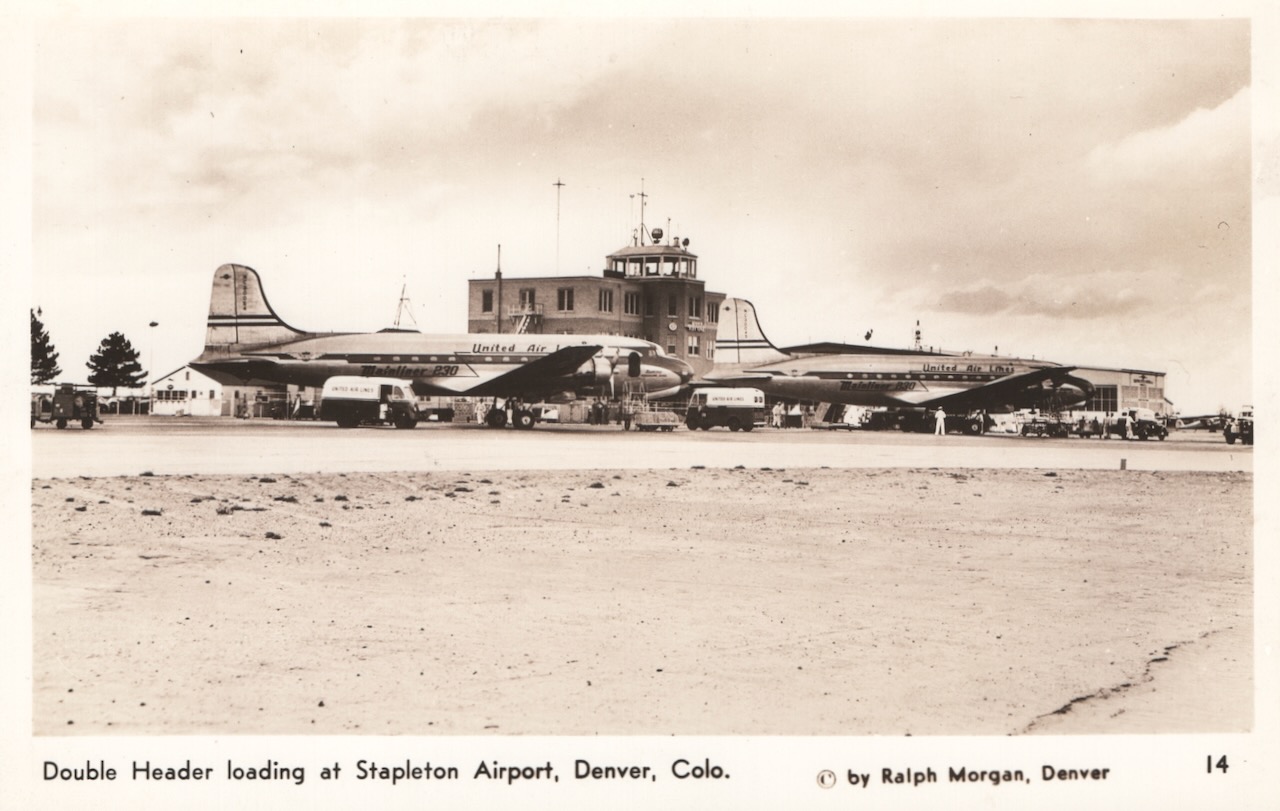
United Air Lines Douglas DC-4s at Denver Stapleton Airport, about 1946. “Real photo” postcard by Ralph Morgan, Denver, no. 14. The original terminal building and control tower can be seen in the rear center.
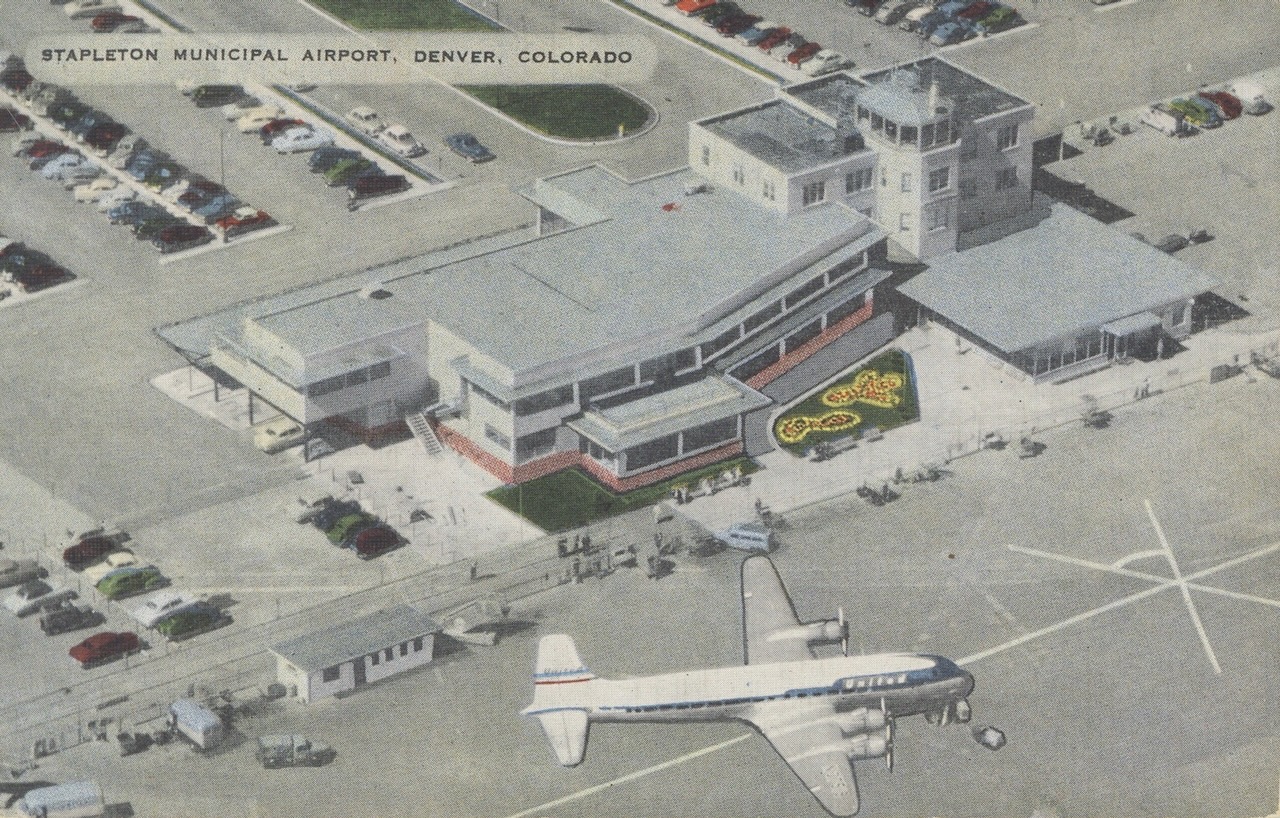
United Air Lines Douglas DC-6 at Denver Stapleton Airport, early 1950s. Pub’r Elmer C. Clark, Denver; Printer E. C. Kropp Co., Milwaukee, no. 28059N, ‘linen’ finish. The card back says “Stapleton Field is considered one of the finest fields in the West and has some 67 flights per day to supply prompt service to all parts of the United States.”
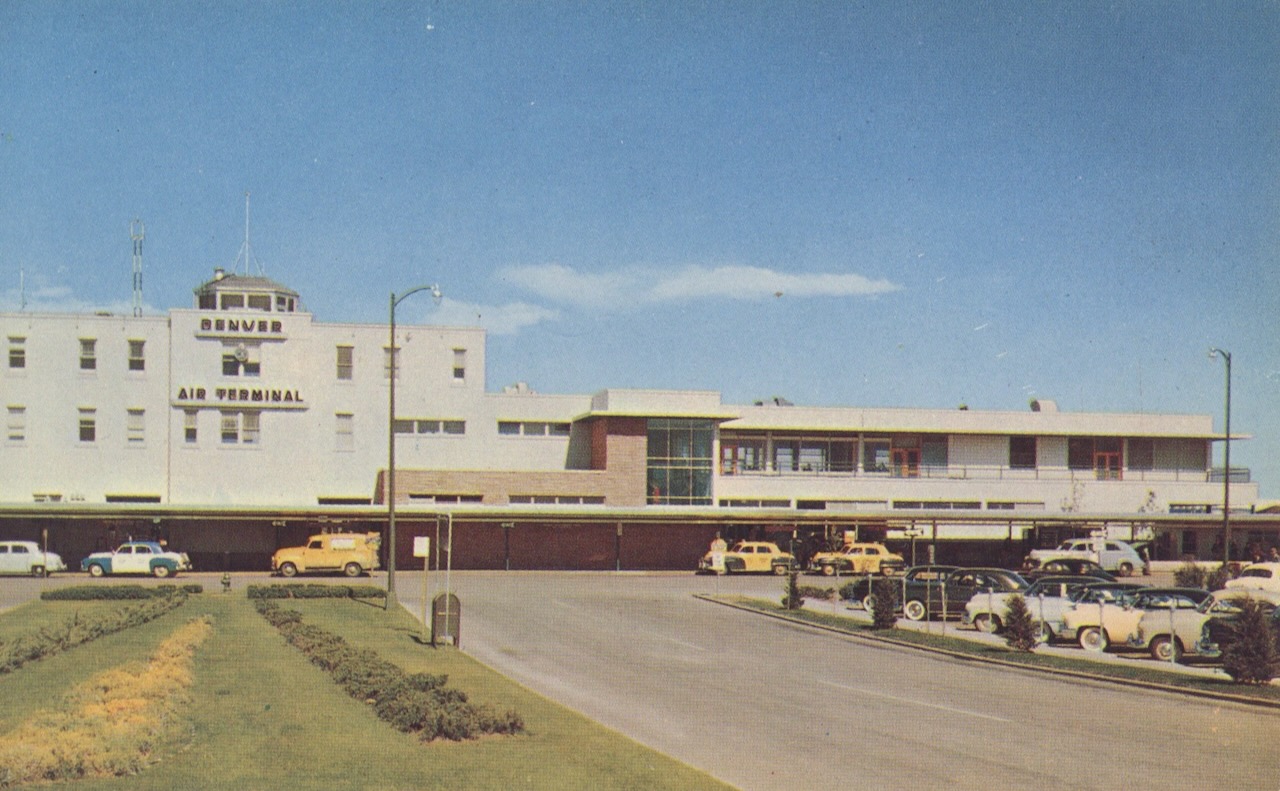
Front of Denver Stapleton Airport terminal building, early 1950s. Pub’r Colourpicture, Boston, no. P5495.
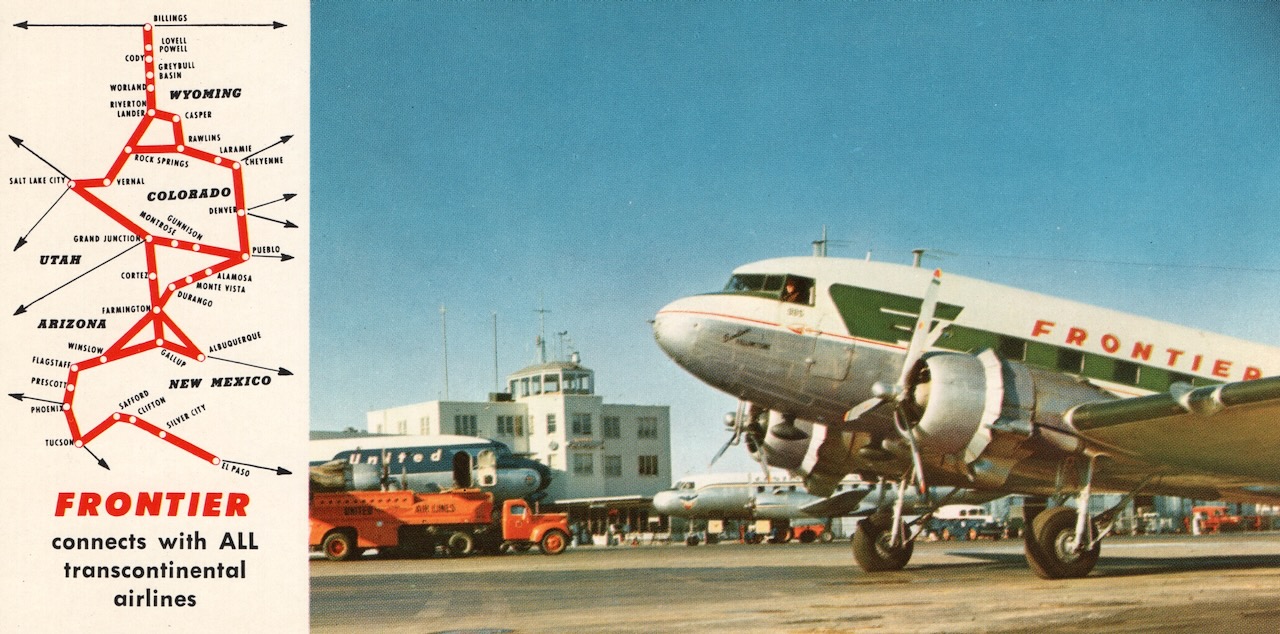
Frontier Airlines Douglas DC-3 at Denver Stapleton Airport, with United and Continental aircraft in rear. Airline issue, 1950s. The original Frontier Airlines was formed in 1950 by a merger of Arizona Airways, Challenger Airlines, and Monarch Airlines, and was headquartered at Stapleton Airport. It ceased operations on August 24, 1986.
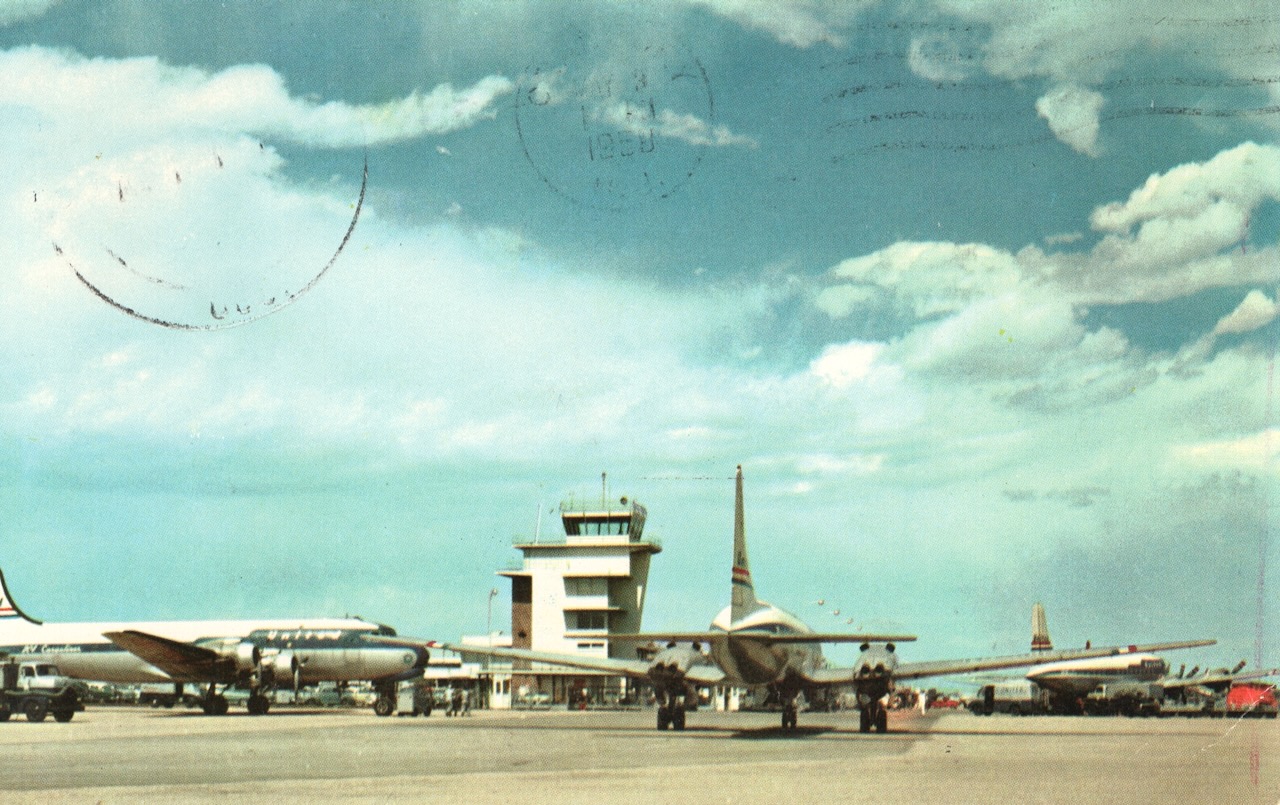
Denver Stapleton Airport’s new six-story control tower, completed in June 1953, with United Air Lines aircraft on the ramp. Postmarked May 3, 1958. Pub’r Cooper Postcard Co., Lakewood CO, no. 51; Printer A. B. Hirschfeld Press, Denver.
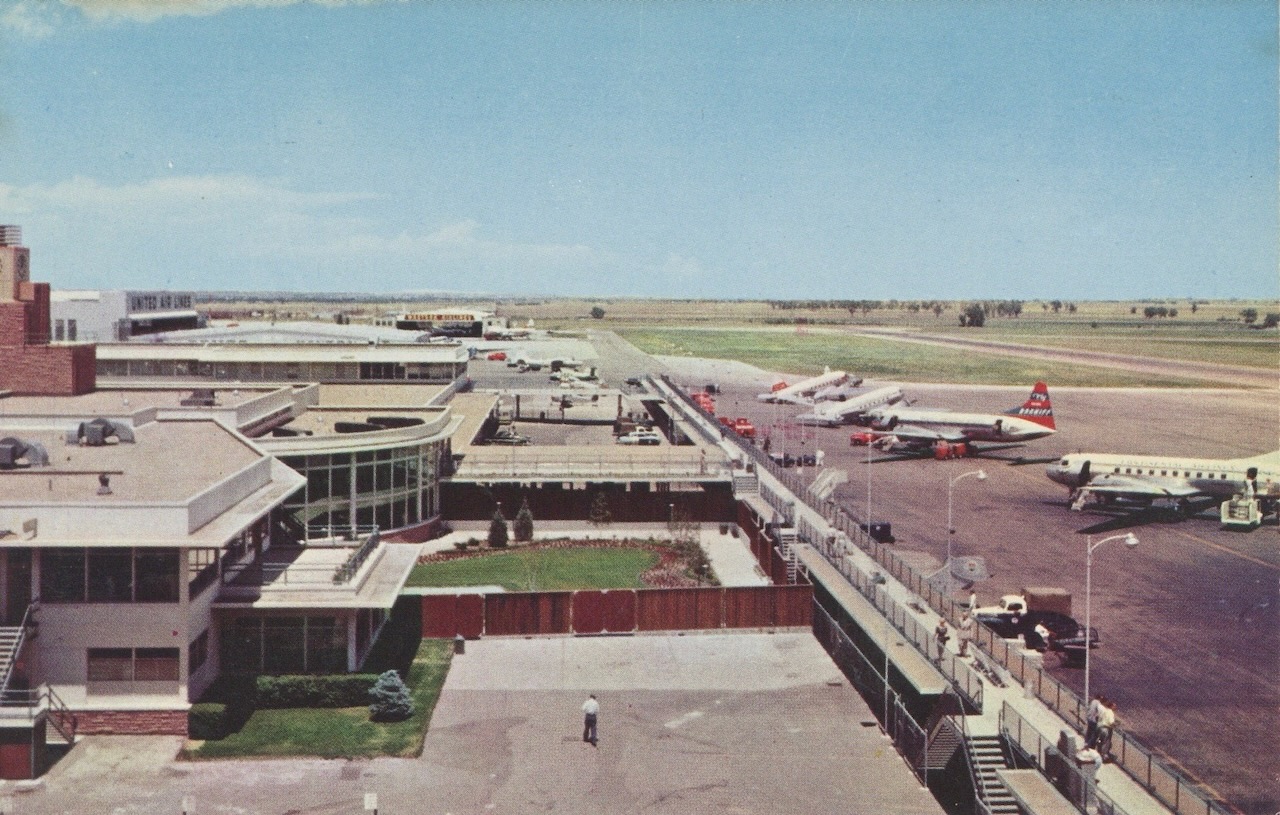
Braniff Airways and Continental Airlines Convair aircraft, and two Douglas DC-3s, on ramp at Denver Stapleton Airport, 1956. Pub’r Cooper Post Card Co., Lakewood, Colorado, no. 6C-K327. Here you can see the terminal and concourse area, updated in 1954, and a passenger walkway viewing area. The main airlines serving Denver at that time were United, Continental, Braniff, Western, Frontier, TWA, and Central. Continental, like Frontier, had its headquarters at the time at Stapleton.
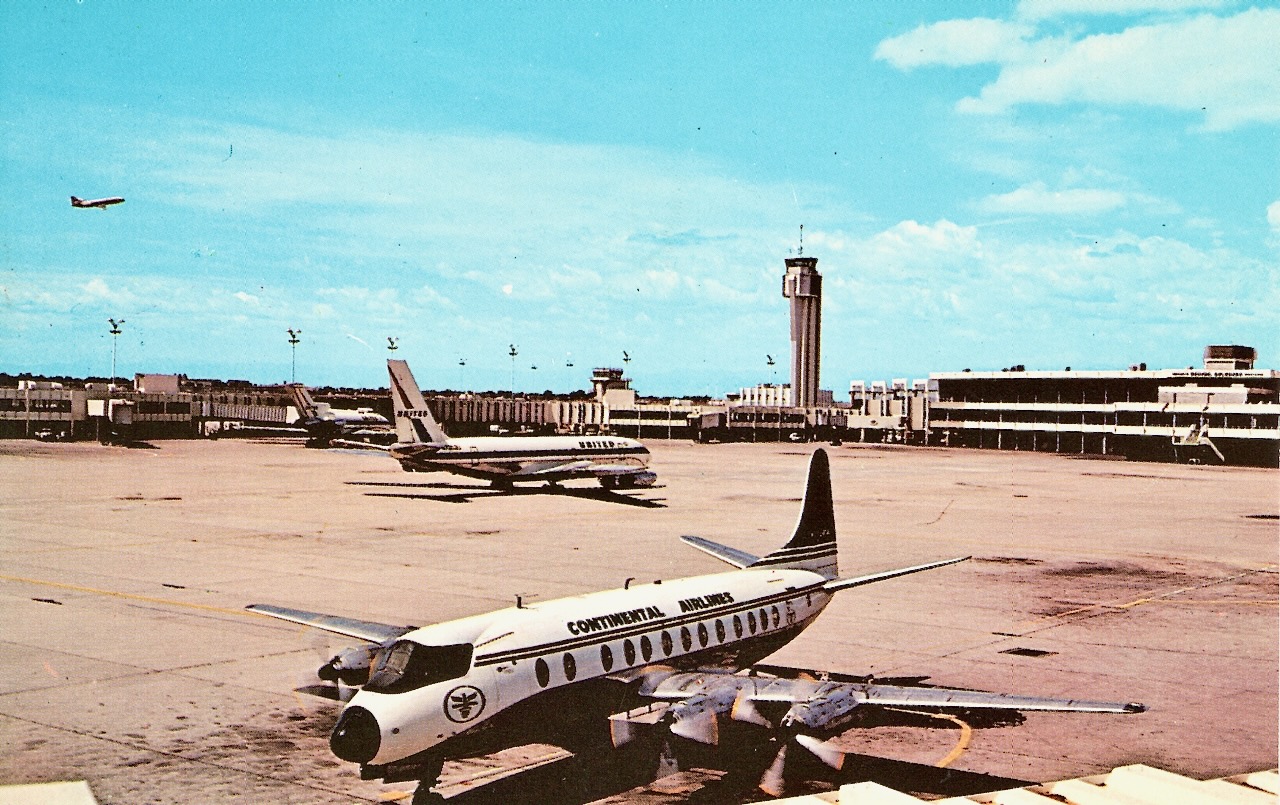
Continental Airlines Vickers Viscount at Denver Stapleton Airport, 1960s. Pub’r Colourpicture, Boston, no. P70865; dist’r G. R. Dickson Co., Denver. Here you can see the new iconic 12-story control tower that opened in 1962-63.
Although Stapleton Airport closed in 1995, its 12-story control tower still exists and is preserved as a historic landmark. The tower is now the home of FlyteCo Tower, an aviation-themed brewery and entertainment complex. The Doubletree Hotel, host for Airliners International 2026, is near the former Stapleton Airport area, and the show’s welcome reception will be held in the FlyteCo Tower, with tours of the tower available.
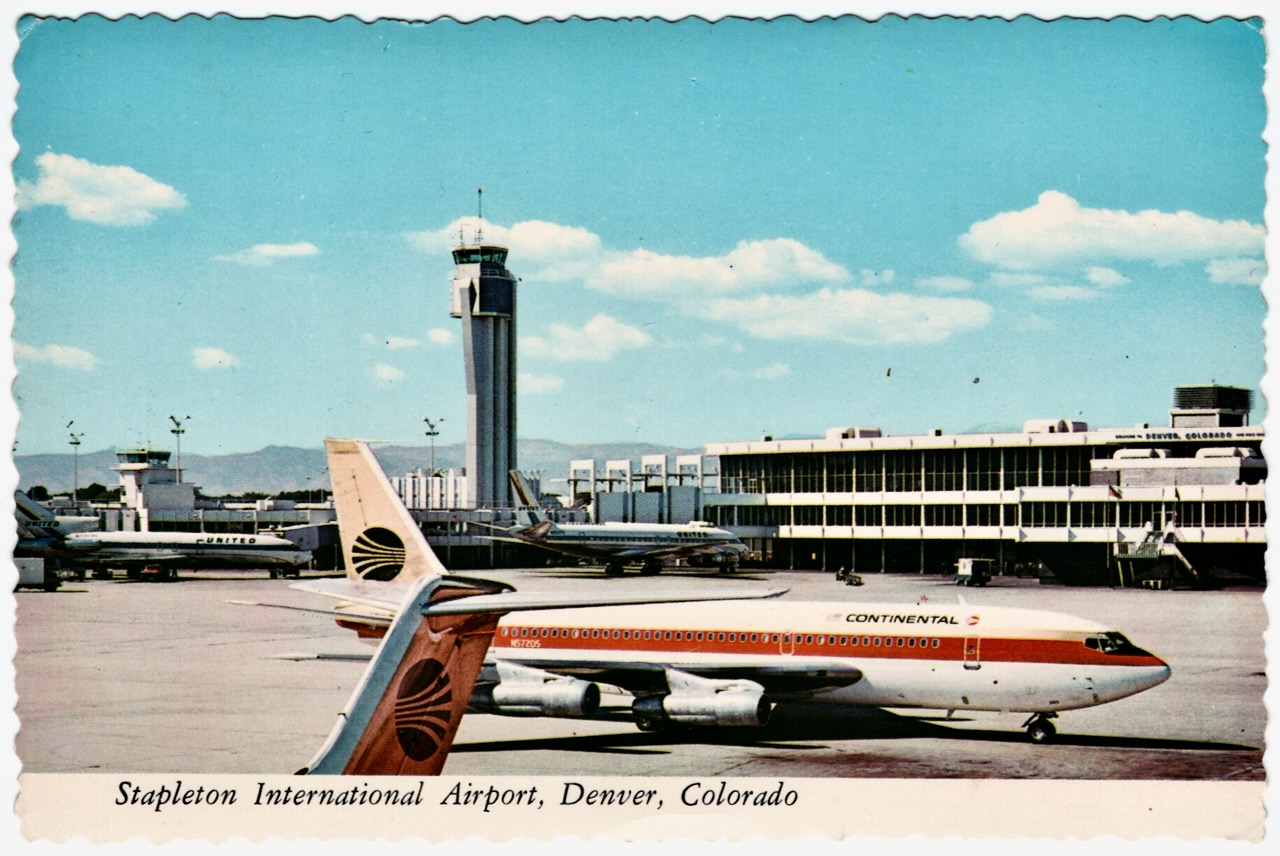
The jet age arrived in Denver in May 1959 when Continental Airlines started operating 707s into Stapleton Airport. My own very first flight was in December 1959 on a Continental 707 “Golden Jet” from Los Angeles (LAX) to Denver Stapleton. This postcard shows Continental Airlines Boeing 720, N57205, at Stapleton, with its tail bearing the classic Continental logo designed by Saul Bass and introduced in 1968. Pub’r Colourpicture, Boston, no. P87834; dist’r G. R. Dickson Co., Denver. The word “International” was added to Stapleton’s name in 1964.
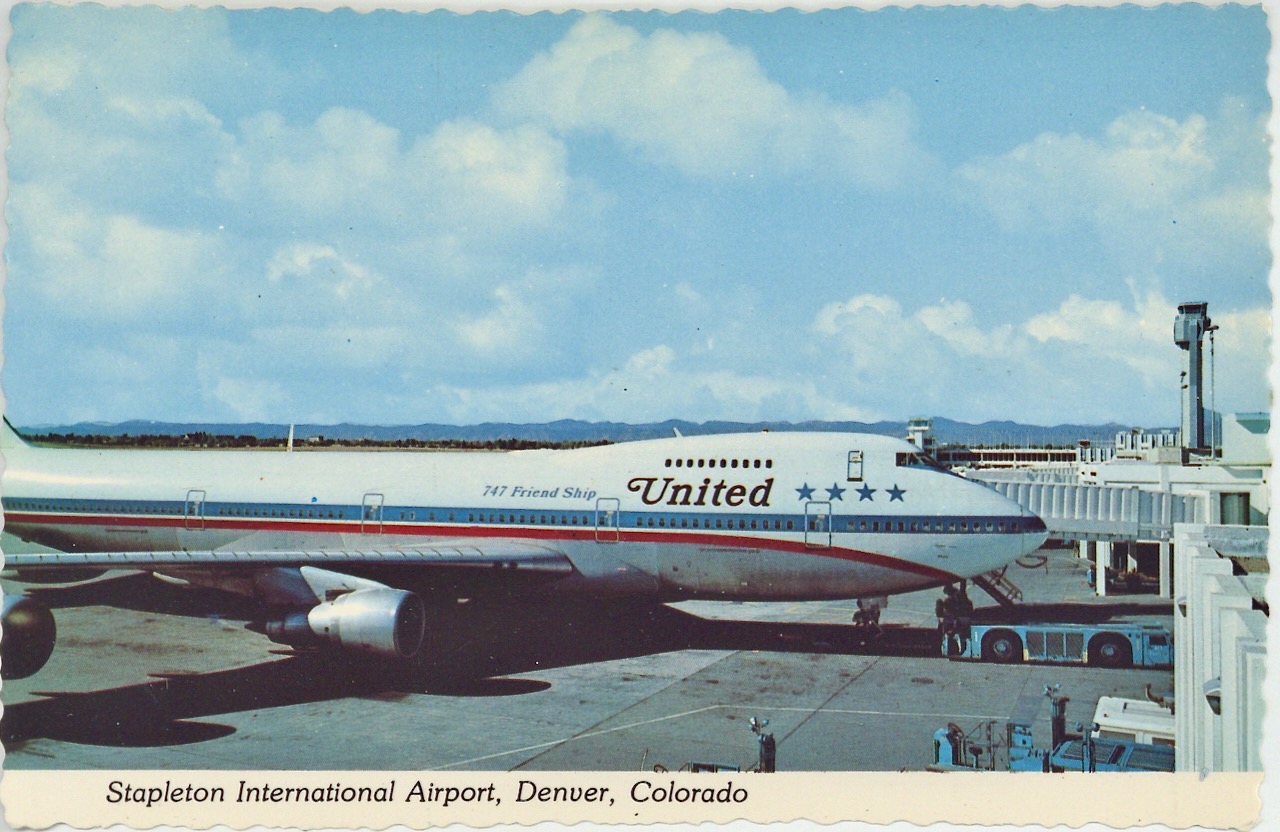
A United Airlines Boeing 747-200 at Stapleton International Airport, in United’s “Friend Ship” livery with four stars, in use during 1972 – 1974. Pub’r Colourpicture, no. P308472; Distributed by G.R. Dickson Co., Denver.
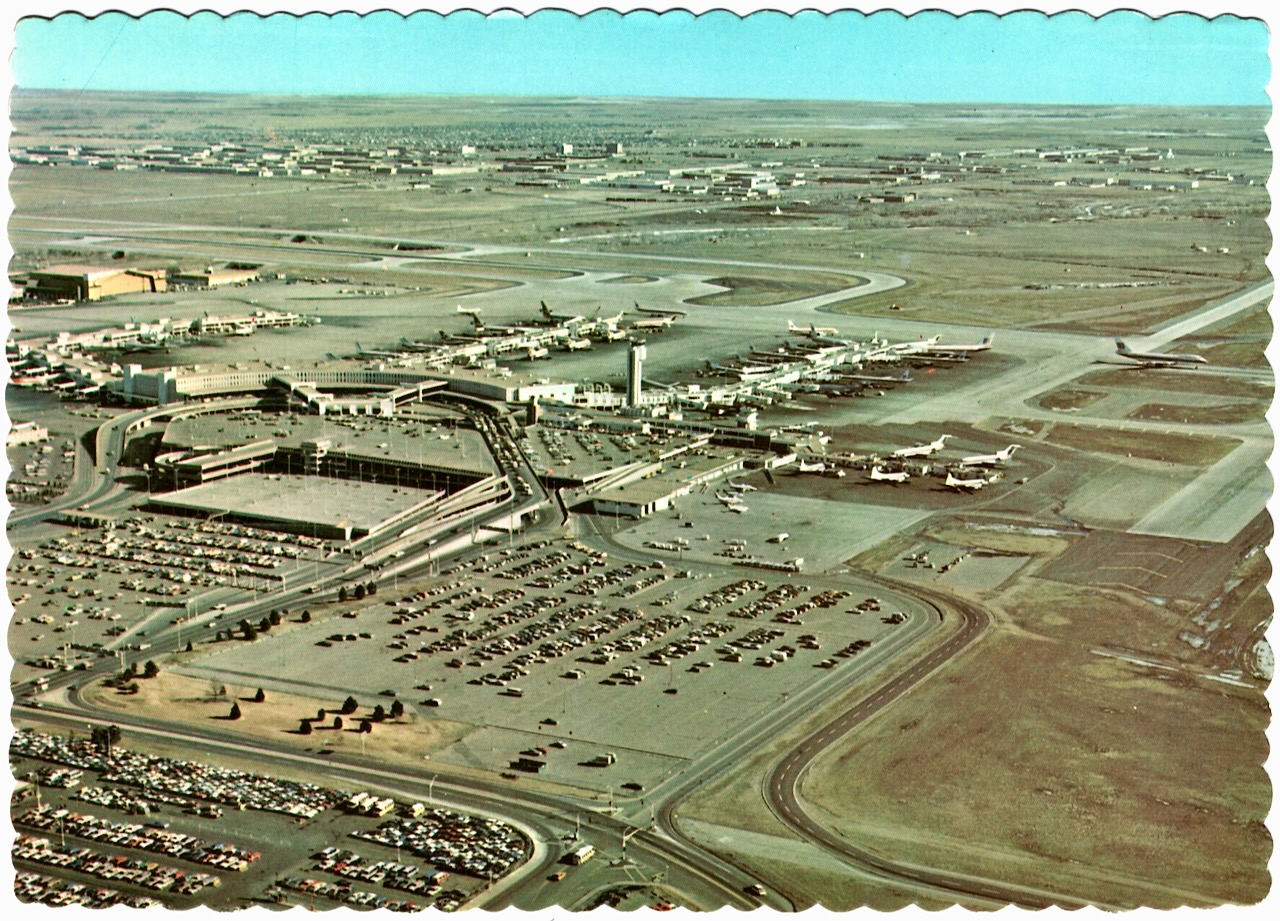
Aerial view of Denver Stapleton International Airport, probably early 1980s. Pub’r Sanborn Souvenir, Denver; printed by Dexter Press, no. 57034-D. Ex Allan Van Wickler Coll’n. Here you see the “horseshoe” arrangement of the main terminal roadways and the two main concourses in the middle — Concourse B for United and Concourse C for Continental. The original concourse, A, is to the right; and Concourse D, built in 1972, is to the left. Later, in 1988, Concourse E opened to the left of the view in this postcard.
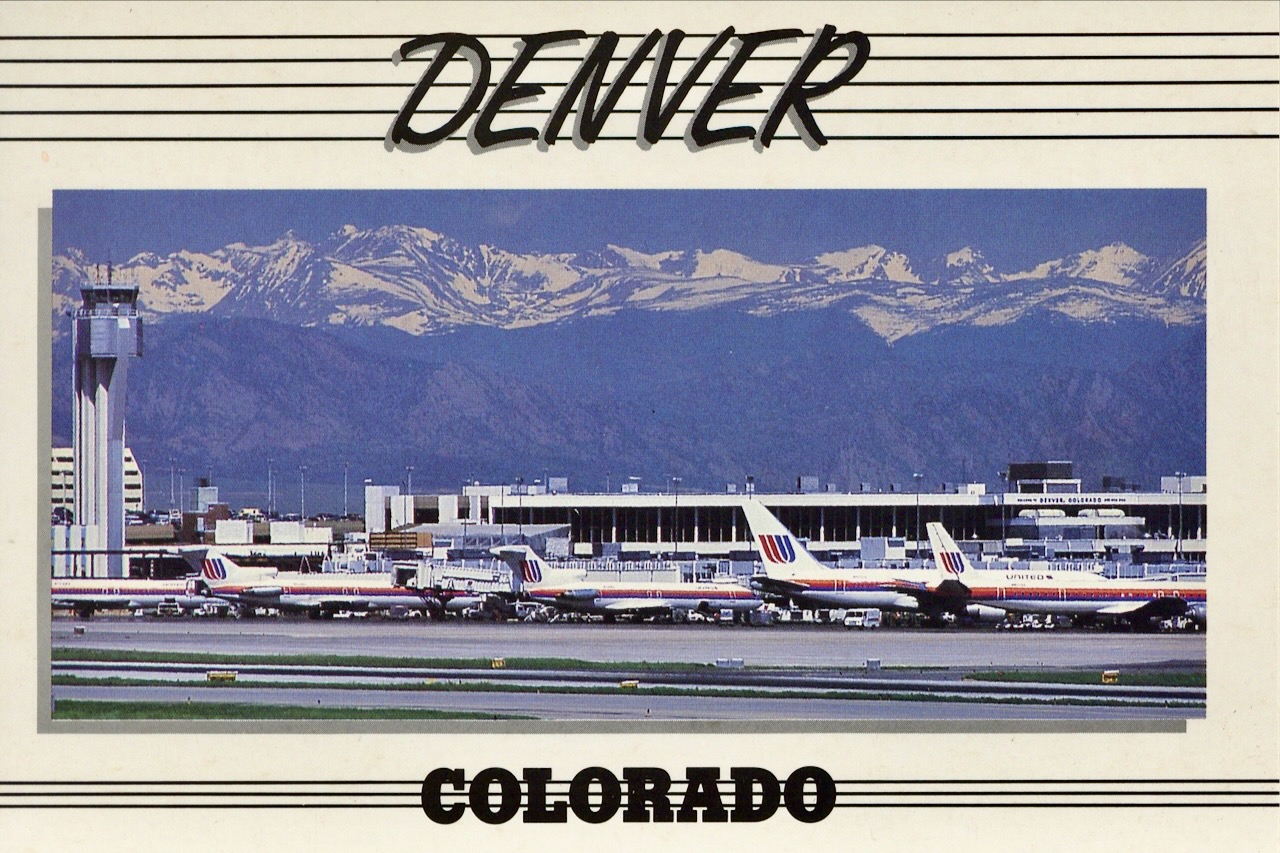
United Airlines aircraft at its Denver hub, Stapleton International Airport, probably in the 1980s. Printer Mike Roberts, Oakland, CA, nos. B16284/D-133; dist’r G. R. Dickson, Denver; photo by Arthur H. Bilsten. Boeing 727s and a 767 can be seen along with a Douglas DC-8. The double “U” logo on the United tails was designed by Saul Bass and introduced in 1974, and United operated the first commercial service of a 767, from Chicago to Denver Stapleton, in May 1982.
The rapid growth of Stapleton’s passenger traffic, coupled with the inability to acquire more land for expansion, led to the construction of a new primary airport for Denver. Following many years of planning and construction, Denver International Airport was finally ready. The last flight departed Stapleton on February 27, 1995, and Denver International Airport opened the next morning. Stapleton was decommissioned, and today the only remaining structure is the preserved 12-story control tower. The rest of Stapleton Airport is now a multipurpose development, including residences, businesses, and parks.
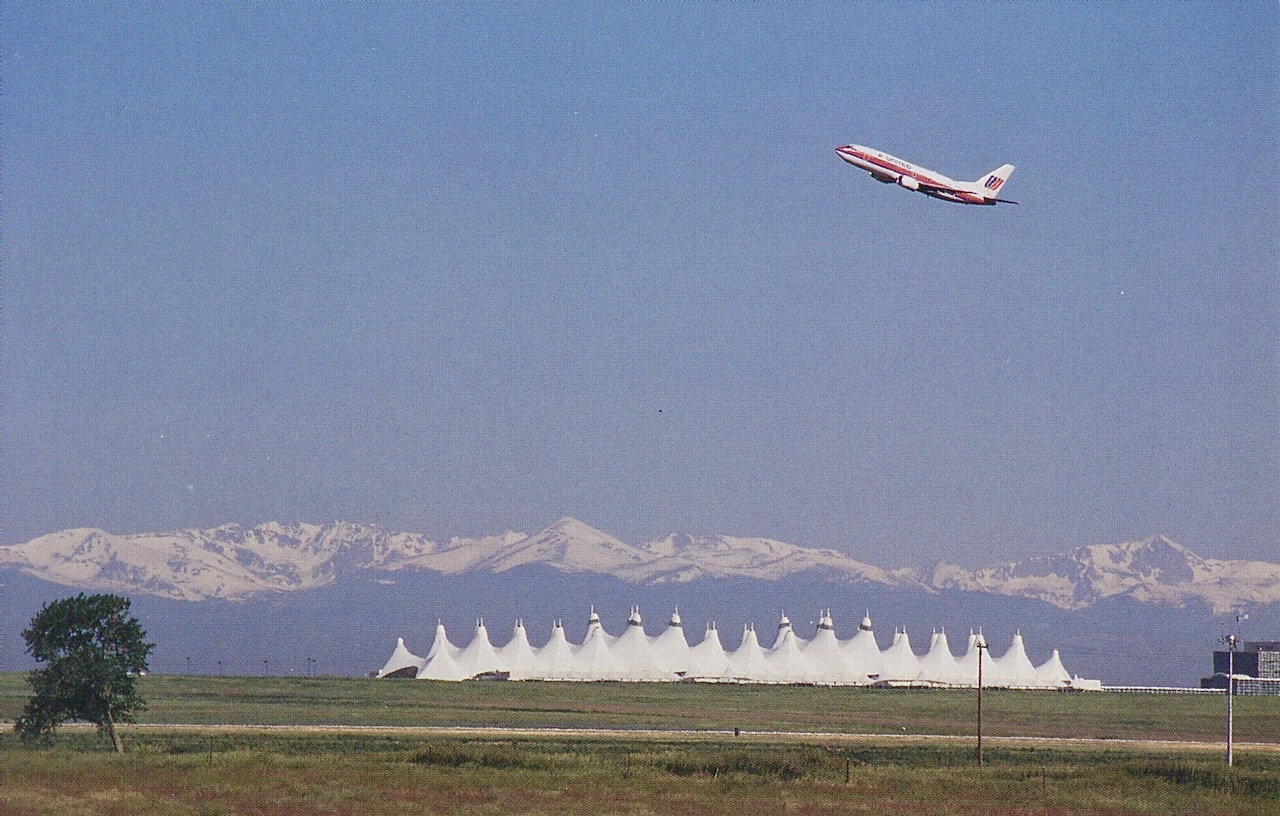
Today’s primary Denver airport, Denver International (DEN), which opened February 28, 1995, can only be described with superlatives. Its sheer size is overwhelming — 53 square miles (137.8 square km) of land, about twice the land area of Manhattan and about twice that of Dallas-Ft. Worth Airport. Its terminal, named after pioneering airline pilot and Denver native Elrey Jeppesen, contains 2.6 million square feet (241,548 square meters) of space and leads to over 170 gates. The terminal’s translucent white tented peaks, designed to simulate the Rocky Mountains in the background, look stunning from the air and impressive from ground level.
Denver International now has six non-intersecting runways. Five are 12,000 ft. (3657m) each in length. The sixth runway (16R/34L) is 16,000 ft. (4875m), over three miles long, the longest commercial runway in North America. That extra length is particularly useful because of Denver’s mile-high elevation and summer heat. Moreover, because of the airport’s enormous land area, it has room to add up to six additional runways if and when needed.
In 2025, over 82 million passengers passed through Denver International Airport, making it the 4th busiest airport in the U.S. and the world’s 10th busiest airport. Denver Airport expects further growth and has adopted a two-phase strategic plan – “Vision 100” to prepare the airport to serve 100 million passengers annually in the next several years, and “Operation 2045” for an expected 120 million+ passengers by its 50th anniversary in 2045.
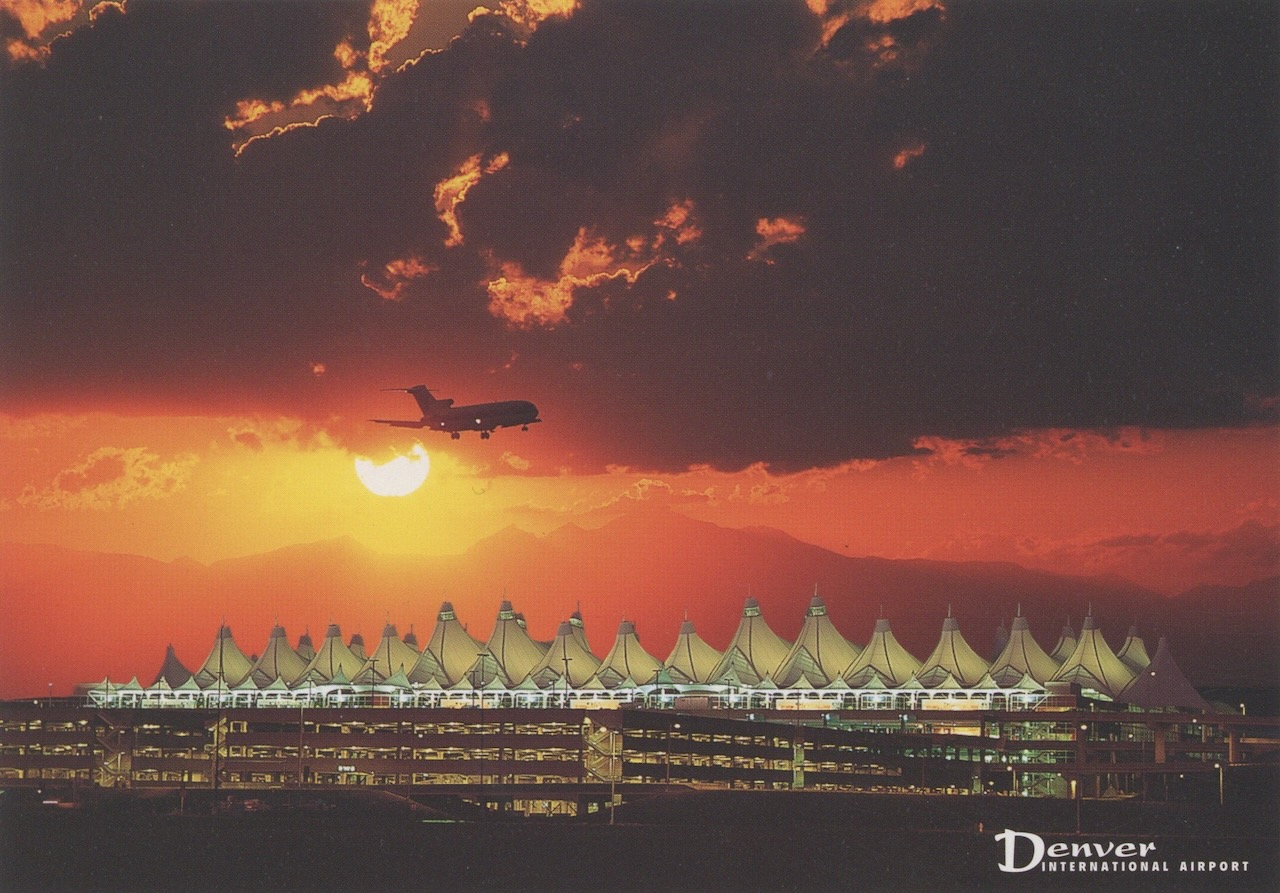
Denver International Airport opened on February 28, 1995, replacing Denver Stapleton International Airport. As seen in this postcard, the white tented peaks of the airport’s Jeppesen Terminal stand out impressively, with the Rocky Mountains in the background and a United Airlines plane climbing after takeoff. Publ’r Sanborn Ltd., Commerce City, Colorado; photo by Ron Ruhoff.
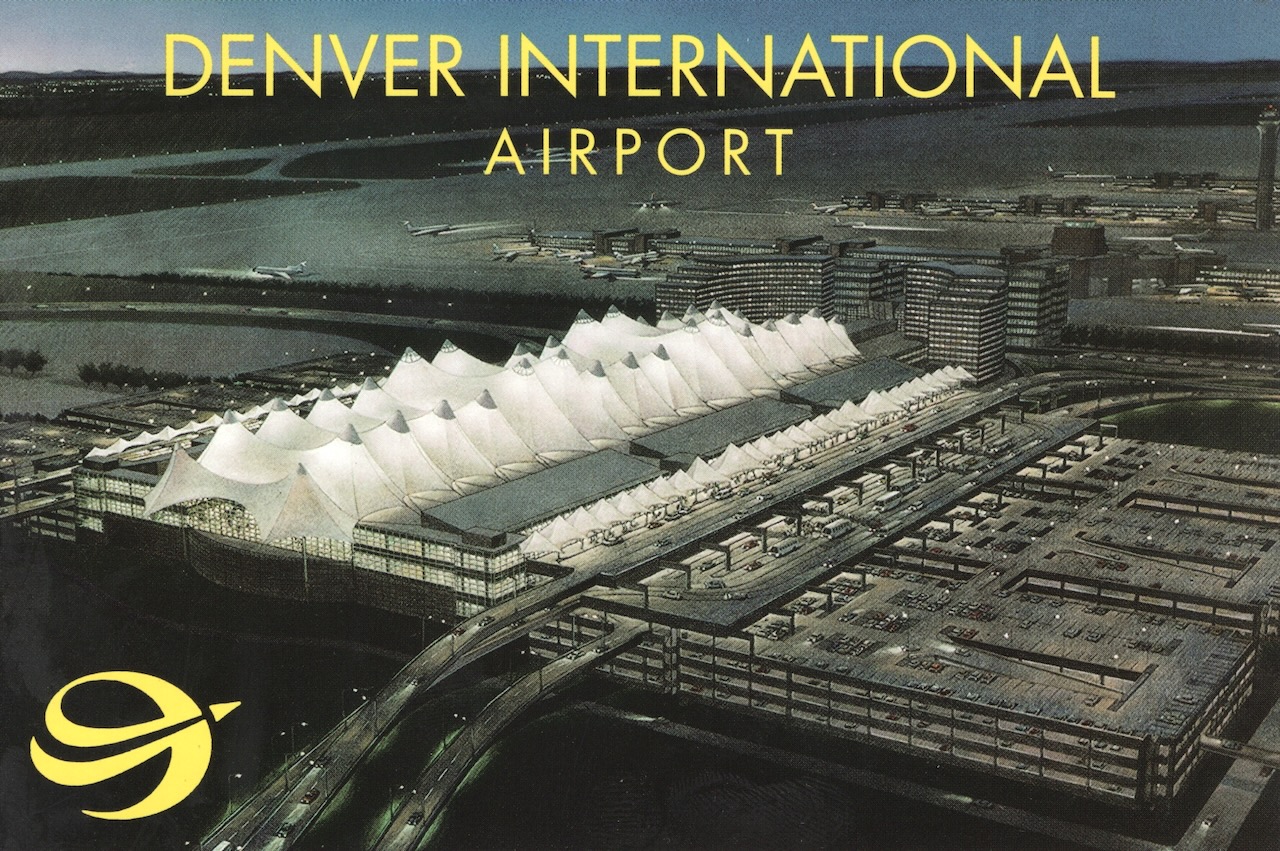
Denver International Airport at dusk. The translucent Teflon-covered fiberglass roof pinnacles of the Jeppesen Terminal create a lighted beacon effect at night. The airport logo appears in the lower left-hand corner. Pub’r Mountain States Specialties, Boulder, CO; Printer Mike Roberts, Oakland, CA, no. B20211.
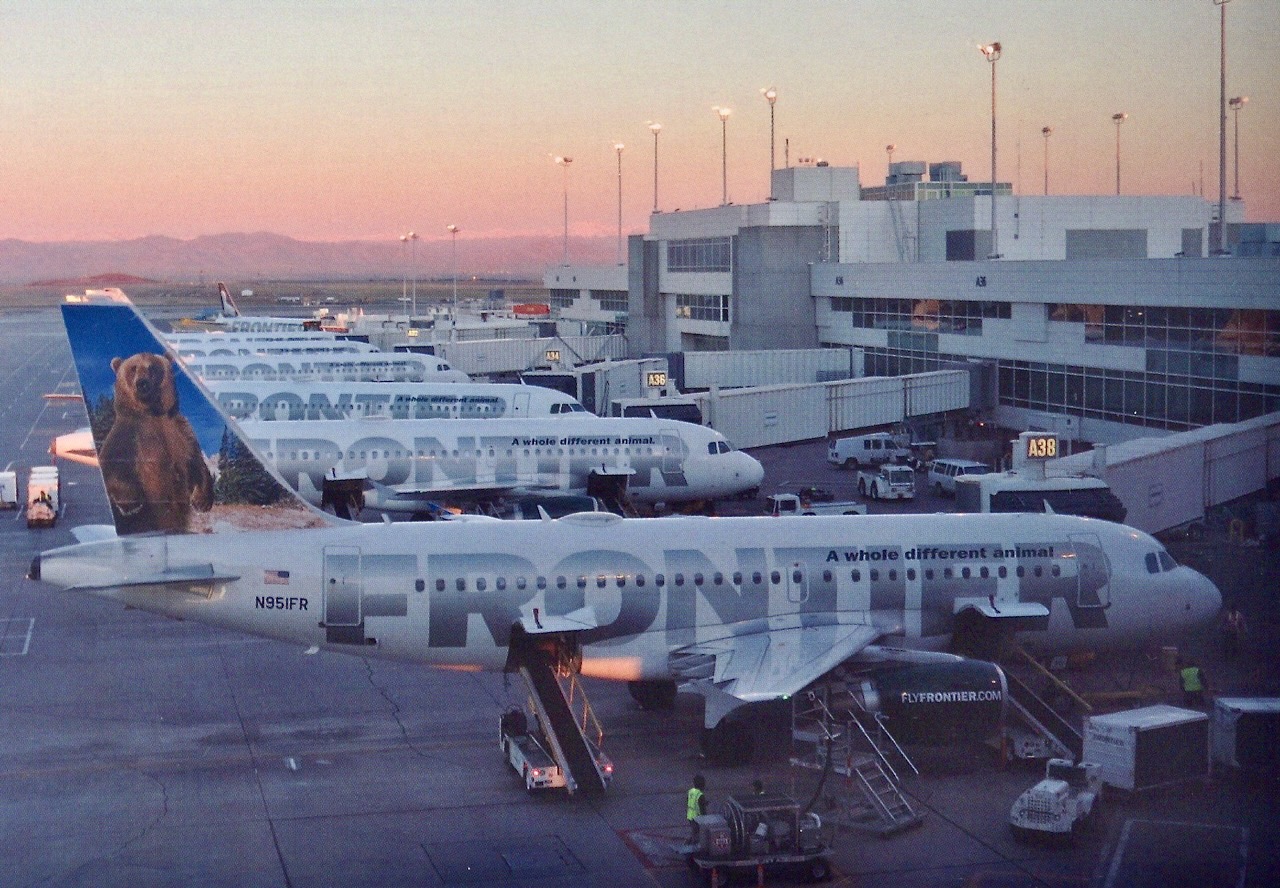
Frontier Airlines aircraft at the west portion of Concourse A at Denver International Airport at sunrise, October 14, 2014. In front is Frontier Airbus A319, N951FR. No. 1 of seven postcards issued for Airliners International 2017 Denver; pub’r jjpostcards, Bassendorf, Switzerland; photo via Aaron Mandolesi.
Denver International Airport at sunset. Pub’r Impact Colorado no. 40281; Photo by Bob von Normann.
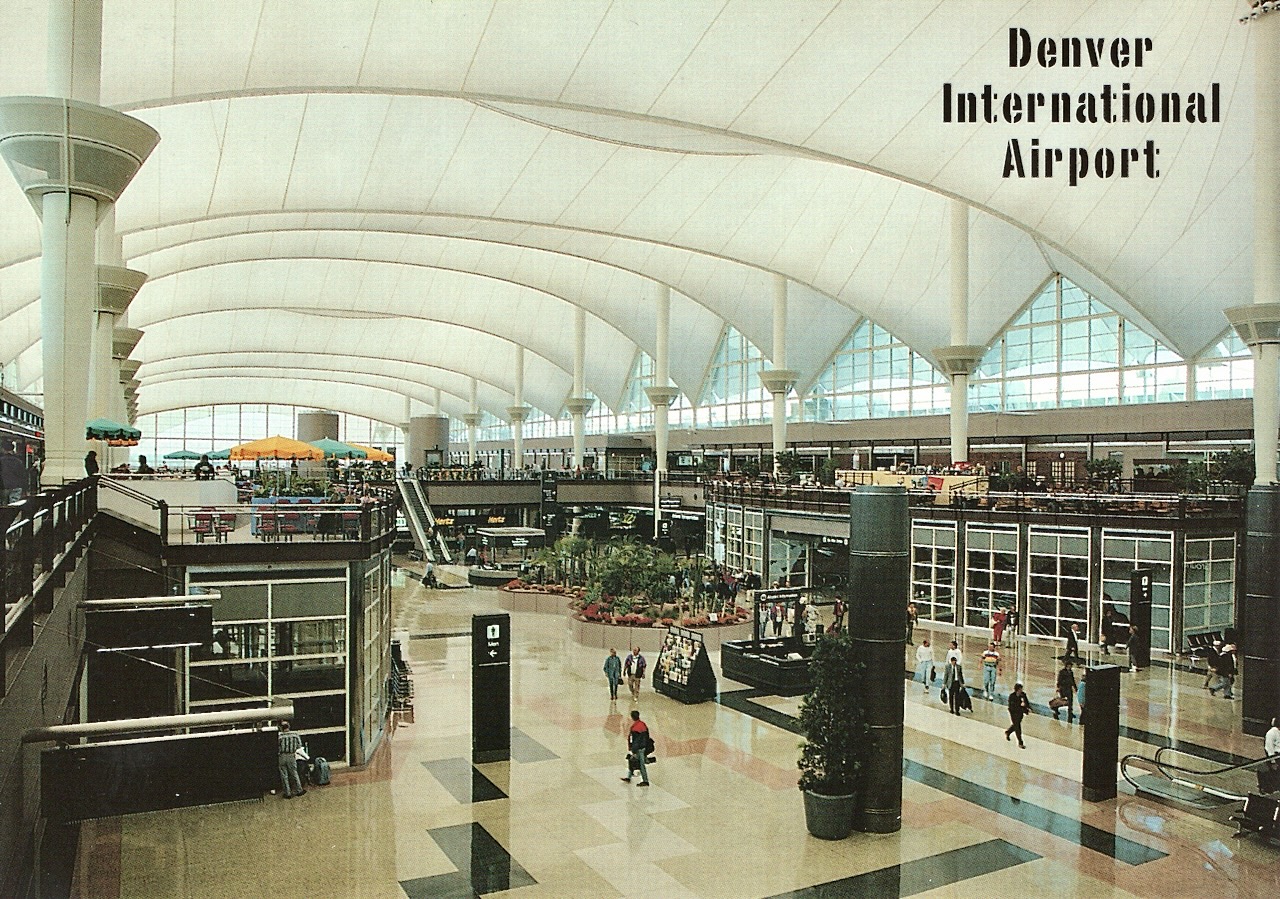
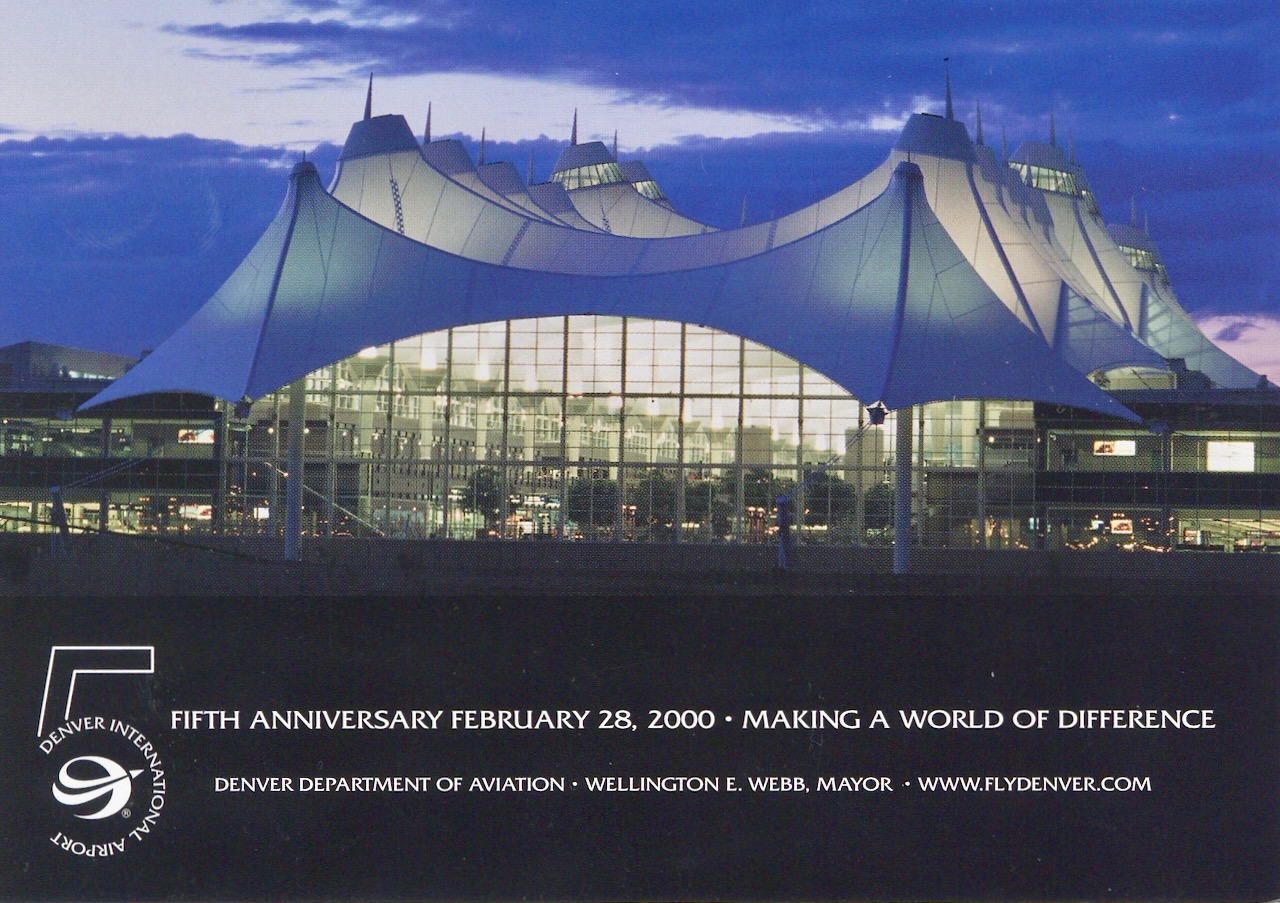
Postcard commemorating the 5th anniversary of Denver International Airport, February 28, 2000, showing the distinctive peaked Jeppesen Terminal illuminated by its spacious atrium. Issued by the Denver Department of Aviation.
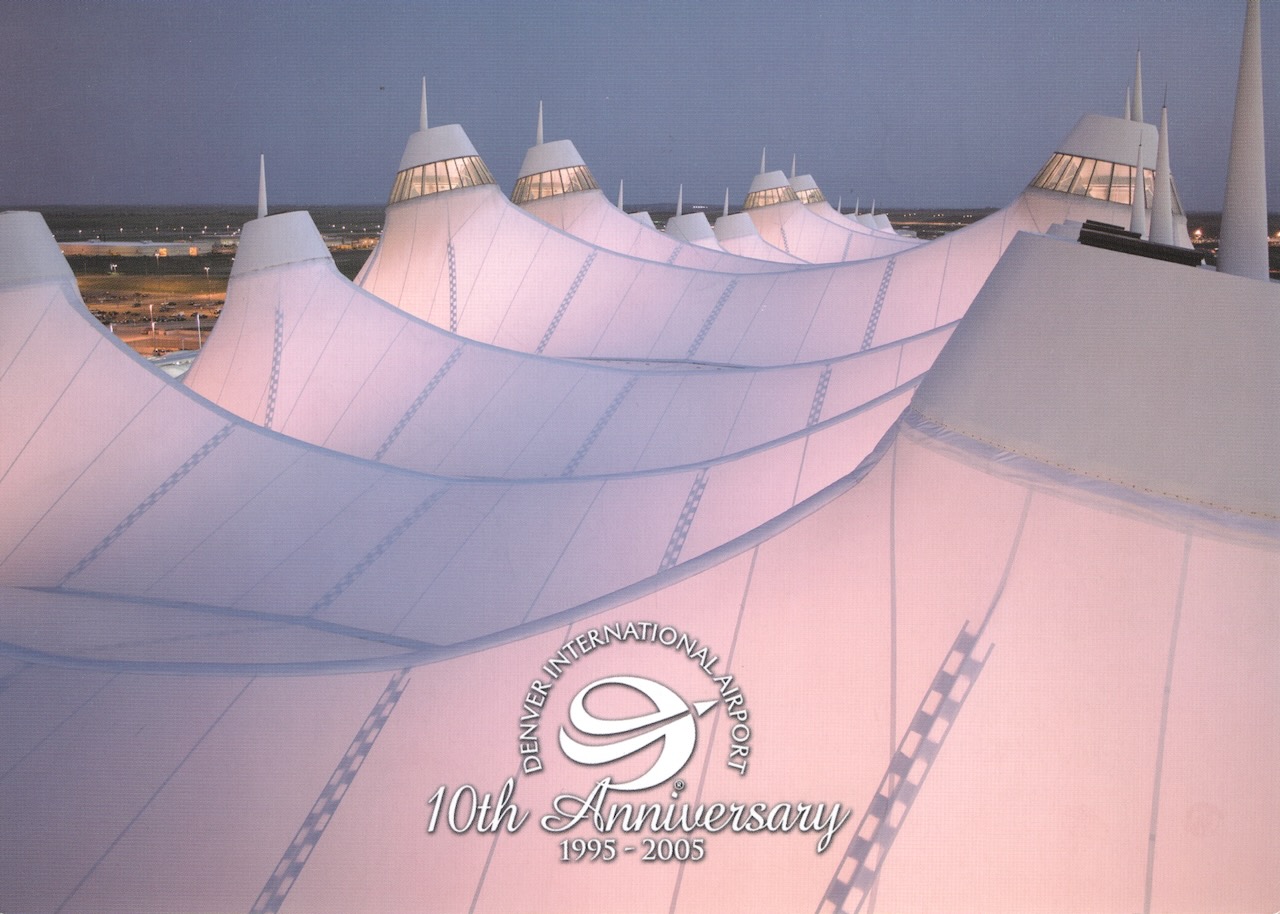
Denver International Airport Jeppesen Terminal “billowing sails” art postcard issued by Denver Airport on its 10th Anniversary in 2005. Oversize.
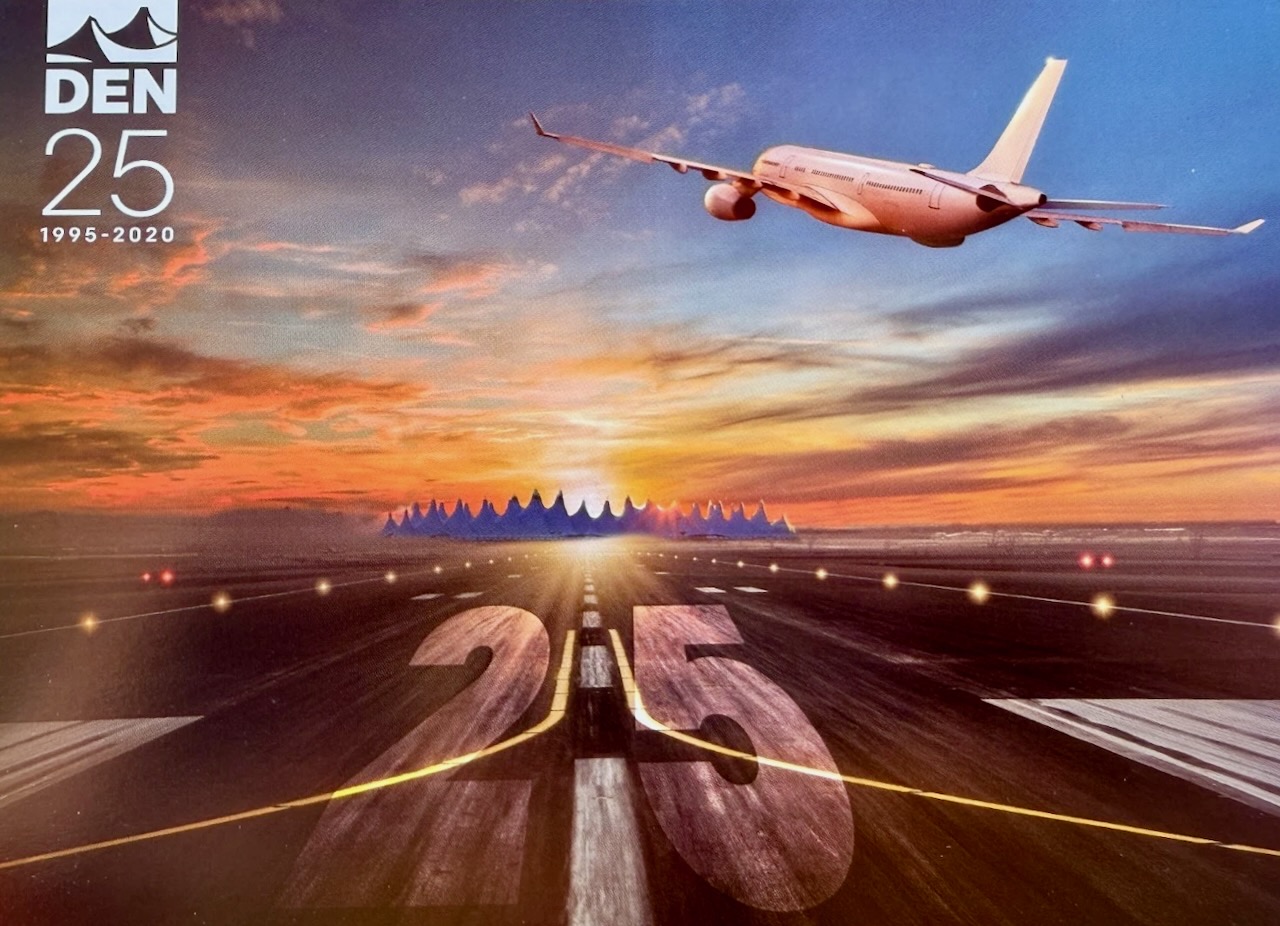
Denver International Airport 25th Anniversary postcard, issued by the Denver Department of Aviation in 2020 for the Airport’s “Don’t Stop Believing” Exhibit in the Jeppesen Terminal.
Note: All postcards shown are from the author’s collection except the last one. I estimate their rarity as follows: Uncommon: the United DC-4s at Stapleton postcard and the three Denver International Airport anniversary postcards.
References:
The Denver International Airport website: flydenver.com
Airliners International 50th Anniversary Show and Convention, 2026 Denver
June 24-27, 2026, at the Doubletree Hotel, Quebec St., Denver, CO:
Details found at airlinersinternational.org, the convention website. Registrants can submit airline and airport postcard exhibits for display at the show; see the Postcard Exhibit Rules posted on the convention website.
In 1925, the owner of Coca-Cola, Asa Candler, leased to the City of Atlanta his abandoned auto racetrack site for development into an airfield named Candler Field.
The first airlines to serve Atlanta were Florida Airways which operated from 1926 to 1927; St. Tammany Gulf Coast Airways, 1927, which became a division of Southern Air Transport System in 1929 and in turn part of American Airways in 1930; Pitcairn Aviation which started in 1927, was renamed Eastern Air Transport in 1930 and then became part of Eastern Air Lines in 1934; and Delta Air Service (later named Delta Air Lines) in 1930. During the 1930s, both Delta and Eastern expanded their routes into and out of Candler Field and became the main airlines serving Atlanta at the time.
In 1929, the City of Atlanta purchased the airfield from Asa Candler on favorable terms, and though the airport was officially renamed Atlanta Municipal Airport in 1942, it continued to be popularly referred to as Candler Field.
Here is my earliest postcard of Candler Field showing an airline:
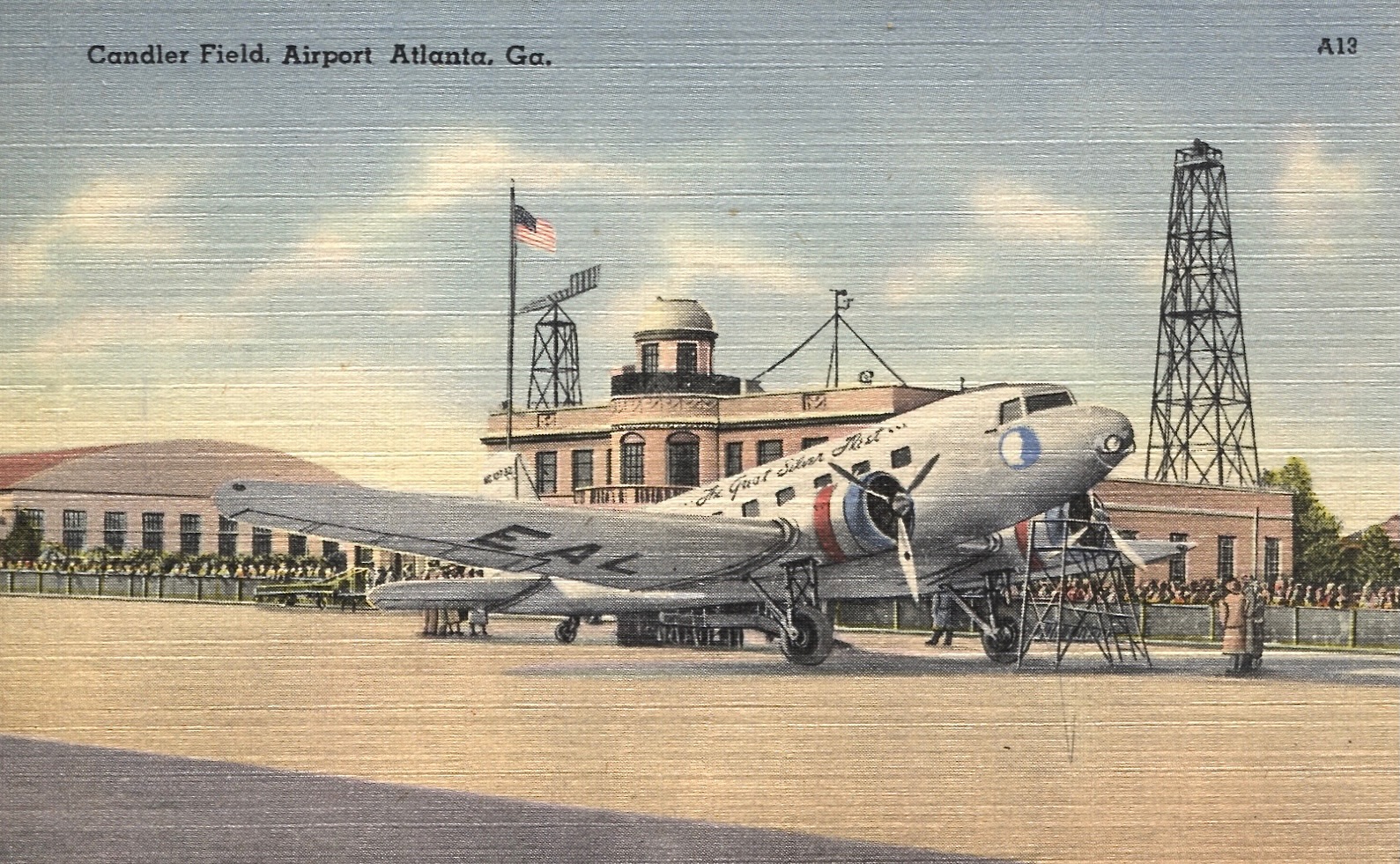
Eastern Air Lines Douglas DC-2 at Atlanta’s Candler Field, mid-1930s. ‘Linen’ finish. Publisher Tichnor Bros., Boston, no. 65610. The airport’s terminal building, which opened in 1932, appears behind the center of the aircraft. The card back says “Twenty-six passenger and mail planes arrive and depart daily from this great modern airport…”(Today, those 26 planes have grown to more than 2,700 daily!)
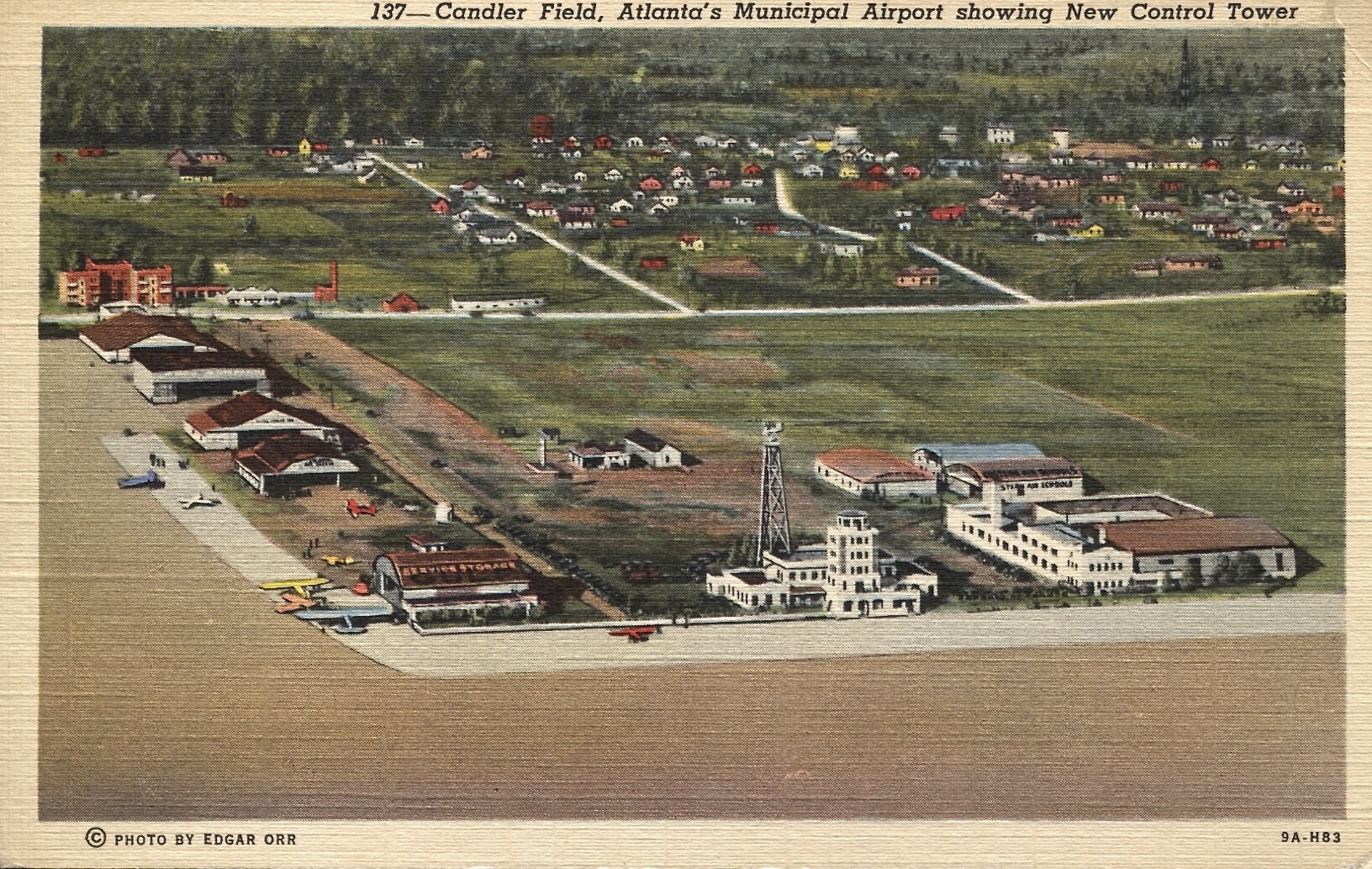
In March 1939, Candler Field built its first control tower in a six-story building with administrative facilities. The control tower can be seen in this next card:
Aerial view of Candler Field showing new control tower in center, 1939. Pub’r Curteich no. 9A-H83. ‘Linen’ finish. The back of the card now proudly claims 28 daily airline arrivals/departures (up from the previous card’s 26).
In 1940, Delta Air Lines acquired four DC-2s, but these were retained only until the end of that year, being replaced by DC-3s.
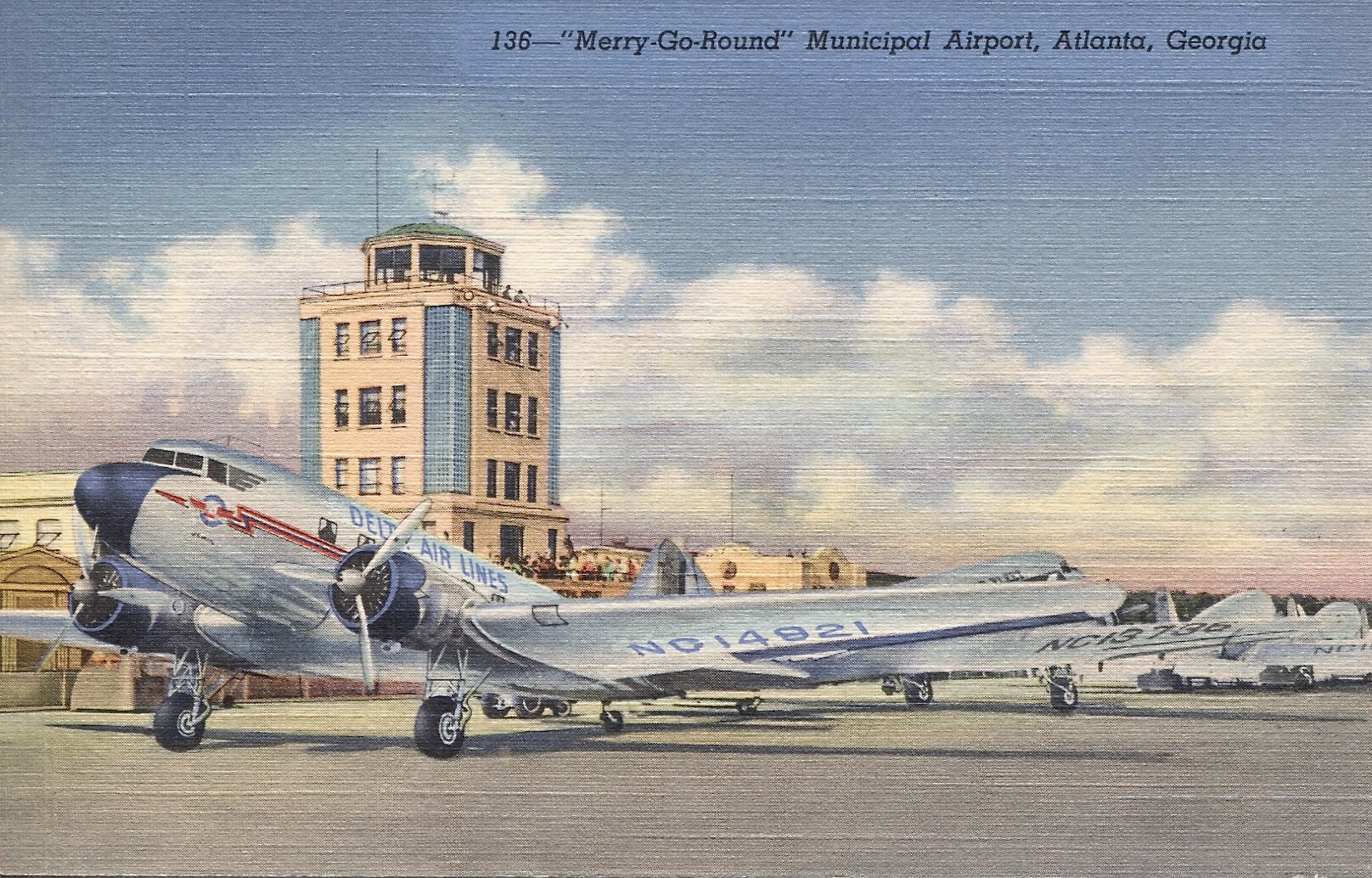
Delta Air Lines Douglas DC-2, NC14921, at Atlanta, 1940. ‘Linen’ finish. Pub’r Curteich no. 0B H1385. There are two versions of this card. This one refers to the “Merry-Go-Round” at the airport, stating on the back: “Large crowds gather twice a day to view the arrival and departure, within a space of only a few minutes time, of seven large passenger ships; and this spectacular sight is known as the famous Merry-Go-Round.” The other version lacks this reference.
During World War II, Candler Field also became a U.S. air base, and it doubled in size. In 1941, Delta moved its headquarters from Monroe, Louisiana, to Atlanta, and for decades it has been the dominant airline there.
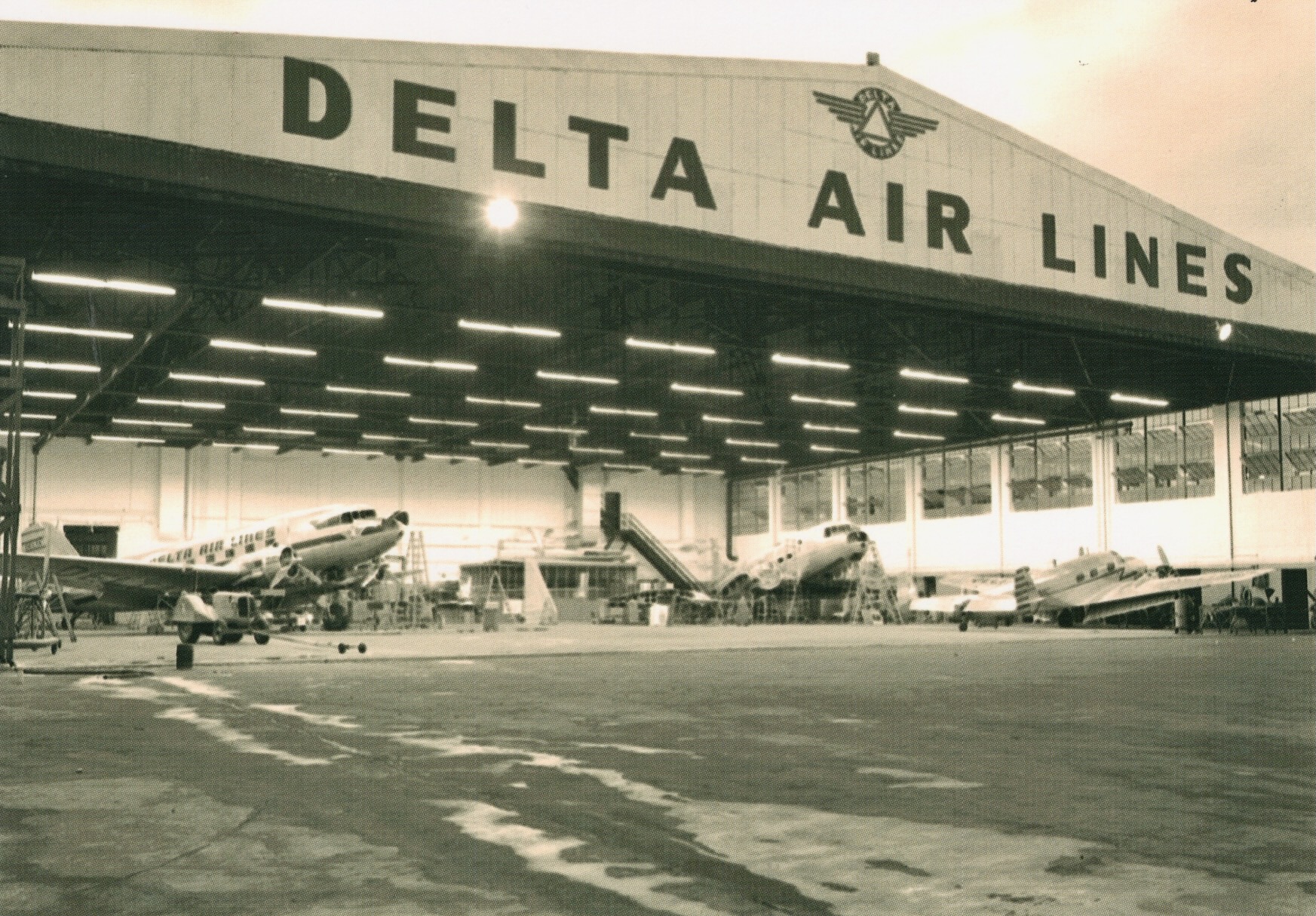
The Delta Air Lines hangar at Candler Field/Atlanta Municipal Airport with Douglas DC-3s and a Lockheed 12A Electra Junior, early 1940s. Postcard issued by Airliners International 2015 ATL. Pub’r jjPostcards. Photo courtesy of the Delta Flight Museum. Today, this hangar is part of the Delta Flight Museum, site of Airliners International ATL 2025.
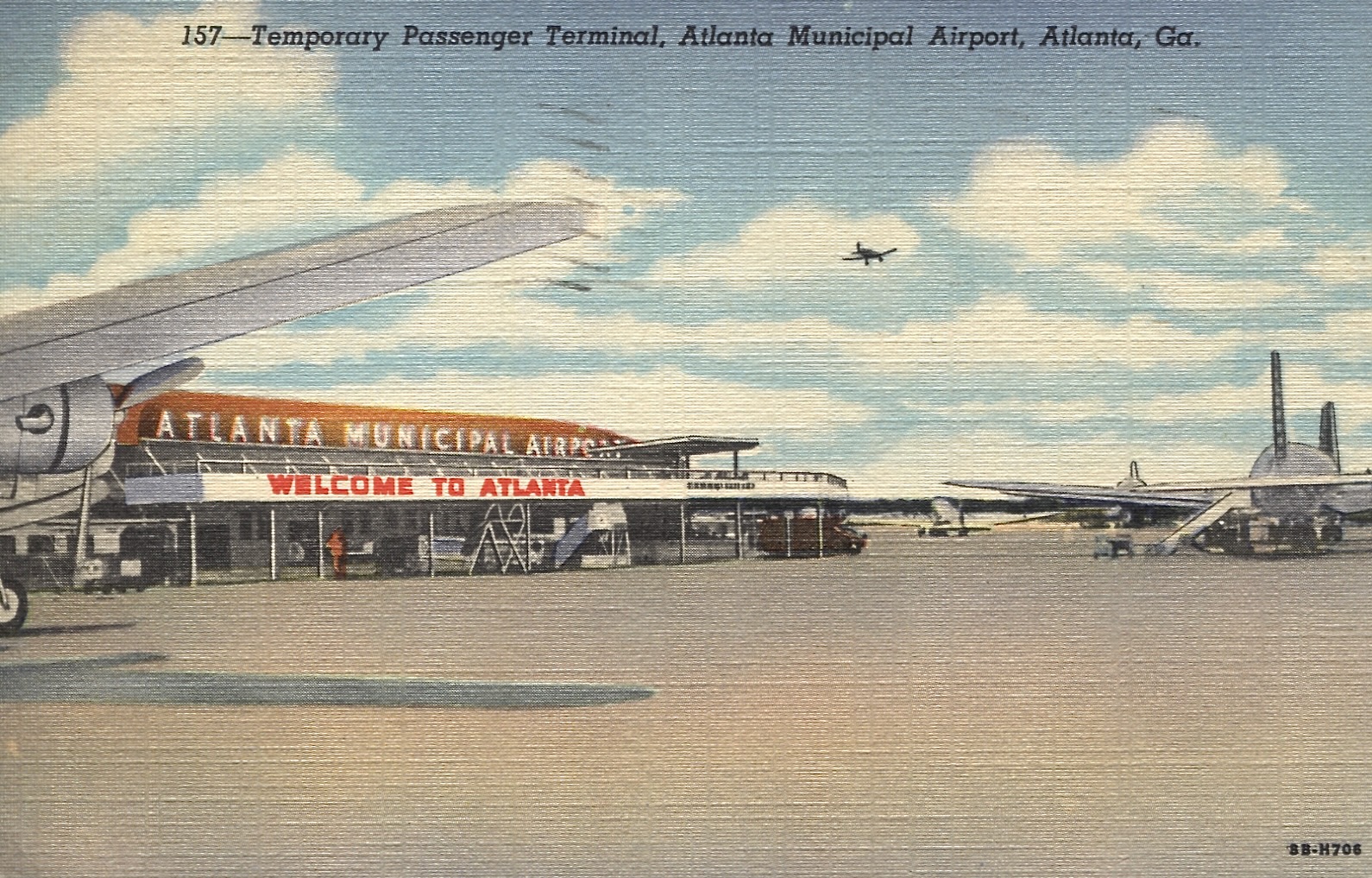
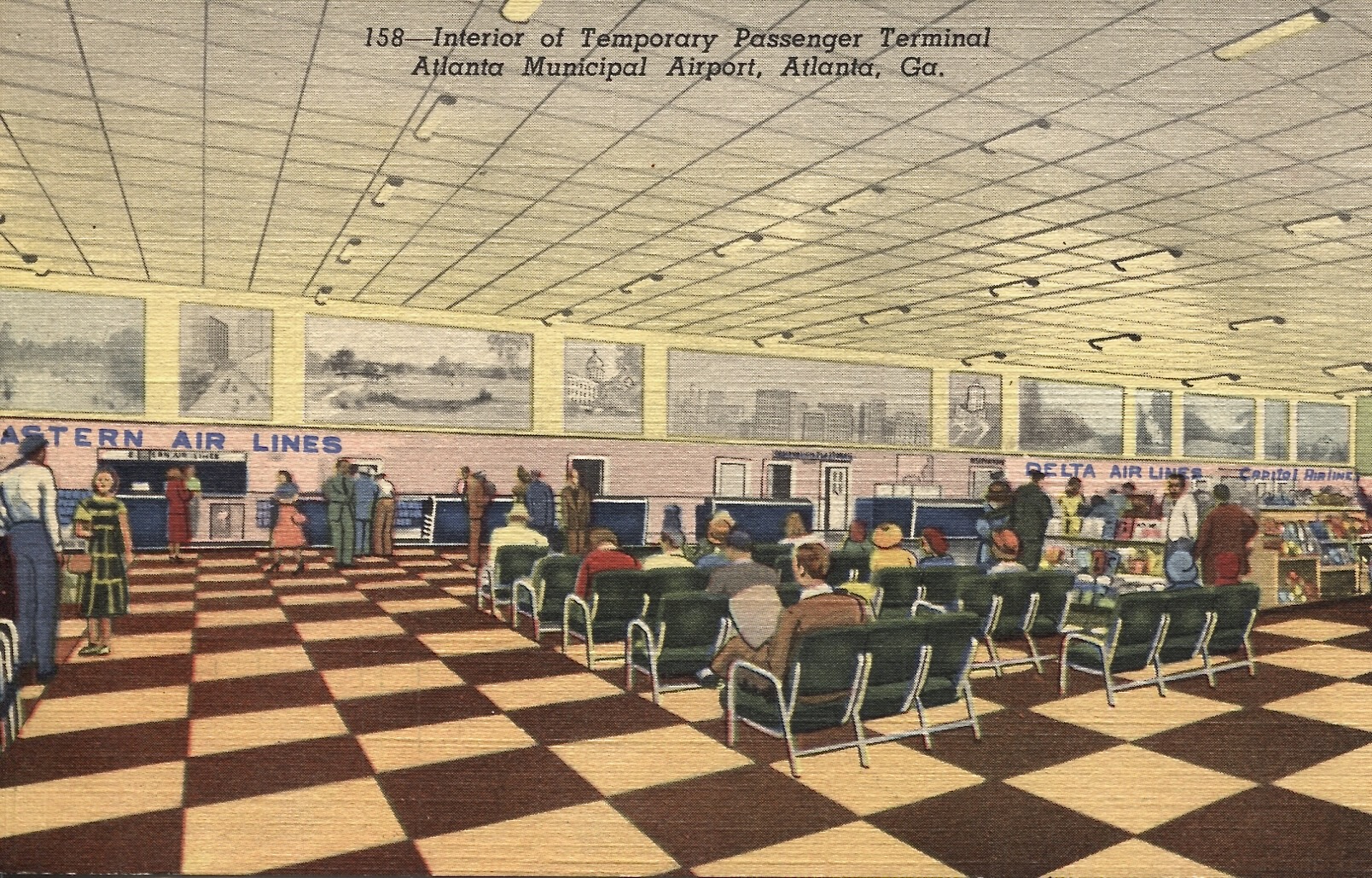
Passenger numbers continued to grow, and in 1948 the airport closed its old terminal building and moved operations into a Quonset hut war-surplus “temporary” terminal while it developed plans to build a larger permanent terminal. That year saw more than 1 million passengers pass through Atlanta airport.
The “temporary” terminal proved to be not so temporary. It served until May 1961, when a new terminal designed to accommodate the jet age finally opened. Here are three postcards from the “temporary” terminal era (1948-1961) at Atlanta Municipal Airport.
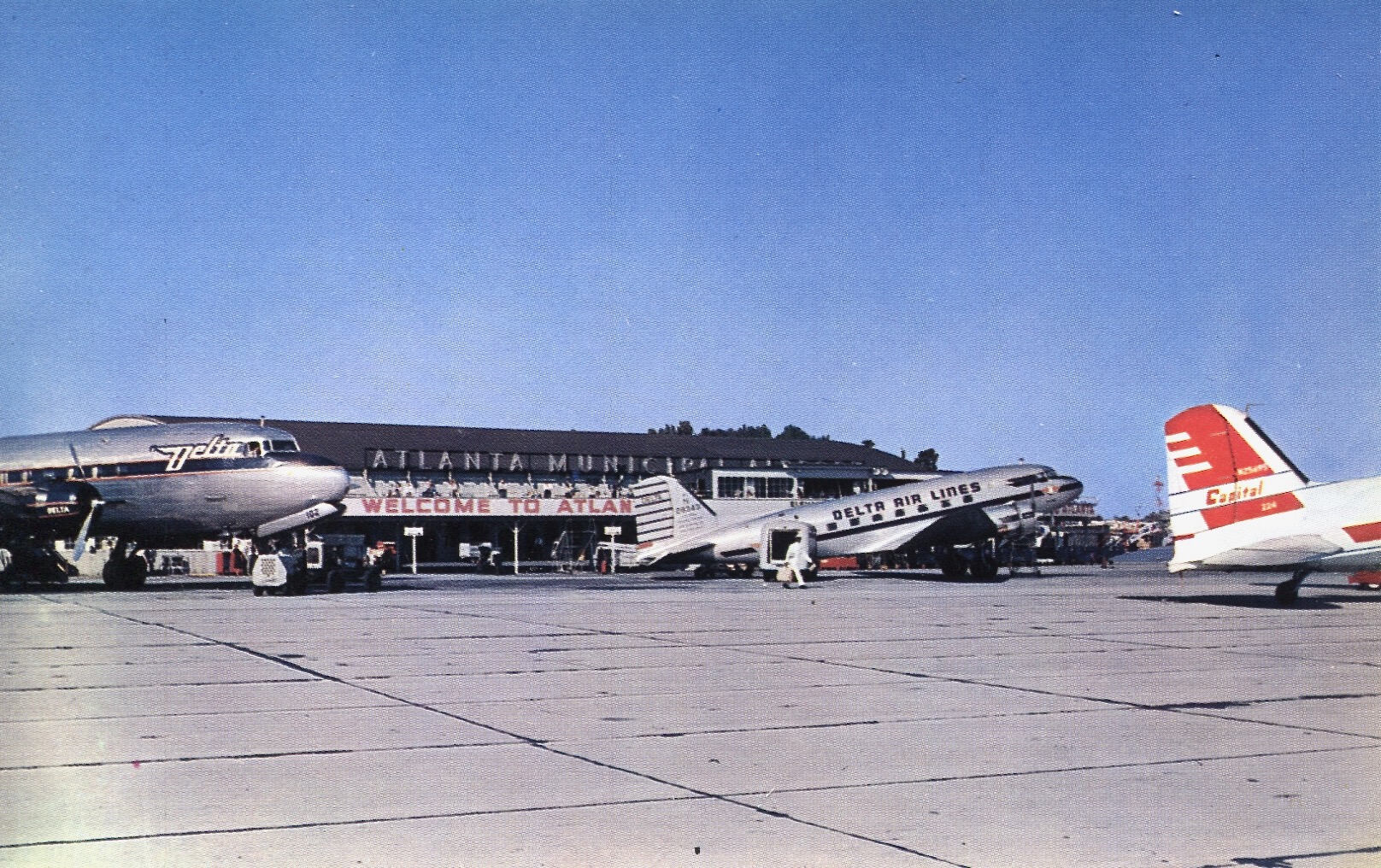
Delta Douglas DC-6, N1902M, Delta DC-3, NC28343 “City of Miami,” and Capital DC-3 in front of Atlanta Municipal Airport “temporary” terminal, about 1949. Pub’r Atlanta News Agency, Dexter Press 50317.
Interior of the “temporary” passenger terminal at Atlanta Municipal Airport, 1948. ‘Linen’ finish. Pub’r Curteich no. 8B-H1640. In this view, you can see ticket counters for Eastern, Delta and Capital Airlines. The back of the card says “The ticket counter, 200 feet in length, is the world’s longest.”
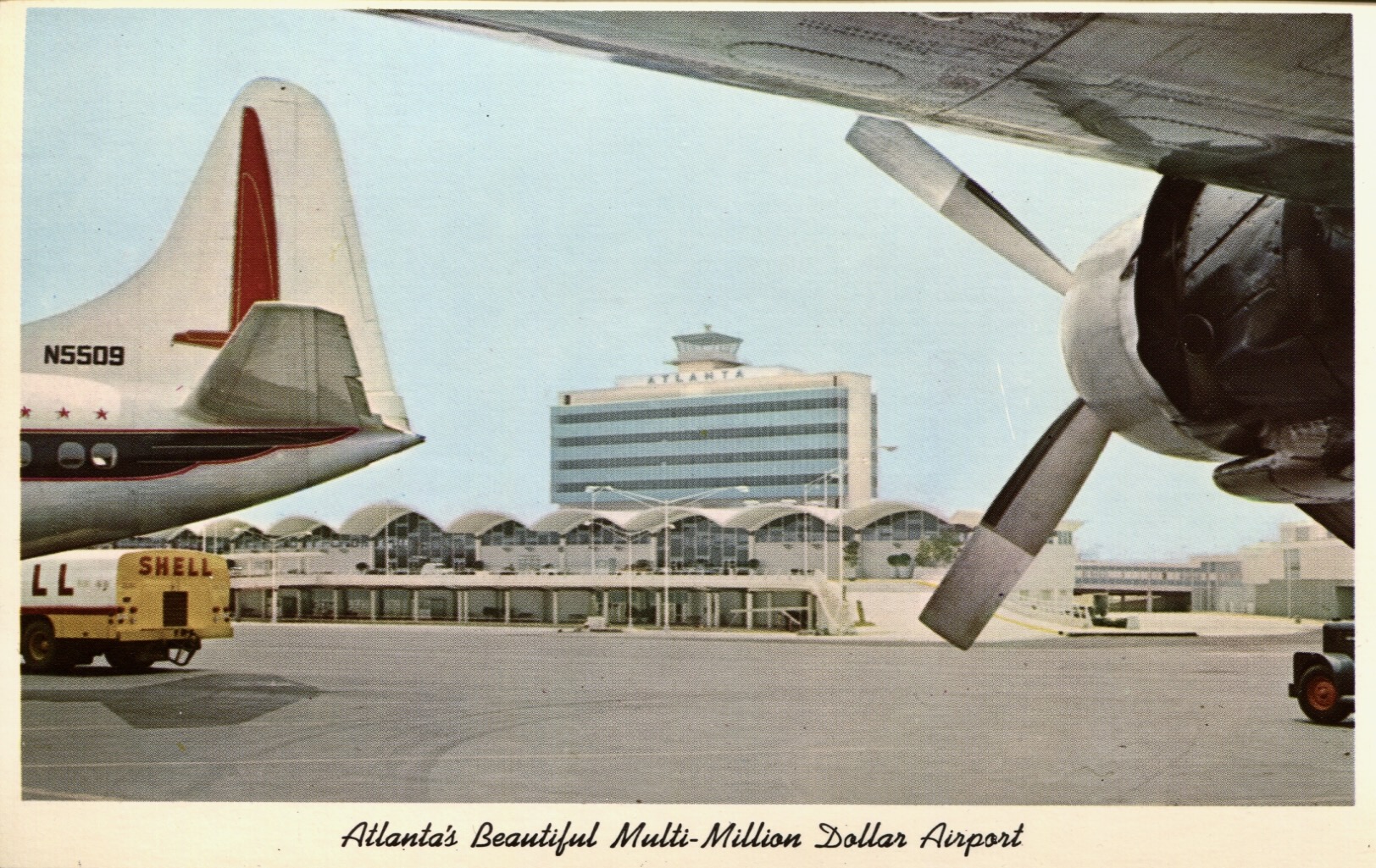
On May 3, 1961, Atlanta Municipal Airport finally opened its new Jet-Age terminal, publicizing it as the largest single terminal in the U.S. The terminal was designed to accommodate 6 million passengers a year, but in its first year, 9.5 million passengers utilized it!
New Jet-Age Terminal at Atlanta Municipal Airport, with tail of an Eastern Air Lines Lockheed L-188 Electra, N5509, 1961. Pub’r Curteich 1DK-777.
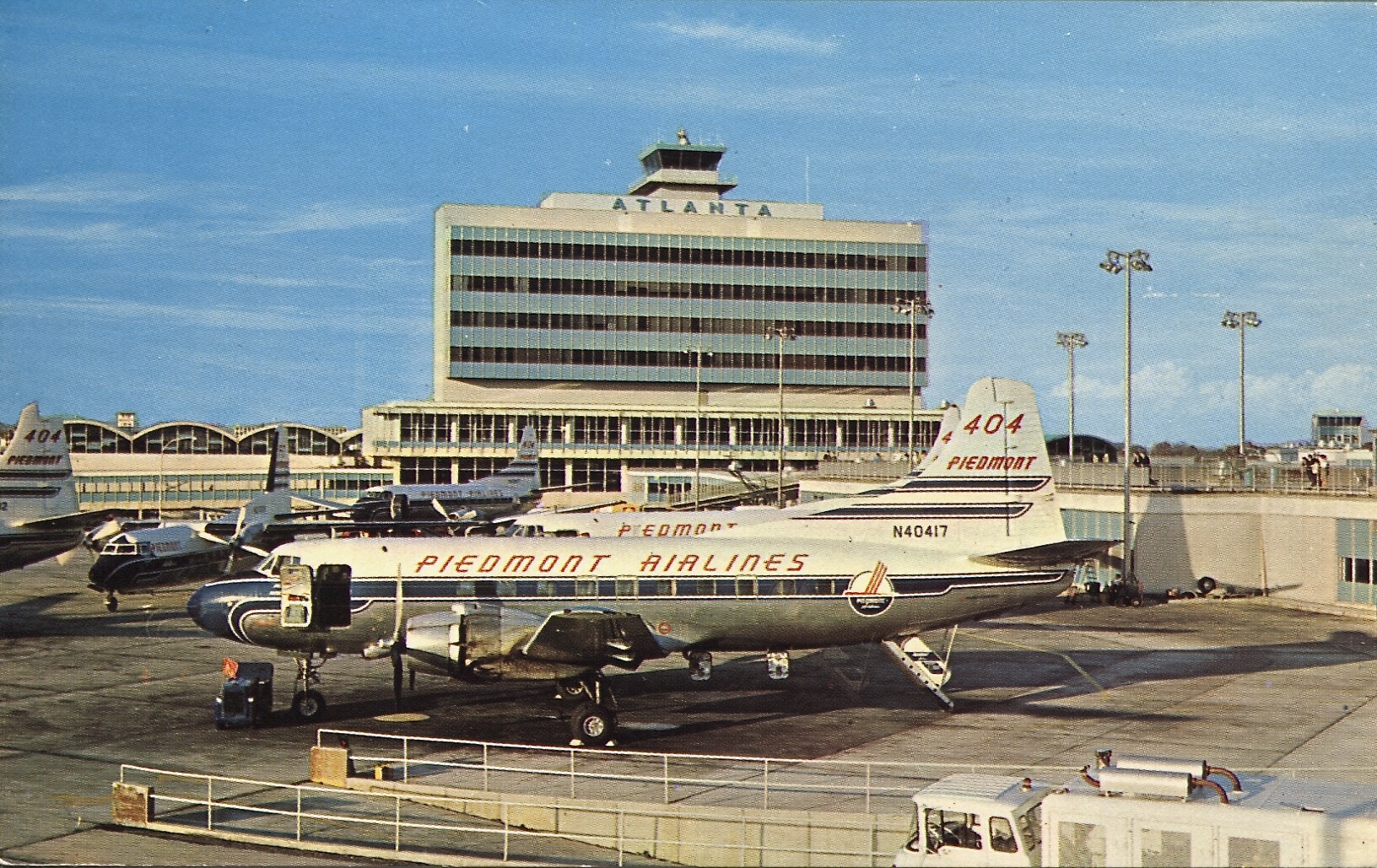
Piedmont Airlines Martin 404, N40417, at Atlanta Municipal Airport. Pub’r Nelson Jones, Lakewood, Ohio, no. K-16186. This aircraft served with Piedmont from 1962-68. Note on the right, the observation deck atop Concourse C/D.
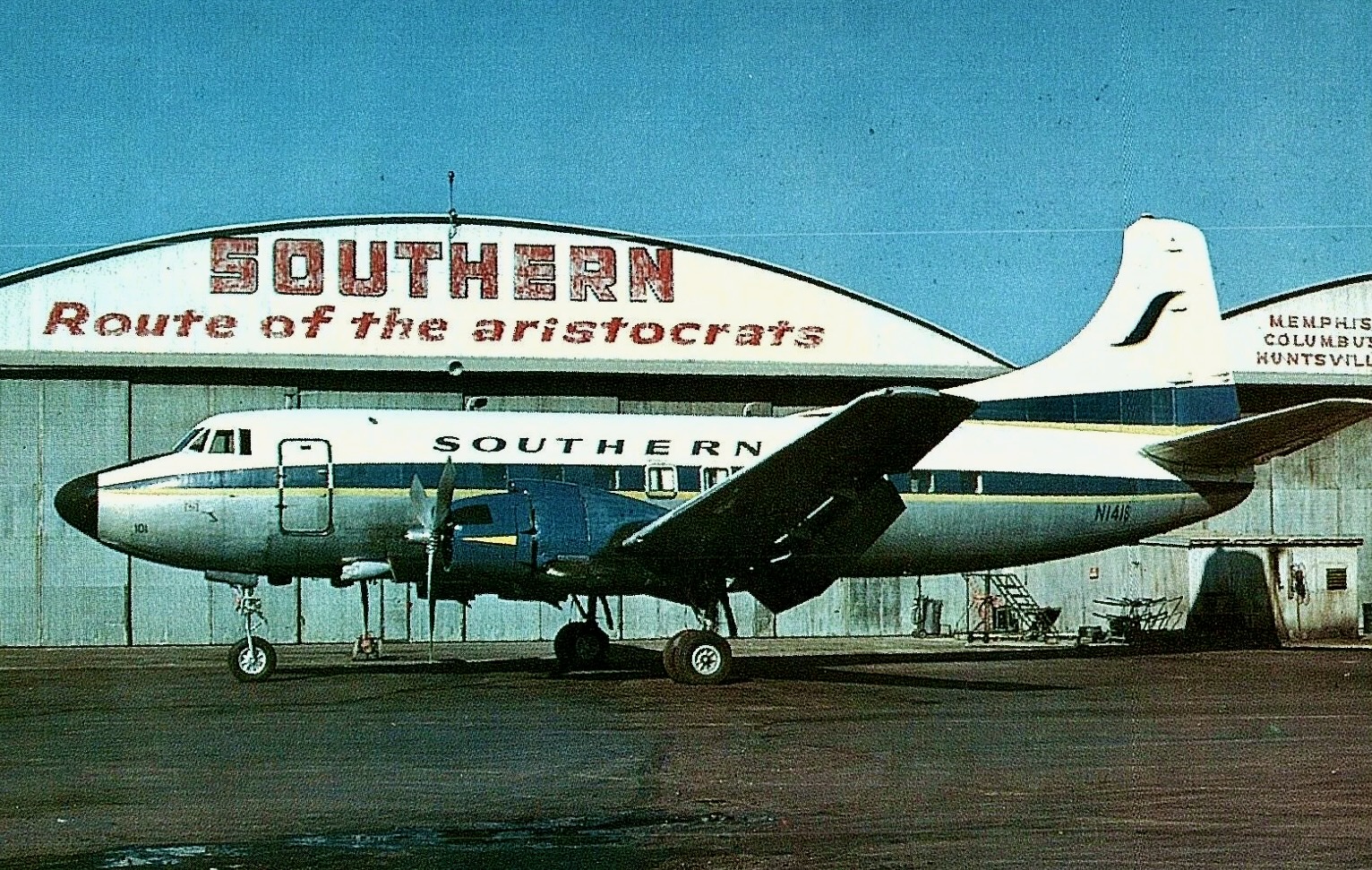
Southern Airways Martin 404, N141S, at Atlanta Airport, February 24, 1973. Pub’r AeroGem, photo by Bruce Drum. Southern became another significant airline serving Atlanta airport and eventually maintained its operational headquarters there. It introduced Martin 404s to its fleet in 1961. The airline merged with North Central in 1979 to become Republic Airlines, which became part of Northwest in 1986. Northwest merged with Delta in 2008.
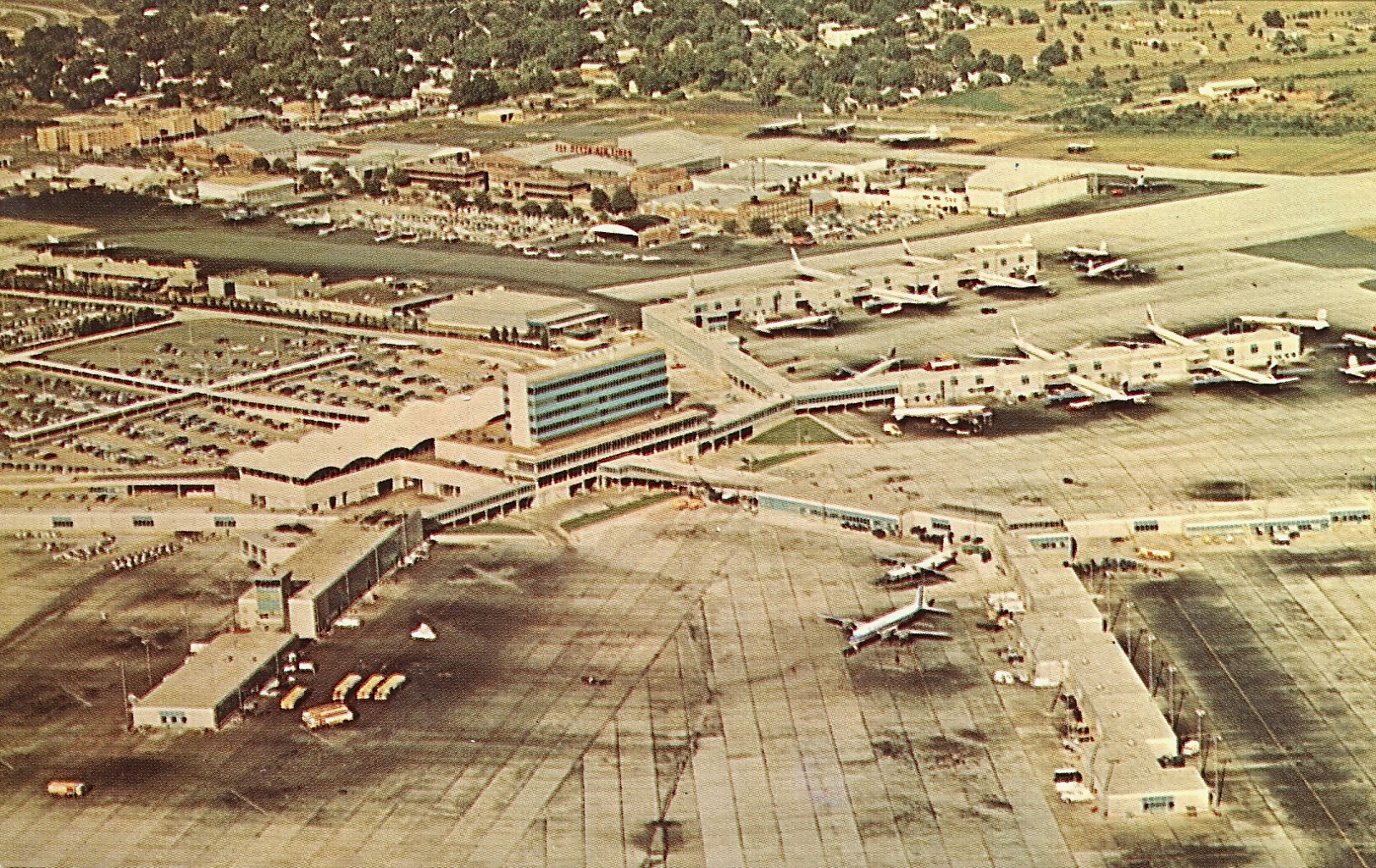
Aerial View of Atlanta Airport showing Concourses B, C and D in the foreground and Concourses E and F with Delta aircraft at the top, all with a mix of jet and prop aircraft. Probably 1961. Pub’r Atlanta News Agency, Chamblee, Georgia, Dexter Press 6255-C.
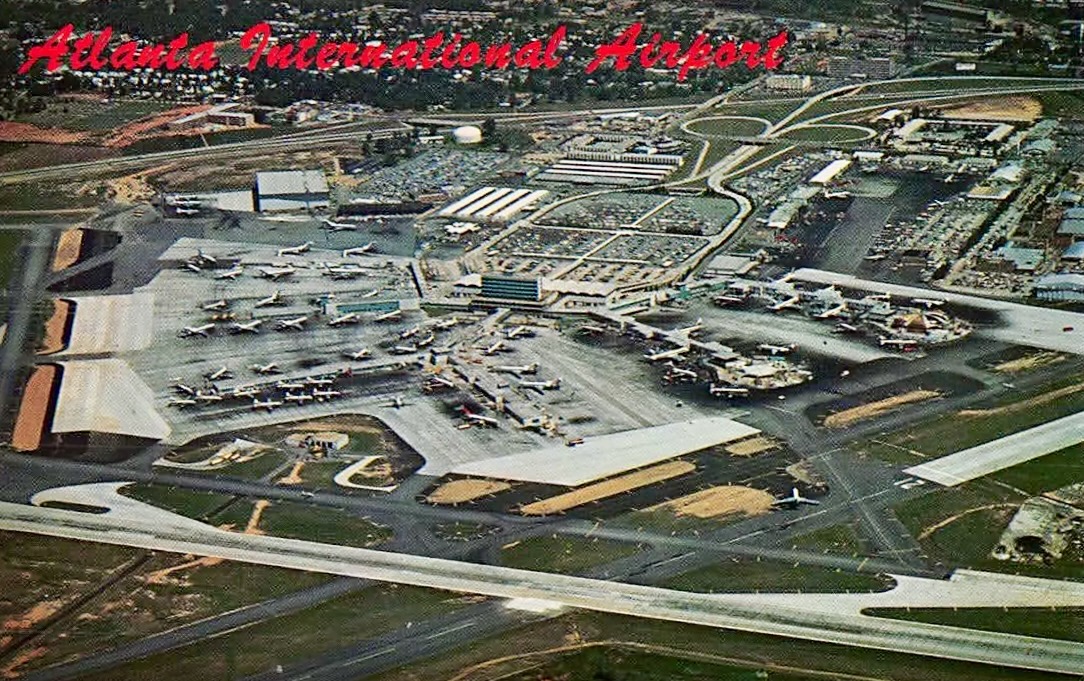
In 1962, a sixth concourse, A, was added, seen here as the top left concourse. It served Eastern Air Lines along with Concourse B next to it. Concourse C in the inverted Y served Piedmont, Southern and some Eastern; Concourse D in the inverted Y served Northwest, TWA and United; and Concourses E and F on the right in this view served Delta. Pub’r Scene South Card Co., Bessemer, Alabama, no. 106086.
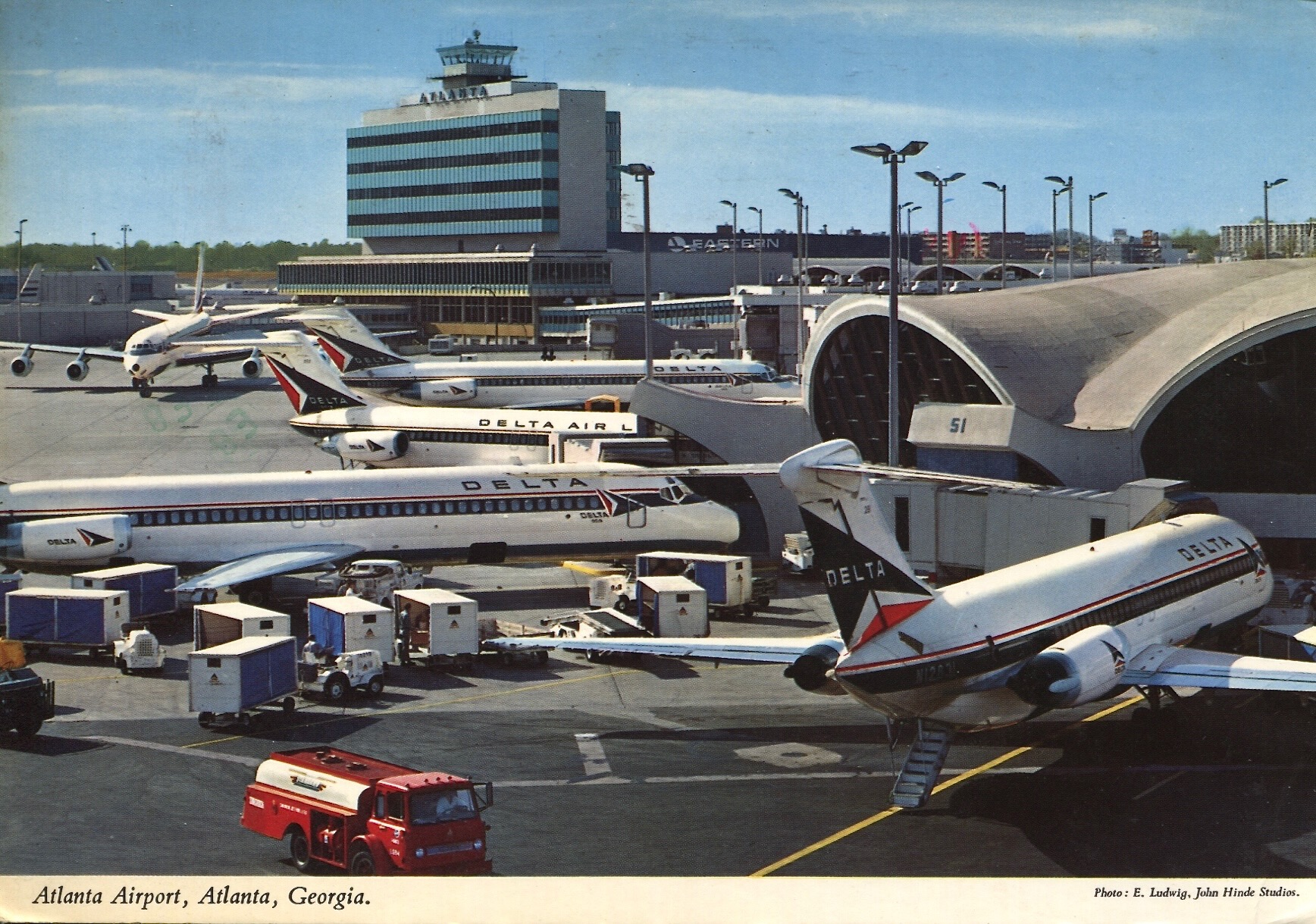
Delta Air Lines aircraft at Atlanta, showing rotundas and gates added in 1968 to Concourses E and F. Pub’r John Hinde, Dublin, no. 2GA13. The back of the card notes that the airport is the third busiest in the U.S., emplaning and deplaning tens of millions of passengers each year, and that between 11AM and 2PM, the airport is the world’s busiest. Airport postcard collector Chris Slimmer has called this card one of his favorites, noting “a wonderful composition. Printed by the best postcard printer in the world…John Hinde.”
Long-time Mayor William B. Hartsfield, the driving force behind the development of Atlanta Airport as a major airline hub, passed away on February 22, 1971, and on February 28, 1971, the airport name was changed to William B. Hartsfield Atlanta Airport. On July 1, 1971, following the launch by Eastern Air Lines of the airport’s first international service (to Mexico and Montego Bay), the airport was again renamed to William B. Hartsfield Atlanta International Airport.
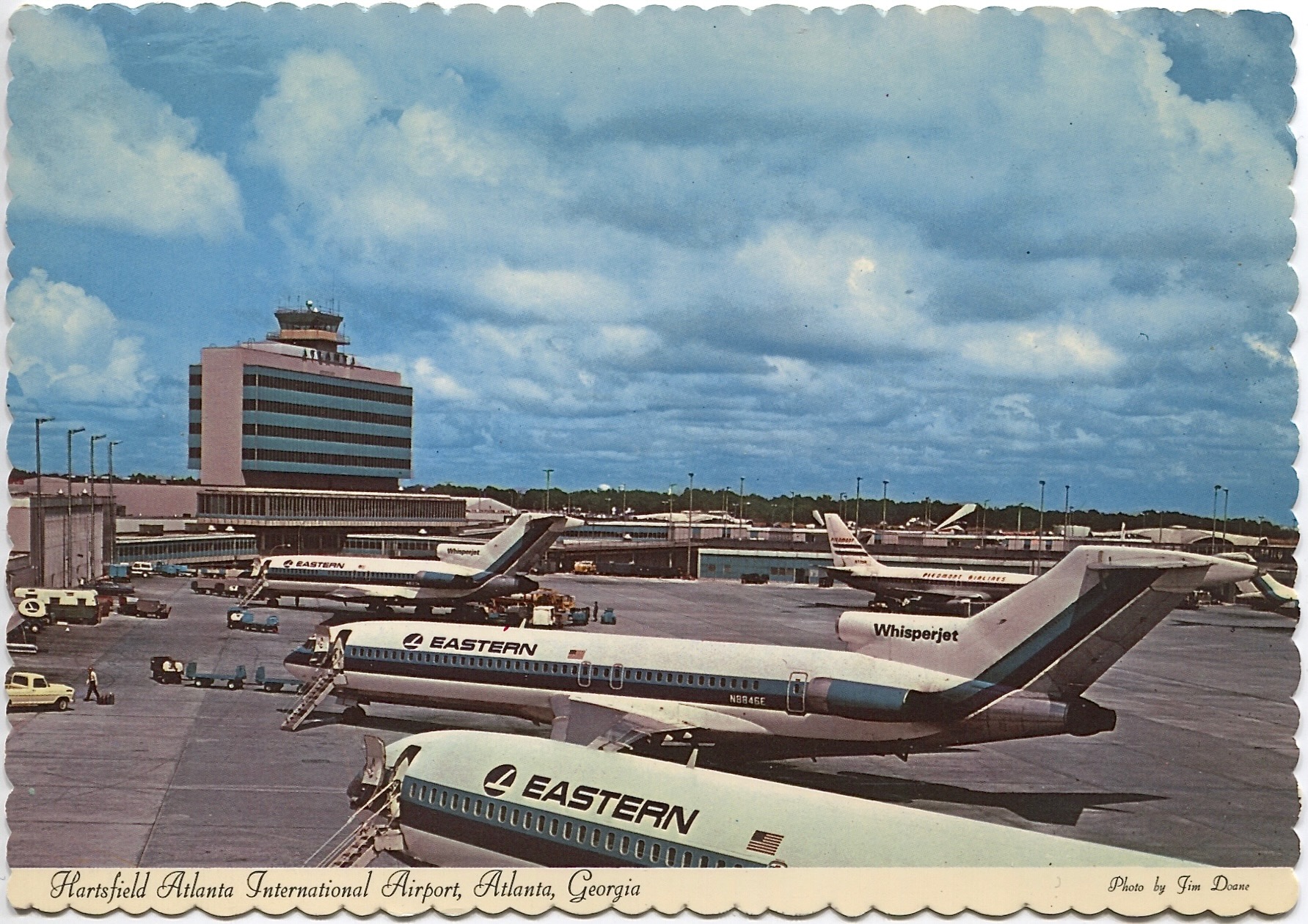
Eastern Air Lines Boeing 727s near Concourse B of Hartsfield Atlanta International Airport, mid 1970s. Pub’r Atlanta News Agency, Atlanta, Dexter Press no. DT-82467-C.
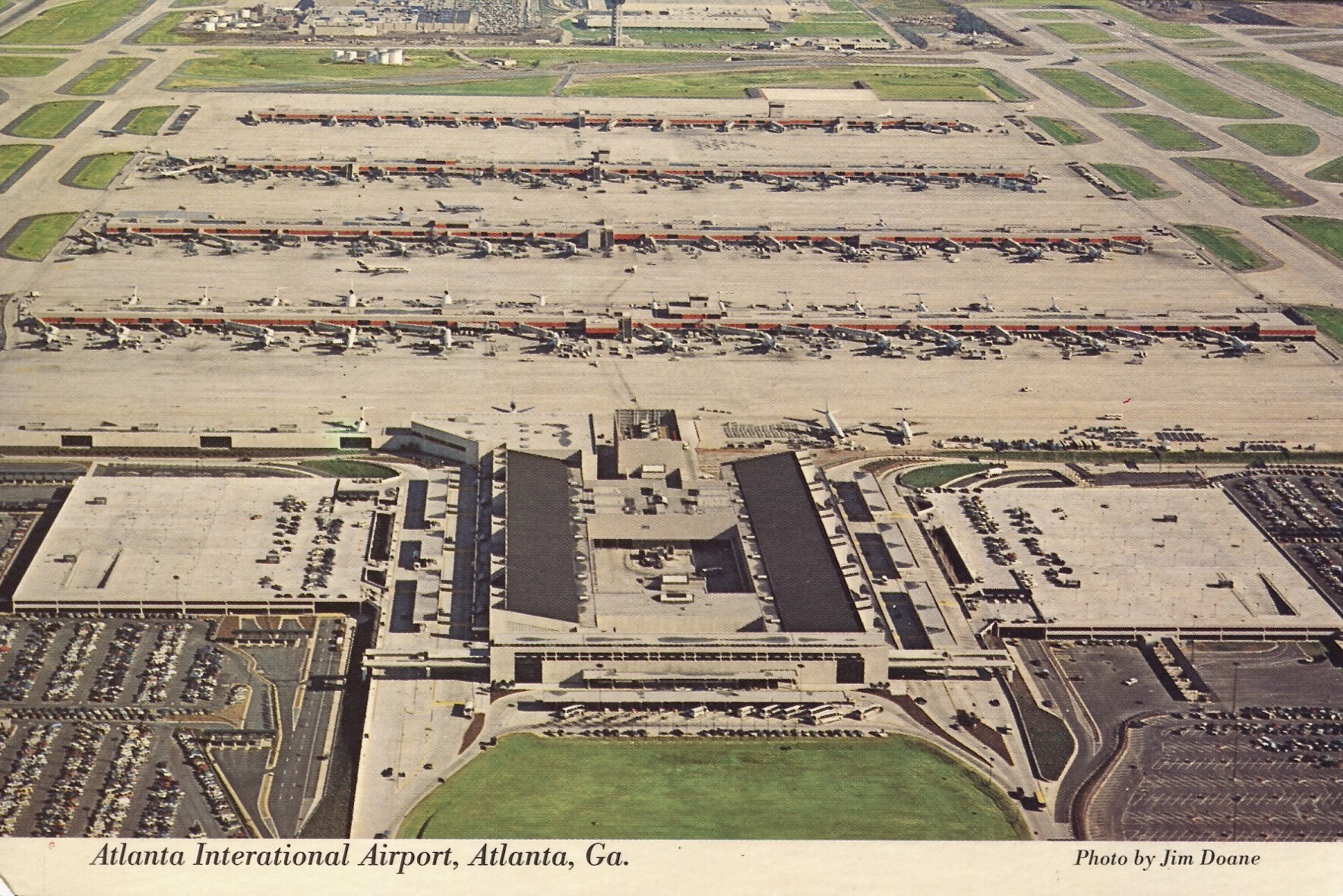
On September 21, 1980, Hartsfield Atlanta International Airport opened the Midfield Terminal. It was the world’s largest air passenger terminal complex at the time, designed to accommodate up to 55 million passengers each year. It replaced in stages the old terminal and its concourses A through F.
View of the new Midfield Terminal complex that opened in 1980, with parallel concourses containing over 125 gates. Pub’r Aerial Photography Services, Atlanta, Dexter Press 70990-D.
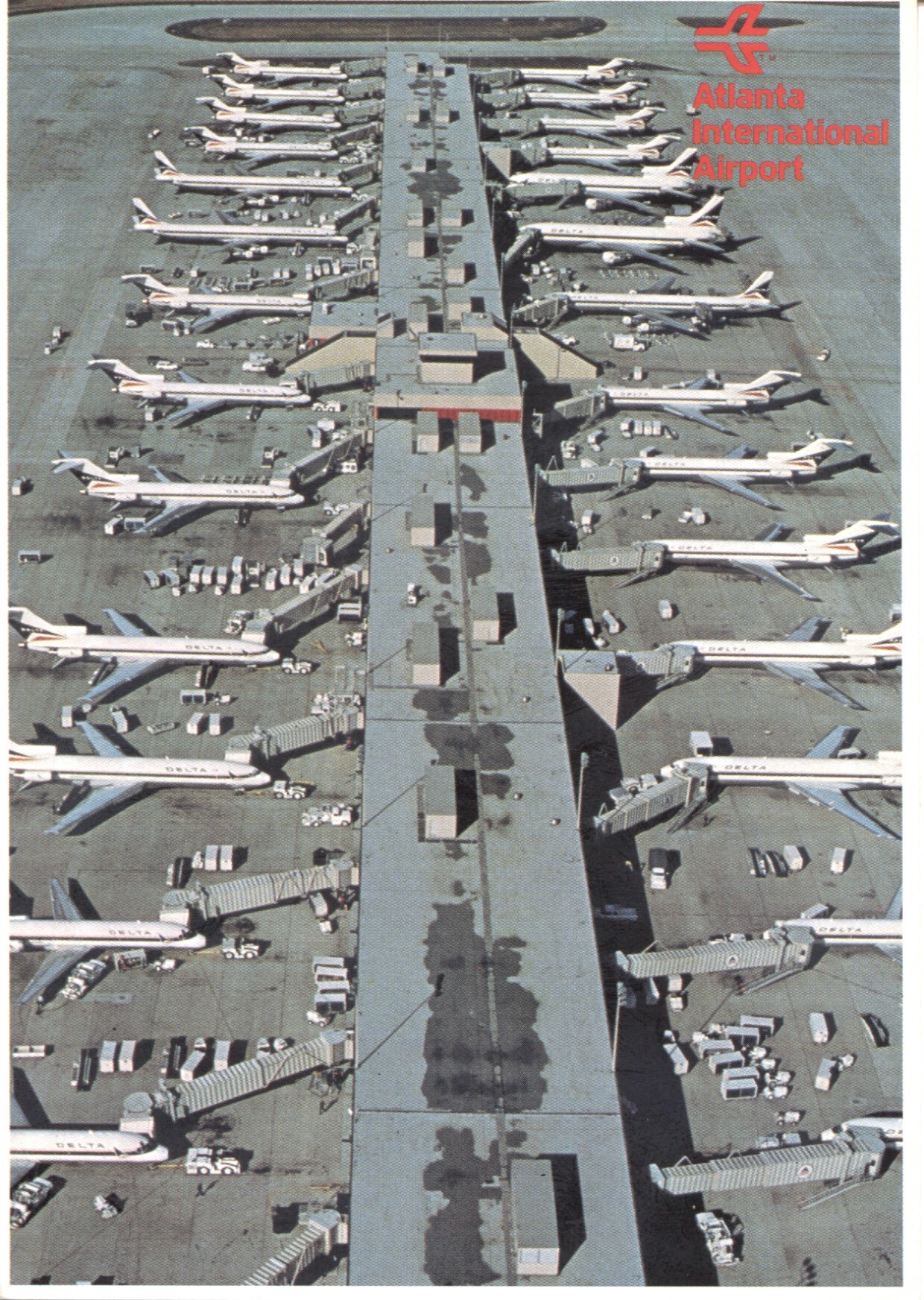
A striking view of Delta aircraft, including Boeing 727s, Lockheed L-1011s and Douglas DC-8-61s and DC-9s, taking on passengers at just one of Delta’s concourses at Hartsfield Atlanta International. Pub’r Thomas Warren, Atlanta, nos. 561109 and A-153.
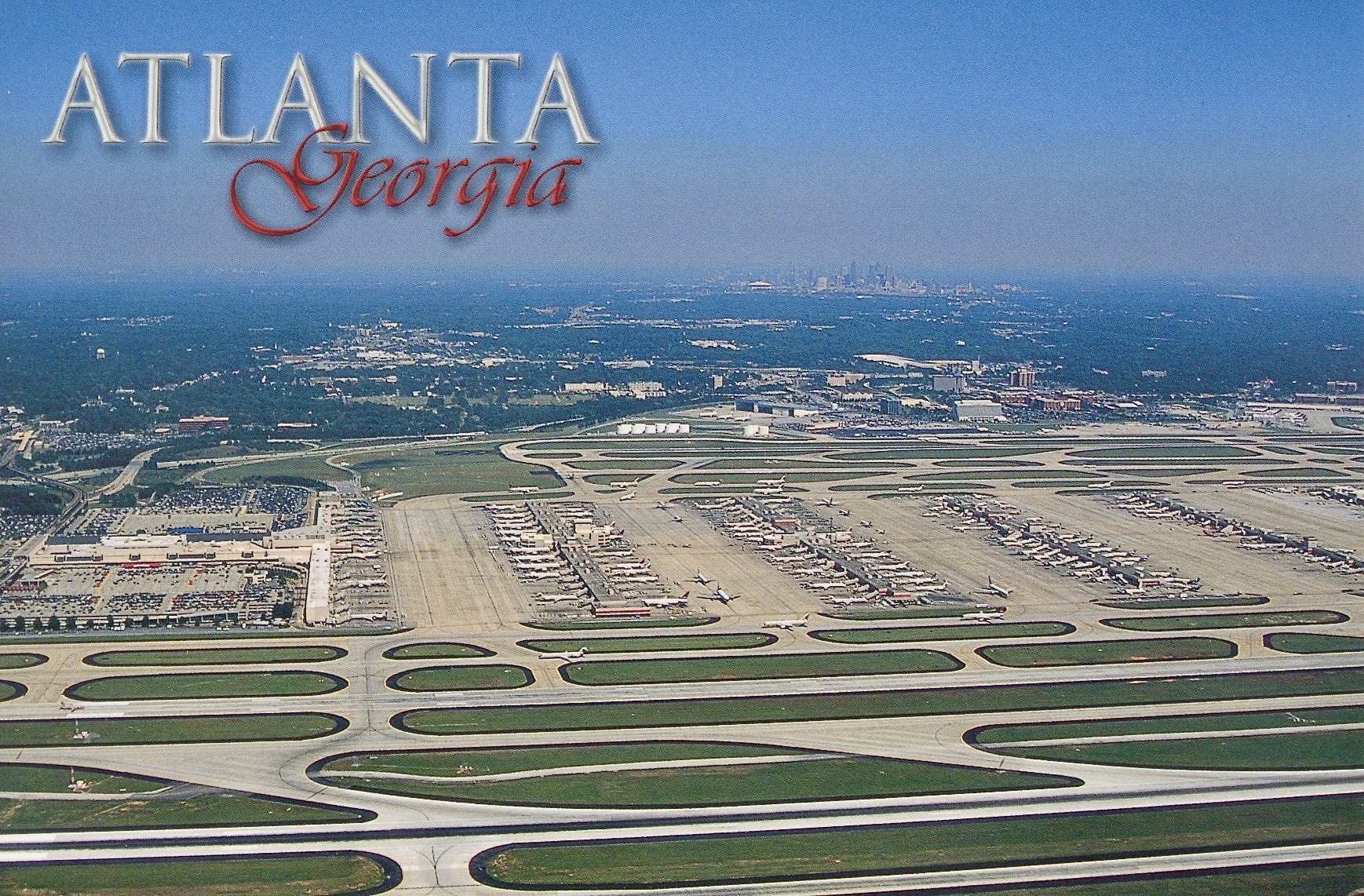
Aerial view of Atlanta airport, probably in the 1990s, showing the seven concourses of the Midfield Terminal, T and F for international flights and A through E primarily for domestic flights. Pub’r APS, Kennesaw, Georgia, nos. K41231 and KA-3-4856.
In October 2003, to honor former Atlanta Mayor Maynard Jackson, the Airport was again renamed, this time as Hartsfield-Jackson Atlanta International Airport.
Since 1998, Atlanta Airport has been the world’s busiest passenger airport. It serves on average 2,700 departures and arrivals daily by airlines operating nonstop to more than 150 U.S. destinations and over 70 international cities in 50 countries. In 2024, Atlanta airport handled 108.1 million passengers (an average of about 295,000 a day), the second-highest year in its history. This represents nearly a full recovery from the general decline in passenger traffic due to the COVID-19 pandemic, which began in 2020 and followed the airport’s record 110 million passengers in 2019.
Delta is by far the dominant airline in Atlanta, with about 73% of the passenger traffic. Southwest is second with 8%, followed by Spirit, Frontier, Endeavor Air (operating as Delta Connection), American and United.
Hartsfield-Jackson Atlanta International Airport is now engaged in a major 20-year capital improvement program, which includes modernizing its domestic terminal, expanding concourses and cargo operations, replacing parking facilities, and eventually developing a hotel and mixed-use facilities.
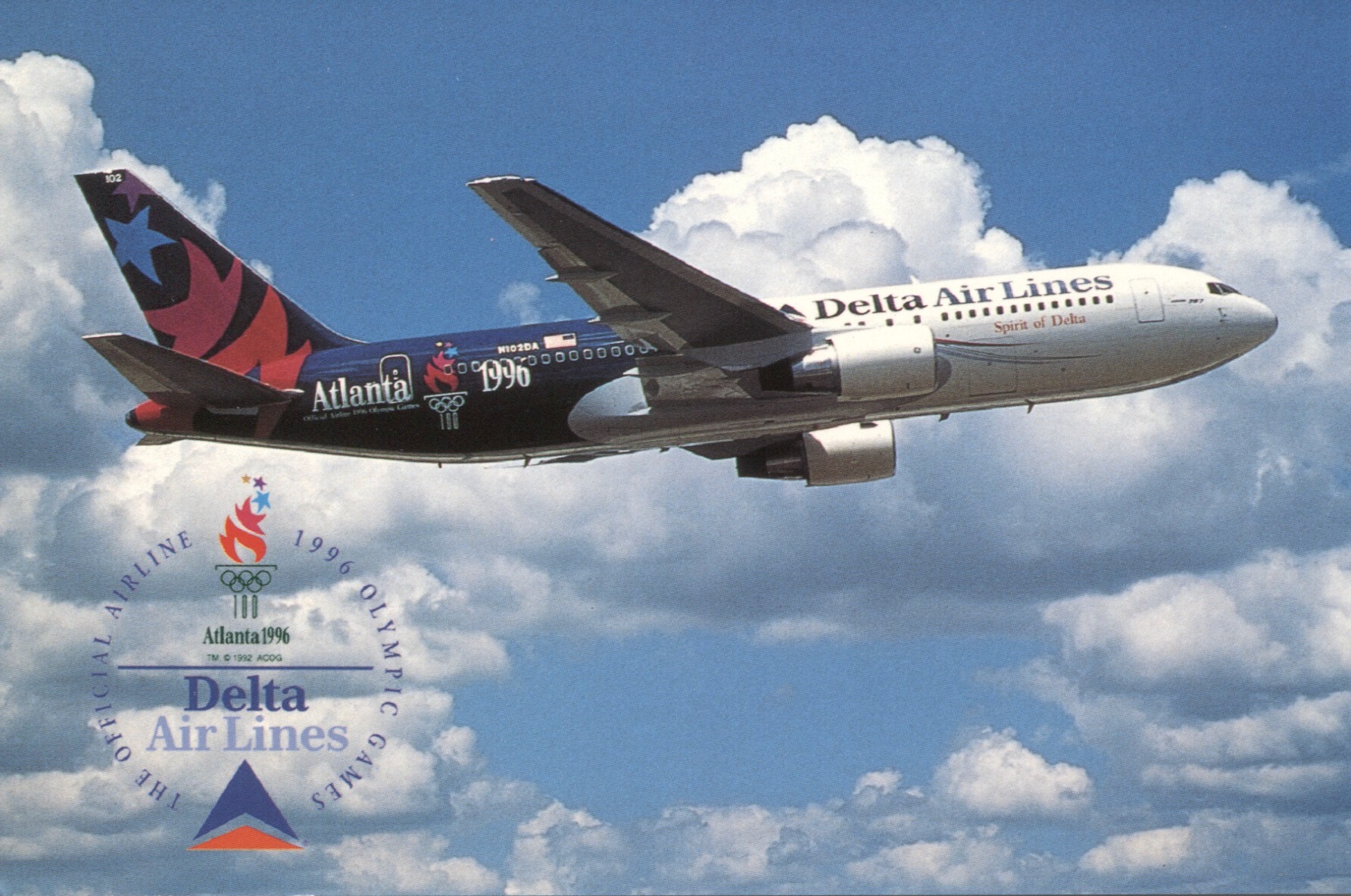
We close this Atlanta postcard article with a beautiful card showing the very aircraft that now resides in full splendor at the Delta Flight Museum, the site of Airliners International 2025 ATL, June 25-28, 2025, adjacent to Hartsfield-Jackson Atlanta International Airport.
Delta Air Lines Boeing 767-200, N102DA, Spirit of Delta, its first 767, with a special livery symbolizing Delta’s role as the Official Airline of the 1996 Olympic Games in Atlanta. Airline Issue, no. P98303. A variation of this card, no. P97977, exists with the aircraft closer up and lower, and with a smaller Delta Olympic logo stamp. The funds to acquire this aircraft were raised by Delta’s employees through payroll deductions. The aircraft is now on display in its original livery at the Delta Flight Museum, site of the Airliners International 2025 ATL show and convention, June 25-28, 2025.
Notes: The originals of all postcards shown are in color and from the author’s collection. All are in standard or continental size. I estimate their rarity as Uncommon: The Candler Field card with an Eastern DC-2; the ‘Temporary’ terminal card with a Delta DC-3 in the center; the Piedmont Airlines card; and the card showing Delta aircraft at the rotundas and gates added in 1968. The rest of the postcards are fairly common. This article is an update and revision of an earlier one by the author on Atlanta airport postcards published in the Spring 2015 issue of The Captain’s Log, vol. 39, no. 4.
Airliners International 2025 ATL Postcard Exhibits by Collectors: The AI 2025 show at the Delta Flight Museum, Atlanta airport, will again feature a display of airline and airport postcard exhibits. Whether you’re an experienced collector or a beginner, please consider submitting an exhibit. It’s a lot of fun, and the postcard displays stimulate greater interest in collecting airline and airport postcards. This year’s Postcard Exhibit Guidelines can be found at airlinersinternational.org under the tab Contest Information (even though it’s an exhibit, not a contest). I look forward to seeing you at Airliners International 2025, Atlanta, June 25-28.
References:
www.sunshineskies.com/atlanta.html. This is a great website with hundreds of pictures, many postcard views, and extensive information on the history of Atlanta airport.
www.atl.com. Official site of Hartsfield-Jackson Atlanta International Airport
www.deltamuseum.org. Official site of The Delta Flight Museum, Atlanta airport, where Airliners International 2025 will be held June 25-28, 2025.
golldiecat.tripod.com/atl.html. History of Hartsfield Atlanta International Airport from 1961 to 1980, illustrated with postcard views.
Cearley, Jr., George W., Atlanta (1991) and The Delta Family History (1985), each self-published.
Davies, R.E.G., Delta: An Airline and Its Aircraft. Paladwr Press (1990).
www.wahsonline.com. Official site of the World Airline Historical Society.