The End of Dolphin Airlines

By Ellis M. Chernoff
Dolphin Tails, Part Three
Operating overweight should not be taken lightly! It is both illegal and potentially unsafe. But the existing rules and quiet acquiescence by the regulators provide for economic success or failure of every airline, large and small. The sale of the product, a revenue seat, is perishable, and airline pricing is highly competitive. Airline sales and marketing departments price their product with little to no regard for the cost of that product.
The costs of a given flight segment are not even fixed. Extra fuel will be consumed due to traffic or weather delays. Flight crew are generally paid by the hour. It can be by the flight hour, the block hour (including taxi time), or by the duty day, by some formula. Aircraft and engines have maintenance schedules, and the costs associated with just required maintenance are calculated by the flight hour. So while the revenue generated is fixed by the price paid for the passenger’s ticket, the costs to operate that flight might be higher than expected.
In 1983, there were several other airlines competing for customers on most of the routes operated by Dolphin. While management might have a goal to fill all of the seats on every flight as well as carry all of the customers’ belongings, on some routes, this is nearly impossible except under perfect conditions. As I had argued during my initial interview, other 18-seat regional aircraft were better suited than the EMB-110. But as a captain, all I could do was use the tools that I had to make the best of the situation.
For example, on the longest routes, if I could use a strong tailwind at a higher altitude, it would be possible to burn less fuel and thus start the flight with less and still have the required fuel at the destination. More baggage could be carried legally and safely.
I am not saying that I would never make a compromise because I did when the conditions mandated it. Even in my prior commuter flying, poor weather conditions might mandate loading more fuel to allow for holding and diversion to safe alternate airports. But better to be overweight a small percentage of the time rather than all of the time.
Although the Bandeirante was a popular plane with commuter airlines in the era, most found that reducing the capacity from 18 to 12 seats was a better use of the type. A dozen single seats would be more comfortable for the passengers than the very tight double bench, and the issue of weight vs. range would also be resolved. The type would make a much better small cargo carrier, and that’s where they found their last use.
Flying out of the Jacksonville base worked out well for me. My most typical route was Jacksonville- Tallahassee-Panama City-Pensacola-New Orleans, the back across the panhandle again to Tallahassee, on to Orlando, and finally back to Jacksonville. The planes did not have autopilots, so pilots got a lot of experience actually flying and logging takeoffs and landings. During half of the year or more, cumulus clouds would prevail, and afternoons would be dominated by severe weather. All that I had learned flying in the Carolinas was put to use navigating through the Florida weather.
On occasion, severe thunderstorms would impact most of the state, and most commercial flights into and out of the area would be suspended. By studying meteorology, you learn that thunderstorms generally have a life cycle. In the end stage, they can lose their vertical turbulence and become simply a steady rain producer. On more than one occasion, I became a trailblazer through airspace that still looked bad on radar but had become benign.
However, on one afternoon, I was inbound to Jacksonville from Charleston and Savannah, and the image I saw on the weather radar screen was distinctive and threatening. A strong cell was racing toward the airport and had the characteristic hook that indicated a likely tornado. Another of our flights was also inbound to JAX, and we were both racing to get on the ground and offload our passengers before the cell arrived.
Both flights made it safely, and the planes were secured before hell broke loose. Thankfully, the actual funnel did not touch the airport, but it did cause damage in the surrounding area. Our planes survived to fly another day, and the crews and passengers were all safe.
Occasionally, flying safely can mean finding ways around standard procedures. One afternoon, I was on approach to Savannah, GA, and being radar vectored for an instrument landing. However, hovering directly over the outer marker fix of the instrument landing path was another very severe thunderstorm. While we were operating under IFR (Instrument Flight Rules), we were at the moment clear of the clouds and could see the ground.
I exercised another rarely used tool in my quiver. I requested cancellation of my instrument clearance and instead continuation of the approach to land under Special VFR. This would allow me to avoid being forced to fly through a dangerous cell and instead turn directly toward the runway and land. This was granted, and I safely concluded the flight.
Sometimes, weather conditions that are forecast to improve do not, and the consequence is circuits in a holding pattern, possible missed approaches, and diversion to an alternate airport. One morning on a flight from Jacksonville to Tallahassee, all of that happened with the flight landing in Panama City. By the time we finally were able to get our passengers to their intended destination, they had missed their meetings and the purpose of their journey that day. This experience is not unique to a commuter airline or to Dolphin, but it does make for unhappy customers who might never buy a ticket on the airline again.
During most of 1983, the company was a flight operation without executive officers. However, they did return near the end of the year. January 1984 started out with everything the same as before. But it was evident that we were not holding our own against our competitors. Ticket prices were high, and loads were decreasing. Not a sustainable business.
On January 18, I operated the morning run Jacksonville-Tampa-Tallahassee and back to Jacksonville, arriving around noon. I was just about to leave the operations office to go to my car when the call came in. Overnight, a news release went out that Dolphin’s assets, i.e. fleet of planes, were being transferred to PBA, our main competitor. With that, all credit was suspended, essentially shutting down the operation. Without credit, bills, including fuel, leases, landing fees, and the like, would not be paid. This stranded our customers who were booked on the day’s remaining scheduled flights. Too bad; PBA would do its best to accommodate them.
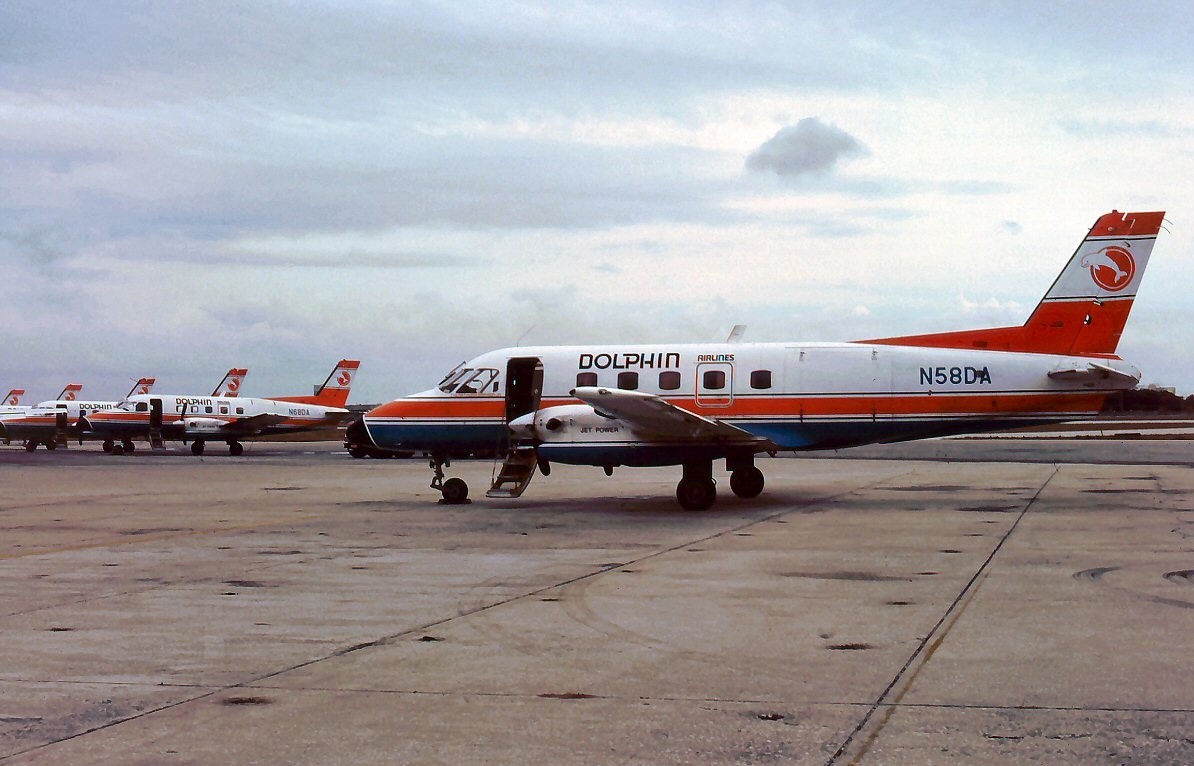
Photo by Ellis M. Chernoff.
I was asked to ferry a plane back to Tampa, the home base of the operation. It was a sad flight and even sadder to see the line-up of our now-grounded planes. Dozens of bewildered employees were also gathered, caught off guard by the sudden ending of their employment.
What had happened? The night before, the executives, controlling partners in each of the limited partnerships owning the planes, had secretly met with the management of PBA to negotiate PBA taking over the operation of the fleet. In essence, the executive sold the employees out.
Along with myself and a first officer were some Jacksonville staff who were now stranded in Tampa. Dolphin provided no help. I was able to meet with the local Eastern Airlines station manager, who graciously provided all of us passes to fly Eastern back to JAX.
The following day, PBA met with the now former Dolphin pilots and offered them temporary employment to fly the planes so abruptly acquired. Some took this offer and eventually went on to other airlines. I was enticed to return to California for something else, which ultimately proved to be a waste of time.
Trackback from your site.