Posts Tagged ‘Denver’

Air Cortez,Denver,F-27,Rolls-Royce,winter airline operations
Turboprops, Round Six: Air Cortez, Scene 2

By Ellis M. Chernoff

January 1985 began with a recall from Air Cortez. The FAA had revalidated their operating certificate upon approval of their tie-down nets, weight and balance program, and other details. I was told to report to Denver Stapelton Airport, where one of the F-27s was in position. Weeknight runs with cargo from UPS operated Denver, Casper, Billings, Great Falls, and return through the same airports. This was a dusk-to-dawn operation in the dead of winter.

If there was snow at any of the airfields, it would surely be at Casper, Wyoming. However, the stopover was brief, and if it was snowing, it was dry powder. No deicing equipment was available, so we had to expect the snow to blow off the surfaces. Air Cortez expected the pilots to “help” offload and load cargo at the stations other than Denver. I was not too keen on this heavy exertion while also being fit to fly a tight schedule.

The basic Fairchild F-27, as I have previously mentioned, used pneumatic pressure to operate the landing gear, brakes, and nose wheel steering. In modern planes, pneumatic air is taken from the engines themselves. But in the ancient systems of this aircraft, a four-cylinder mechanical air compressor was mounted as an accessory to each of the Rolls-Royce Darts. These compressors were like shop air compressors, and they charged up a series of three compressed air bottles. One for the landing gear operation, one for the normal brakes, and one for the emergency system.

Again, in modern aircraft, conditioned air to pressurize the cabin comes from the aircraft engines. But in the F-27, there were dedicated “Roots” blowers. These were the type of accessory found in older piston airliners. These blowers were also mechanical devices run by the Dart’s accessory section. Pressurization is designed for a maximum of 4.16 PSID, or an 8000-foot cabin at FL250. But the blowers were so worn out that barely half of that pressurization was available. In addition, the “choke valve” that was designed to
enhance cabin heating in the original production had been removed by prior operators who had this aircraft in the tropics. The cockpit was darned cold, and the main source of real heat came from the lights and electronics in the cockpit itself. The modest amount of pressurization barely kept the cockpit at freezing.

During the month that I was in Denver, I had three different ships, and none was in very good condition. Logbook write-ups of mechanical issues often caused a flight to be cancelled. Following the FAA suspension, UPS was not too happy with the reliability of performing the schedule.

One of the planes had issues with weak engine ignition. During every engine start, fuel would pool in the exhaust, as well as drip onto the tarmac, and when the engine would finally light off, a flame would extend all the way to the tail and light up the whole airport. It was truly spectacular.

The engine-driven air compressors were also worn out. The system was designed to operate at 3000 psi. This ensured rapid retraction of the landing gear. The pressure tank provided a reservoir of air to operate the gear and brakes and was recharged by the compressors. The pressure should be at 3000 psi at preflight, but there was a lower minimum for flight. On one of the planes, the mechanics had to charge the bottle on the ground. One night, I idled the engines for 45 minutes just to get the pressure up to the minimum for takeoff. The poor mechanics had little experience and few parts.

On a different night, climbing out from Billings, a side window shattered, causing the loss of even the modest pressurization. Normally, the young man who had driven the cargo van to meet our flight would have left the airport. But he stuck around to phone his girlfriend. Thankfully, he was still at the airport when we made an emergency return.

Contemplating being locked out, I had figured we would have to burn the freight to survive the cold night. But since the guy was still there, we were safe and able to get to a local hotel in town. Once in a warm hotel bar, I telephoned the boss in Las Vegas. He wanted us to return to the plane and ferry it unpressurized back to Denver.

No way I would do that. The route had minimum altitudes between 7,000 and 9,000 feet. It would be insane, not to mention highly dangerous, to fly two-plus hours back to Denver with no heat or supplemental oxygen in the middle of the night.

The following day, I reluctantly agreed to the ferry flight. By the time I contacted Denver Approach Control, hypothermia had set in. We were given holding instructions due to the amount of arrival traffic. It was snowing. I refused the holding instructions and told the controller we had no heat. He asked what other problems we might have. We had plenty, including almost no pressure in the pneumatic tanks. I was pretty sure that we could extend the landing gear, but steering and braking would be limited at best. We were assigned an inactive snow-covered runway, and this assisted the deceleration after landing. The pressure gauge read zero upon shutdown at the ramp.

More cancelled flights and another replacement junker plane. On my last flight for Air Cortez, I had to write up 21 items in the logbook. Upon arrival in the morning, the boss met the flight on the ramp. While the prop was spinning down, he motioned for me to open the window and hand him the logbook. His face turned red, and he shouted, “You’re fired!” I replied from the cockpit, “Thank you, sir. I’ll live longer.”

Air Cortez had originally been issued their Air Taxi (FAR 135) certificate many years ago. They had operated charters mainly to Mexican resorts and fishing destinations using light twins. When they acquired the Fairchilds, their certificate had been upgraded to a Supplemental Air Carrier (FAR 121), but clearly, the FAA had not demanded of them the more detailed manuals and procedures mandated by those rules. The family that owned the airline was really nice and were well-intentioned people. But, lack of competent and experienced staff and lack of FAA oversight were responsible for a sub-standard
operation.

The first officer who had shared most of my experiences for that month in Denver would also later be a pilot with FedEx. We would often share our recollections of those flights and mutual respect for the decisions we had to make.

The night I packed up to depart Denver for home, I received a phone call from my parents. They were relieved that I had been let go from this operation. But they also informed me that they had received a phone call from a former Dolphin Airlines colleague who had been trying to locate me. This information would ultimately lead to my next gig.
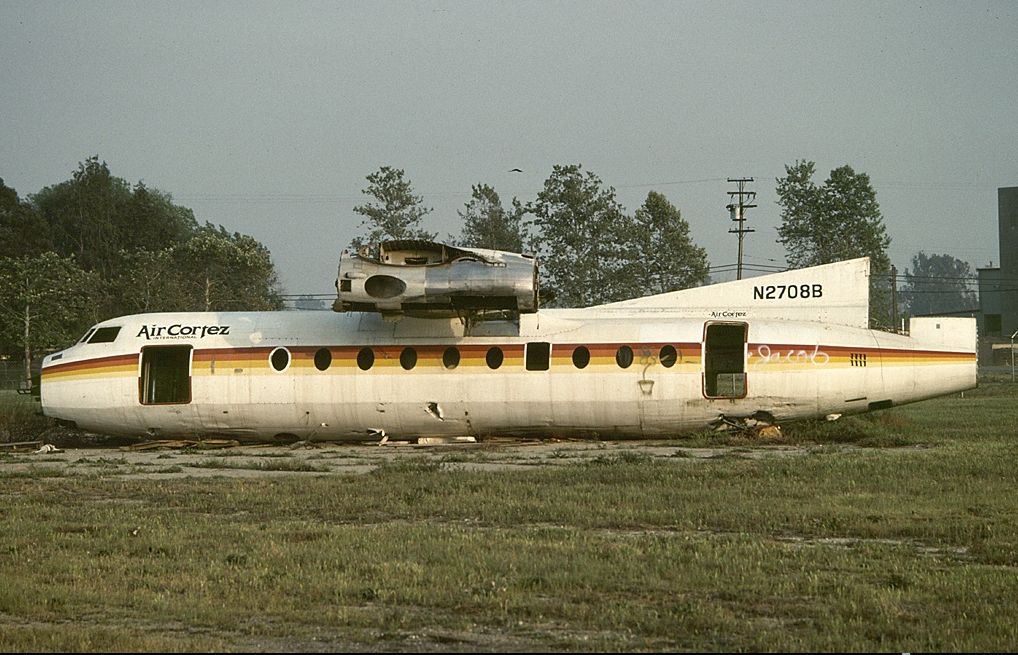
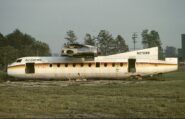
Air Cortez F-27A, N2708B, sits derelict at Ontario International Airport (ONT), CA, March 26, 1990.
It would become a fixture at ONT as a rotting hulk used for firefighter training.
Photo by Bill Blanchard.
Continue Reading No Comments

airlines,Continental,Denver,FlyteCo Tower,Frontier,Jeppesen,postcard,postcards,Stapleton,United

Denver Stapleton and Denver International Airport on Postcards

By Marvin G. Goldman

In celebration of the 50th annual Airliners International show and convention, held in Denver, CO, June 24-27, this article for the Captain’s Log of the World Airline Historical Society covers Denver’s main airport as illustrated on postcards.

From 1929 to February 1995, Denver’s primary airport was located at what was eventually named “Stapleton International Airport.” On February 28, 1995, Stapleton was closed to flights and replaced by an entirely new airport: “Denver International Airport (DEN).”

Denver’s primary airport opened on October 17, 1929, as “Denver Municipal Airport.” It was called the “Union Station of the Air” and claimed to be the most modern in the U.S. at the time. The two main airlines serving Denver in the 1930s were United and Continental.

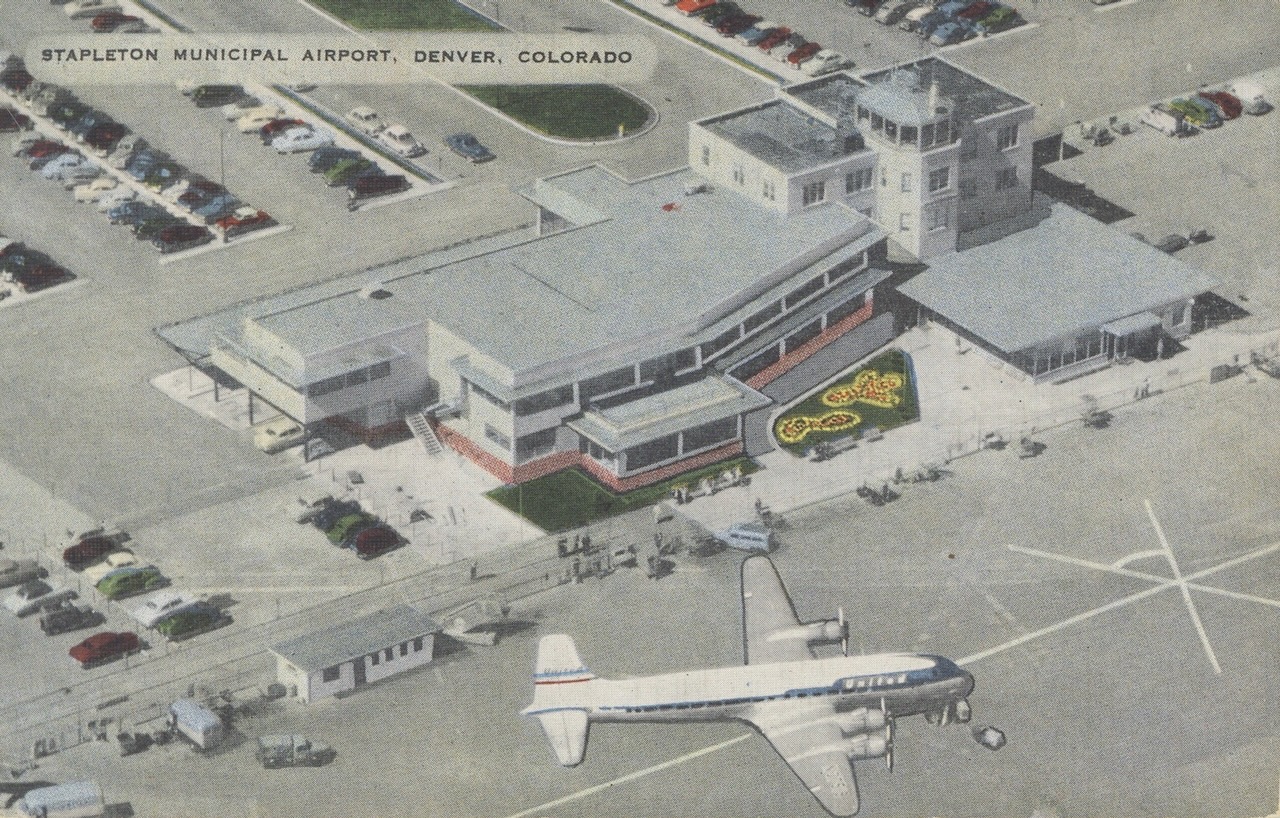
After a 1944 expansion, the airport’s name was changed to Stapleton Airfield in honor of Denver Mayor Benjamin Stapleton, who strongly supported the development of Denver Airport.

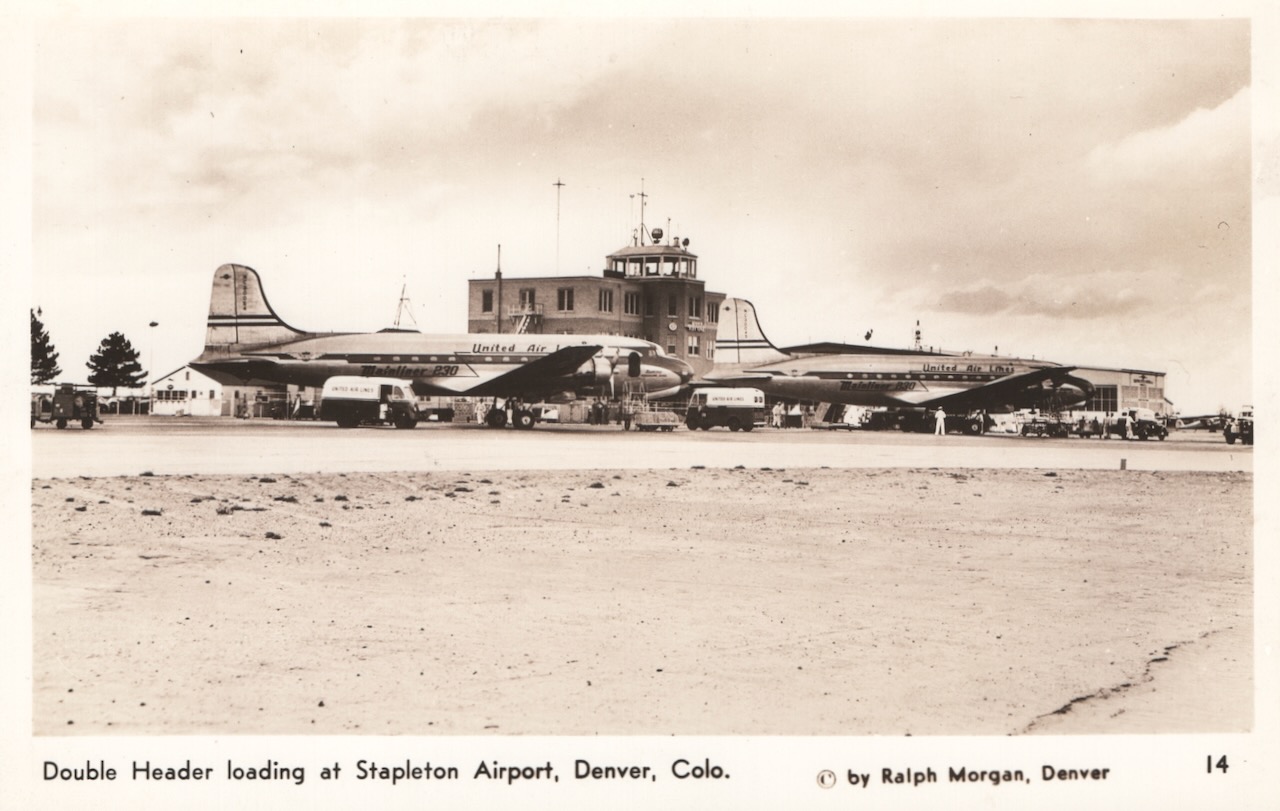
United Air Lines Douglas DC-4s at Denver Stapleton Airport, about 1946. “Real photo” postcard by Ralph Morgan, Denver, no. 14. The original terminal building and control tower can be seen in the rear center.
United Air Lines Douglas DC-6 at Denver Stapleton Airport, early 1950s. Pub’r Elmer C. Clark, Denver; Printer E. C. Kropp Co., Milwaukee, no. 28059N, ‘linen’ finish. The card back says “Stapleton Field is considered one of the finest fields in the West and has some 67 flights per day to supply prompt service to all parts of the United States.”
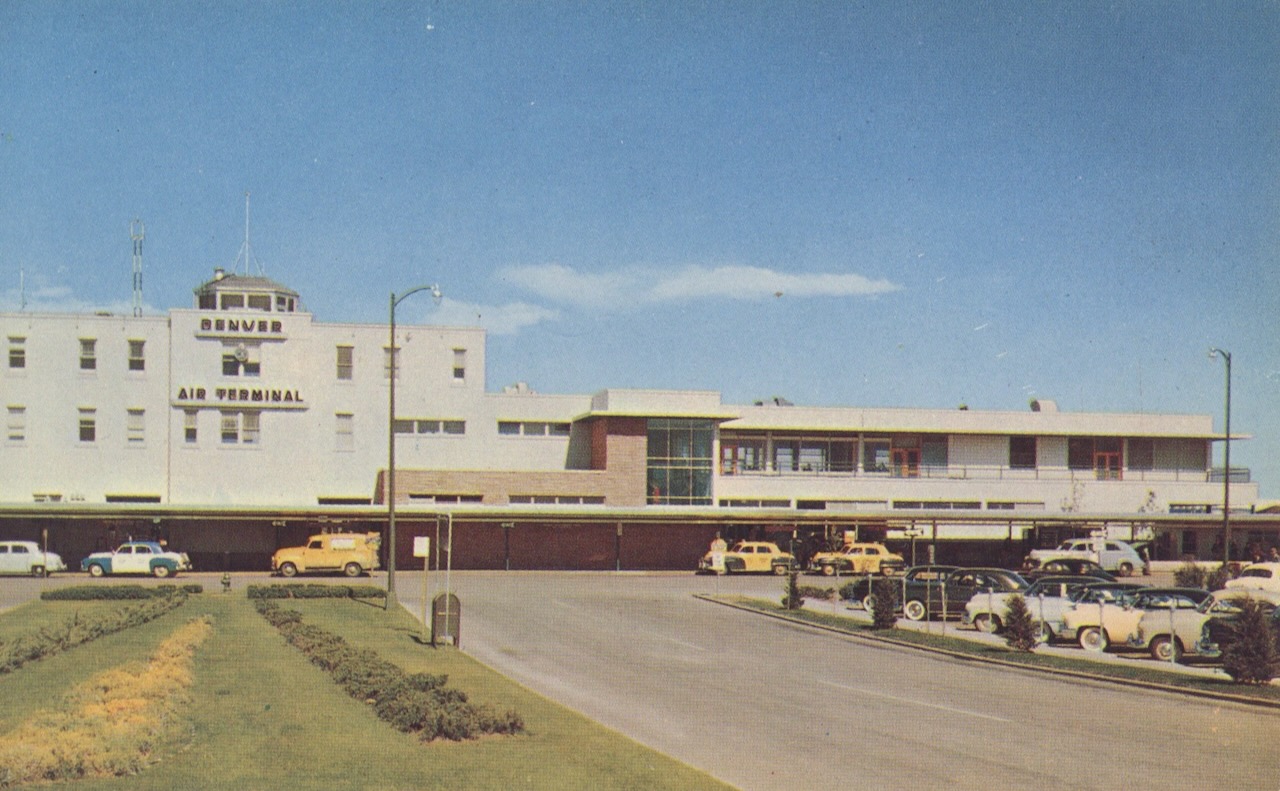
Front of Denver Stapleton Airport terminal building, early 1950s. Pub’r Colourpicture, Boston, no. P5495.
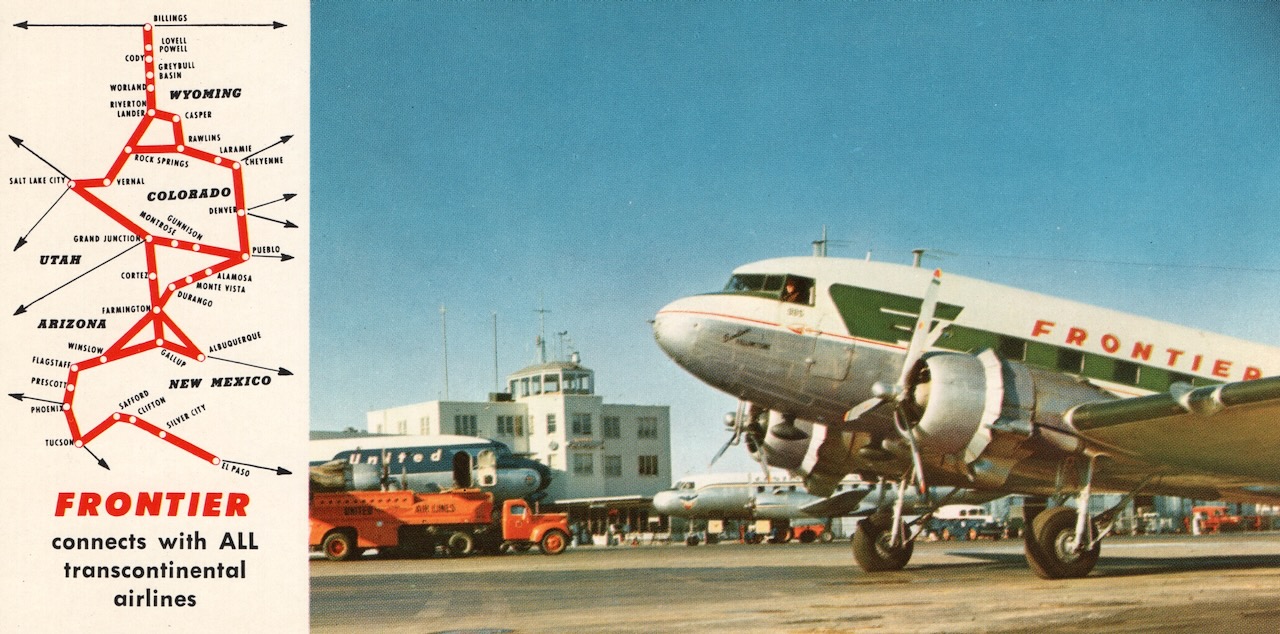
Frontier Airlines Douglas DC-3 at Denver Stapleton Airport, with United and Continental aircraft in rear. Airline issue, 1950s. The original Frontier Airlines was formed in 1950 by a merger of Arizona Airways, Challenger Airlines, and Monarch Airlines, and was headquartered at Stapleton Airport. It ceased operations on August 24, 1986.
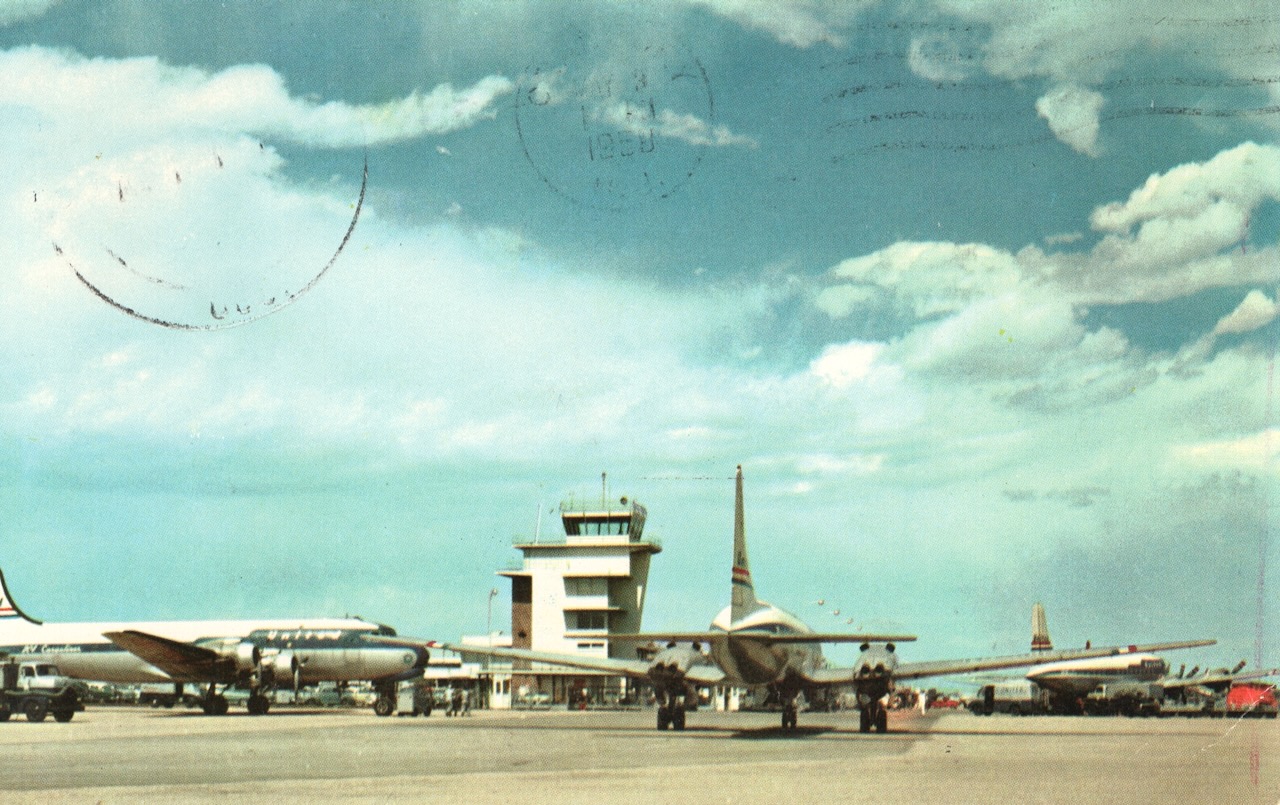
Denver Stapleton Airport’s new six-story control tower, completed in June 1953, with United Air Lines aircraft on the ramp. Postmarked May 3, 1958. Pub’r Cooper Postcard Co., Lakewood CO, no. 51; Printer A. B. Hirschfeld Press, Denver.
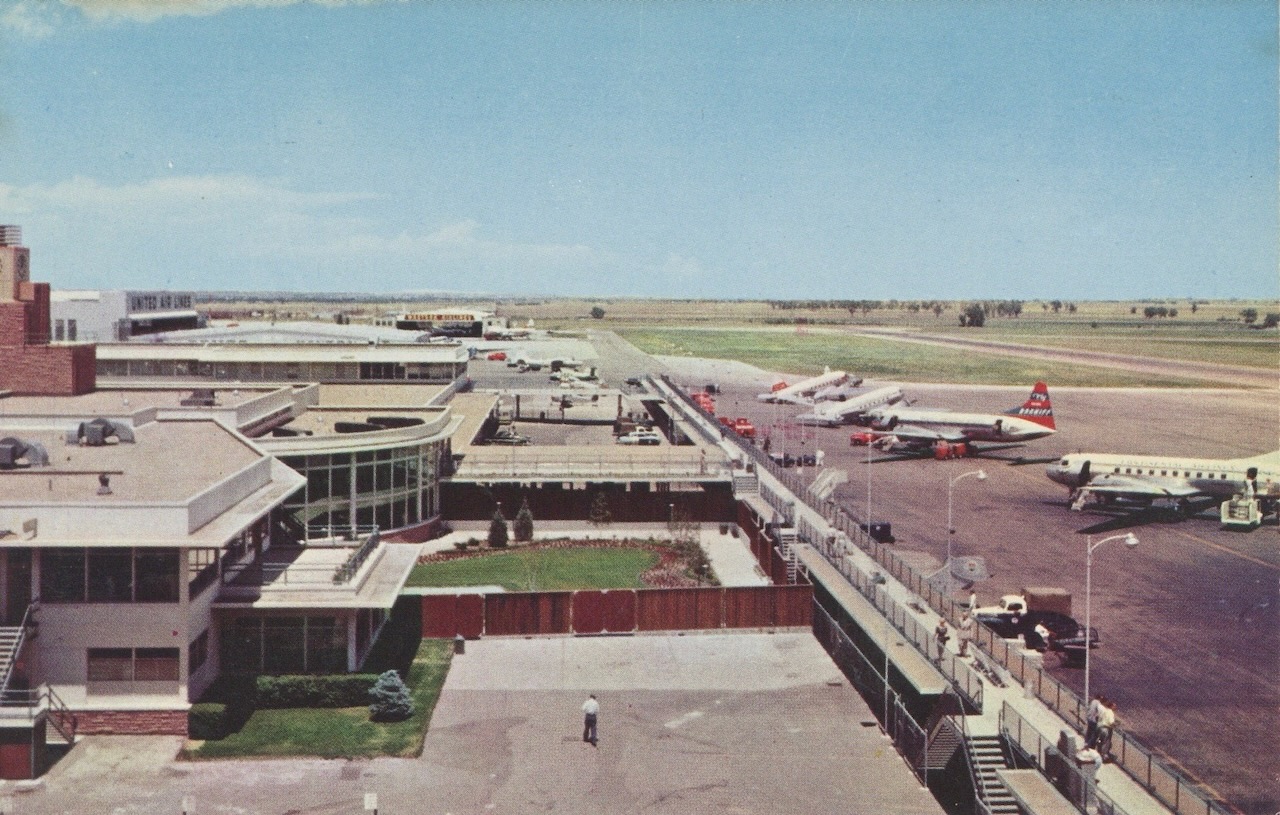
Braniff Airways and Continental Airlines Convair aircraft, and two Douglas DC-3s, on ramp at Denver Stapleton Airport, 1956. Pub’r Cooper Post Card Co., Lakewood, Colorado, no. 6C-K327. Here you can see the terminal and concourse area, updated in 1954, and a passenger walkway viewing area. The main airlines serving Denver at that time were United, Continental, Braniff, Western, Frontier, TWA, and Central. Continental, like Frontier, had its headquarters at the time at Stapleton.
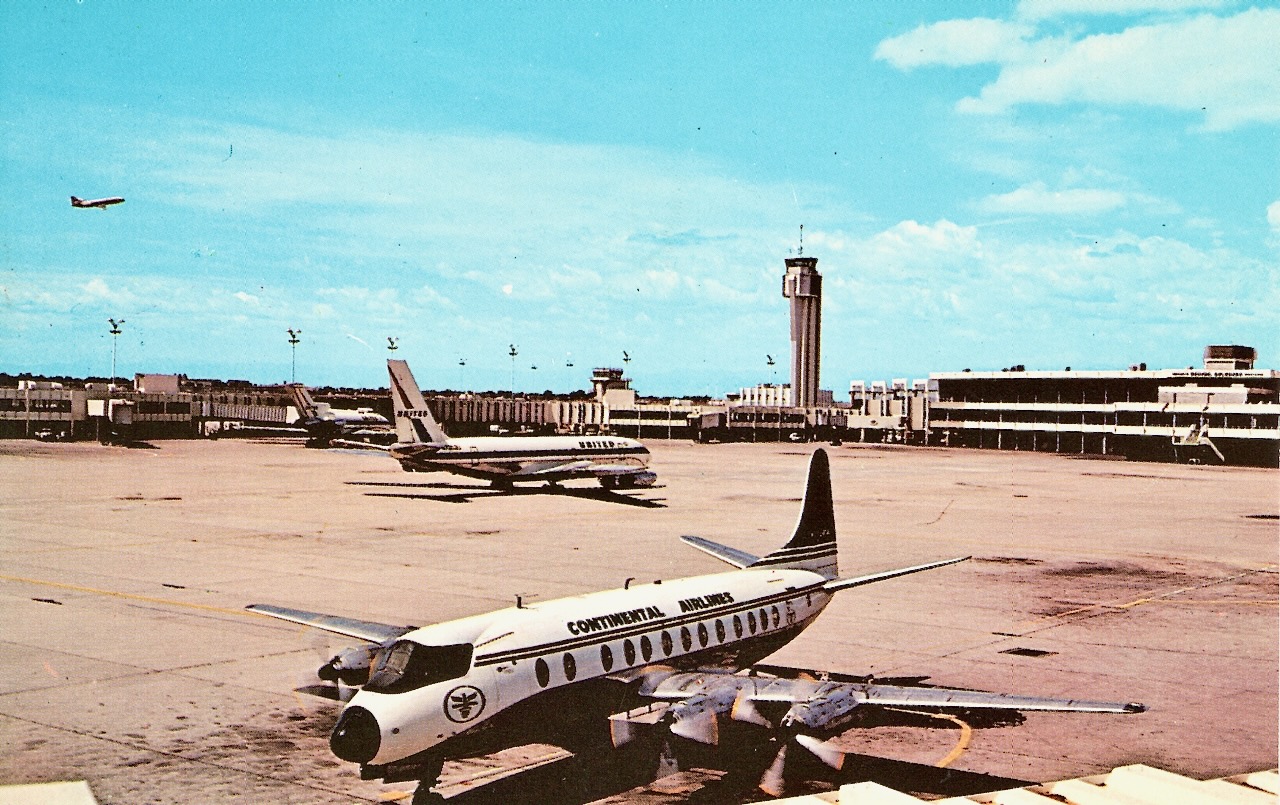
Continental Airlines Vickers Viscount at Denver Stapleton Airport, 1960s. Pub’r Colourpicture, Boston, no. P70865; dist’r G. R. Dickson Co., Denver. Here you can see the new iconic 12-story control tower that opened in 1962-63.

Although Stapleton Airport closed in 1995, its 12-story control tower still exists and is preserved as a historic landmark. The tower is now the home of FlyteCo Tower, an aviation-themed brewery and entertainment complex. The Doubletree Hotel, host for Airliners International 2026, is near the former Stapleton Airport area, and the show’s welcome reception will be held in the FlyteCo Tower, with tours of the tower available.

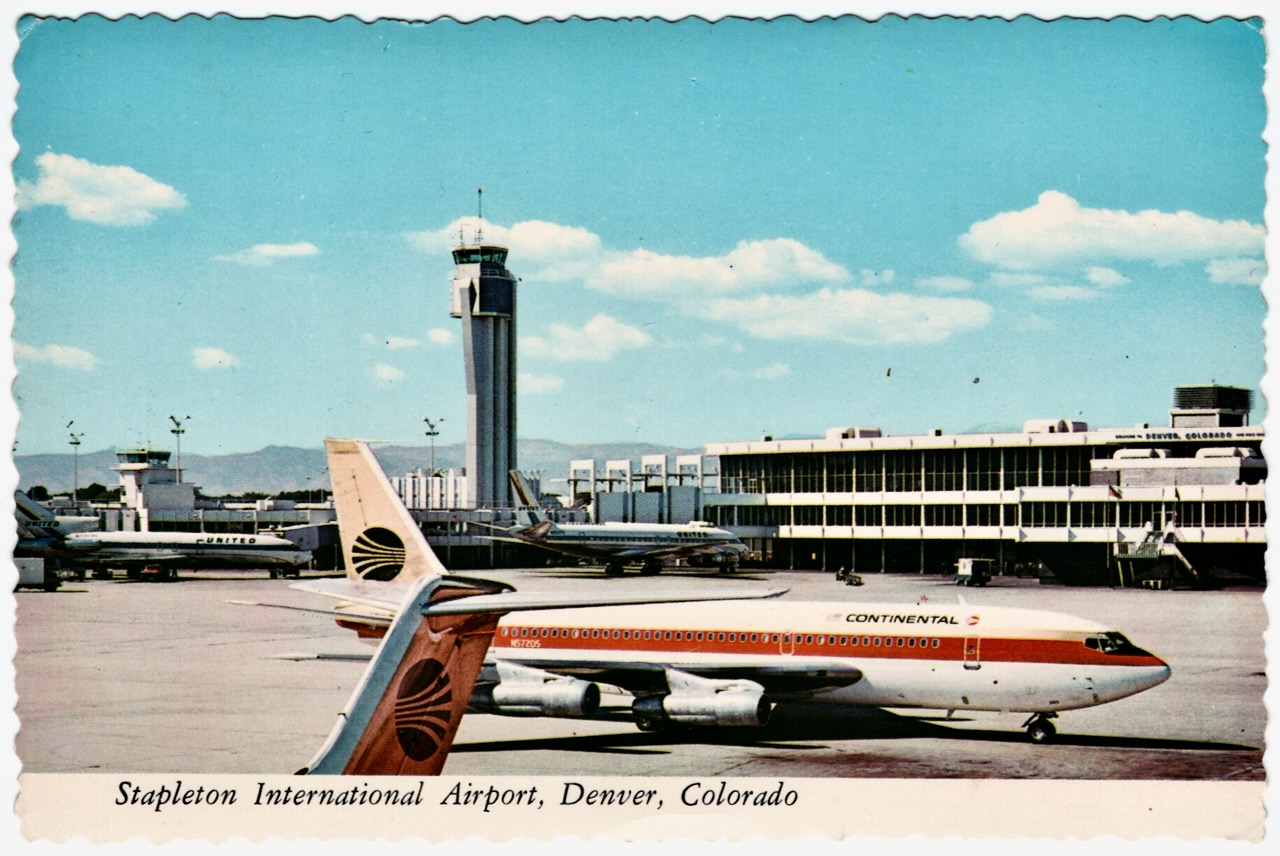
The jet age arrived in Denver in May 1959 when Continental Airlines started operating 707s into Stapleton Airport.  My own very first flight was in December 1959 on a Continental 707 “Golden Jet” from Los Angeles (LAX) to Denver Stapleton. This postcard shows Continental Airlines Boeing 720, N57205, at Stapleton, with its tail bearing the classic Continental logo designed by Saul Bass and introduced in 1968. Pub’r Colourpicture, Boston, no. P87834; dist’r G. R. Dickson Co., Denver. The word “International” was added to Stapleton’s name in 1964.
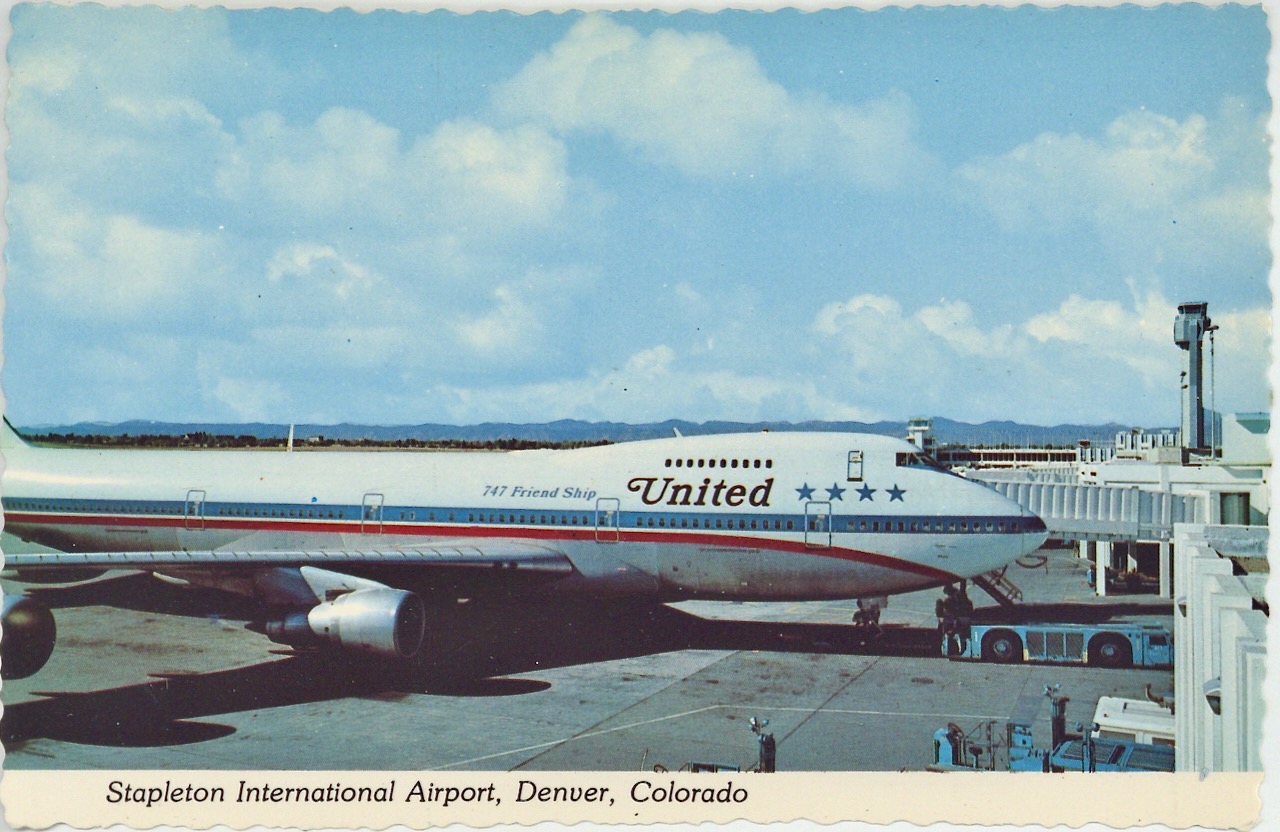
A United Airlines Boeing 747-200 at Stapleton International Airport, in United’s “Friend Ship” livery with four stars, in use during 1972 – 1974. Pub’r Colourpicture, no. P308472; Distributed by G.R. Dickson Co., Denver.
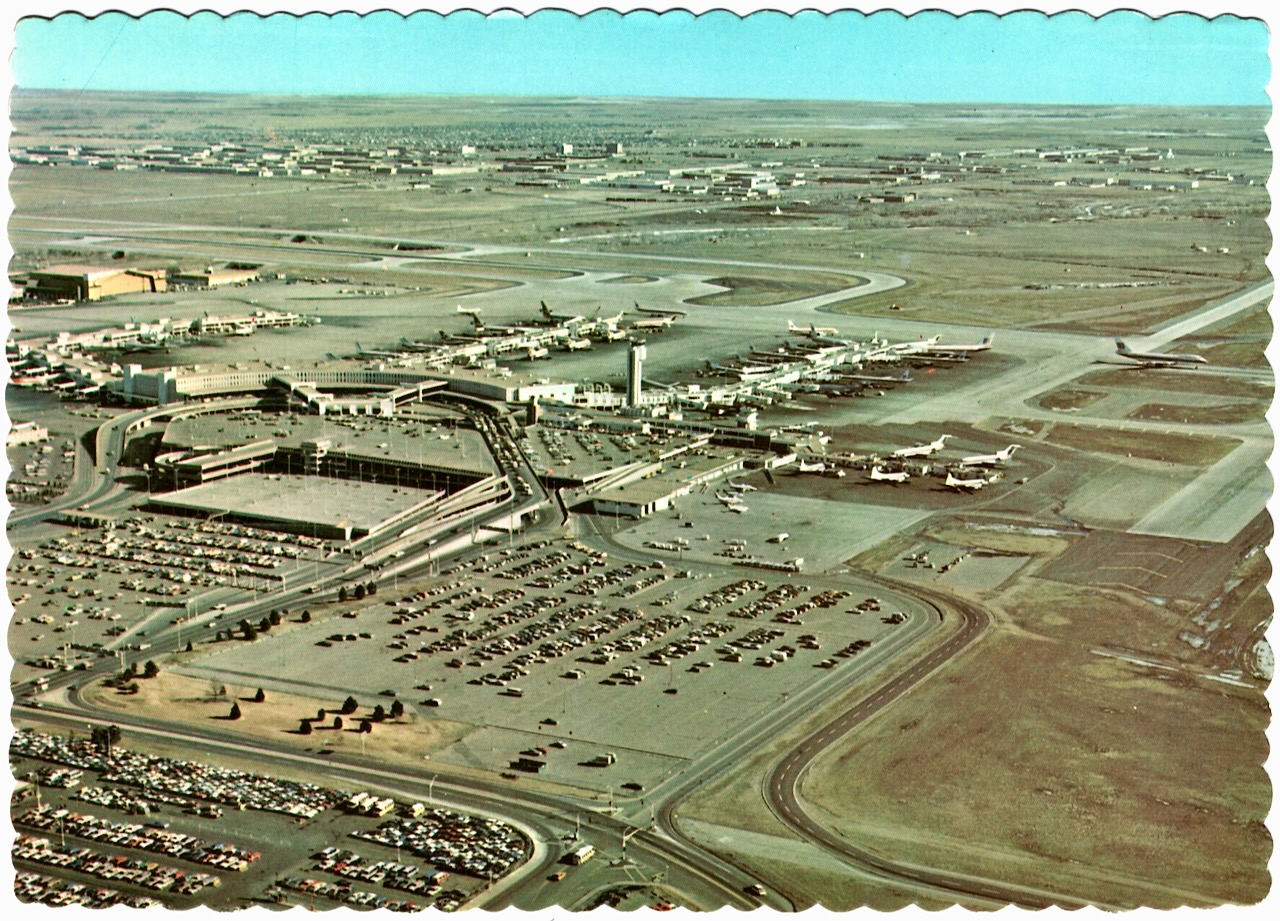
Aerial view of Denver Stapleton International Airport, probably early 1980s. Pub’r Sanborn Souvenir, Denver; printed by Dexter Press, no. 57034-D. Ex Allan Van Wickler Coll’n. Here you see the “horseshoe” arrangement of the main terminal roadways and the two main concourses in the middle — Concourse B for United and Concourse C for Continental. The original concourse, A, is to the right; and Concourse D, built in 1972, is to the left. Later, in 1988, Concourse E opened to the left of the view in this postcard.
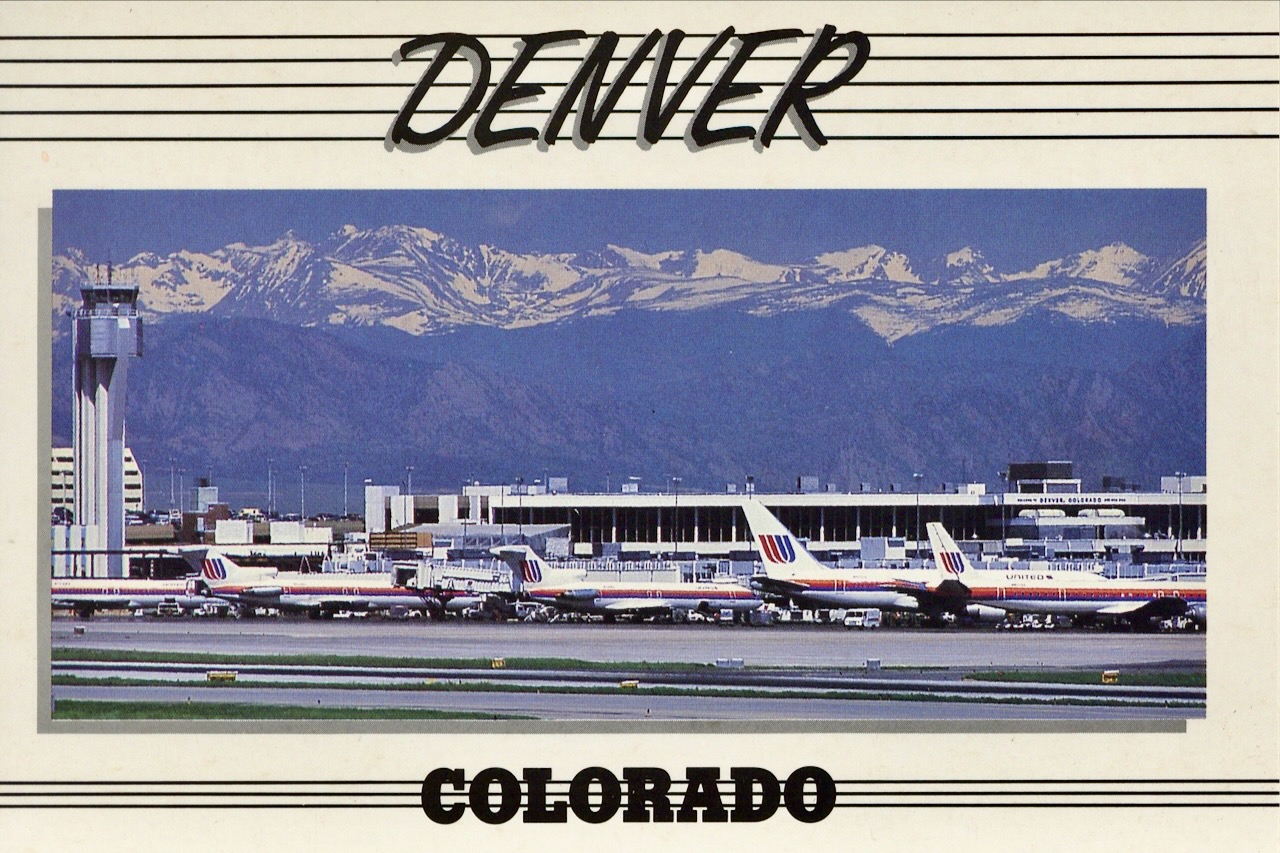
United Airlines aircraft at its Denver hub, Stapleton International Airport, probably in the 1980s.  Printer Mike Roberts, Oakland, CA, nos. B16284/D-133; dist’r G. R. Dickson, Denver; photo by Arthur H. Bilsten. Boeing 727s and a 767 can be seen along with a Douglas DC-8. The double “U” logo on the United tails was designed by Saul Bass and introduced in 1974, and United operated the first commercial service of a 767, from Chicago to Denver Stapleton, in May 1982.

The rapid growth of Stapleton’s passenger traffic, coupled with the inability to acquire more land for expansion, led to the construction of a new primary airport for Denver. Following many years of planning and construction, Denver International Airport was finally ready. The last flight departed Stapleton on February 27, 1995, and Denver International Airport opened the next morning. Stapleton was decommissioned, and today the only remaining structure is the preserved 12-story control tower. The rest of Stapleton Airport is now a multipurpose development, including residences, businesses, and parks.

Today’s primary Denver airport, Denver International (DEN), which opened February 28, 1995, can only be described with superlatives. Its sheer size is overwhelming — 53 square miles (137.8 square km) of land, about twice the land area of Manhattan and about twice that of Dallas-Ft. Worth Airport. Its terminal, named after pioneering airline pilot and Denver native Elrey Jeppesen, contains 2.6 million square feet (241,548 square meters) of space and leads to over 170 gates. The terminal’s translucent white tented peaks, designed to simulate the Rocky Mountains in the background, look stunning from the air and impressive from ground level.

Denver International now has six non-intersecting runways. Five are 12,000 ft. (3657m) each in length. The sixth runway (16R/34L) is 16,000 ft. (4875m), over three miles long, the longest commercial runway in North America. That extra length is particularly useful because of Denver’s mile-high elevation and summer heat. Moreover, because of the airport’s enormous land area, it has room to add up to six additional runways if and when needed.

In 2025, over 82 million passengers passed through Denver International Airport, making it the 4th busiest airport in the U.S. and the world’s 10th busiest airport. Denver Airport expects further growth and has adopted a two-phase strategic plan – “Vision 100” to prepare the airport to serve 100 million passengers annually in the next several years, and “Operation 2045” for an expected 120 million+ passengers by its 50th anniversary in 2045.

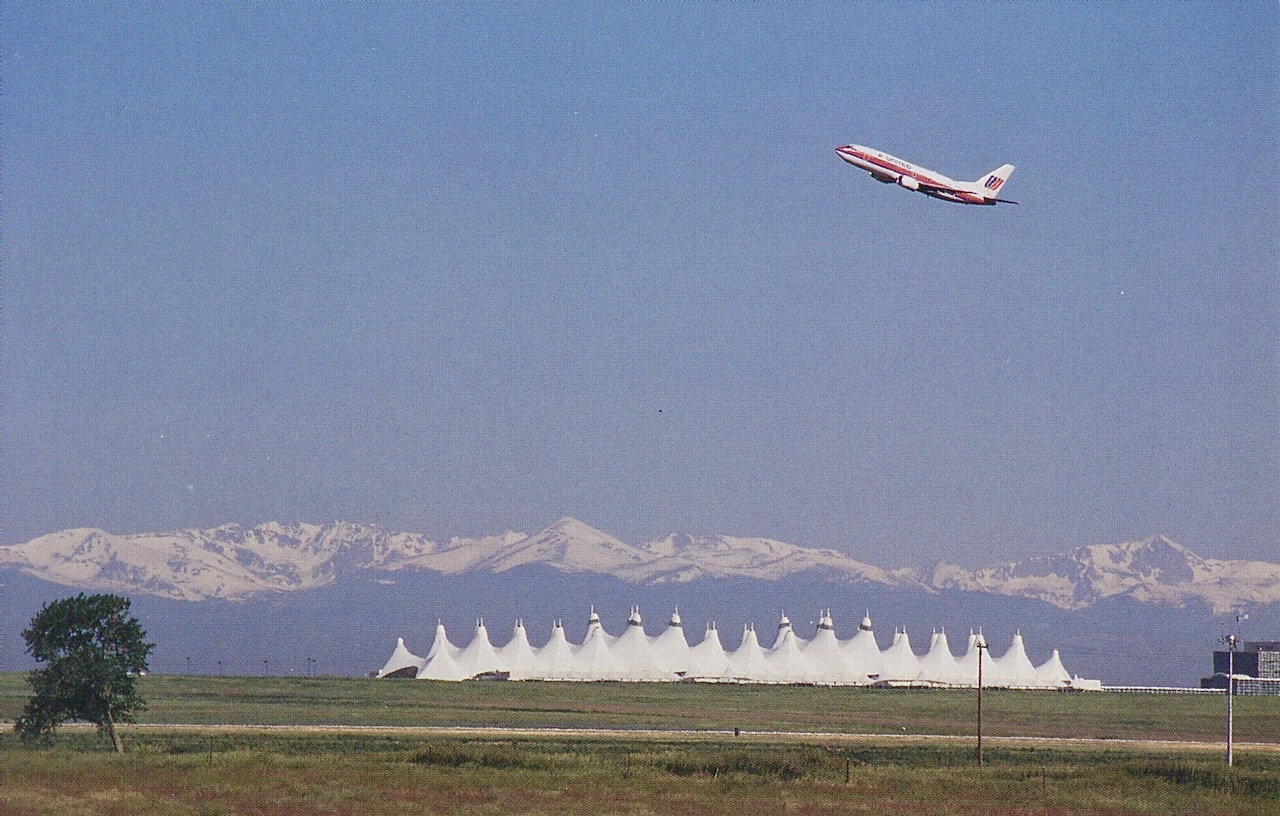
Denver International Airport opened on February 28, 1995, replacing Denver Stapleton International Airport. As seen in this postcard, the white tented peaks of the airport’s Jeppesen Terminal stand out impressively, with the Rocky Mountains in the background and a United Airlines plane climbing after takeoff. Publ’r Sanborn Ltd., Commerce City, Colorado; photo by Ron Ruhoff.
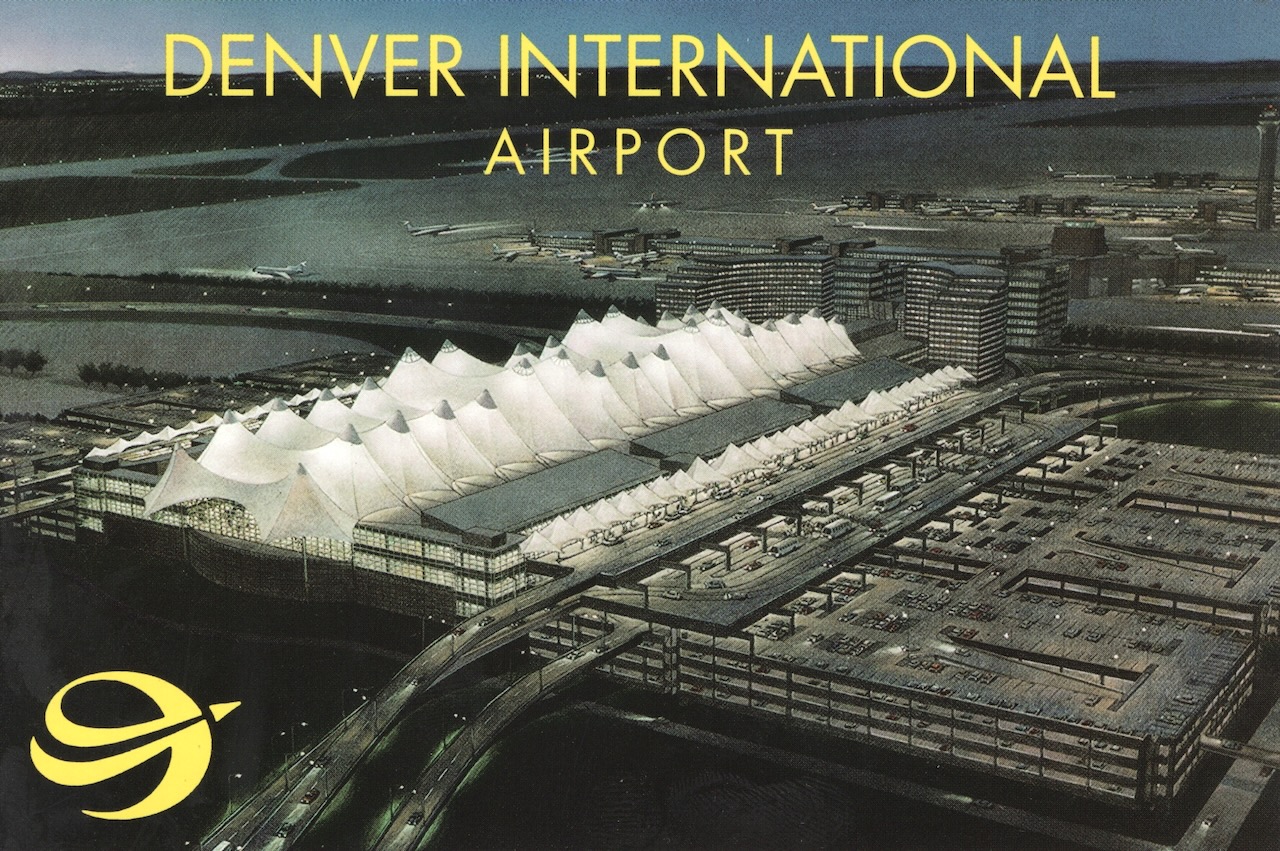
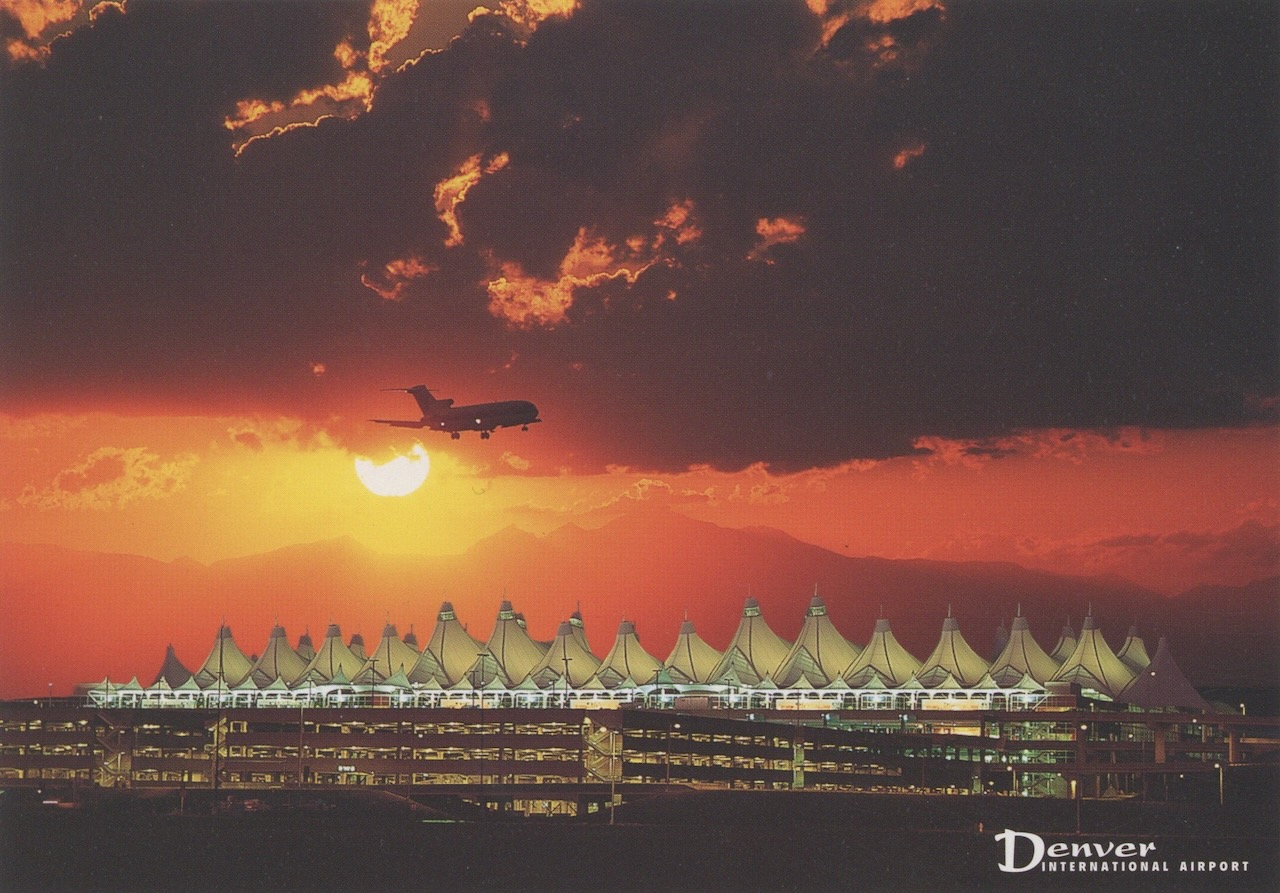
Denver International Airport at dusk. The translucent Teflon-covered fiberglass roof pinnacles of the Jeppesen Terminal create a lighted beacon effect at night. The airport logo appears in the lower left-hand corner. Pub’r Mountain States Specialties, Boulder, CO; Printer Mike Roberts, Oakland, CA, no. B20211.
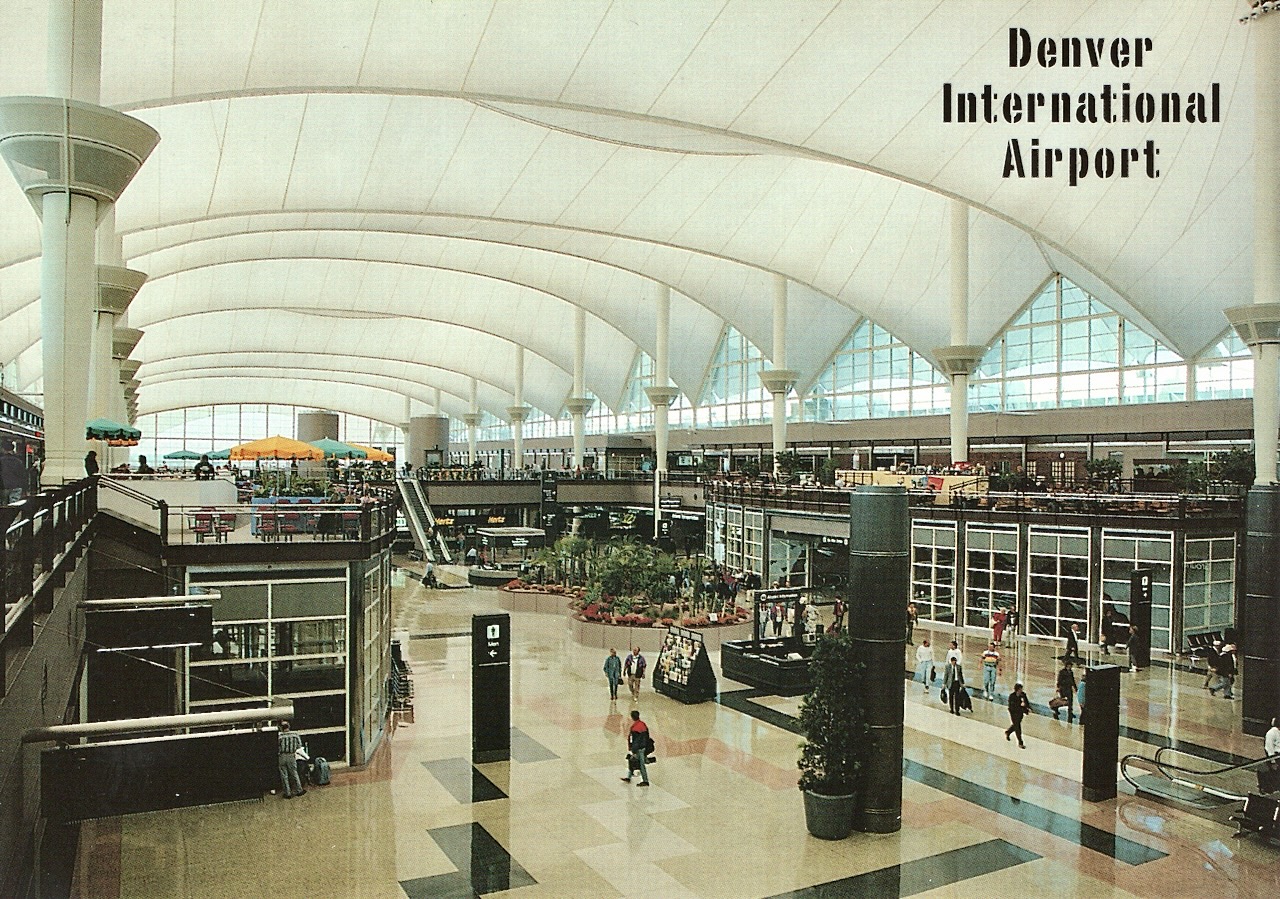
Jeppesen Terminal Partial Interior View. Pub’r Mountain State Speciaities, Boulder, CO, no. 420B.
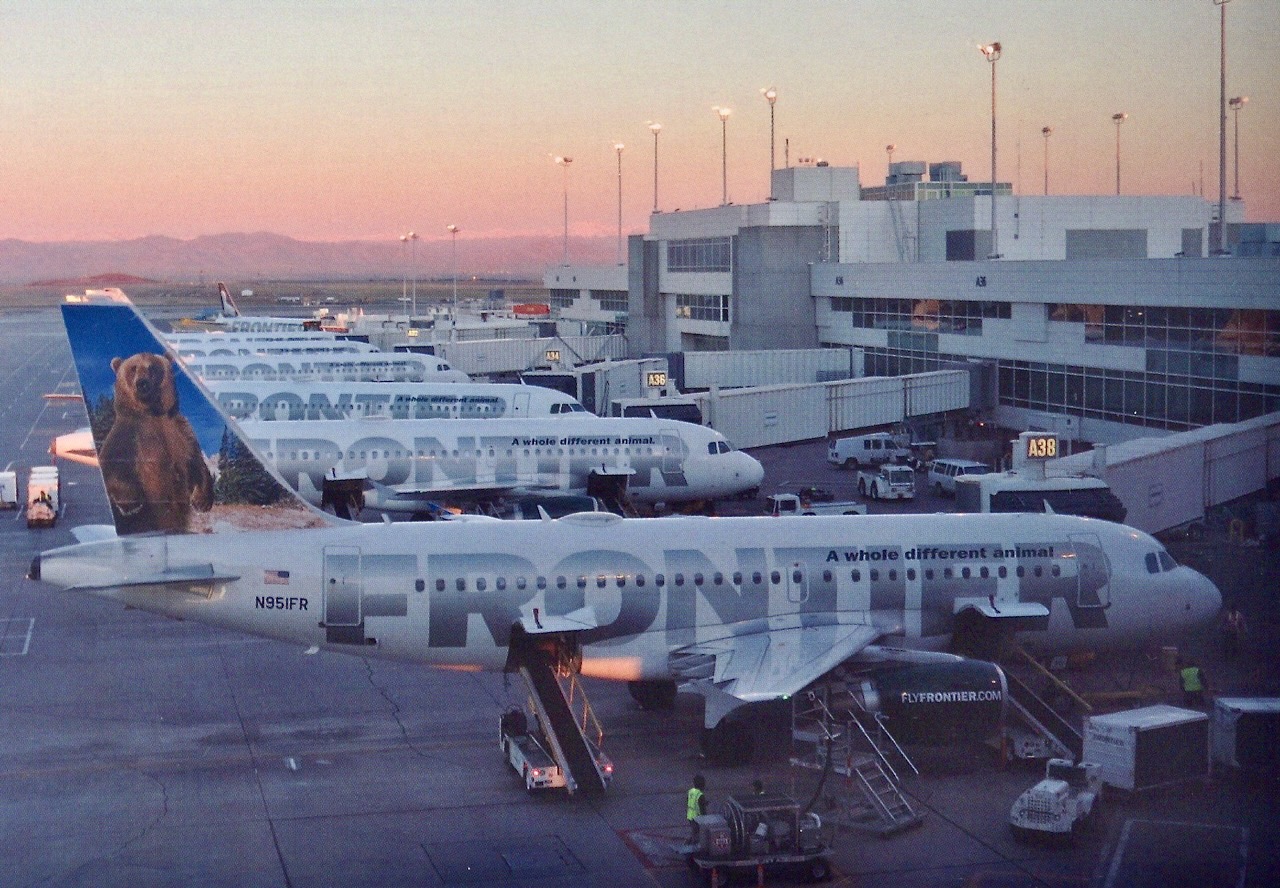
Frontier Airlines aircraft at the west portion of Concourse A at Denver International Airport at sunrise, October 14, 2014. In front is Frontier Airbus A319, N951FR. No. 1 of seven postcards issued for Airliners International 2017 Denver; pub’r jjpostcards, Bassendorf, Switzerland; photo via Aaron Mandolesi.
Denver International Airport at sunset. Pub’r Impact Colorado no. 40281; Photo by Bob von Normann. 
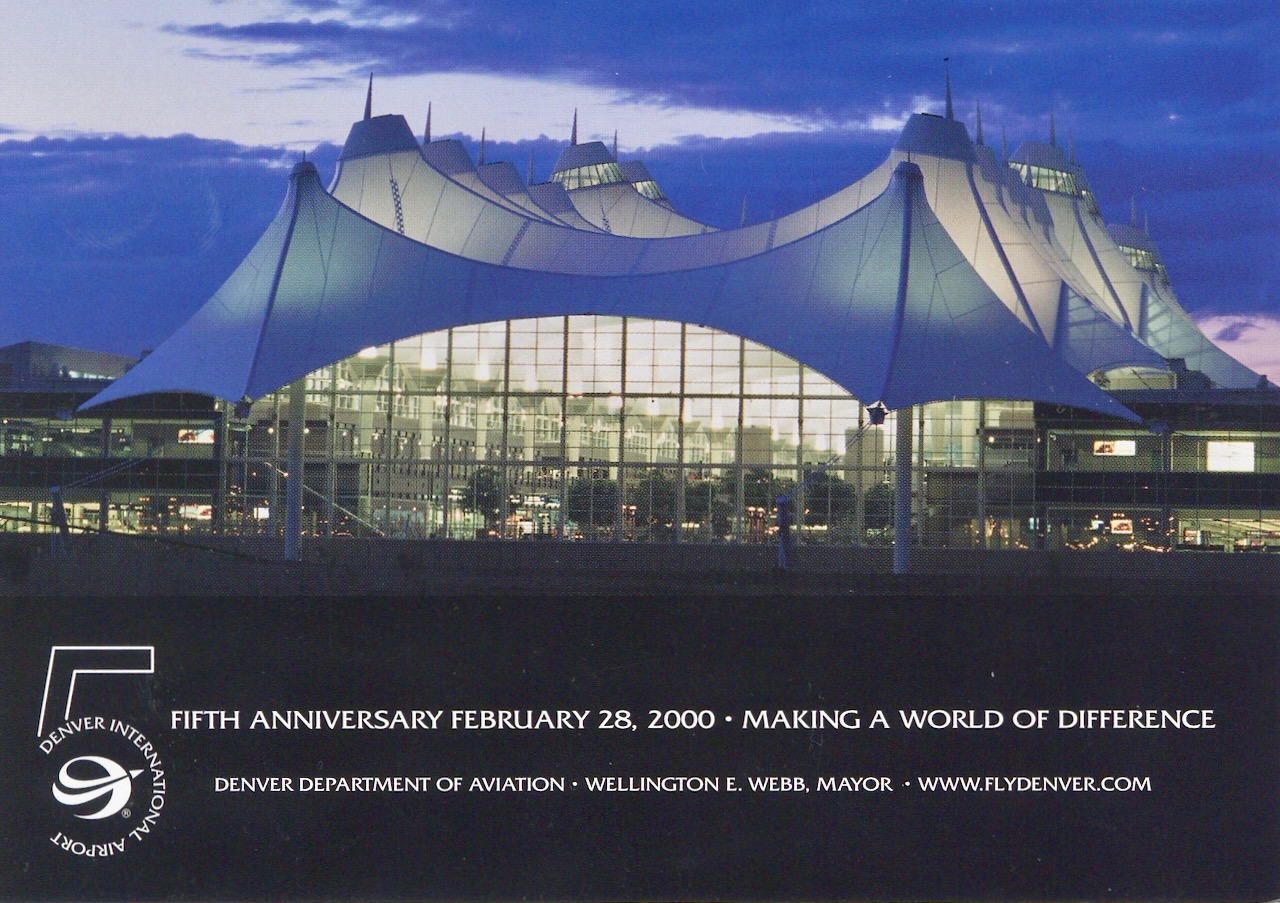
Postcard commemorating the 5th anniversary of Denver International Airport, February 28, 2000, showing the distinctive peaked Jeppesen Terminal illuminated by its spacious atrium. Issued by the Denver Department of Aviation.
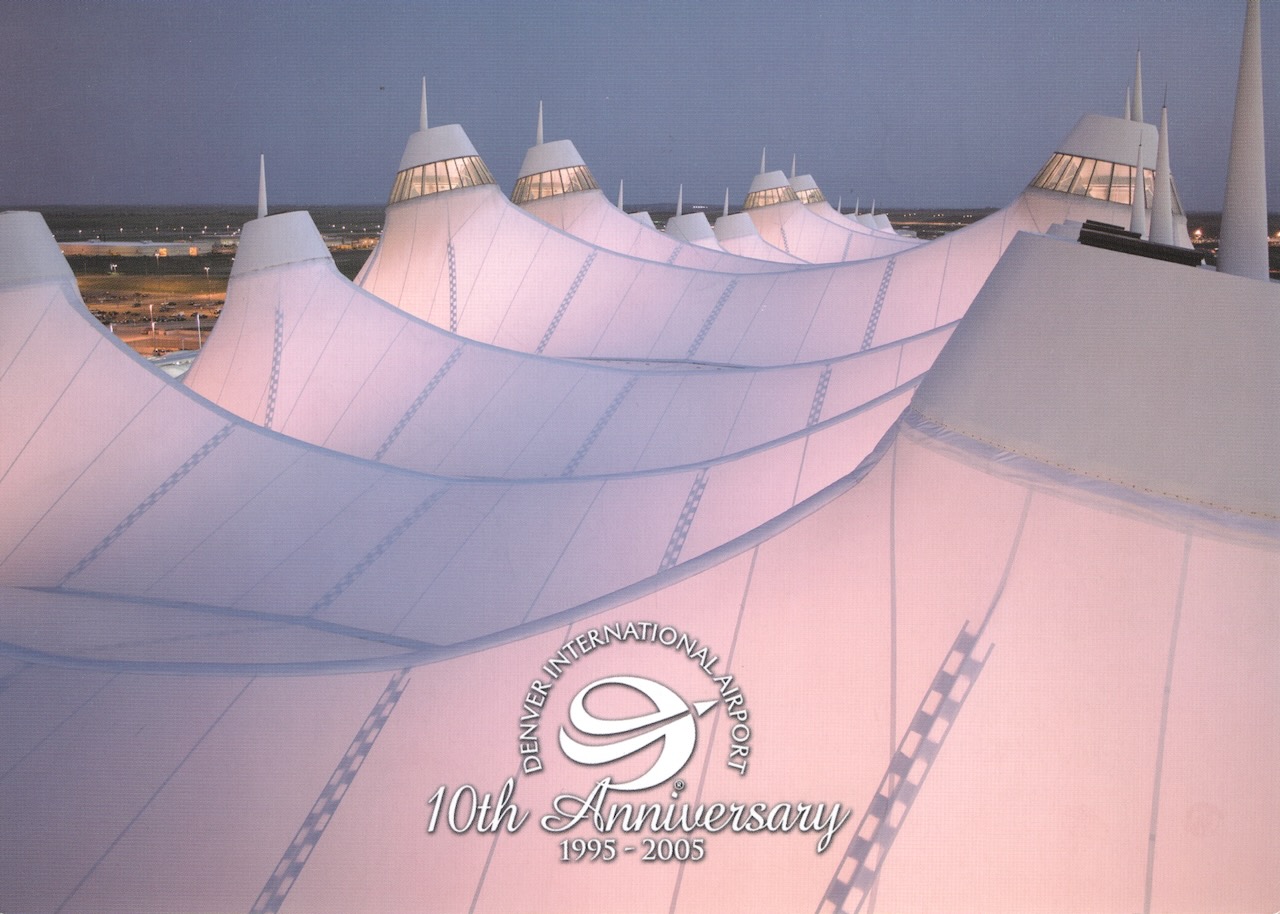
Denver International Airport Jeppesen Terminal “billowing sails” art postcard issued by Denver Airport on its 10th Anniversary in 2005. Oversize.
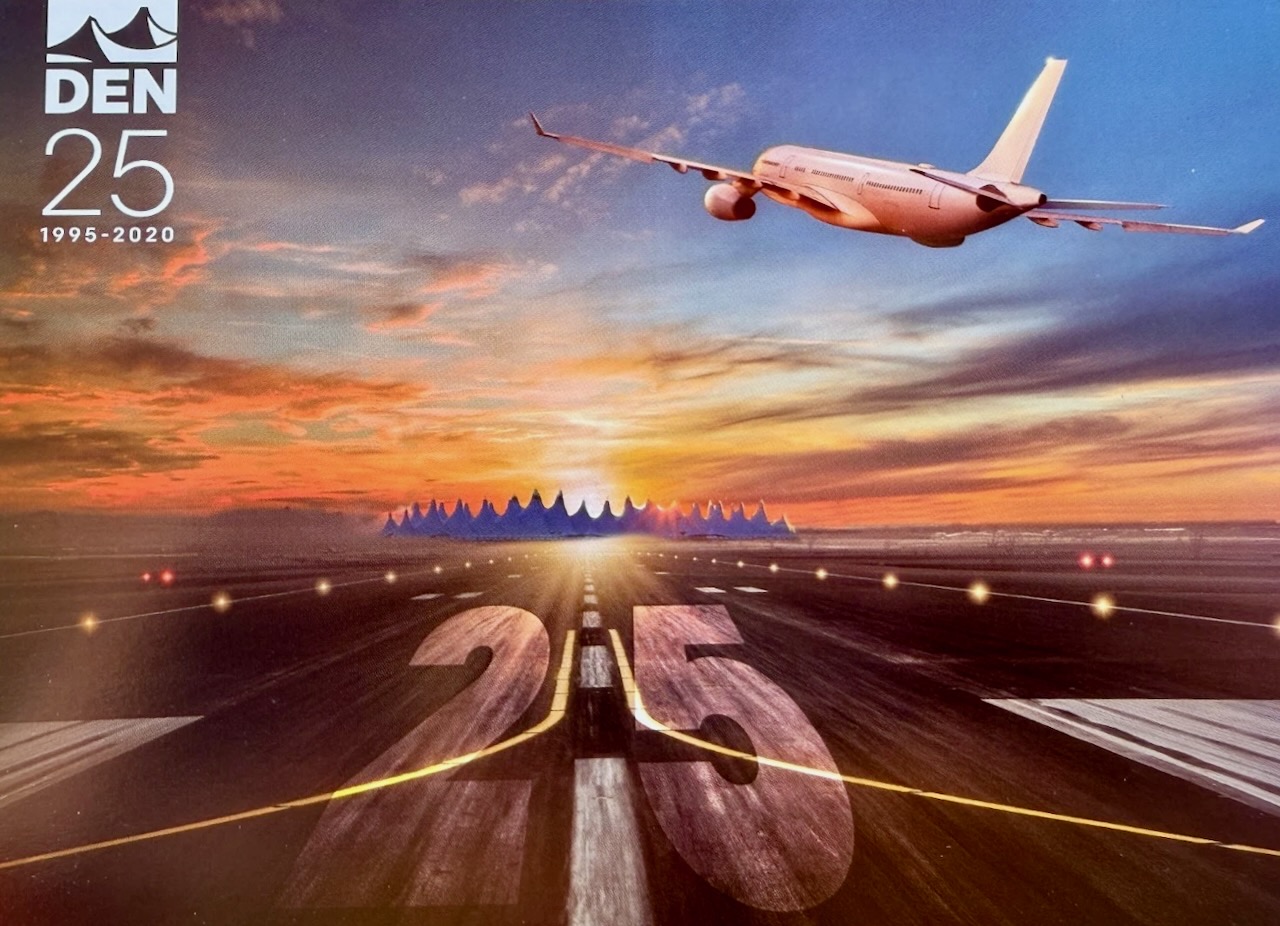
Denver International Airport 25th Anniversary postcard, issued by the Denver Department of Aviation in 2020 for the Airport’s “Don’t Stop Believing” Exhibit in the Jeppesen Terminal.

Note:  All postcards shown are from the author’s collection except the last one. I estimate their rarity as follows: Uncommon: the United DC-4s at Stapleton postcard and the three Denver International Airport anniversary postcards.

References:

The Denver International Airport website: flydenver.com

airfields-freeman.com/CO/Airfields_CO_Denver_NE.htm#stapleton

aviationphotographs.net/StapletonAirport/stapletonairport.html

coloradoencyclopedia.org/article/stapleton-international-airport


Airliners International 50th Anniversary Show and Convention, 2026 Denver

June 24-27, 2026, at the Doubletree Hotel, Quebec St., Denver, CO:

Details found at airlinersinternational.org, the convention website. Registrants can submit airline and airport postcard exhibits for display at the show; see the Postcard Exhibit Rules posted on the convention website.

Until next time, Happy Collecting,

Marvin

Continue Reading 1 Comment

World Airline Historical Society, Inc.
PO Box 13693, Tampa, FL 33681-3693 USA
Contact Us

Archives

Copyright © 1975-2025 World Airline Historical Society, Inc.

Read our Privacy Policy