Musings from a Passenger’s Seat: Memories of Idlewild and Kennedy Airport visits

Written by Lester Anderson

Photographs by Mel Lawrence via the Shea Oakley Collection.

When I was in high school I had the airplane/airport bug. Fortunately, two friends also had it, so I was not alone in my quest to see airplanes during the early 1960s.

Idlewild airport was the destination of many weekend trips to the airport. We started the trip (from NJ) on the bus into the Port Authority bus terminal. We then took the 15 cent subway ride, the Independent line (IND) E 8th Avenue subway, from 42nd street to the Kew Gardens stop in Queens. Although local in Manhattan, it was known as the 8th Avenue Express once it got into Brooklyn and Queens.

At Kew Gardens we went up to street level and took the Q10 bus (subway token or 15 cents coin) which about 25 minutes later dropped us at our destination, Idlewild Airport.

Idlewild was heaven for airplane fans. You could easily walk between the terminals. The Port Authority had buses (Mercedes buses-the only Mercedes busses I had ever seen) between terminals for a 25 cent fare. Almost all of the time we walked and “smelled the occasional whiff of kerosene” from airside when the wind was in the right direction.
Photographs by Mel Lawrence via the Shea Oakley Collection.

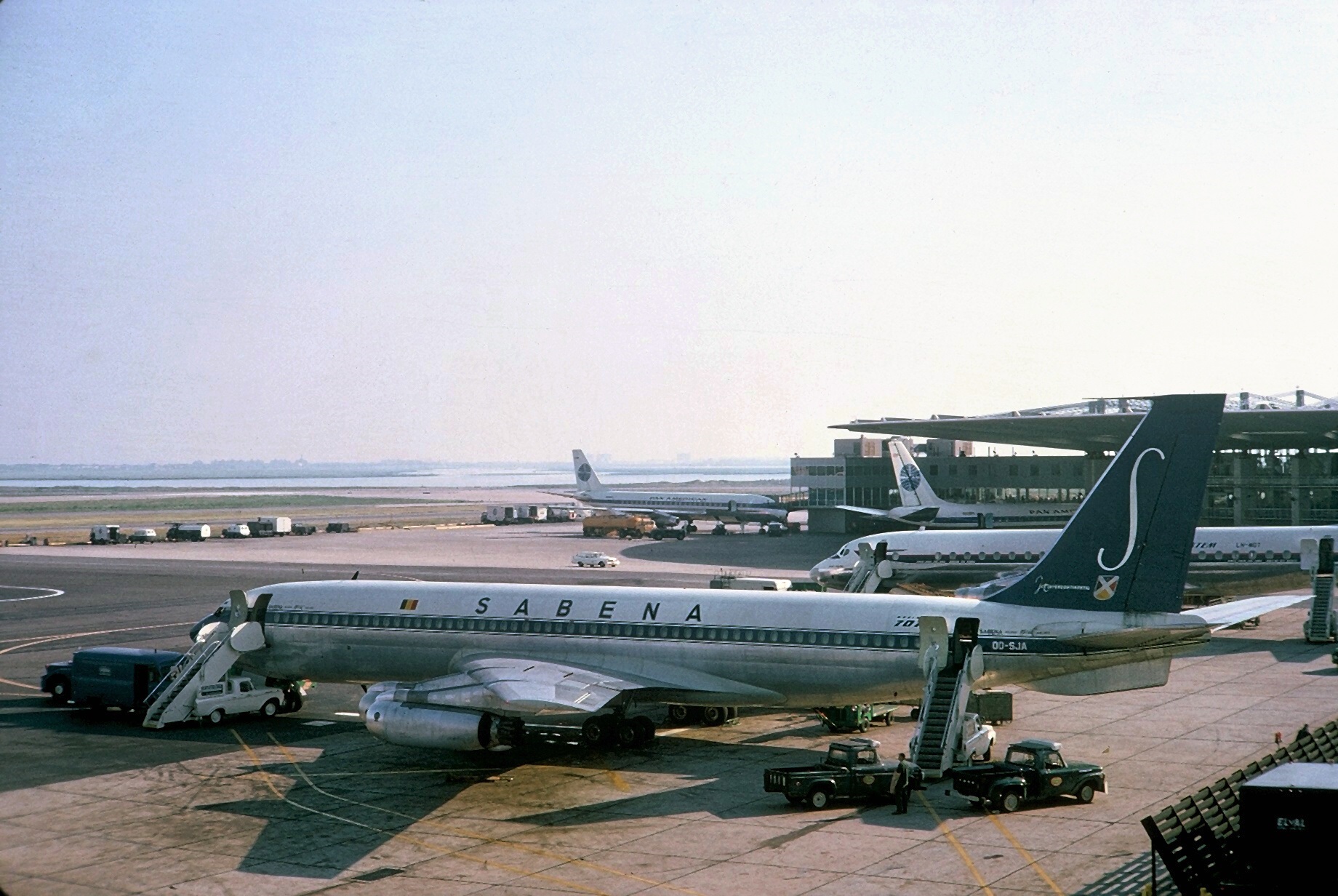
The Pan Am Worldport was a major attraction. It had the first “air door” I had ever seen or walked thru. It had a great view of the airplanes that were parked at the terminal for boarding. As high school students we often used our “juvenile status” to ask for things—and I remember during one Pan Am Terminal visit a gate agent allowed us to go aboard a 707 before the passengers went on, so we could see what it was like inside. We did have to put blue cloth protectors on our shoes so we would not get the rug of the plane dirty.

The IAB (International Arrivals Building) was a necessary stop since it had the best and biggest observation deck (for 10 cents). You could look at the airplanes below, and got to see things you would not see at Newark or LaGuardia like VC-10’s and Bristol Britannia’s as well as familiar airliners (DC-7Cs DC-6Bs and Constellations) from foreign exotic carriers. We also saw a lot of international 707’s and DC-8’s but our fascination was mostly with airplanes with propellers at that time. You also looked up and saw the building-wide sign “NEW YORK INTERNATIONAL AIRPORT”. You also had a great view of airplanes taking off and I remember a number of jets with heavy black smoke that I later found out might have been water injection take-offs.
Photographs by Mel Lawrence via the Shea Oakley Collection.

They were building terminals right and left at that time, but I fondly remember the field in front of the IAB with the infrastructure power plant with pipes and valves (probably for HVAC – my father’s occupation) that instead of being hidden in a nondescript brick building, were there in a building with glass window walls, and all of the pipes and valves painted in exciting different colors. In the same oval grassy field there were also three religious chapels. As teens who had just taken their first flights, we probably could not understand anyone’s fear of flying, but looking back, they were probably a great comfort to travelers who, in the back of their mind, began their worries with “If God had meant man to fly ….”

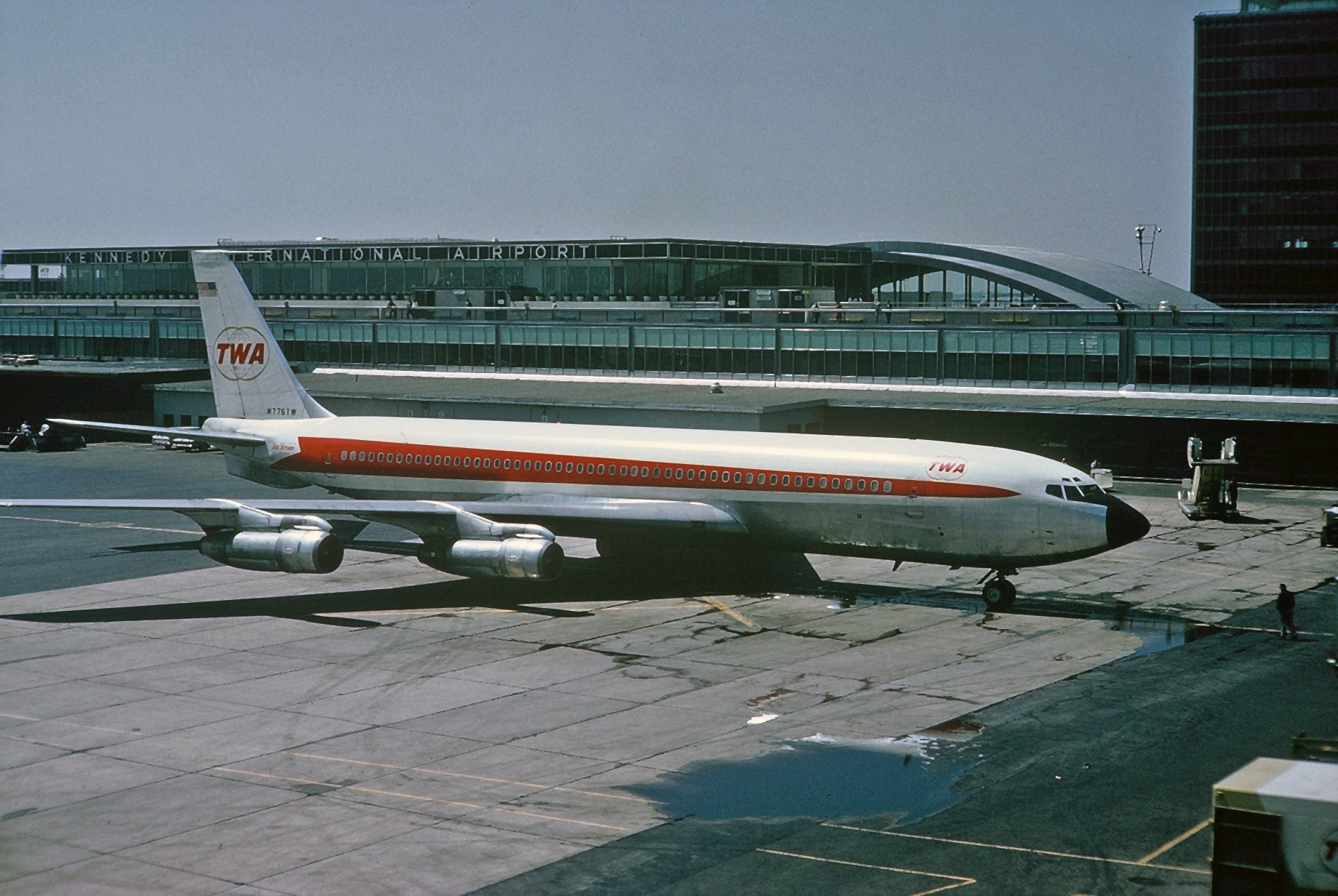
Probably the most moving visit to Idlewild was Christmas Eve in 1963. John Kennedy was assassinated November 22, 1963 which was an event that profoundly affected everyone I knew. Moving faster than government and agencies normally do, the decision was made to rename New York International Airport to John F Kennedy International airport.

The dedication ceremony was on Christmas Eve in 1963. I don’t know if my parents would have allowed me to take the day off from school, but since school was on vacation, I took the bus and subway and bus to the airport to see the dedication. It was in the International Arrivals building and I was on an upper level, but could see the entire ceremony. Ted Kennedy spoke briefly (as probably others who I don’t remember), then they drew the curtain and you saw the letters JFK. They said they did not have enough time to get the entire building-wide sign done for that day, but these were the letters everyone wanted to see.
Photographs by Mel Lawrence via the Shea Oakley Collection.

A few years later when I was student teaching, I saw a newly published American History book, and reading it, I saw printed in the book pictures from that ceremony that I attended. I must admit I felt I was too young to be a witness to an event published in a history book.

The other memory of Idlewild I can remember and express was that while the National Airlines terminal was being built, National used a temporary terminal. And that terminal had a food vendor that my friends and I thought had the best hamburgers at IDL.

About the Author – Lester Anderson

I am not a typical author for an airplane/airline publication. I have never piloted a plane (once, actually, for about 5 minutes in France—but that is a story for another day). I have never worked for an airline. I have never worked at an airport.

However since the early 1960’s I was a frequent visitor to airports, mostly in the NY area but if my family ever visited relatives or friends in a far city, I would beg them to visit that airport.

Some pleasure travel but mostly business travel allowed me the honor to achieve Million Mile status on United Airlines (by flying on United as well as its two predecessor carriers, Continental and Eastern).

Now retired, I fly much less, but as the shirt my daughter gave me last Christmas proudly says, every time I hear an airplane overhead, I stop and look at it. And with today’s iPhone technology, I can identify it as to carrier, origin and destination, which I do and often bore those around me telling them that wealth of knowledge.

I am a volunteer at the Aviation Hall of Fame of New Jersey. One of my greatest joys is giving tours of the last Martin 202 passenger plane, and have children (and often their parents younger than me) sitting in the plane, and my explaining how different things were at the time the 202 was flying with passengers.

Photographs by Mel Lawrence via the Shea Oakley Collection.
Continue Reading 2 Comments

From Props To Jets

Written by Shea Oakley

The post-war period in commercial aviation saw the advent of the fully developed piston-powered airliner. This included short to medium range twin-engine transports like the Convair 240/340/440 and the Martin 202 and 404, all designed to fill the pre-war DC-3’s large shoes. Handling the longer haul services were the Douglas Commercial series of four-engined airliners; the DC-4, 6 and 7, Lockheed’s classically beautiful triple tail Constellation and Boeing’s Luxurious B-377 Stratocruiser. These longer-ranged pressurized aircraft made the first U.S. transcontinental, and eventually transatlantic, nonstop flights possible. Among the many innovations these planes introduced onto the civil scene were tricycle landing gears, airborne radar and coach class seating. They were also considerably faster than any transports developed prior to World War Two.

By the middle of the Fifties piston-engine design had reached its technical zenith. Late model DC-7’s and L-1049 Constellations equipped with turbo-compound power-recovery systems were capable of maximum speeds in the 350 to 375 mile per hour range but this was effectively the practical limit for aircraft equipped with reciprocating engines. The power levels required from these increasingly complex motors to attain such speeds led to sometimes-spotty reliability. In-flight engine failures became an increasingly common problem. Moreover an inherent problem with any “propliner” of this era was the noise and vibration associated with 18 to 28 pistons firing in sequence. To achieve the next level in speed and comfort a whole new kind of power was necessary. The answer would come in the form of the turbine.

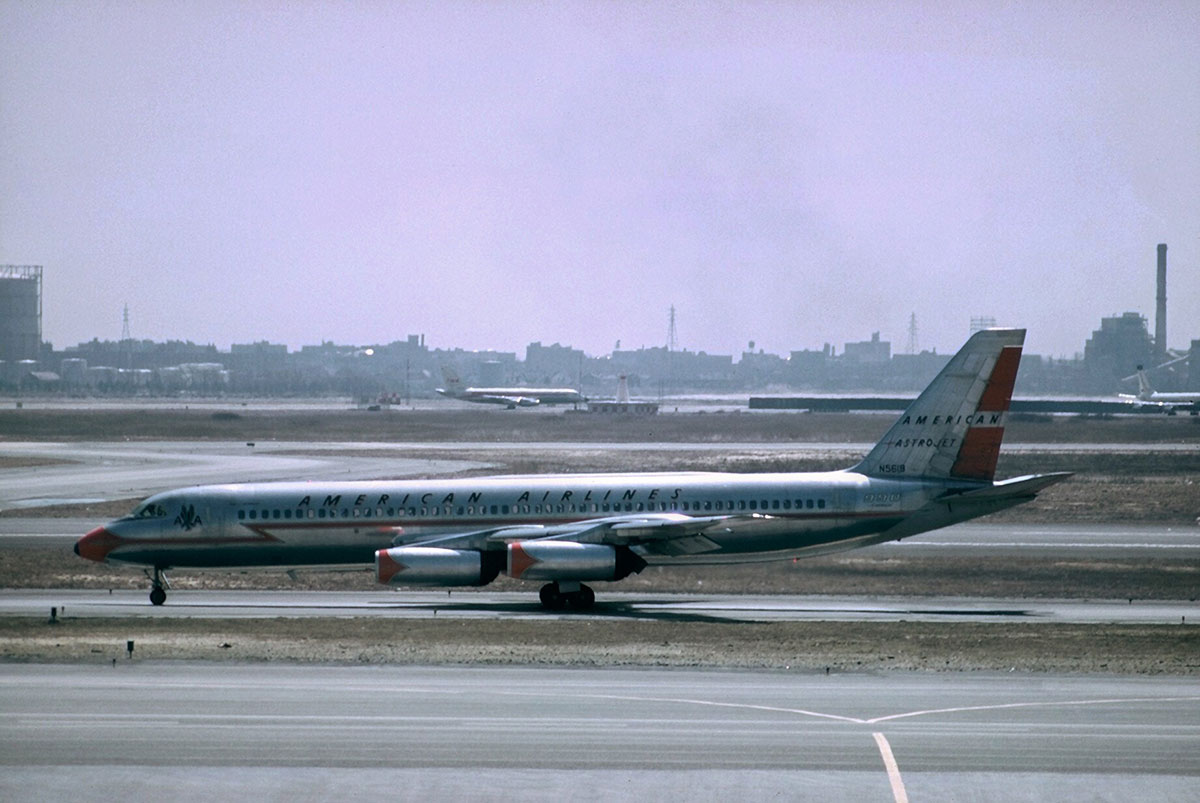
The second stage of the pure jet age was heralded by fanjets including the American Airlines Convair 990 “Astrojets”, in scheduled service starting in 1962.

While the first jet planes were introduced during the late thirties and early forties in Britain, Germany and America they were initially all small single-engined military machines. It was not until May 1952 that the first pure jet airliner entered service with the British flag carrier, B.O.A.C. This was the DeHavilland Comet 1, a beautiful but ill-fated design that developed fuselage metal fatigue problems after only a year in service. This flaw led to two catastrophic in-flight airframe failures and the grounding of the aircraft, but not before giving the public an early taste of the pleasures of jet flight.

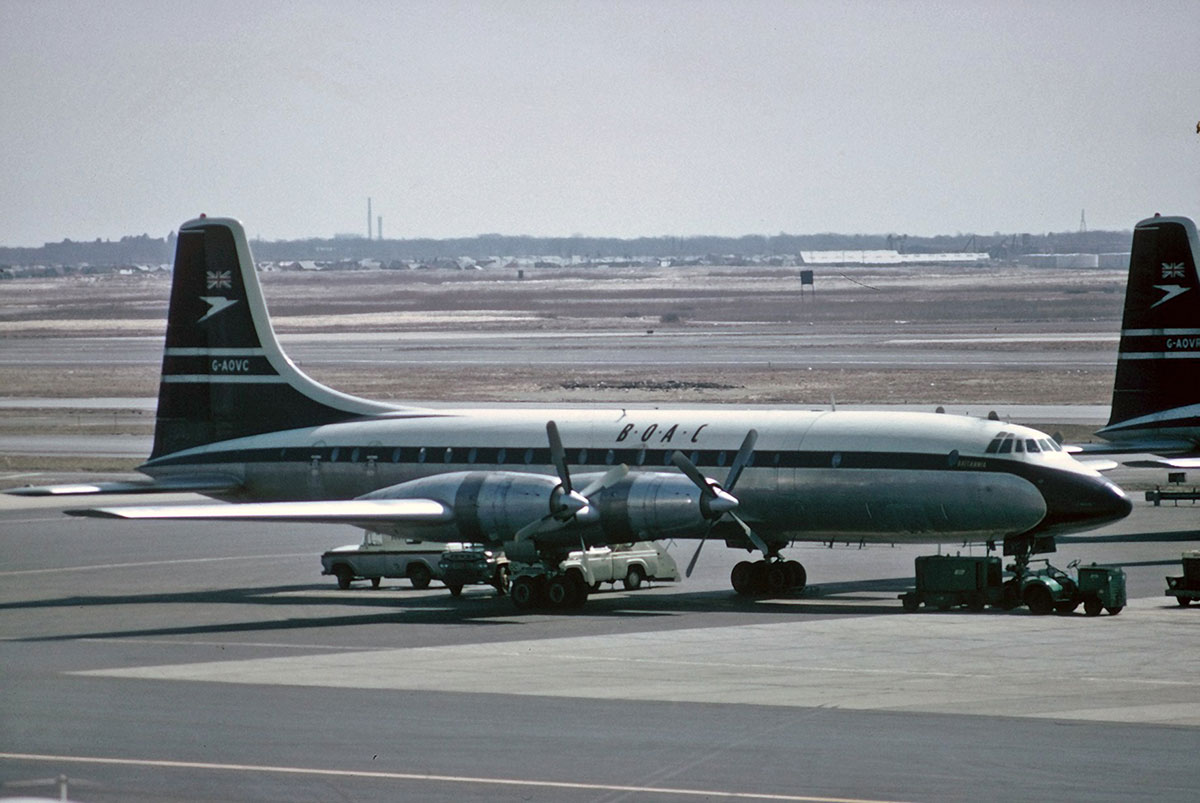
Supreme on the North Atlantic route, but only for a year. BOAC introduced the Bristol Britannia propjet on the LHR-IDL route in 1957. Pure jets made it obsolete in 1958.

Four years later in 1956 the state carrier of the Soviet Union, Aeroflot, introduced the twinjet Tupelev 104 medium range transport on the Moscow-Irkutsk route. It’s 477 mile per hour cruising speed cut eight hours from the previous schedule. Service to cities in Western Europe followed sometime later. A not so thinly disguised commercial version of a Russian bomber (made obvious by the “bombardier glass” surrounding the nose), the TU-104 was the second jetliner to fly in regularly scheduled service and a major propaganda tool for the U.S.S.R. at the time.

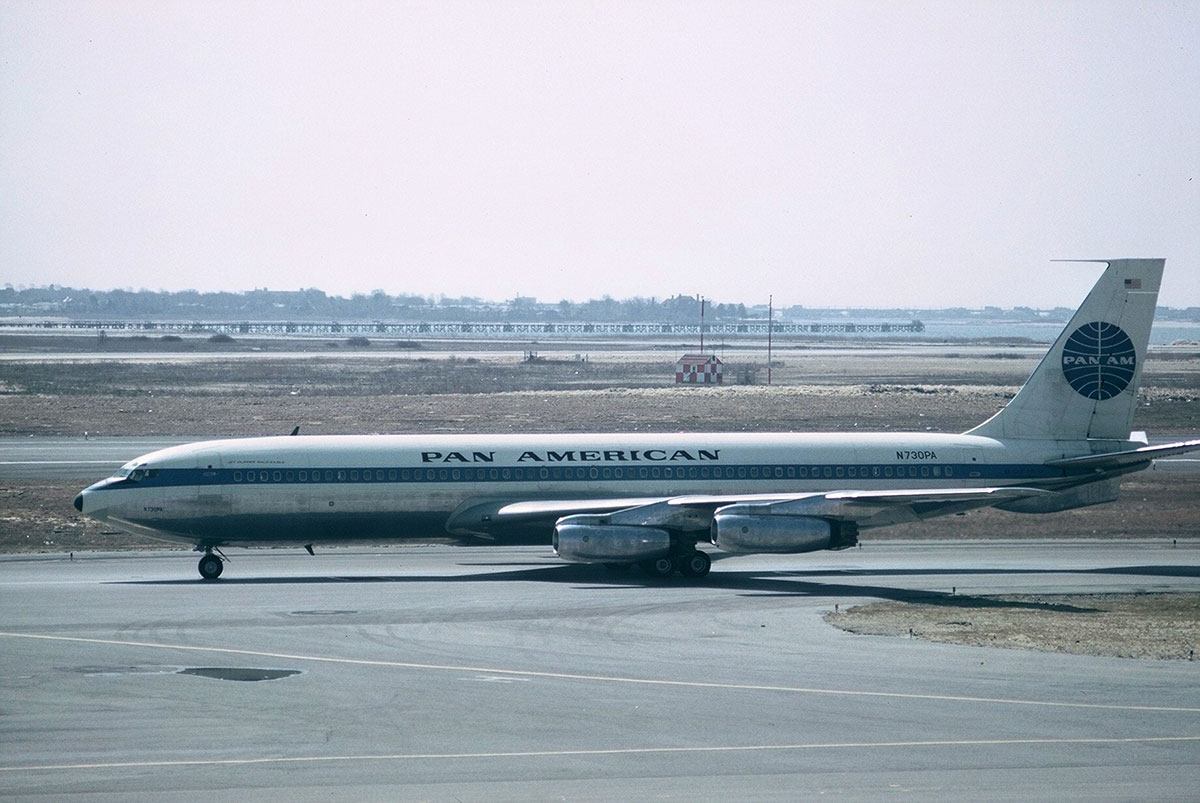
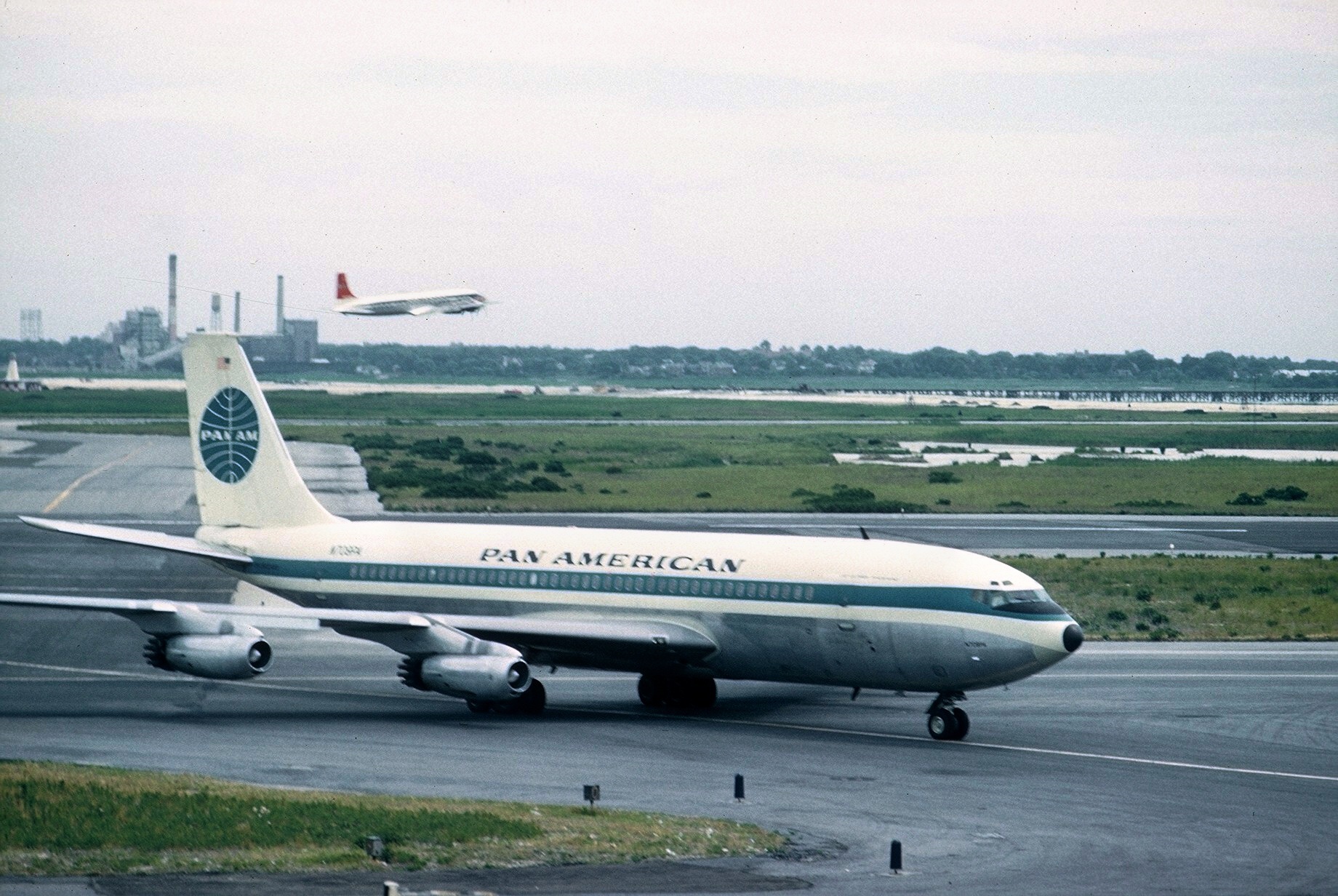
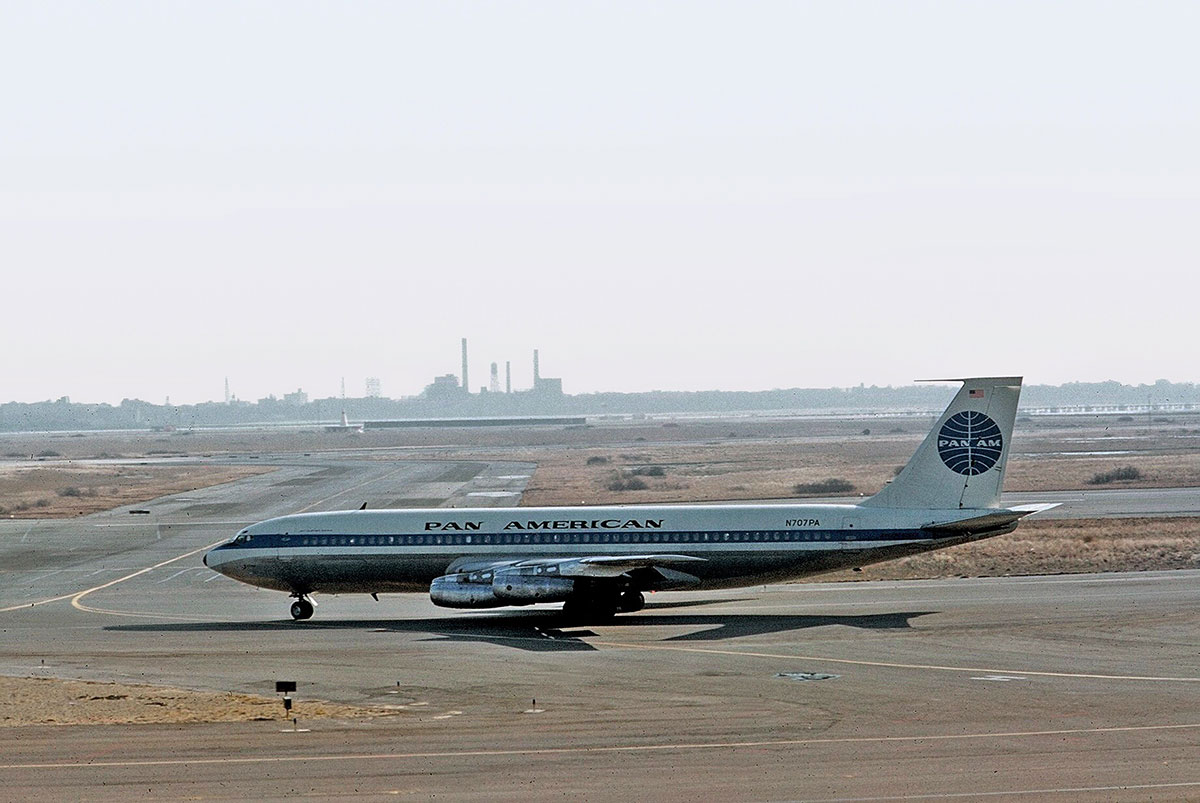
After a long and expensive re-design DeHavilland and B.O.A.C. inaugurated the world’s first transatlantic jet service on October 4, 1958 with the Comet 4. Only a few weeks later, on October 26, Pan American World Airways followed with the first of the American jetliners, the Boeing 707-121, on the New York Idlewild-Paris Le Bourget route. In 1959 and 1960 the longer ranged 707-320 “Intercontinental” and the first of the Douglas DC-8s began nonstop service between the United States and Europe From this point forward the fate of the piston-engined propeller plane was effectively sealed.

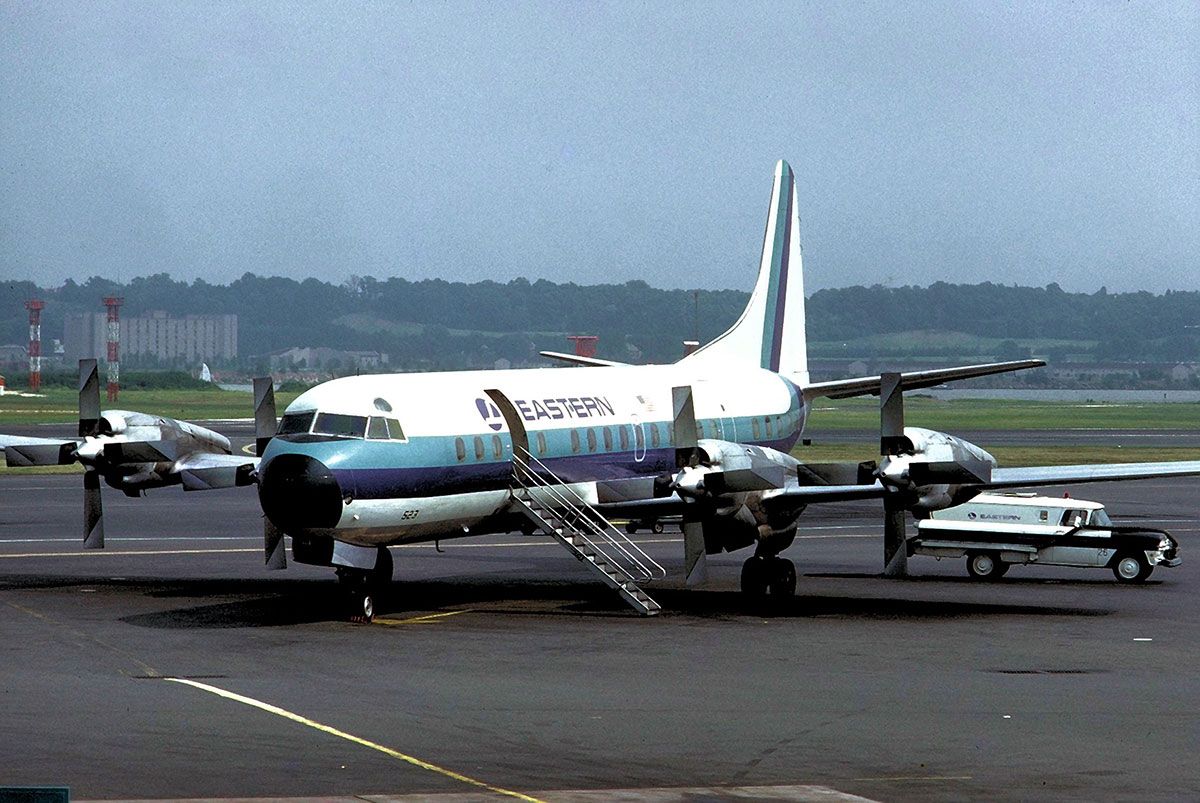
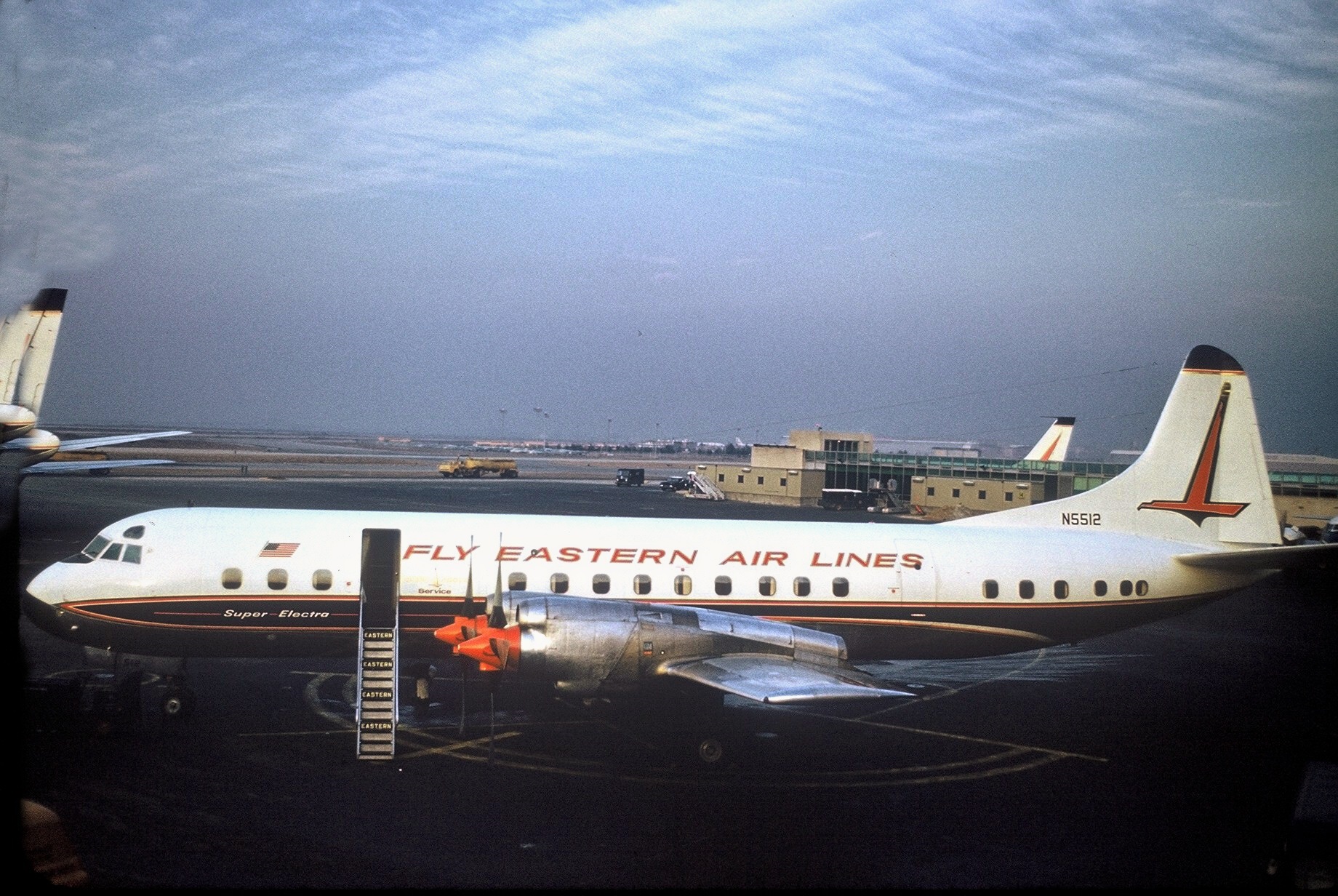
A transitional aircraft in the early days of jet power the turboprop Lockheed Electra remained in service with launch customer Eastern until 1977.

The new jets required radical changes in all aspects of airline and airport operations as well as ATC procedures and sometimes there was a lag in the learning curve. For instance some captains who were still “thinking prop” while “flying jet” were involved in several early crashes. At first, pilots tried to make approaches and landings like props, often from circling traffic pattern maneuvers. The problem with this was that pure-jets do not spool up as quickly as a piston engines do and this led to accidents in which rate of sink could not be corrected in time. Also, the higher speeds called for a greater ability to “stay ahead of the plane”. Better standardization of training and procedures, coupled with a new emphasis on stabilized straight-in approaches, became the new norm.

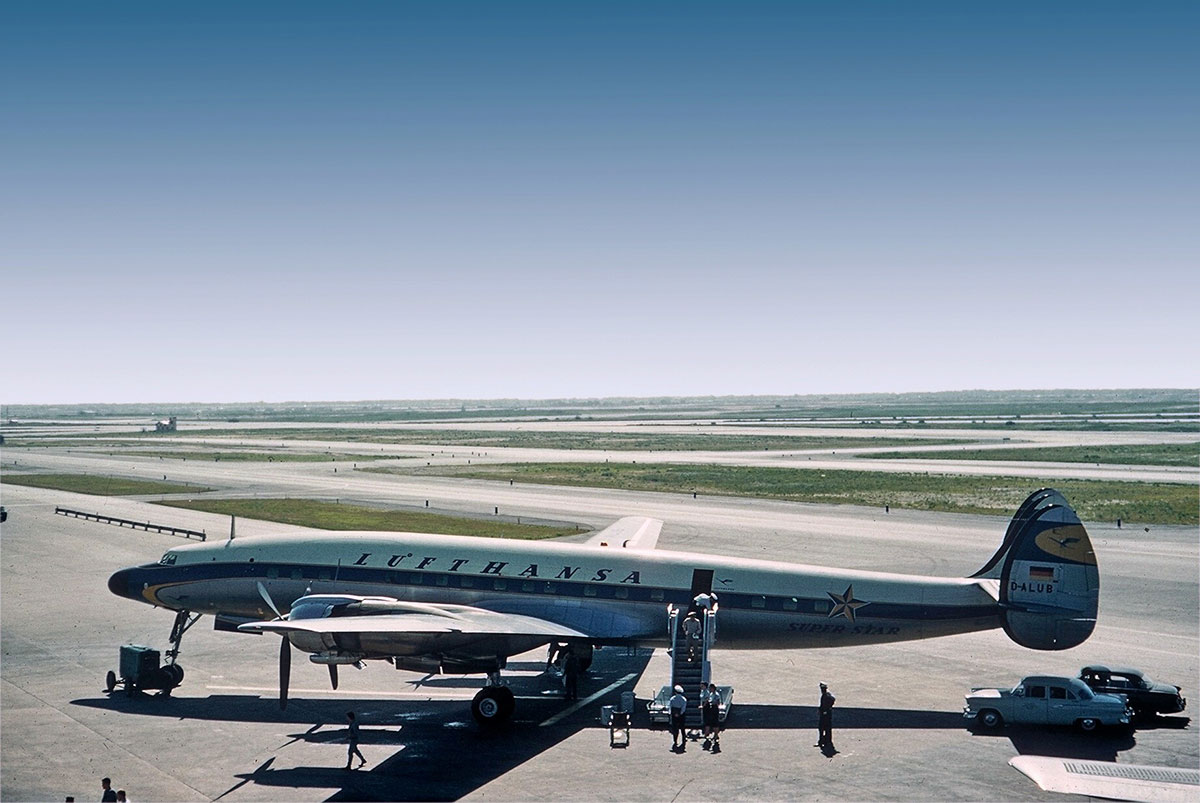
Lockheed’s zenith in piston transports was reached in the form of the 1649A Starliner. Lufthansa is currently restoring one to flying condition.

Air Traffic Control went from mostly non-radar to mostly radar, because the jets were faster in nearly all flight regimes and pilots therefore had less time to see-and-avoid other aircraft. On the ground virtually all purely civilian airports had to extend their runways. Most of the early four-engine jetliners used on domestic services required 7000 feet and intercontinental flights required at least 10,000. On hot and humid days that grew to 10,000-12,000 feet. Screaming water-injected turbo-jets made airport noise a major issue, and some airport communities enacted tough restrictions. The courts later overturned some of these rules, but others were upheld. Meanwhile, at the terminal ramp, evolutionary change from “power-in, stair unload, power-out” to “power-in, jet-bridge unload, pushback-out” occurred. In the area of baggage loading the larger jets brought in a change from bulk-baggage to containerization.

Pacesetter of the American Jet Age, the Pan Am Boeing 707-121 in delivery colors.

Cabin service was also greatly altered now that stewardesses had to deal with halved flight times. This was especially true on the shorter hops that even the early jets sometimes flew. Block to block times of 15 minutes on flights of 150-200 miles meant that they had to hustle just to get a drink service in. Both cockpit and cabin-crews had to contend with the increases symptoms of “jet-lag” that resulted from flying across multiple time zones at 600 miles per hour.

Concurrent with the advent of the pure-jet engine was the so-called “prop-jet” or turboprop power plant. This hybrid of the turbine and the propeller was viewed at the time as the perfect engine for short to medium ranged aircraft; the reason being that the early four-engined pure jets could not operate efficiently at the lower speeds and altitudes routes of such distance entailed. The first commercial airframe to receive this form of power was the ground-breaking Vickers Viscount of Great Britain which entered service in 1950 with British European Airways (B.E.A.) In the United States Lockheed followed almost a decade later, in early 1959, introducing the L-188 Electra with first services by co-launch-customers Eastern and American. During this period an attempt was also made by the British to produce a successful long-range turboprop in the form of the Bristol Britannia, which began transatlantic nonstop service with B.O.A.C. and El Al Israel Airlines in December of 1957. Unfortunately for Bristol and both carriers the Britannia was the fastest airliner to Europe for less than a year before the new Comet 4 and Boeing 707 jets made it obsolete virtually overnight.

Within a year of the October 1958 inauguration of jet service Pan Am added the stretched 707-321 to their fleet.

From the late 1950’s onwards the world’s airlines began retiring their fleets of propliners. They might have remained in service longer on the shorter, less glamorous routes but for the introduction of yet another progression in engine technology, the turbofan. Introduced by American Airlines on their 707 “Astrojets” in 1961 this quieter and more powerful development of the pure jet made it possible for the U.S. airframe manufactures to design and build shorter haul aircraft like the Boeing 727 and 737 and McDonnell Douglas DC-9, some advanced versions of which remain in service today.

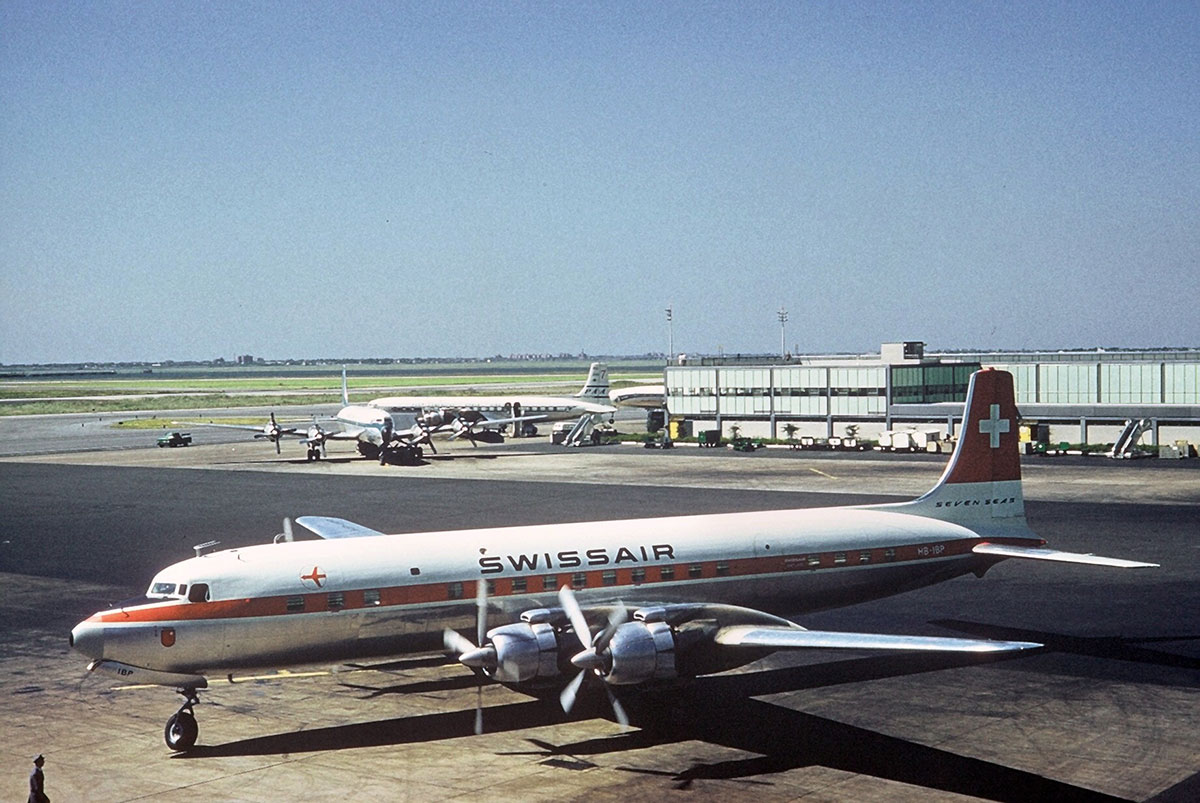
The ultimate Douglas propliner, the DC-7C, in Swissair colors at New York International Airport at Idlewild.

By the middle of the prosperous 1960’s all of the big American domestic carriers had embarked on huge jet re-equipment programs with the stated goal being the retirement of all propeller-driven aircraft of any type. The early advent of the turbofans resulted in even relatively new turboprops becoming obsolete in the public’s perception. By the early 1970’s not a single western airline was left with piston-engined passenger equipment in their inventory and only one company, Eastern, retained any turboprops. Then, in late October of 1977, EAL retired the last of its once mighty fleet of Electra’s from New York/Boston/Washington Air-Shuttle back-up duties bringing to a close the use of propeller airplanes on mainline routes by all U.S. trunks and the vast majority of major foreign carriers. The transition from props to jets was complete.

All Photos by Mel Lawrence, Shea Oakley Collection

Continue Reading 2 Comments

World Airline Historical Society, Inc.
PO Box 13693, Tampa, FL 33681-3693 USA
Contact Us

Archives

Copyright © 1975-2025 World Airline Historical Society, Inc.

Read our Privacy Policy