Seat 21J: A Century of Airline Seat Designations – Part 2

The numeric-alpha grid becomes the norm, with variations
By Fons Schaefers
INTRODUCTION
Following the June 2025 crash of a Boeing 787 in India, seat 11A was proclaimed on the internet as the safest seat on board commercial airplanes. This was because the sole survivor of that accident occupied that particular seat. The fact that seat numbers vary between airplane types and between airlines was omitted by the posters. Also omitted was the fact that each accident is different and that seat location is not a good “survivability indicator.”
The link between a seat’s number and its location on board is indeed loose. To illustrate that, I examined the location of a selected seat number. That seat number is 21J, the number I chose when writing the first part of this short series, published in May 2023. On a recent trip from Europe to South Korea and Japan, I looked for seats numbered 21J. More on this at the end of this second, and final, article on airline seat designations.
As readers of the Captain’s Log are well aware, in each airliner, signs are placed above seats to help passengers identify their assigned seat. In the first part of this series, I introduced the term “numeric-alpha” for the seat designation method that became common in the late 1950s. The numeric element (the numbers) indicates the rows. The alphabetic element (the letters) identifies the seats within a row. It generally looks like this:
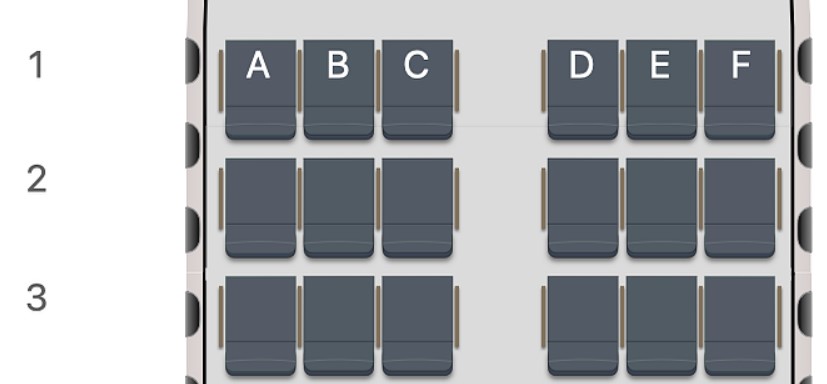
The example is for a narrow body airplane with six seats abreast, three on each side of the single aisle. For a widebody airplane, the same concept is in use. The only difference is an extra aisle and more seats across, and thus, letters.
All airliners, be they single-aisle or twin-aisle, essentially have the same basic arrangement of rows of adjacent seats. This grid pattern makes the seat designation system predictable. The location of each seat is defined by two axes (longitudinal and lateral) as in a table. This determines its numeric-alpha identification. But the day-to-day practice is tougher. Initially, it took some iterations before it became stable. And once stable, it turned out that airlines still apply many variations. This part discusses both the historic development and the current variations.
EARLY ITERATIONS
United’s pioneering use of the numeric-alpha method in its Boeing 377 around 1950 was gradually followed by airlines.
In Europe, Sabena and SAS were early adopters. They realized that the new system required some explanation to passengers. Hence, they added a cabin layout with seat numbers to their boarding cards. Below is the neat embarkation card for Sabena’s “Super DC-6” in a first-class-only cabin. It was used for a flight in September 1954 from Brussels to Africa. While perhaps confusing to present readers who are accustomed to a nose-up layout, contemporary users may not have had difficulty with the tail-up orientation, as any form of presentation was new at the time. The assigned seat, 13A, was in the last row, on the left.
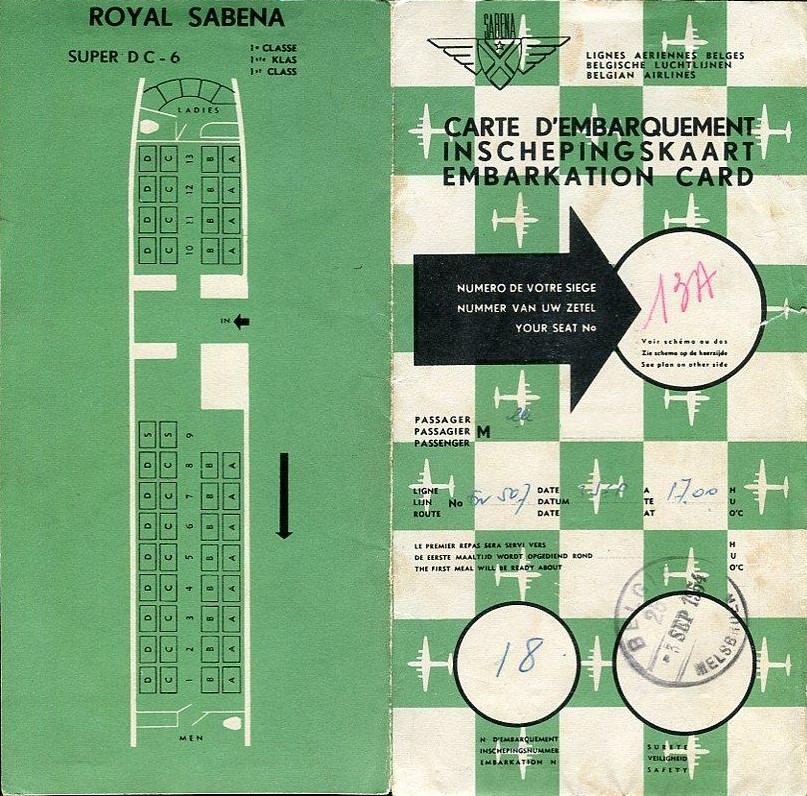
Source: www.airticketshistory.com/web/bpsabena.htm.
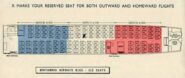
BOAC used the numeric-alpha method on its Comet 4 in 1958, as evidenced in a book on the airline’s history by Charles Woodley. It shows two different layouts: a 56-seat first class cabin and a 16/43-seat mixed class cabin, reproduced here. Both begin with row number 1 and end with row 15 and 14, respectively. Seats across were labelled A to D in first class and A to E in tourist class.
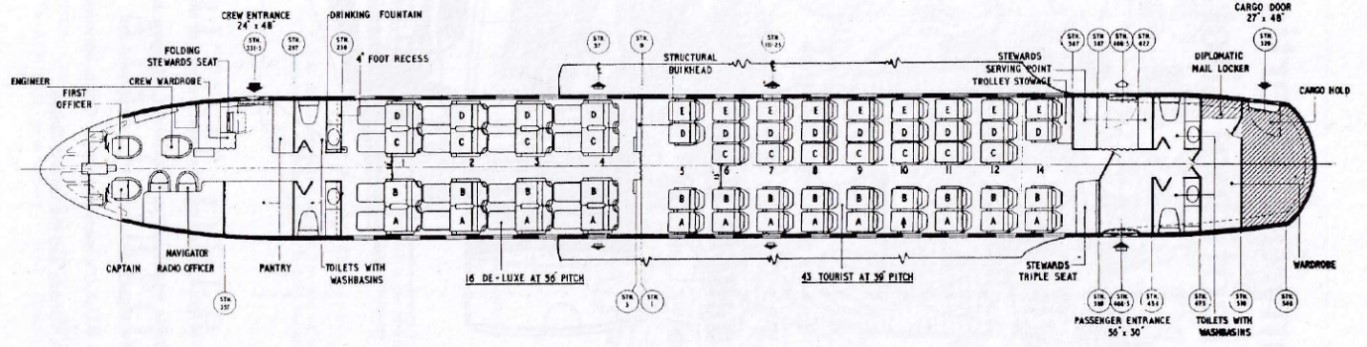
Source: BOAC – an illustrated history by Charles Woodley.
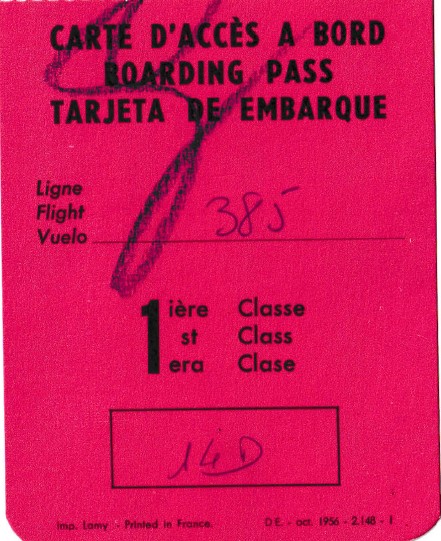
Air France is also known to have introduced it around 1958. Replacing the system in use in 1957 (see part 1) a boarding pass for a Constellation flight in May 1959 allocates the first class passenger to seat 14D. This was a seat to the right of the aisle in the 14th row from the front (or perhaps the 13th, if row number 13 was omitted).
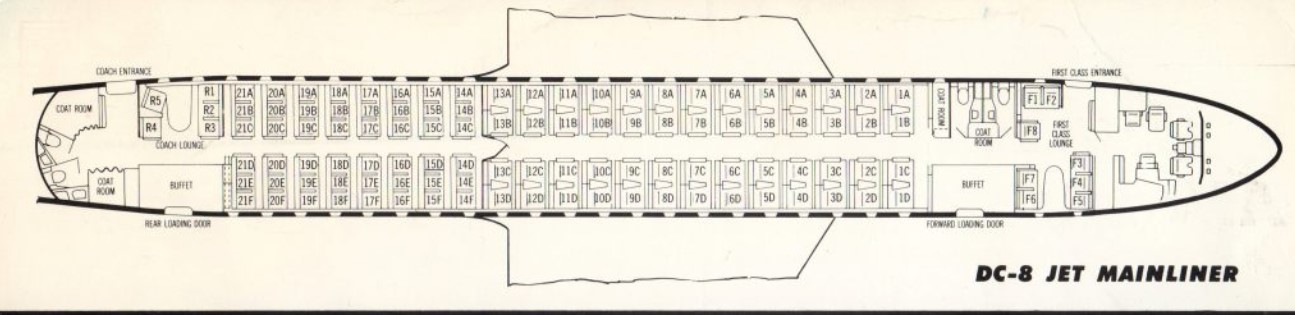
When introducing the new jets in 1959, United Airlines remained committed to the numeric-alpha grid that it had pioneered in 1950. However, the seats in the lounges at the front and rear of their DC-8 were numbered F1 through F8 and R1 through R5, respectively. F meant forward; R meant rear. The “Mainliner” name, introduced in the 1930s, was still in use in the early 1960s.
Source: WAHS Safety Cards – Lester Anderson.
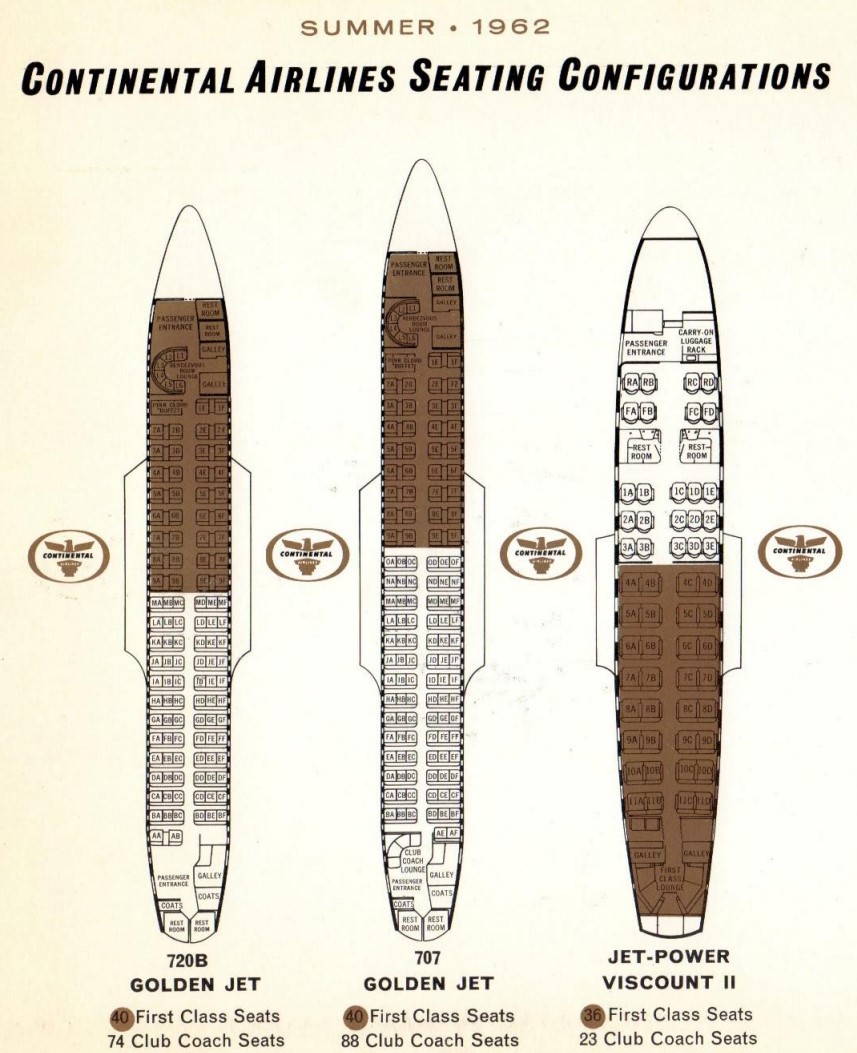
Continental Airlines adopted a hybrid version. A 1962 seating diagram shows that on their new jets (Boeing 707 and 720), they used the numeric-alpha grid for first class. This stretched from the forward boarding door to about midship. But coach class passengers, boarding aft, had to navigate by means of an alpha-alpha grid. It started at the rear with seats AA and AB and extended to row MA-MF, which was overwing (on the 720, even OA-OF on the 707). Forward lounge seats were identified as L1-L6, yet row L was in the coach section.
Source: WAHS Safety Cards – Lester Anderson.
Continental still used this row numbering method in 1965, as can be gleaned from the CAB report on the non-fatal 707 accident at Kansas City on July 1. By then, they had added a third class, called economy, with 3+3 abreast seating. Such a seating arrangement was formerly in their club coach class. That name was now used for a new 3+2 abreast arrangement in the center of the airplane. Its rows were numbered rather than lettered, so boarding was likely via the front.
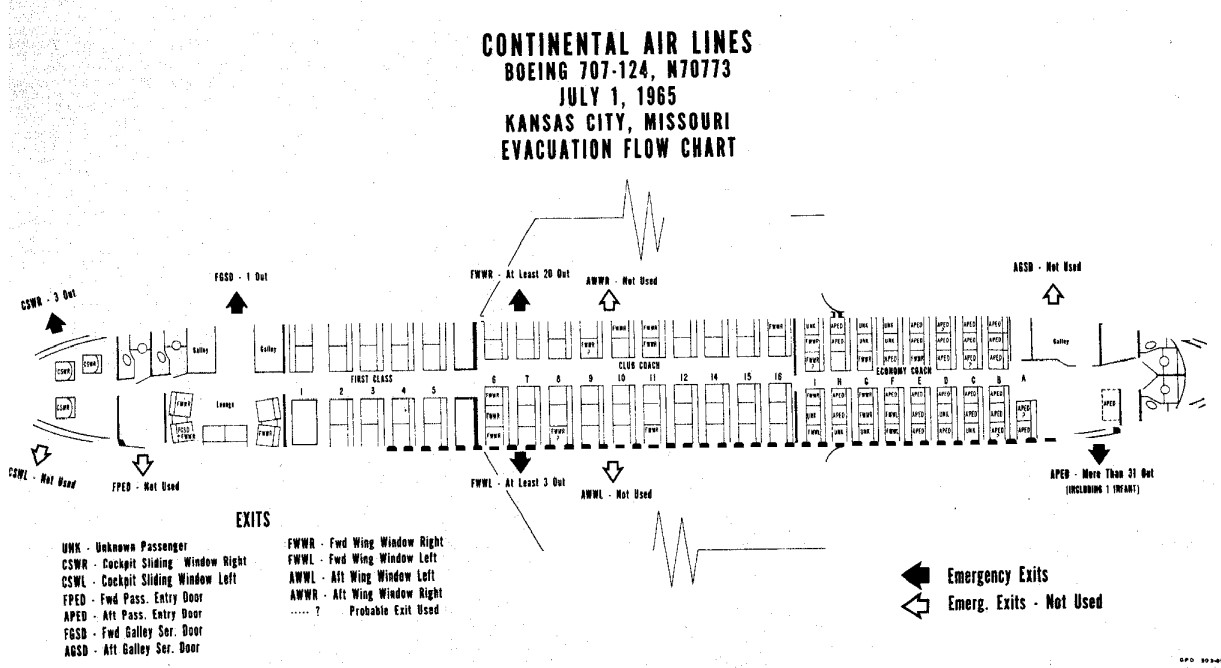
Source: CAB report File no. I-0019, released June 24, 1966.
Continental’s Viscount was yet different: numeric-alpha in both first (aft) and tourist class (forward), except for the first two rows of club seating. Here, F and R meant forward-facing and rearward-facing. The illustration suggests the forward row was forward-facing, but actually, it was rearward-facing.
As mentioned in part 1, another early adopter of the numeric-alpha system was TWA. A July 1960 passenger layout drawing shows the Boeing 707 and the Lockheed L-1649 Starliner. The latter was marketed as “Jetstream” although it was piston-engined. The L-1649 had first class in the rear, near the main entrance door, and economy class at the front, with a separate entrance door. The economy class cabin started with row number 3, first class had rows 16, 17, 20 and 21.
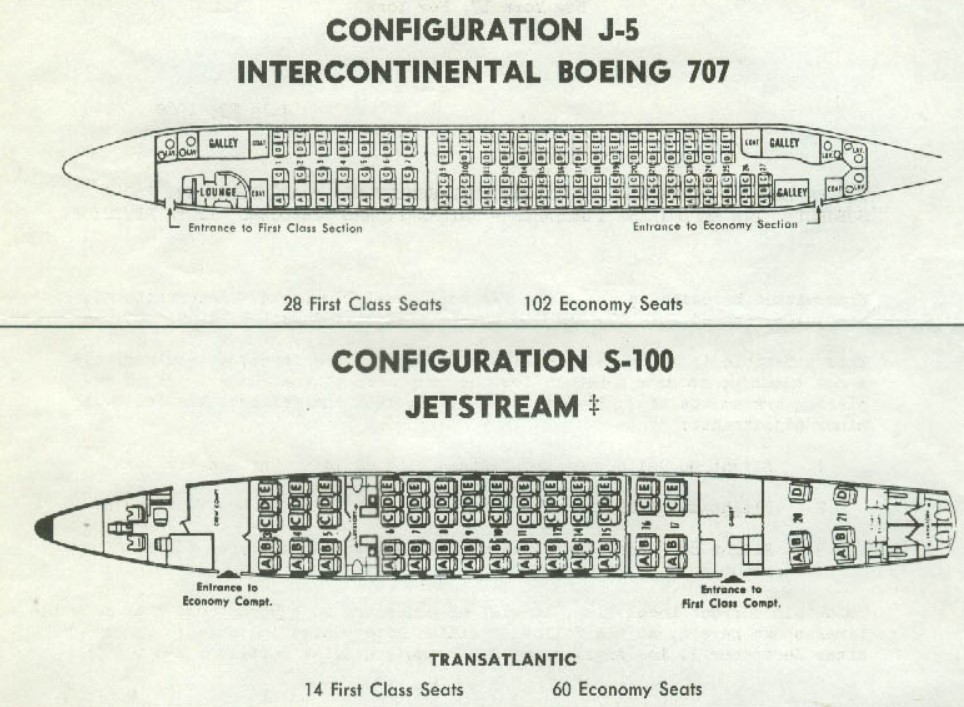
Source: calclassics.proboards.com/thread/6446/connie-seating.
TWA’s Convair 880s featured a regular 4-abreast first class and a 5-abreast coach class cabin. But, interestingly, it also had a 12-seat lounge at the front. The first class section started with row number 4, and the coach class section with row 17. The lounge had no row numbers, but its seats were individually numbered from 1 to 12. A later cabin layout (reproduced) shows the lounge being reduced to six seats, on the right side only, with more traditional seating and the omitted row numbers now included.
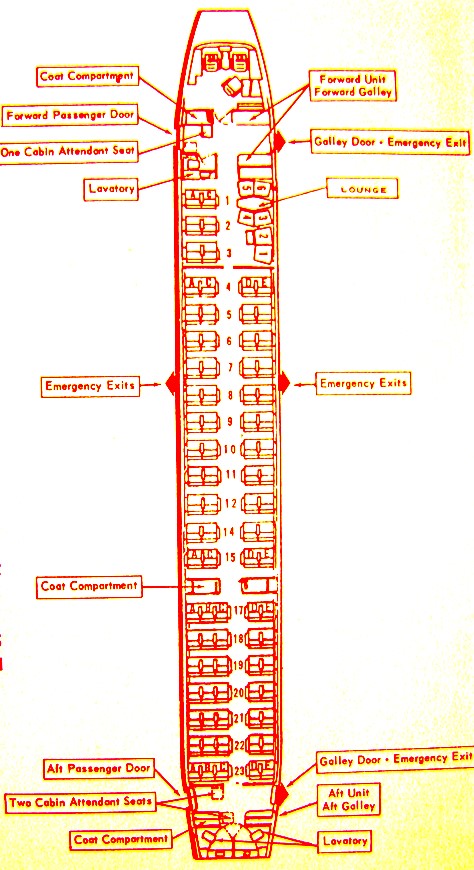
Source: Airline History Museum at Kansas City, MO.
The United Kingdom’s BEA followed the numeric-alpha method, but with a quirk. It counted rows from rear to front, as shown in this layout of their Trident 1C (which is used for mass and balance calculations and lacks seat letters). On their Vanguards, there was a double quirk. In addition to counting from the rear, they stopped with row 5, just aft of the rear entrance door. This was because only the first class seats could be reserved and thus needed numbering. They were the furthest away from the noisy engines.
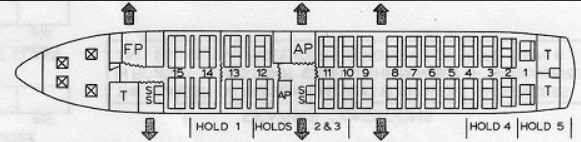
Source: www.bealine.de/59901.html.
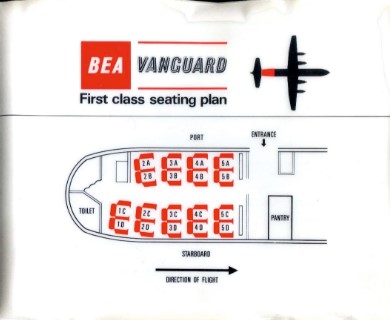
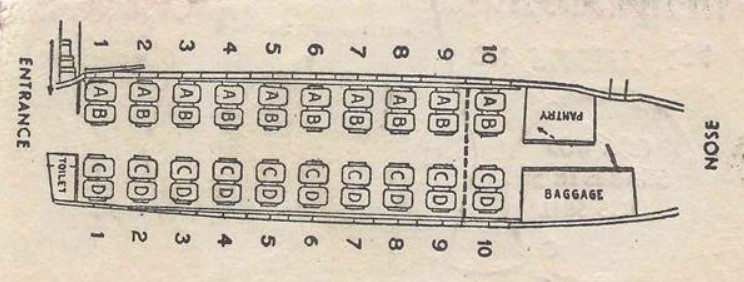
Indian Airlines changed from alpha-numeric (see part 1) to its reverse when introducing the Fokker F.27 around 1961. They also started counting from the rear, where the boarding door was.
Around 1970, the numeric alpha system was in use by most airlines, but not all. In the UK, some charter airlines did not assign seats at all. Consequently, they had no signage for seats. According to a letter by UK tour operator Clarksons, this led to the infamous “tarmac scramble” to board aircraft. Passengers keen to have a good seat made sure they would board first, overtaking others. This practice was arrested by introducing seat numbers. But rather than adopting the signage method then common with the scheduled airlines, they used a simple system of consecutively numbering all seats from front to back. I found examples from Court Line and Dan-Air.
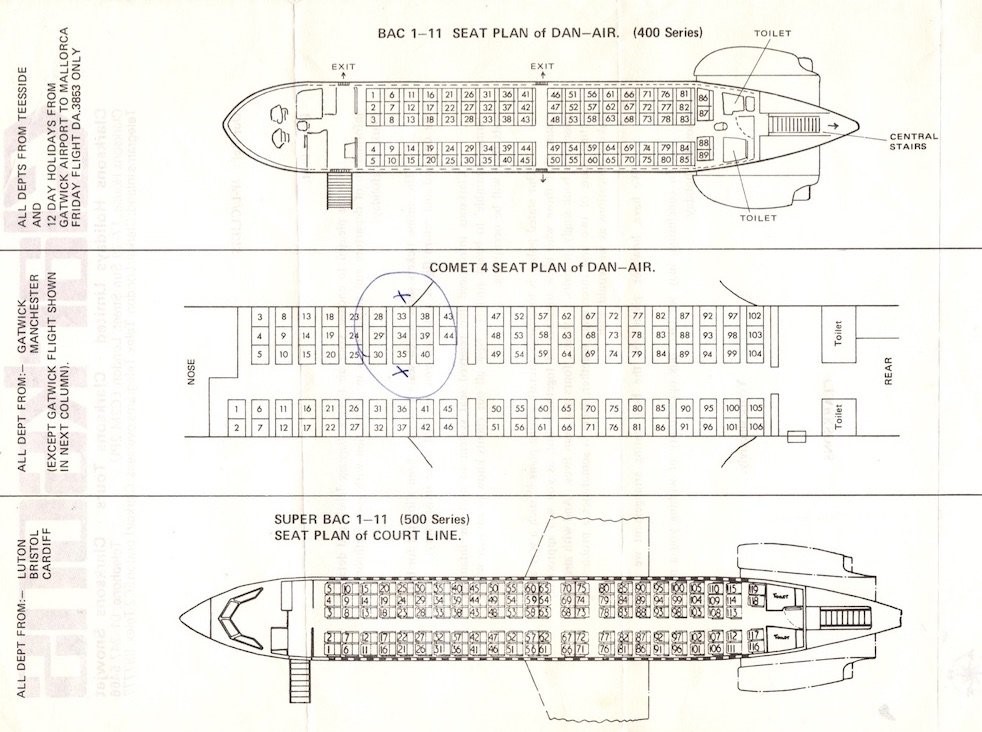
Source: travelupdate.com/charter-airlines-number-seats.
These airlines folded in 1974 and 1992 respectively.
British charter airline Britannia Airways had yet another method. They divided the cabin of their 1960s Britannia 102s into three sections, identified as B, Y and R. These were color codes that matched the color of seat covers. Within each section, they followed the other charter airlines’ practice and numbered the seats consecutively.
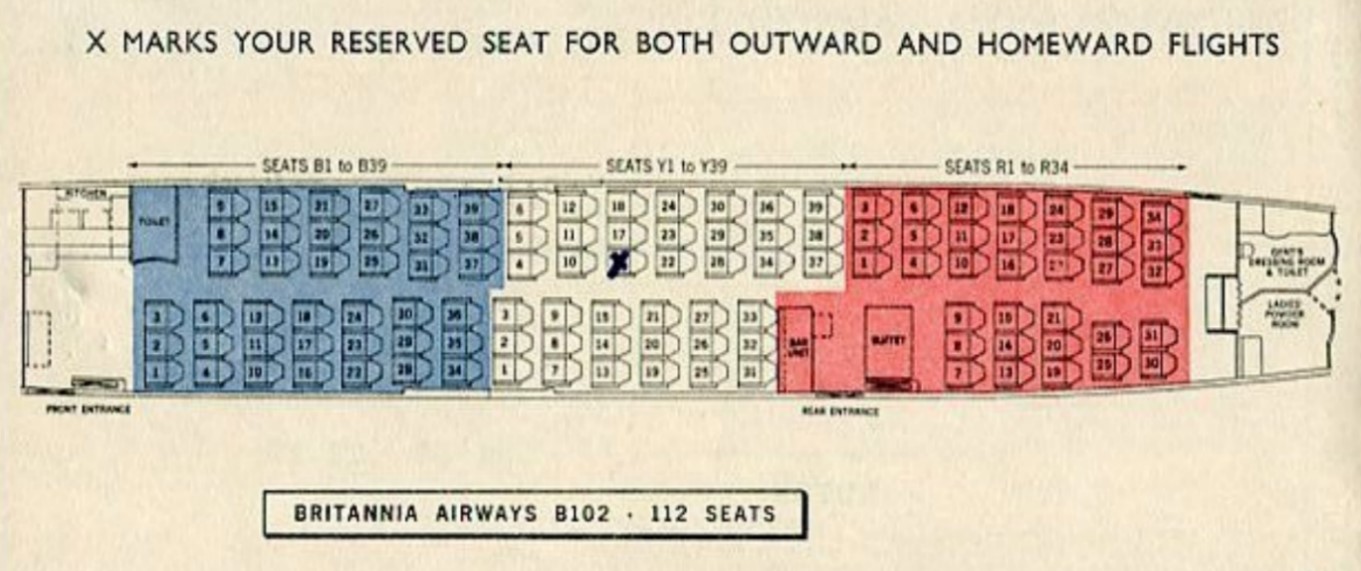
Source: airticketshistory.com.
Gradually the UK charter airlines began to adopt the numeric-alpha system. Dan-Air’s Comet G-BDIX, preserved at East Fortune in Scotland since 1981, still shows a quirk. Its seats are numbered 1A through 24E from front to rear, so seemingly normal. But the lettering, uniquely, was from right to left. A was the starboard window seat; E the port window seat. (www.airhistory.net/photo/237045/g-bdix).
CURRENT VARIATIONS
Now, to fast-forward . . . How do airlines apply the numeric-alpha system nowadays and what variations are there? I approach it from two angles: the longitudinal axis, composed of numbers, and the lateral axis, composed of letters.
Longitudinal Numbering
All airlines start counting rows at the front and end at the rear. At least, in single-deck airplanes (double-deckers are discussed below). But not all numbers are used. A well-known interruption in the Western world is the omission of row number 13. This number is regarded as unlucky. The idea is that passengers do not want to sit in this row because they fear an accident. This is, of course, pure superstition. Plus, in the unlikely event of an accident, it will affect the passengers in all the other rows as well. It is interesting to find airlines that do not give in to this superstition. British Airways and Southwest Airlines are just two examples.
In China, superstition with numbers works in two ways: there are unlucky numbers, but also lucky numbers. Four (4) is seen as unlucky, 8 as lucky. This may explain row sequencing as employed by Chinese airlines. Here, it is not unusual to find the first row numbered as 11 or even 31. Or there is a first or business class section of only 2 or 3 rows (so obviating row 4) and then a jump to number 11 or higher for economy. Or it starts at 6, thus omitting rows 1 to 5 but including the 8.
What is the fewest number of numbered rows? A search of the airline seating websites (seatmaps.com; seatmaestro.com, etc.) reveals that this is likely to be 4, on the Learjet 31 of the Italian carrier Air Vallee (now defunct). There are several King Airs with 5 numbered rows.
The lowest row number obviously is 1, but what is the highest? The candidate airline type for that is the Airbus A380. A quick search discloses this as row # 99, on Lufthansa’s A380. But this does not mean it has 99 rows. Rather, it is 65. The A380 configuration with the highest number of rows is the 615-seat version of Emirates, which has 79 rows: 15 in business and 64 in economy.
Now that I mention this airplane type, let’s have a look at how airlines go about numbering the double-deckers, of which there are only two types: the A380 and the Boeing 747. The former has two decks along the length of the aircraft; the latter only has an upper deck hump at the front. Do they actually start by identifying the deck and then number per deck, such as is very common in hotels (where room 214 is # 14 on the 2nd floor)? It appears not. In all cases, both decks share the same numbering sequence. Some airlines start counting on the main deck, others on the upper deck. In some cases, the airline exhausts the numbering on one deck before continuing on the other deck. In other cases, the numbering alternates between decks. An example of that is Asiana Airlines. They start the numbering on the main deck (first class: rows 1-3), continuing with business class on the upper deck (rows 7-24), then economy class on the main deck (rows 30-62), and ending economy back on the upper deck with rows 70-83. This requires some good guidance during boarding.
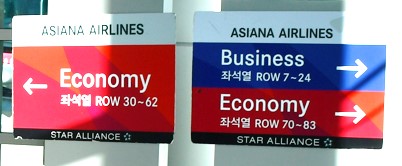
Photo by the author.
Lateral Lettering
In the lateral axis, the width of the aircraft and thus the number of seats that fit between the two sidewalls determines the lettering. This number varies from 2 on the smallest of airliners to 10 on the megajets. Although there have been airliners built for all these 9 sizes of seats abreast, currently four of them dominate. The most popular by far is 6-abreast. This size accounts for about 65% of the current passenger airliner fleets, involving only two types: the Boeing 737 family and the Airbus A320 family. Next in line is the 4-abreast size, present in about 12% of the fleets. The types are primarily the ATR and Dash 8 turboprops and the Embraer and CRJ jets.
The third and fourth size groups are those with 9- and 10-abreast, which represent about 6% to 7% each. They are typified by the 10-abreast Boeing 777, Airbus A380 (main deck) and, fast dwindling in numbers, 747. Growing in numbers is the 9-abreast size with the Airbus A350 and Boeing 787 as the most common types, both in production.
In the past, the 5-abreast size group was very common (DC-9/MD-80/717 family, Fokker jets, Caravelle, BAC 1-11, etc.), but this group has significantly gotten smaller. Currently, two 5-abreast airliners are in production: the Airbus A220 (née Bombardier CSeries) and the COMAC C909, in essence a DC-9 derivative. Together with the two leftover types (Boeing 717 and Fokker jets), their 2025 worldwide fleet share is about 3%.
Lateral lettering ranges from A_B (the underscore depicts the aisle) for the 2-abreast cabin to ABC_DEF for 6-abreast cabins. Beyond that, a second aisle is required. With nine seats across, the lettering becomes ABC_DEF_GHJ. While this looks straightforward, in practice, there are many variations. Rather than listing them all, I present some general principles and trends. Initially, the airlines tended to indeed use consecutive alphabetic lettering from left to right. In a 3-abreast cabin, they chose A_BC, in a 5-abreast cabin AB_CDE, in a 7-abreast AB_CDE_FG, and so on.
But gradually different patterns crept in. One in particular was to standardize lettering for aisle and window seats. This was influenced by the popularity of the two 6-abreast family types (737 and A320). In these types, A and F are window seats; C and D are aisle seats. To identify aisle seats on other types in their fleets with fewer seats across, airlines started to omit the letters B and E. This gave clarity to customers as to what to expect: A and F for a window seat, C and D for an aisle seat. Thus, in a 5-abreast layout, this became AC_DEF, in a 4-abreast AC_DF, and so on. But also in the business class sections, where wider but fewer seats fit, they use this designation method.
When the first widebody (the Boeing 747) entered the market in 1970, the airlines added an extra aisle and three more seats across. Consequently, three more letters were used: G, H and J. With a 3-4-2 layout this worked out as ABC_DEFG_HJ. See the seating diagram published by Northwest Orient in the early 1970s. This diagram shows the above-wing section. Interestingly, further forward in the cabin, a 2-3-3 layout was used with triple seats on the right labelled HJK.
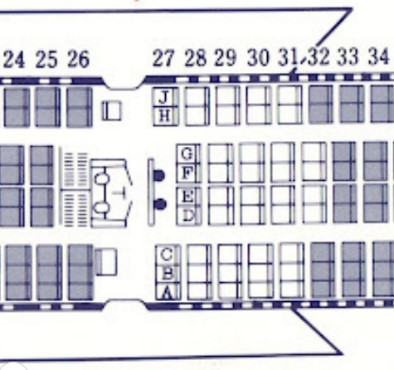
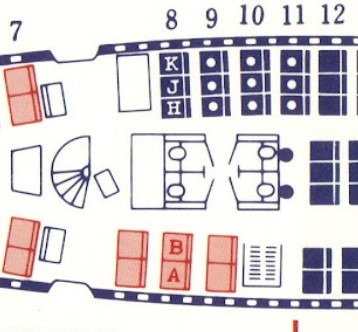
Soon, the 747 airlines changed from 9- to 10-abreast to increase capacity. They needed an extra letter, so the K became omnipresent.
Later, some airlines added an eleventh letter: the L. Unlike what logic says, this was not for an eleventh seat across. Rather, 10 seats were kept, but one of the other letters (typically the E or F) was skipped: e.g. ABC_DEGH_JKL. The first airline to use this letter is believed to be Air Inter on its 8-abreast Airbus A300. Air Inter was the French domestic airline that was absorbed into Air France in 1997. In June 1990, on a flight from Paris to Toulouse, I sat in seat 4L. They probably introduced this letter in the 1980s or perhaps even earlier, at the inauguration of the type in its fleet in 1976. Air France currently alternatively uses K or L for the rightmost seats. The L is now the highest alphabet letter in use for assigning seats. There are no signs that an M or higher letter is needed soon.
Once the letters G, H, J, K and L were common on the widebodies, they entered single-aisle seating layouts as well. But why is that? The maximum on a narrow body cannot be more than six, so up to F would be sufficient? The answer is that they want to bring consistency between the narrow and widebodies in their fleets. By using the higher letters, they can use the same letters for any aisle or window seat, regardless of whether it is in a single-aisle or a twin-aisle cabin. This brings predictability for passengers. C and D are then always aisle seats, and A and J (or K or L) always window seats. Some narrow-body examples: Royal Jordanian Embraer 170 AB_HJ; Garuda Indonesia ATR42 AC_HK; China Southern A320 ABC_HJK; Ethiopian Airlines Dash 8 Q400: AC_JL.
Interestingly, I found one airline with a 3-abreast airplane as the largest in its fleet to apply this practice as well: Pacific Coastal Airlines of British Columbia, Canada. It assigns seats on the Beech 1900s as A_F and on theSaab 340s as A_DF.
Readers will have noticed the skipping of the letter I. The reason for that is to avoid confusion with rows ending on 1. Seat 11I will undoubtedly lead to trouble. But was there ever an airline that used the I? I did find one: Aeroflot. In their widebodies (Il-86, Il-96, DC-10), they used it, as evidenced in their 1997 timetable. I assume they had translated it from the ninth letter of the Russian Cyrillic alphabet. This is written as И so not confusing with the number 1. Later, they replaced it by the J.
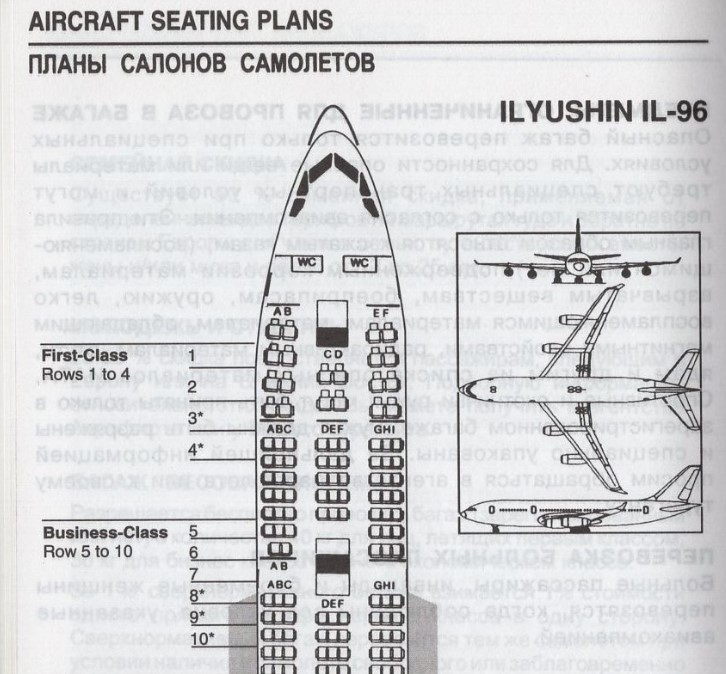
Source: Aeroflot 1997 timetable (airline-memorabilia.blogspot.com).
Non-Conformists
Some airlines, either deliberately or otherwise, did not follow the practices described so far.
One U.S. airline assigned seats laterally with numbers, not letters. That airline was TWA. This was when they introduced the 747 in 1970. In a March 1970 folder, they explained how to board the new plane. It shows a cabin layout with numbers for both rows and seats. With a 9-abreast layout, the highest seat number was 9. On the boarding pass, the seat was indicated by 2 numbers with a hyphen in between, e.g. 6-1. (i.s.o. 6A). I do not know why TWA did that, and neither do the folks at the TWA museum in Kansas City, MO. Perhaps a reader knows?
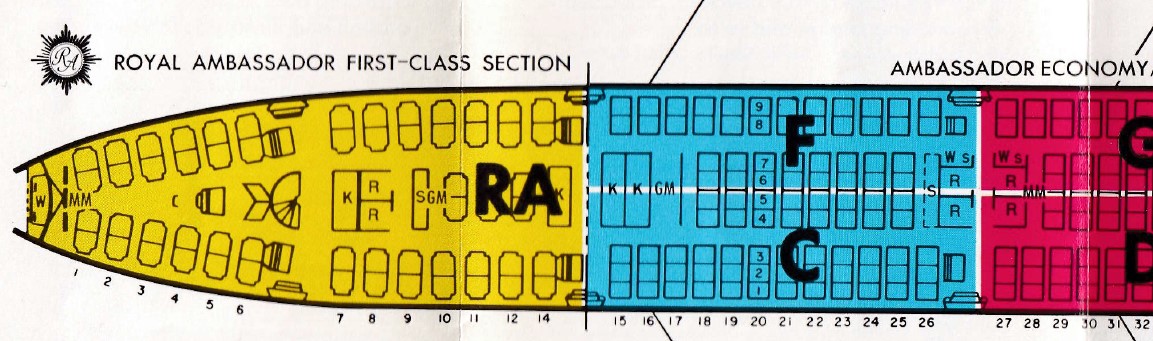
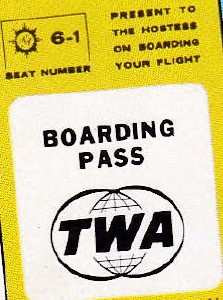
TWA used the same system on other widebodies (L-1011, 767), but kept the traditional assignment method, with letters, on their single-aisle fleet. Later, they added a 10th seat on the 747. Rather than numbering it as 10, they added the number 0 for the right window seat. So, next to the number 9 came 0, as opposed to next to the number 1. For actual boarding passes with these kinds of seat numbers, see the website of air ticket collector Gklavas Athanasios: www.airticketshistory.com. In Europe, Lufthansa is believed to briefly have used the number-number system as well.
I know of at least one airline having operated aircraft that normally sat 6-abreast to have a layout with only 4 seats abreast throughout. It downplayed the designating as:
AB_CD
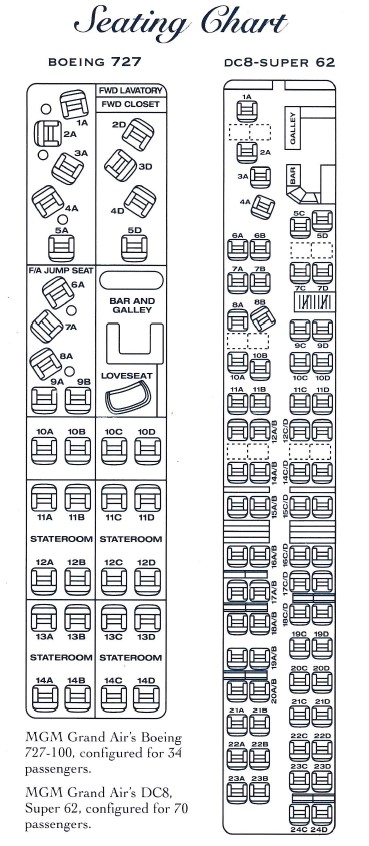
The airline was MGM Grand Air, which ran high luxury service between Los Angeles and New York from 1987 to 1992. The clientele largely consisted of wealthy celebrities in the showbiz world, with commitments on both the West and East Coasts. The seating plans of their 727s and DC-8-62s are shown below. Where the DC-8 plan shows an aisle, the 727 plan does not. This, of course, does not mean there was none. Both configurations featured a bar. The 727-100 had four closed-off staterooms and a “love seat.”
Some airlines with small aircraft find it easier to number all seats sequentially. An example is ATSA Peru with its Beech 1900D. Visitors to the 2011 WAHS convention in Portland may remember having flown on the Seaport PC-12, which also had sequential numbering. While these small airplanes have an aisle, albeit narrow, there is one airliner family without: the Britten-Norman Islander and Trislander. These types are not as well-known as the Airbuses, Boeings, Embraers and ATRs, but actually quite ubiquitous when it comes to connecting islands. The Islander is a small, twin-engine airplane seating 9 passengers in a cabin only 43 inch (1.09 m) wide at shoulder height. One next to the pilot and a further 8 in 4 rows. Its stretch version, the Trislander (so called because of its third engine, in the T-tail), even sits 16, in 8 rows. This excludes the front row where the pilot sits, plus an occasional extra passenger. Passengers enter directly their seat, or rather bench, from the ramp, using one of the five doors. Neither seat nor row numbers are posted in the cabin. Typically, ground staff or the pilot guide passengers to their seats.
Seat 21J
I conclude by coming back to seat 21J. On the Asian trip, I flew on nine airliners. Three were twin-aisle, the remaining six were single-aisle. I found a seat 21J on three occasions: in two of the widebodies and in one of the narrow bodies.
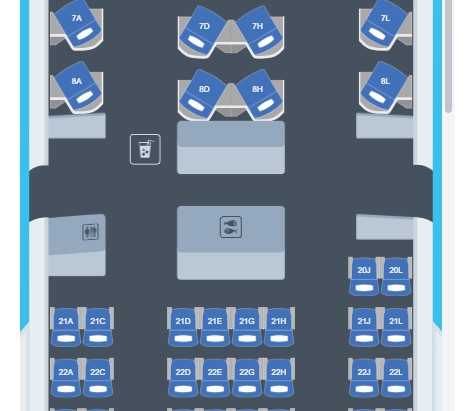
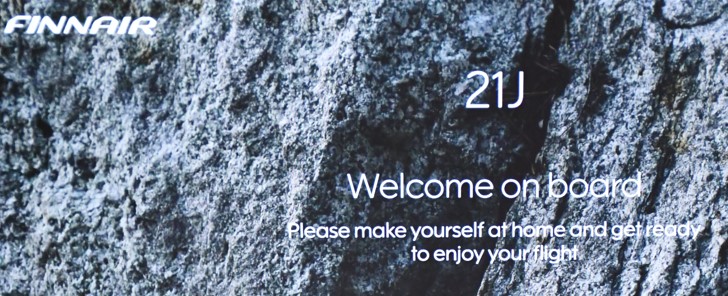
The first was a Finnair A350, where seat 21J is the aisle seat of a double located on the right just aft of the second pair of doors. The adjacent seat is 21L.
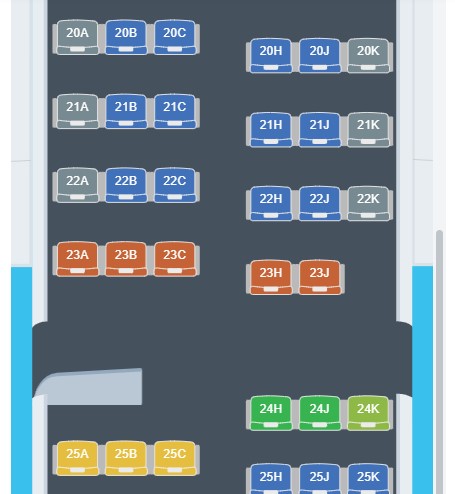
The second 21J was found in the middle of a right triple seat located over the wing of an ANA A321neo. It is wedged between an aisle/H and a window/K seat.

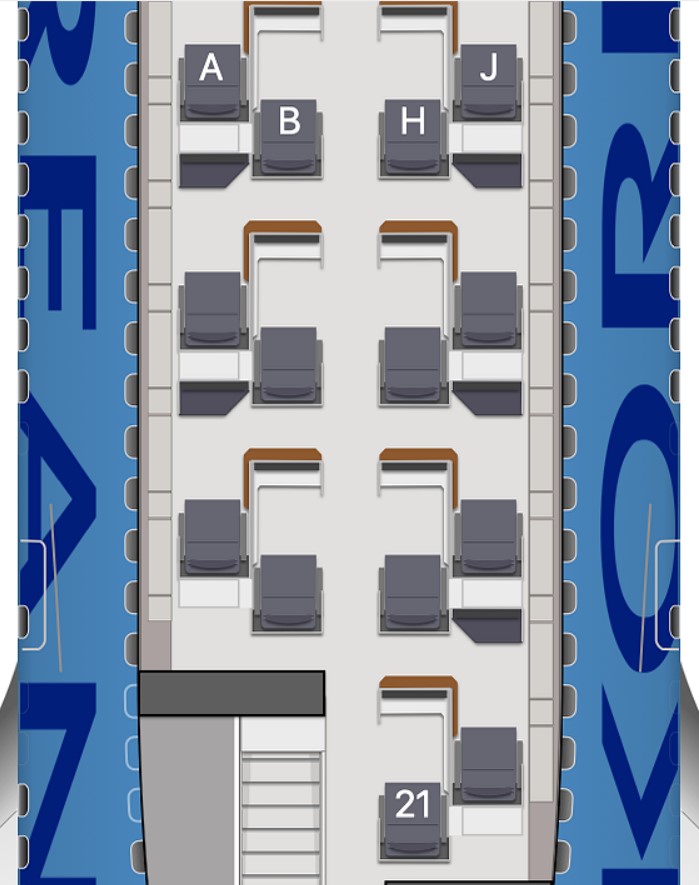
The final 21J seat was on a Korean Air Boeing 747-8. It is the window seat in the last row on the right side of the upper deck. Being a well-secluded business class seat exclusively bordering five external windows, it feels like a private cabin.
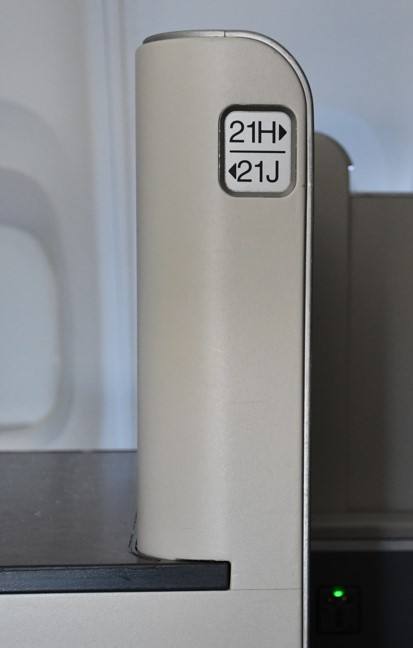
This small sample shows that the seat number does not give a reliable clue as to its location on board. The only element that gives something away is, in this case, the J: the seat it is on the right side of the cabin (as seen in the direction of flight). To find out where the seat exactly is, one has to consult a seat diagram. These are published by the airline and often pop up as part of the online booking process. Alternatively, they can be found on dedicated websites such as aerolopa.com, seatmaps.com and seatmaestro.com.
Enjoy your airline seat navigation!
Fons Schaefers
December 2025
Trackback from your site.