Metro I,Metro II,Palm Springs,pilot career,Sun Aire,Sun Aire Lines,turboprop
TURBOPROPS, ROUND THREE: Sun Aire Lines
By Ellis M. Chernoff
Having packed up and returned to California, it was back to sending out resumes and applications to all of the airlines and scanning classifieds for pilot jobs. Sun Aire Lines, in Palm Springs (PSP), invited me for an interview. I had tried previously to gain employment with this commuter airline, but they rarely had openings, rarely expanded their fleet, and required experience with the Metroliner. This time, when they had an opening, I had the required flight experience. I was issued a non-revenue pass to ride from LAX to PSP. Sitting in the rear of the cabin, I was to experience something somewhat shocking. The plane made a steep approach from over the mountains, west of PSP. There was no curtain blocking the view of the cockpit, and looking forward from the rear, it looked to me like we were pointed straight down.
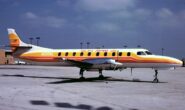
I interviewed with the Director of Operations in his office, took a short written exam, and we headed out to fly N1006L, a beautifully painted Metro II. This flight, which lasted less than an hour, was my checkride, and I was hired as a first officer to replace one who had gone to a major airline. Sun Aire, as well, didn’t waste money on training! Soon after, I was flying the line on their routes that included Los Angeles, San Diego, Burbank, Imperial County, Yuma and Borrego Springs.
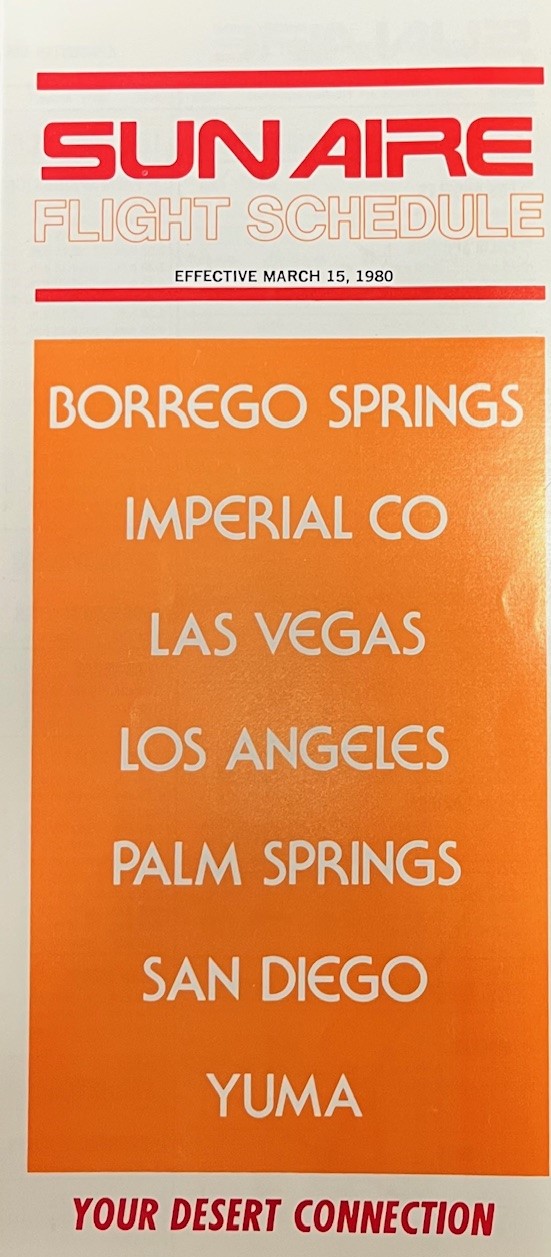
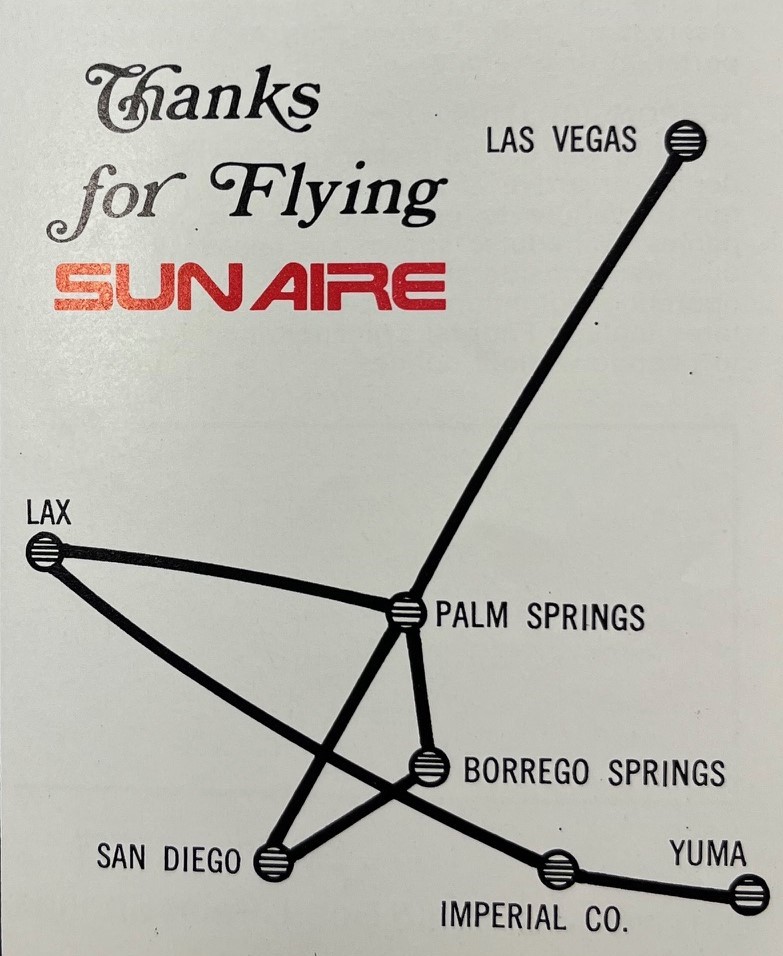
I interviewed with the Director of Operations in his office, took a short written exam, and we headed out to fly N1006L, a beautifully painted Metro II. This flight, which lasted less than an hour, was my check-ride and I was hired as a first officer to replace one who had left for a job at a major airline. Sun Aire didn’t waste money on training! Soon after, I was flying the line on their routes that included LAX, San Diego, Burbank, Imperial County, Yuma, and Borrego Springs.
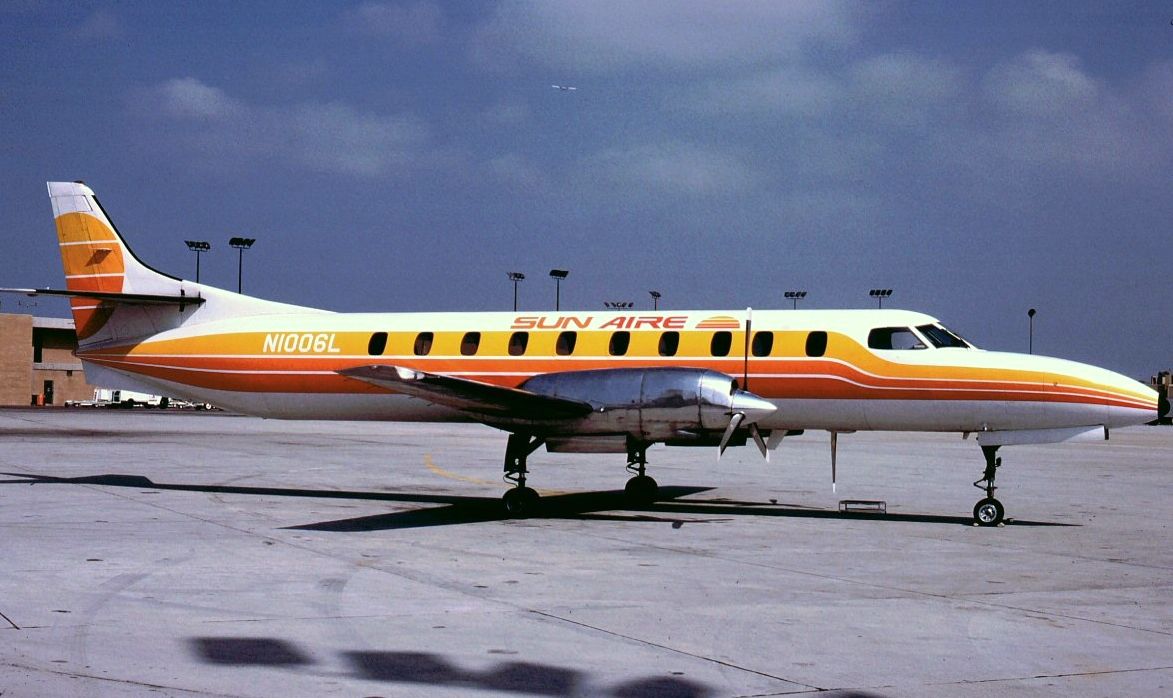
The pay scheme at Sun Aire was unusual in that rather than pay for block time, they paid by the leg. The routes were categorized as Short, Medium, and Long legs. The company view was that they did not want to provide an incentive to operate slowly and get behind schedule. In truth, not so bad; I made more money at Sun Aire as a first officer than I did as a captain at SoonAir. Easy duty as well. Ties and jackets not required, nor did we have flight bags to carry. There was a set of navigation charts in each airplane, and the company supplied a David Clark headset. I only had to bring the headset and a flashlight to work.
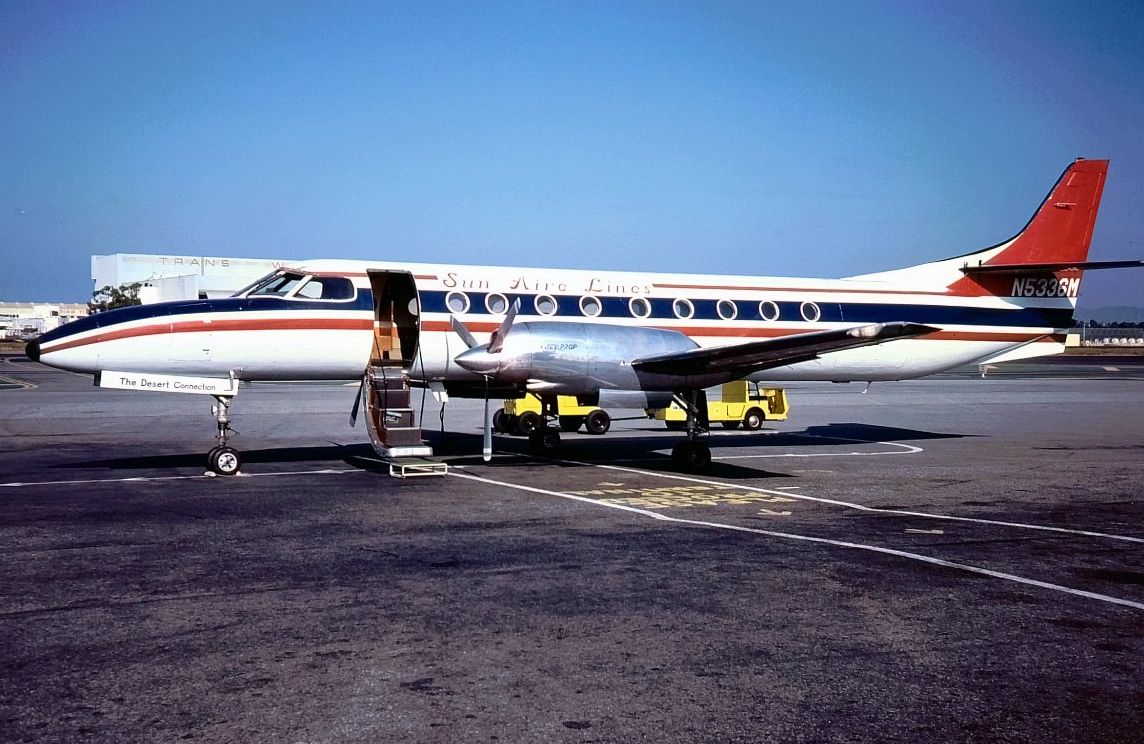
Photo by Ellis M. Chernoff.
The Sun Aire fleet consisted of only four Metros when I started there. A single Metro I, the previously mentioned N1006L a Metro II that they had bought new, and two former Scenic Airlines Metro IIs. All of these were equipped with the Garrett TPE-331-303 engines that produced 840 HP at sea level standard day. The aircraft had a maximum weight of 12,500 pounds. While the plane had wet wing fuel tanks that could take the plane nearly 2,000 miles, on our short-haul routes, we would trade fuel for passengers and baggage. In fact, normal fuel at departure to operate between Los Angeles and Palm Springs was only 800 pounds.
One of the responsibilities of the first officer was to plot the takeoff weight and balance. This was made easy with a custom plotter to include the fuel load, number of passengers and weight of the baggage. The ramp crew was tasked with loading the baggage and providing a number. Miraculously, we never took off overweight. The plane had a large baggage compartment and door in the rear that was pressurized. There was also an unpressurized compartment in the nose.
The Metro IIs also had a water-methanol injection system to add 100 hp per engine during takeoff. With the hot ambient temperatures typical on our route structure, use of this was necessary to obtain the required initial climb performance without reducing the passenger and baggage load. Similarly, the Metro I had an emergency water-methanol system that would augment the thrust of one engine in the event the other failed during takeoff.
We later acquired additional Metro IIs, and a few were equipped with a JATO bottle in the tail. Much lore about this rocket exists. While the water-methanol injection improved initial climb performance at high weights and in high temperature conditions, takeoffs with both high temperature and field elevations were an issue for some operators. The idea of the JATO rocket was to keep the plane from settling back onto the runway if an engine failed before the landing gear was retracted.
What a concept; maximum takeoff weight, and engine fails just at liftoff, and even with 940 HP on the working engine, the plane could only remain in the air if the JATO was fired. But it was not automatic; it had to be armed prior to takeoff, and a button pushed to fire it. But the Metro was a real handful with an engine out on one side. It took lots of rudder and two hands on the yoke. The other pilot had to carefully handle the very sensitive thrust levers to keep the working engine at maximum power without over-temping it and melting it. So, how does one also punch the JATO button? Thankfully, Sun Air deactivated them, so I never needed to!
Flying right seat to the captains at Sun Aire was an enjoyable experience. Once I got familiar with the routes and destination airports, I could fly as aggressively toward landings as any of them. One captain I flew with regularly had earlier in his career been a pilot at Catalina Airlines, flying the Grumman Goose. I enjoyed sharing experiences and my affection for that vintage airplane. This particular pilot did not particularly feel comfortable flying in instrument conditions. This was in spite of his being a designated pilot examiner. So on foggy and cloudy days, I might find myself flying nearly all of the legs on our schedule.
On one occasion, I was flying between San Diego and Burbank for the entire day. Starting up in San Diego, one of the engines refused to light off. The passengers were sent back to the terminal, and the captain said he was going to call maintenance in Palm Springs for assistance. I volunteered that I knew how to deal with this issue from my prior experience with SoonAir. He said to go ahead. I had to take out my seat to access the electronic speed switches. Having done so, I could use the good one to start the right engine and then switch it to the left one. I reinstalled my seat, and with the passengers once again on board, we were able to start the left engine. We avoided cancelling the flight with minimal delay. I was the hero of the day, although today I would not be allowed to do this type of hands-on work.
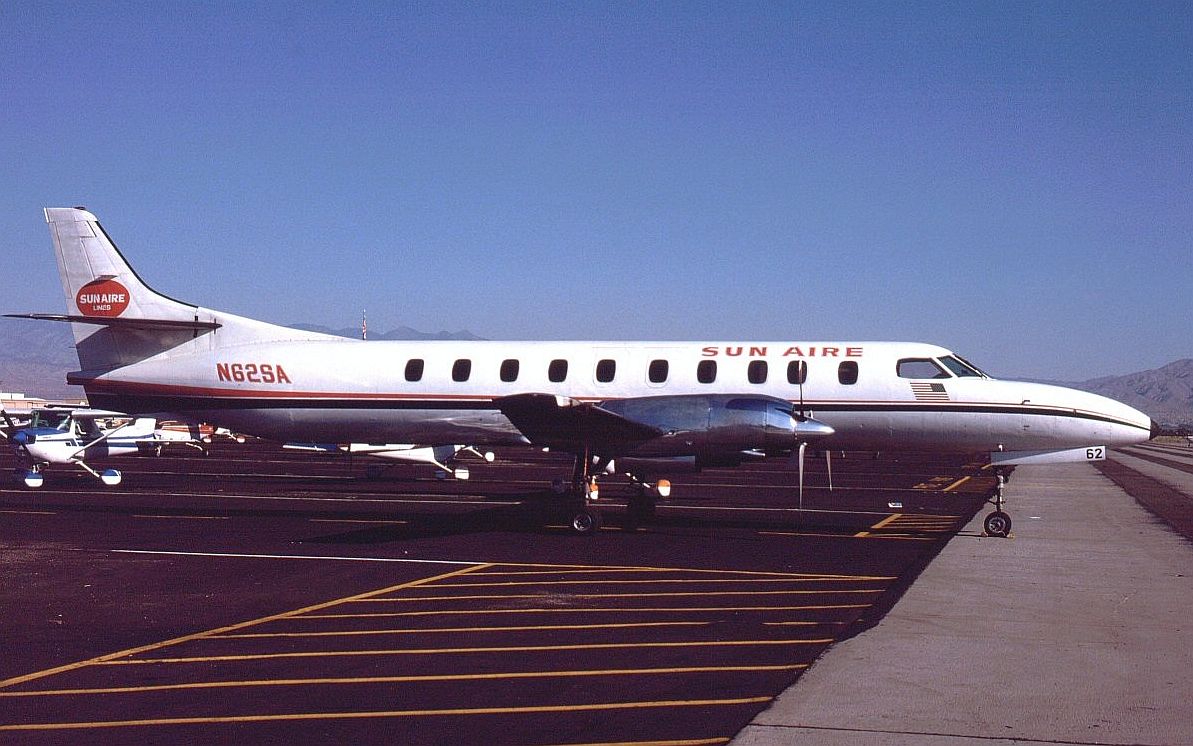
The Director of Operations made up each pilot’s schedule and it would be a weekly scheduled until there was a need for a change. Typical duty would be four, ten or twelve legs per duty period. Rarely would my schedule involve a layover hotel. The planes were well maintained, the company was profitable, and life was good.
Flying between Los Angeles and Palm Springs, I had some interesting passengers. Among some of the famous people who were on my flights were President Gerald Ford (post presidency), Bob Hope, Howard Cosell, Arthur Ashe, David Hartman, and Eva Gabor. Unlike today where the pilots have no contact with the passengers, we did greet each boarding and deplaning. In the case of President Ford, the secret service always made a big deal of exactly when we would arrive at the destination. I had to be clear that we were NOT Air Force One and had zero control or priority with air traffic control. I could merely assure them that we would arrive X minutes after takeoff.
During my first month of employment, my prior efforts to get a job at a major airline paid off: I was invited to interview with two airlines! Of course, I had to confess this to the Director of Operations, as he would schedule my time off. He expressed encouragement as he would have liked a major airline career earlier in his life. But this sealed my prospects with Sun Aire. Ultimately, in that round, I did not get a job offer from the majors, and, knowing I had loftier aspirations, this sealed my prospects with Sun Aire: I would never upgrade to captain.
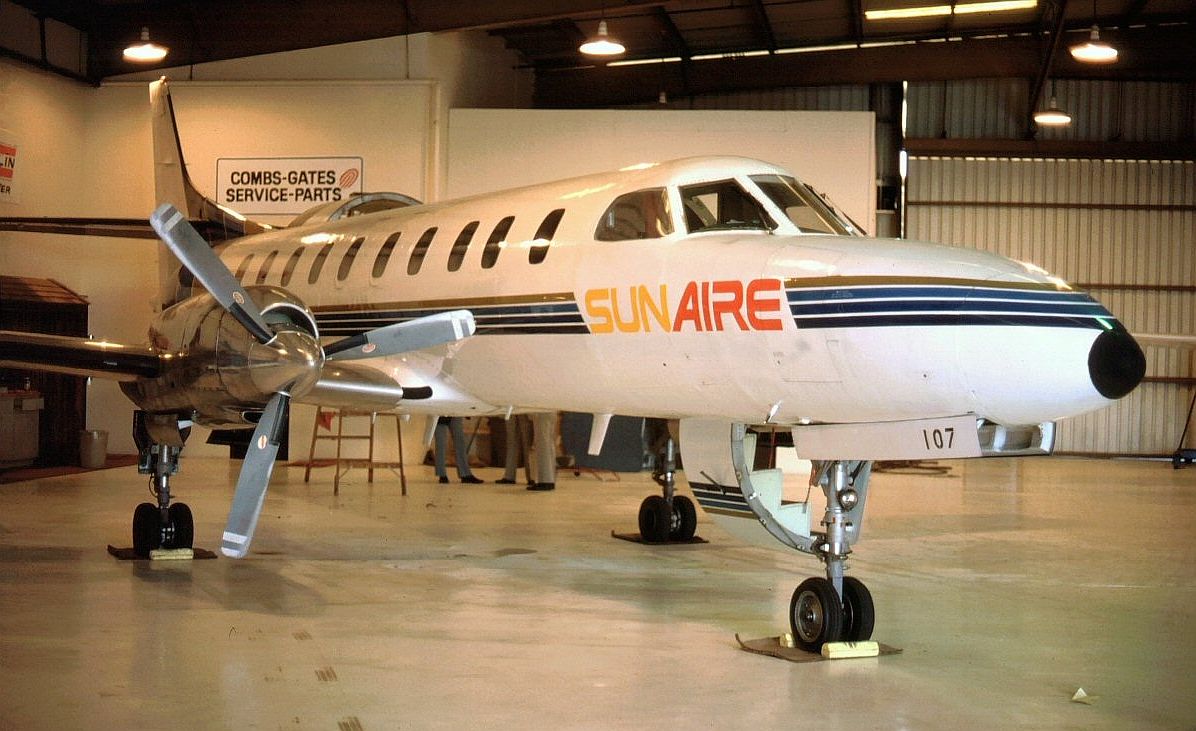
The Sun Aire Metroliners were just a bit different than the others I had flown. While they were equipped with the same engines and propellers, they had been tweaked to settings that produce less idle power and more drag than manufacturer specifications. This facilitated the standard Space Shuttle-type approach we did in Palm Springs, as well as the high-speed approaches we did in places like LAX and SAN. In fact, we could approach at the 248 knot redline to nearly three miles from the runway and suddenly slow, drop the landing gear and flaps. It was fun to race other planes on parallel approach paths and watch Boeing and Douglas jets appearing to be going backwards. ATC would often as us to maintain maximum speed which we called “Warp Factor Nine”. However, you did not dare reduce power to idle until the wheels were on the ground. Landing with power on was a must.
On one occasion, I was with a captain who misjudged his height while landing at night in Yuma, AZ. He thought he had touched down, yet was still a good six feet or more in the air. As the plane fell to a very firm contact with the earth, all the passengers could hear him yell, “OH NO!”
Sun Aire was a subsidiary of a San Francisco-headquartered conglomerate corporation. Unusual for a regional or commuter airline, the little airline made money and was in the black. I actually bought some stock in the parent corporation and received the annual reports. Yet, mention of the airline was little more than a tiny picture and footnotes in the financials. I truly enjoyed working there and the lifestyle of living in Palm Springs.
Life and love threw me a curveball, and toward the end of 1981, I would be considering yet another airline and a start-up at that. There was an expectation that I would finally be flying a jet airliner, too. Great expectations.