Archive for October, 2025

Avalon,Avalon Air Transport,California,Catalina Channel,Catalina Seaplanes,first flight,flying boat,Grumman Goose,Long Beach,Mother Goose,seaplane,Sikorsky VS-44A
First Flights, First Love

By Ellis M. Chernoff

Everyone remembers their first kiss, first date, and other special occasions. Most World Airline Historical Society members recall our first flight in an airplane. And so it is for me. In 1960, when I was seven years old, my parents planned a week of summer vacation on Catalina Island off the coast of Southern California. At that time, you could either take the SS Catalina ship or you could fly on an amphibious Grumman Goose seaplane.

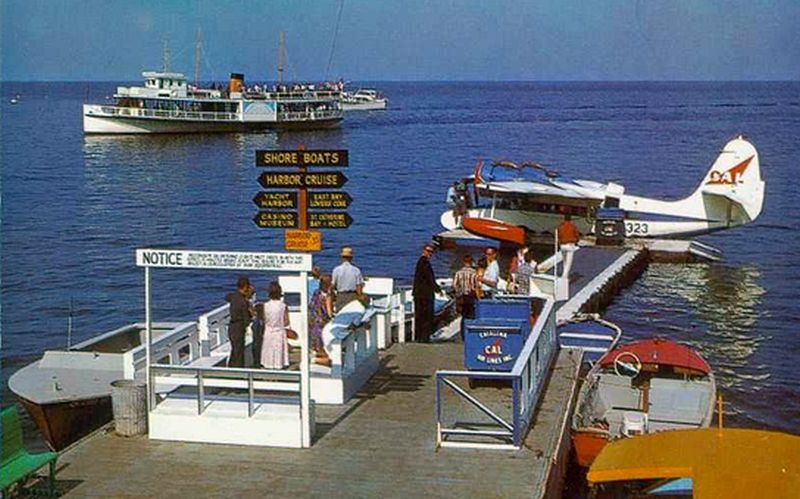
There were actually three airlines providing Grumman service from the mainland, but only Avalon Air Transport actually docked in the heart of Avalon at the Green Pleasure Pier. The two other airlines, Catalina Channel and Catalina Seaplanes, used the Pebbly Beach ramp south of Avalon. Those airlines made water landings but came up on land to disembark.

For my first trip, we drove from the San Fernando Valley down to Long Beach Airport. Interestingly, the terminal building is much the same today as it was in 1960. We checked in at the ticket counter and deposited our baggage before heading upstairs to the outdoor observation deck to watch the planes arrive and depart. In the distance was the Douglas Aircraft factory and a line of DC-8 tails on the pre-delivery ramp.

While Avalon Air Transport may have had a schedule, being peak tourist season, the Grumman Gooses seemed to depart as soon as they had a load of passengers.
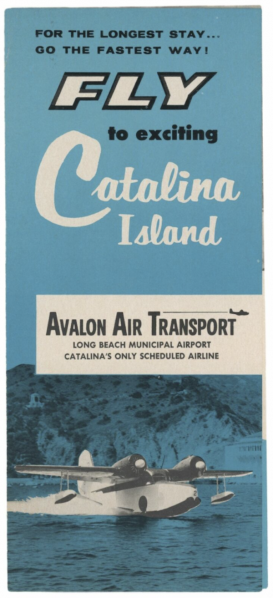
It was eventually our turn. I seem to recall that my father got the co-pilot seat, my mother and younger brother (he was a babe-in-arms) sat in the next row, and I was closer to the rear.  Passengers’ baggage was loaded into the nose, as well as into another compartment behind the passengers. 
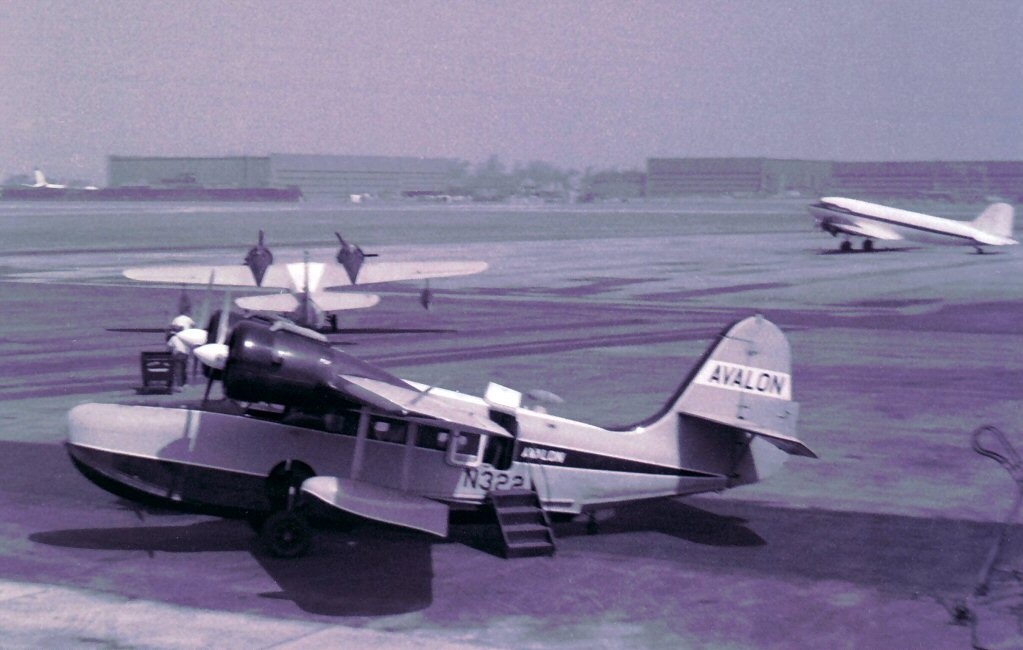
This is the only photo in my collection that I took of the Grumman Goose from the Long Beach observation deck. This was taken in 1961, the year after my first flight. 

Finally, the door was closed, engines started, and we waddled out to the runway. This was all so exciting! Soon, with lots of noise, we took off and headed south. I loved the view of not only what was below, but also the view of the wing and pontoon. That pontoon was supported by struts and cables. 

The entire flight was only about 15 minutes. When we reached Catalina, I watched the wing flaps extend as we descended to the water. I was somewhat shocked at the sound of the water on the keel as we gently skimmed the surface of the ocean. Settling onto the water after a few skips on wavetops, my view was completely obscured by water, just like riding in a car through a car wash! But within moments, that all cleared, and we water-taxied to the dock. 

I was mesmerized by not only how blue and clear the water near the island was, but also by the dual wakes of the Grumman’s hull and the pontoon. When the Goose alights in the water, it’s with one pontoon in and the other out of the water. In fact, the pilots plan the fuel balance so that arriving at the dock, the left pontoon will be up and out of the water so it can pass over the floating dock. The dock boys quickly lashed the plane (as you would a boat) so the passengers could deplane, and the baggage was unloaded onto a cart.

From the water level ramp, you proceeded up some inclines toward the end of the pier and the Avalon Air Transport ticket booth to retrieve your luggage before heading on to your hotel. That one quick flight had me hooked!

While the week was full of beach time, glass-bottom boat and flying fish tours, food, and salt-water taffy made before your eyes, my main fascination remained with the activities of the seaplanes arriving and departing.

In addition to the Gooses, Avalon Air Transport also operated a single Sikorsky VS-44A flying boat. That plane was the sole survivor of only three built. It was brought to California from the Amazon in 1957 by Dick Probert, the airline’s owner. With a high wing and four engines, it was a grand flying boat reminiscent of the Golden Age. Watching it come and go was even more exciting than the little Gooses.  The big Sikorsky was fondly nicknamed “Mother Goose,” but she was a true seaplane. To ride on her, you had to drive down to Long Beach Harbor, which we did not choose to do.
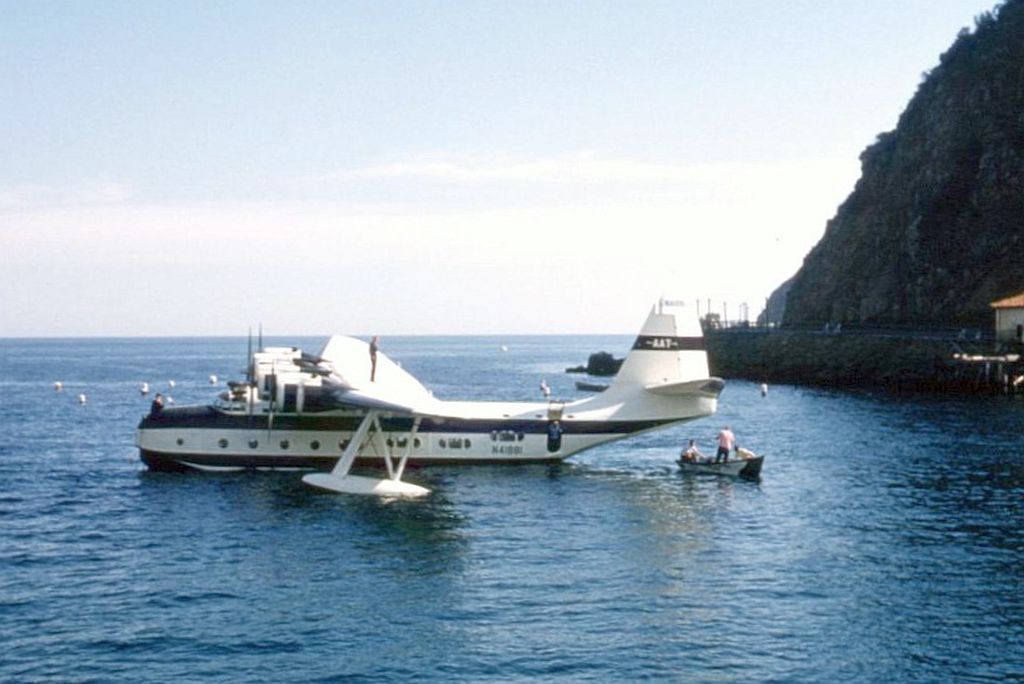
Avalon Air Transport, Vought-Sikorsky VS-44A, N41881 s/n 4402, at Avalon-Harbor Seaplane, California  [CLOSED] in November 1958. Ready to return to Long Beach Harbor. The aircraft is preserved in the New England Air Museum. Photographer: Mel Lawrence.
Catalina Airlines N323, c/n 1191, at the Pleasure Pier in Avalon. The glass-bottom boat “Phoenix” is at the upper left. Photographer unknown, slide from the author’s collection.

The return flight at the end of the week was even more thrilling than my first ride!  However, being the smallest passenger (in my own seat), I had to wait until everyone else had boarded. Getting into the Goose from the floating dock was a bit tricky for a landlubber. The dock and the plane both bobbed in the swells. There was a step inside the hatch at the left rear, and once everyone was boarded, the seat back was raised, and I could sit down there and fasten my seat belt as the hatch was closed. It wasn’t unusual for a little water to come through the gaps.

As the engines started and we cast off from the dock, I again enjoyed the view of the water and the wake. As soon as the captain applied takeoff power, I could again see nothing but water out my window. It was a combination of being in a car wash and a submarine. I could both feel and hear the slapping of the water on the hull even over the din of the Pratt & Whitney R-985 engines. But all was instantly smooth as we rose into the air and headed back to Long Beach Airport.
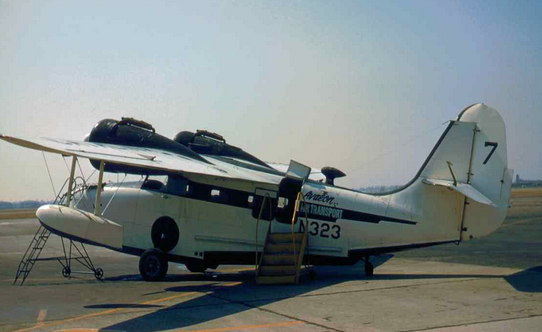
This is a scan of a slide in my collection. 
Original photographer unknown.

Just 15 minutes later, we made a smooth landing and waddled to the ramp. I was first off and marveled at the plane on the ramp. The next summer, our family would take another trip to Catalina with some added experiences. I could hardly wait!

With this trip, my love and fascination with Grumman amphibious airplanes had begun. It’s a love that has lasted throughout my life.
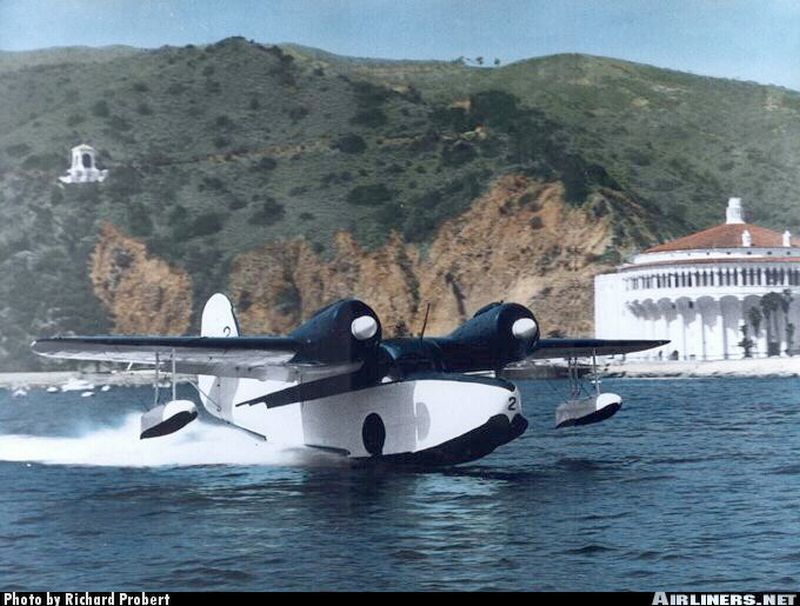
This is a widely published photo of an Avalon Air Transport Goose, N1583V, taking off from Avalon-Harbor Seaplane Base, now closed. Date is mid-1950’s.
Photographers Richard Probert and his son (also Richard) are long deceased.

If you’re interested in learning more, about the Grumman Goose, check out Grumman G-21 Goose (June 2021) in The Captain’s Log and this YouTube posted by Ken Butz with excellent footage of a Goose flight from Long Beach to Catalina.
Continue Reading 2 Comments

Airline,airline pilot,airlines,Boeing 727,engineer,FAA,Federal Express,FedEx,flight engineer,pilot career,type rating

BOEING 727 – ROUND ONE

By Ellis M. Chernoff

Like all of my peers flying for small commuter airlines, we aspired to fly the big jets. Since about 1964, nearly all of the major U.S. airlines were flying fleets of the Boeing trijet. Serving as a second officer, or Flight Engineer, was the usual entry level for new hires. Very few airlines were hiring new pilots in the mid-1970s. To be competitive, at a minimum, an applicant must have passed the FAA Flight Engineer-Turbojet written exam. This exam was based on the Boeing 727 systems, limitations, and procedures. To be truly a standout applicant, a pilot needed to have the full FAA certificate. The airlines took advantage of the glut of potential applicants and expected pilots to purchase their own training rather than have the airline provide it upon employment.

Countless books and articles have been written on the history and characteristics of the classic Boeing. I need not repeat it here other than to say that I rode on my first one, a Northeast Airlines B727-95 from Montreal to Boston in 1967. My first jumpseat ride was on a United B727-22 from Charlotte on a multistop flight to Los Angeles in 1977.

Like most people, I prepared for the written exam with a study guide and attending a quickie weekend ground school. Only the very basics were explained, and many test question answers were pure rote memory.

By 1979, the airlines were finally hiring aggressively, and there was a rush to complete the full training and receive the certificate to land that coveted airline job. Since the course would be several weeks, it would not be possible to complete it on a vacation, so it was necessary to resign from one’s current employer. That came with the consolation that one’s dream airline job could be just weeks away!

So it was that I left Air Carolina and their fleet of Pipers and enrolled at Flight International in Atlanta. They operated a full school with classroom instruction, a cockpit procedures trainer (CPT), and a fully functional simulator based on the Delta Air Lines Boeing 727-232A version cockpit. It was a non-motion and non-visual simulator strictly for training flight engineers.

The classroom systems instructor really knew the plane, having retired from Pan Am on their Boeing 727s. The handouts and system boards were excellent for preparing for procedure practice in the CPT. This also built toward the required FAA oral examination. Finally, pairs of students were assigned to a “flight instructor” to learn to operate the systems in the normal, abnormal, and emergency procedures. I learned to know what every switch and gauge did and how to identify the results of every action.

Some procedures, such as Hydraulic Leak/Loss and Electrical Fire of Unknown Origin, were drilled again and again so the student flight engineer could isolate a fault in a system and restore as many functions as possible. Real system knowledge stuff. Strut overheat and Lower Aft Body Overheat were other classics drilled again and again.

Each student was scheduled for their closed-door oral exam with the FAA. This spread much anxiety as many guys did not pass or spent many hours being grilled and barely getting a pass. Not to brag, but when my turn came, the inspector gave me a performance problem first and then began the questions. In about 20 minutes, he asked a question I had never encountered before. He said, “I know they didn’t give this to you, but how do you think it works?” Before I could even answer, he told me I had the oral in the bag. I postulated an answer to his technical question, which was correct. We chatted for a few more minutes so it would not appear to the next guy that I had finished so quickly.

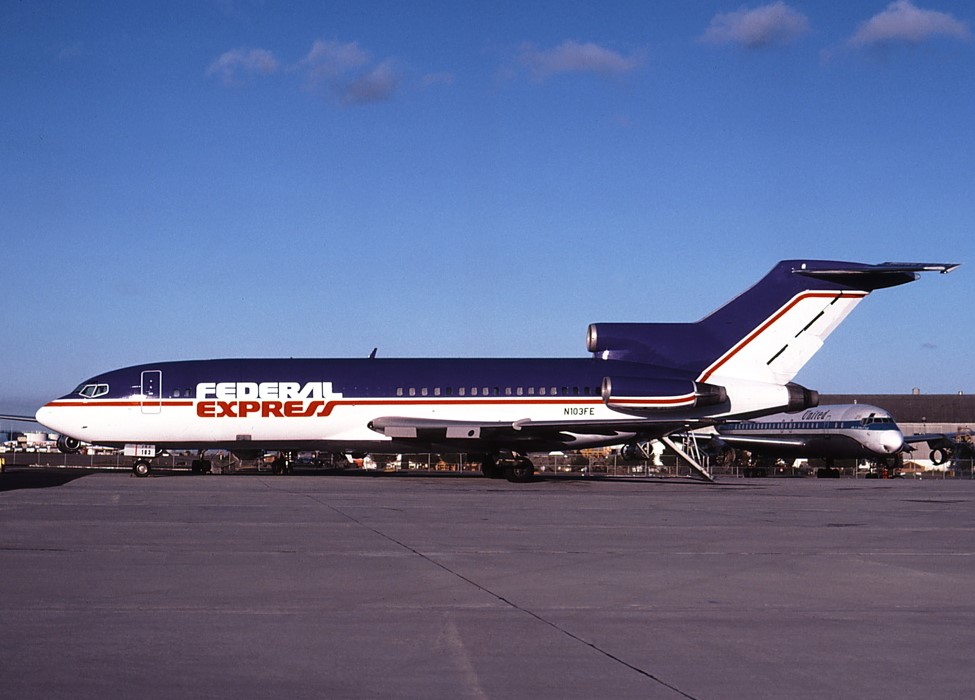
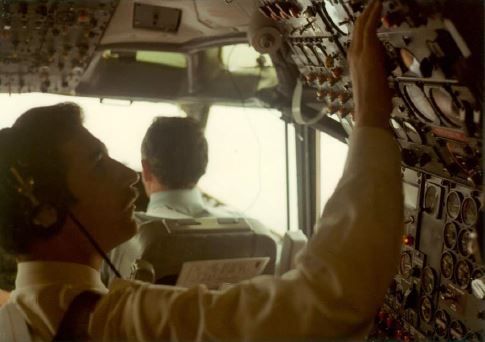
Since the simulator did not “fly”, it was necessary to do one more thing to finish up the exams. A Federal Express B727-22QC was rented in Memphis and six of us would go there and get 20 minutes each in the seat. Before the flight, we would receive a “differences“ training class and a walk-around preflight on the ramp. I would start an engine, run the after-start and before-takeoff procedures and checklists, the
pilots would fly once around the pattern, and after landing, I would restart the APU and do the after-landing procedures through an engine shutdown. The cost of this little ride worked out to $920.00 of the total tuition.

Final certification exam being flown in FedEx B727-22QC N103FE. Unknown photographer, Ellis Chernoff Collection.
N103FE, Boeing 727-22QC at San Francisco Int’l Airport on Mar 31, 1978. Photo by Jon Proctor.

With another temporary FAA Airman certificate in hand, I could again start the process of applying to the airlines and hopefully land an airline job and start that long-planned for dream airline career. But that would not be how it turned out.

On May 25, 1979, American Airlines 191, a DC-10, took off from Chicago. The #1 engine detached from the wing, resulting in loss of control and a crash. All 271 occupants on board were killed on impact, along with two people on the ground. It remains the deadliest aviation accident to have occurred in the United States. The FAA subsequently grounded all DC-10s in service, resulting in nearly all airlines cancelling hiring and new hire training classes.

For now, my Flight Engineer-Turbojet certificate was useless paper in my wallet. Having given up my prior employment, I returned to my parents’ house and began again to look for any flying job I could get. Hopefully, I would get something where I could log turbine time. I already had plenty of PIC and Multiengine time. It seemed every interviewer would talk about what I didn’t have and not give me much credit for the experience and potential I did have.

For now, my Boeing 727 materials and knowledge would be stored away for another nine years.

Stand by for Round Two.

Continue Reading No Comments

World Airline Historical Society, Inc.
PO Box 13693, Tampa, FL 33681-3693 USA
Contact Us

Archives

Copyright © 1975-2025 World Airline Historical Society, Inc.

Read our Privacy Policy