Archive for August, 2022

Pan American,PAWA,varig
The History of Safety Cards, Part 3: The Jets Arrive (Turn of the decade 1950s/1960s)

By Fons Schaefers

Early attempts

One of aviation history’s most narrated events of failure is the false start of air transport by jets. I am referring to the years 1952 to 1954 and the operation of the first iteration of the British-built De Havilland Comet. Safety card-wise, this was a non-event as no leaflets specific to the type were carried. BOAC, at the time, used a generic leaflet focusing on surviving a ditching without identifying aircraft types. The other users of the first Comets were Air France, UAT, and Canadian Pacific which, as far as I know, neither used safety leaflets that showed the aircraft type.

Neither meant the introduction of the Tupolev 104 in the Soviet Union in 1956 jet-specific safety cards. Aeroflot was then far away from using safety leaflets at all. CSA, the Czech flag carrier and the only non-Soviet user of the type, did have Tupolev 104-specific safety leaflets but I doubt that was from the start (see 18 July 2017 contribution by Brian Barron under the ‘safety cards’ tile on this website for the CSA Tupolev 104 card and other cards relevant to this part).

Proper start

In the western world, jet airliners properly began in 1958. In Britain, De Havilland, now better understanding the phenomenon of metal fatigue, launched the Comet 4, which was put in service by BOAC in October 1958. The French Sud-Est Caravelle took off with Air France and SAS in May 1959. In the USA, the Boeing 707 was introduced by Pan American in October 1958 and by American Airlines and TWA in early 1959, while United and Delta started with the Douglas DC-8 in September 1959. The third US airframe contender was Convair with its 880 model (followed later by the 990 derivative), which started commercial service with Delta in 1960.

The arrival of jet airliners was generally welcomed as a major improvement in air travel. Some even considered it a quantum leap. The new propulsion method meant much shorter traveling times. This was entirely due to their higher speed, as their range was not better: the number of hops on the longest route at the time (the Kangaroo route from London to Sydney) remained about the same: typically eight. The jets also brought a capacity step. Pre-jet aircraft had maximum seating capacities of up to about 100; the first jets jumped to around 180, although initially, airlines employed luxury rather than high-density seating arrangements so typically installed around 110 to 140 seats.

Jet engines vibrate less than piston engines and are most economic at altitudes higher than where the props fly, where ‘weather’ and associated turbulence can be avoided. This brings a smoother and more comfortable ride. Yet, as air at altitude is thinner, it requires back-up oxygen for all occupants in case of a decompression. Here, there was a difference in policy between the two sides of the Atlantic Ocean. In the US, automatic oxygen presentation capability to all passengers was required when flying above 30,000 ft. In Europe, that altitude was 35,000 ft. This meant that aircraft such as the Caravelle and most Comets did not need automatic oxygen as they stayed below 35,000 ft. Exemptions were the long-range Comet 4 which BOAC operated at higher altitudes and the Caravelle when operated under US rules, such as by United Airlines.

Jet’s effect on safety cards

Did the introduction of the jet mean a quantum leap in safety cards? The answer is both no and yes.

No: piecemeal changes

Most of the first airlines to fly jets were flag airlines. Many already had safety leaflets in use for their propliners covering their entire fleets (hence called fleet leaflets). The new jets were simply added to the existing leaflet designs with minimum changes. Good examples of this were BOAC, SAS, TCA and Pan American.

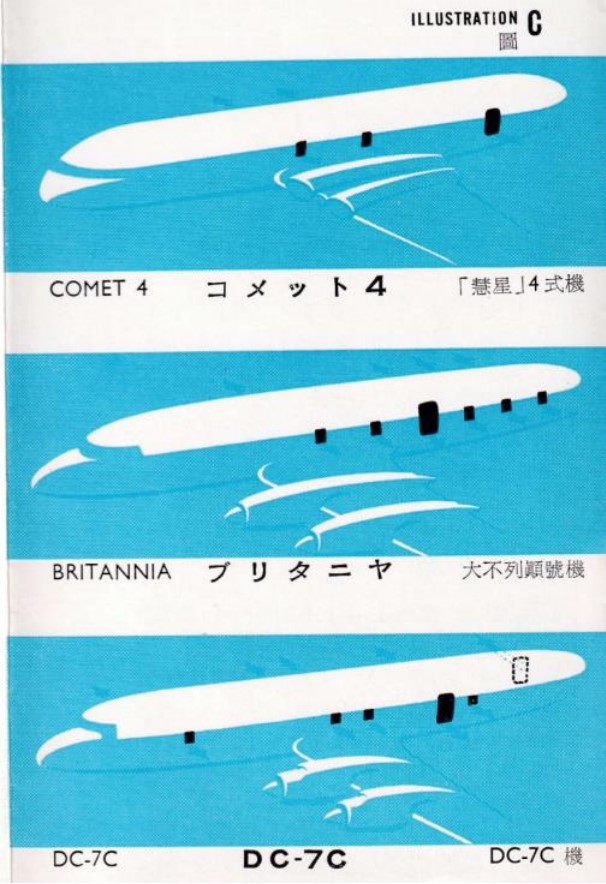
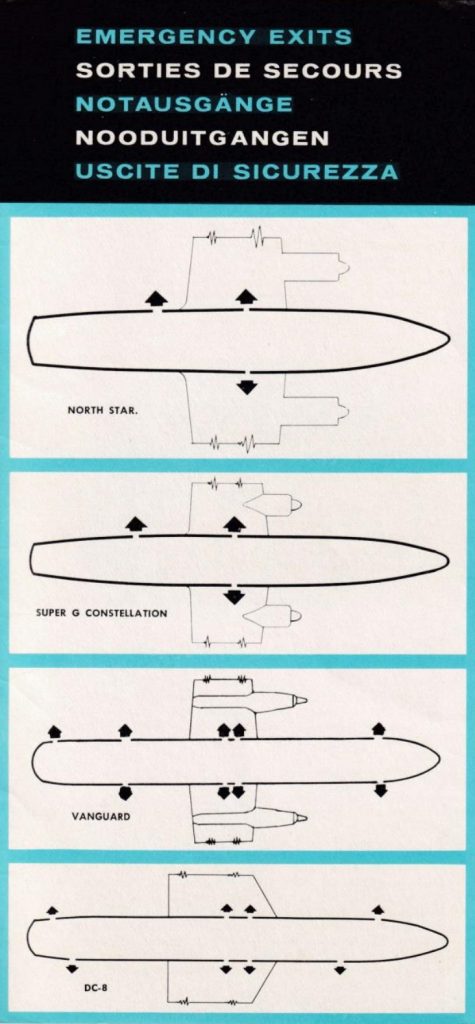
Comparing BOAC’s 1957 elaborative, ditching-oriented safety leaflet edition with that of 1958 shows only one change: the aircraft exit diagrams of three types (Stratocruiser, Argonaut, and Constellation) are replaced by that of the Comet 4 (the Britannia and DC-7C remained).
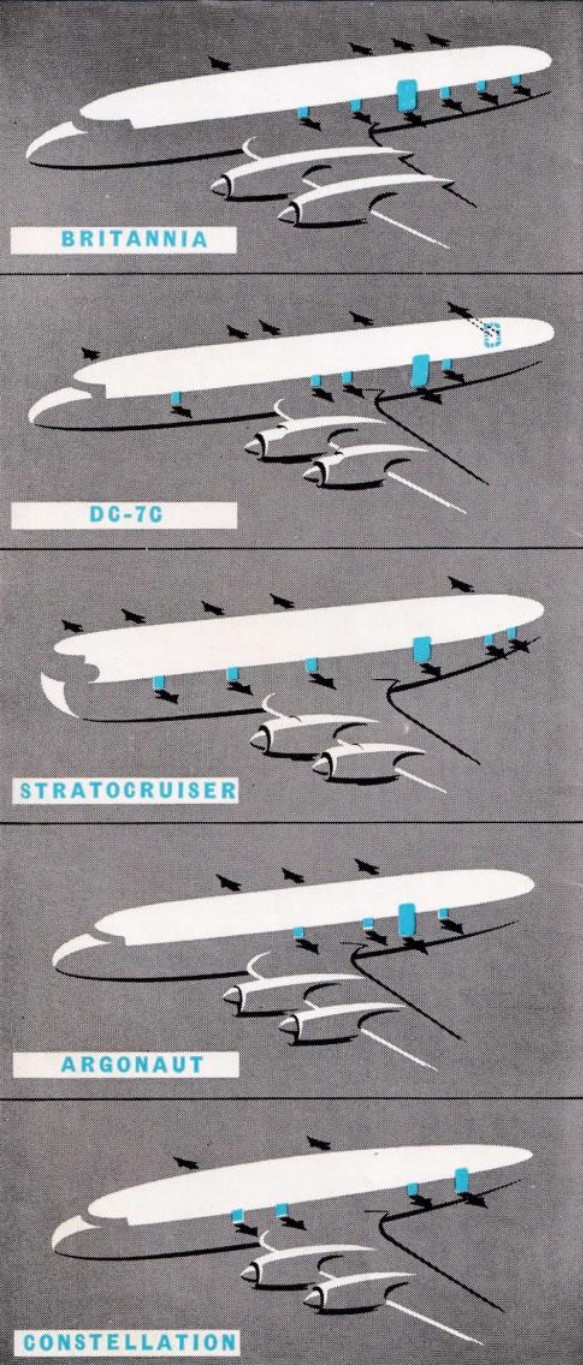
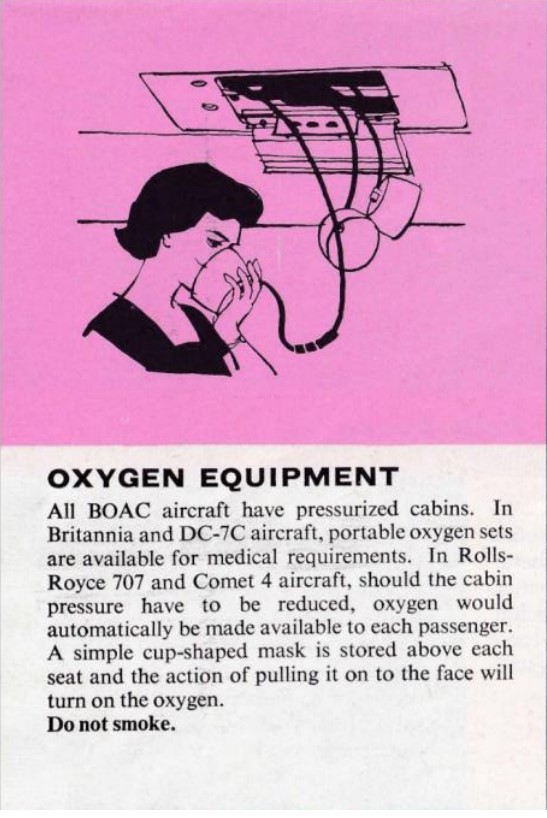
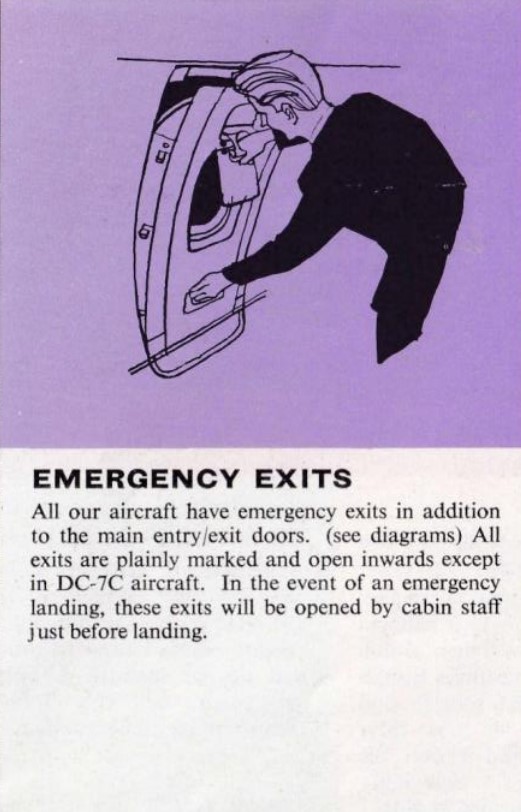
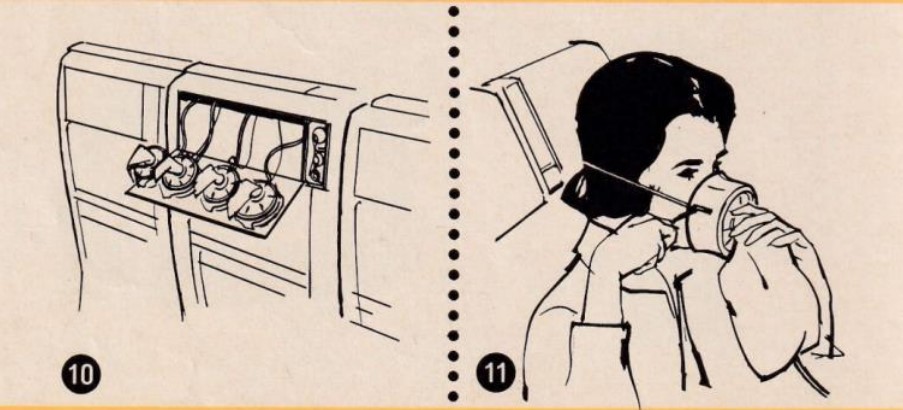
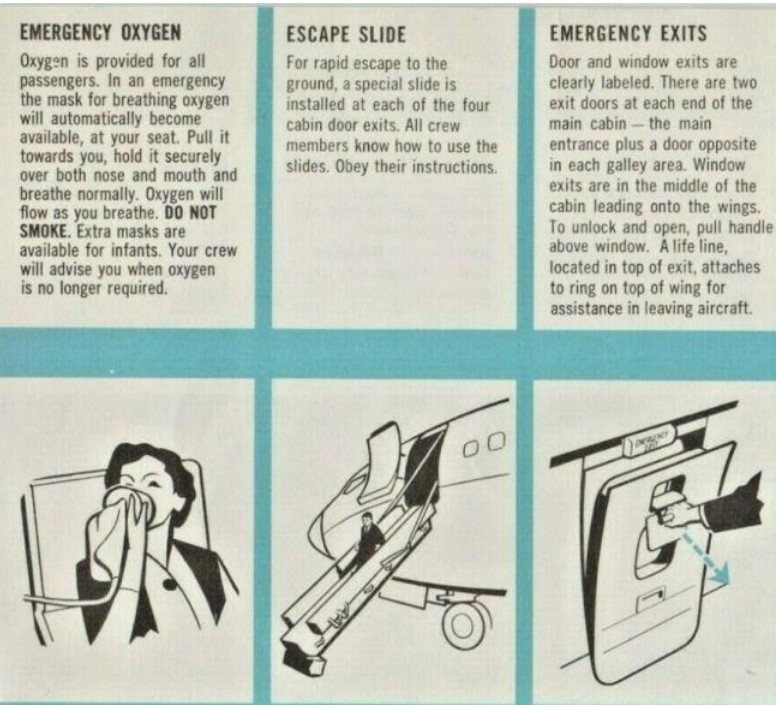
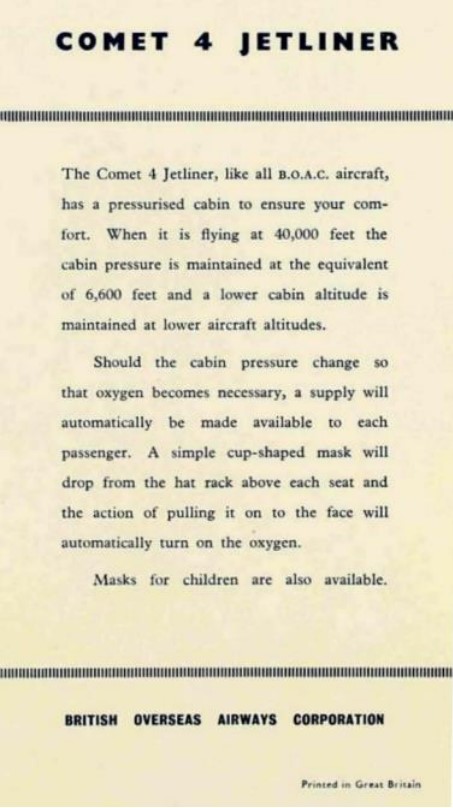
As BOAC flew their Comet 4 up to 40,000 ft it had oxygen provisions for all passengers, so a separate text only leaflet was made to explain those. Its use was no longer required when in 1960 the main leaflet was updated when the Boeing 707 was added to the fleet, and thus to the leaflet. A text plus an illustration on the oxygen equipment was added and, in true piecemeal change style, an illustration of how to open a window exit was added.
At SAS, we see something similar: in the 1959 edition of the leaflet, the Caravelle is added to the diagram page without any further changes to the leaflet. Even the front page still sports the DC-6B!
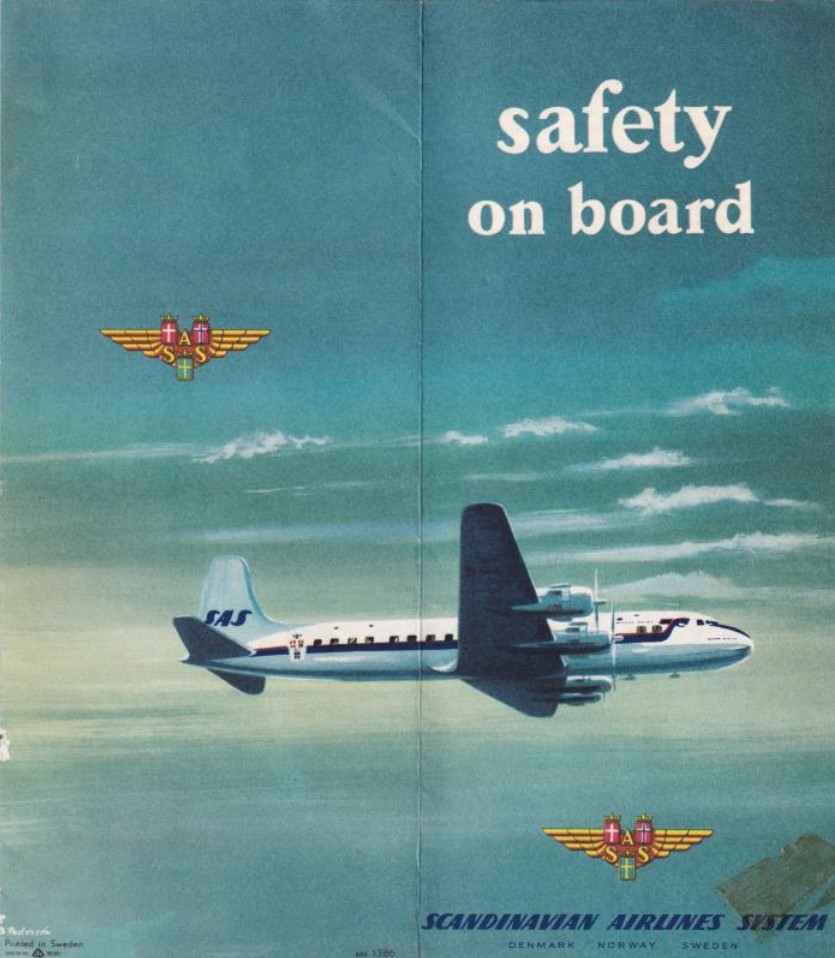
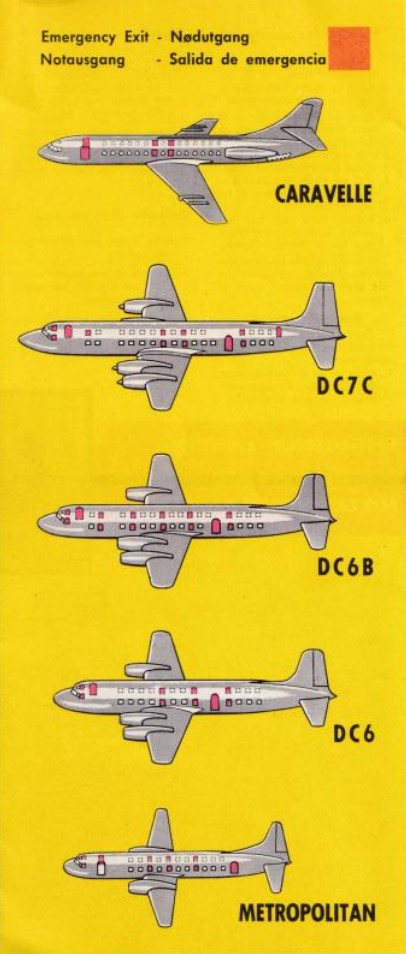
SAS, 1959
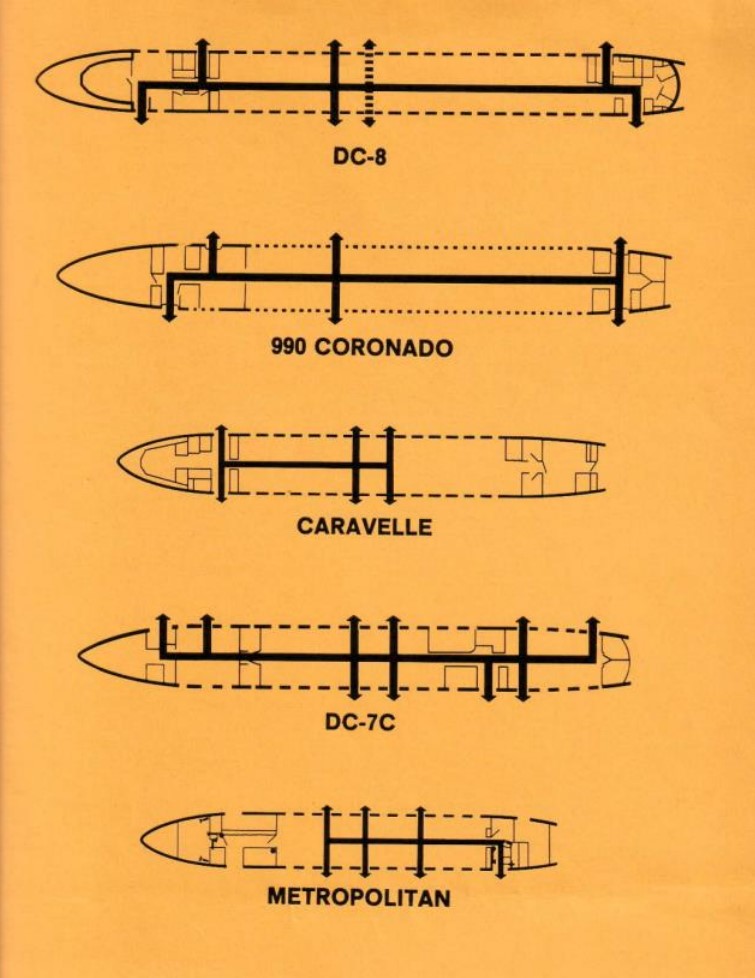
SAS, 1959: front page and exit diagrams panel. Note that entrance doors on the Caravelle (in the tail) and Metropolitan (left forward) are not rated as emergency exit.

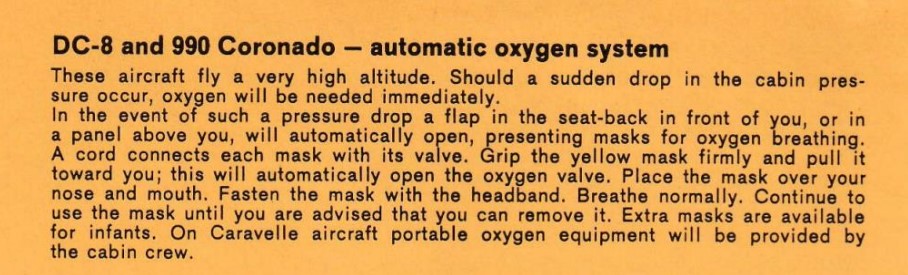
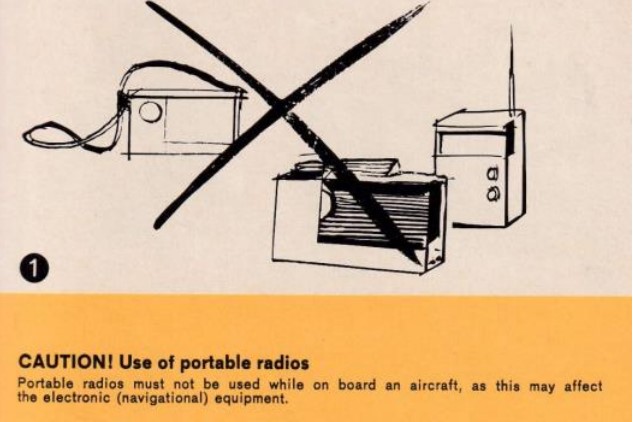
But in the 1962 edition, which has both the DC-8 and Convair990 Coronado added, window exit pictures appear and, for these two types only, so not for the Caravelle as it had none, a page explaining the automatic oxygen system. (See Brian Barron’s contribution for the interim edition, which has the DC-8 added but not yet the 990). In 1962, SAS adds a caution against the use of portable radios on board, as they may affect navigation equipment.
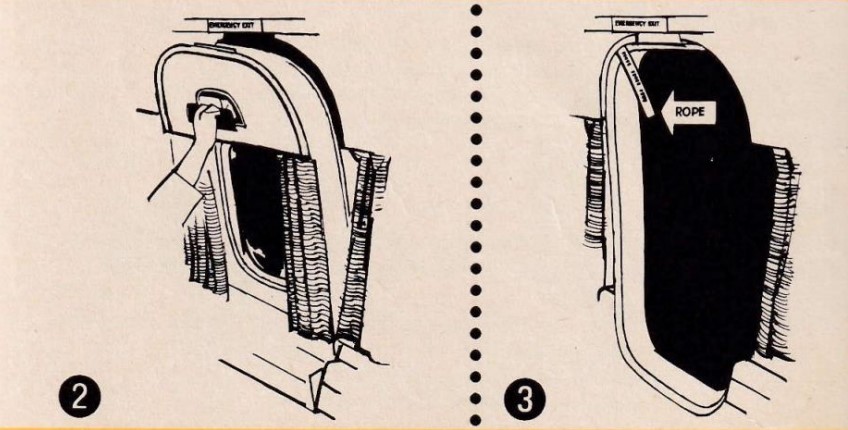
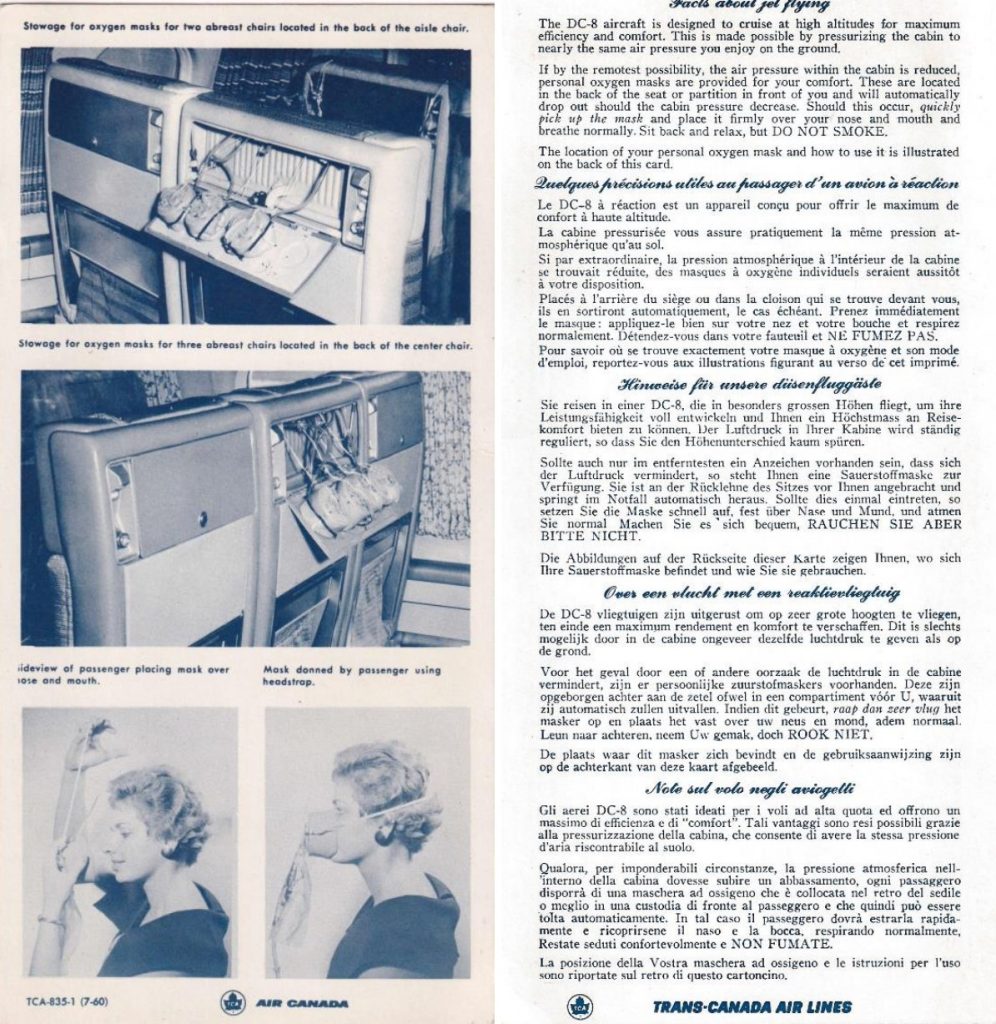
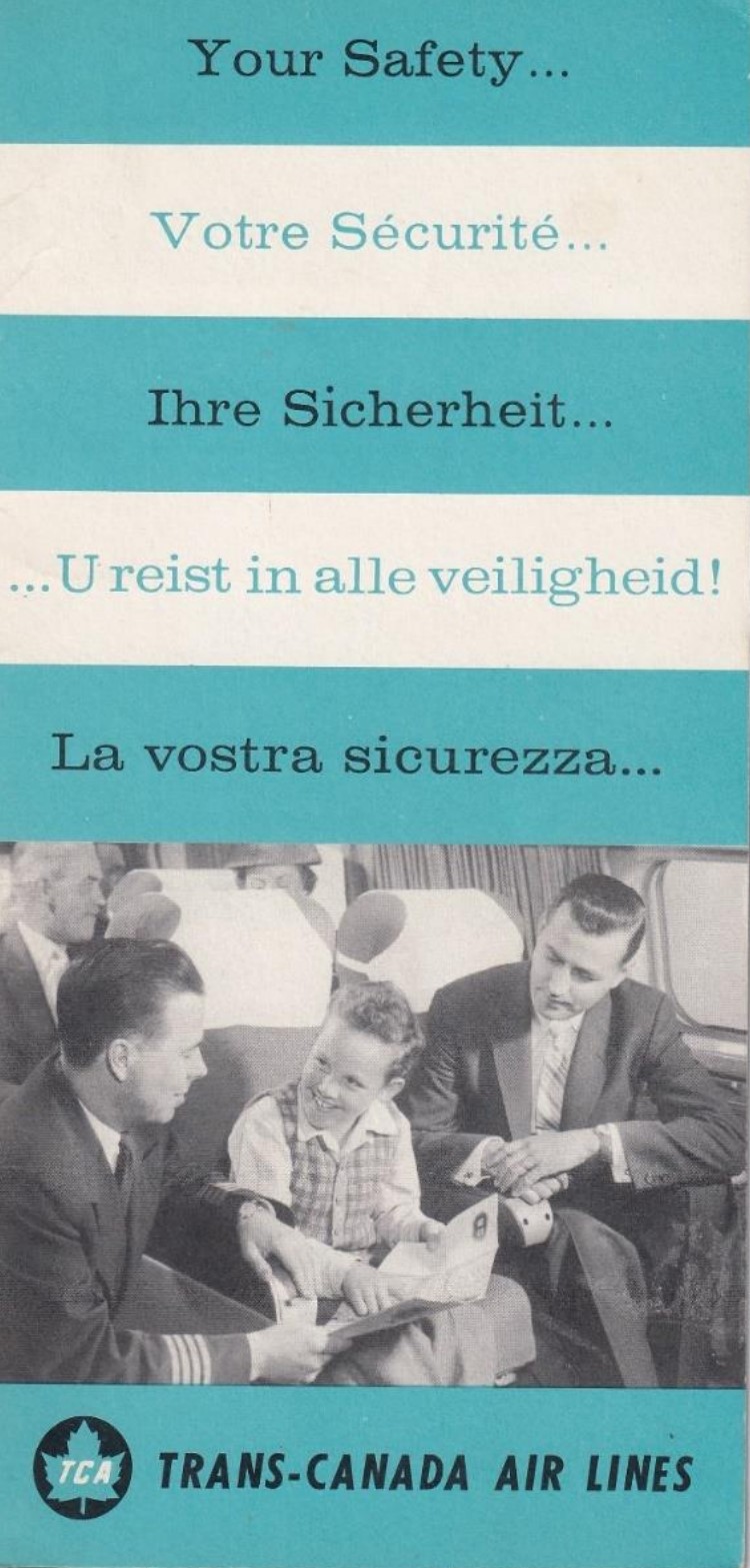
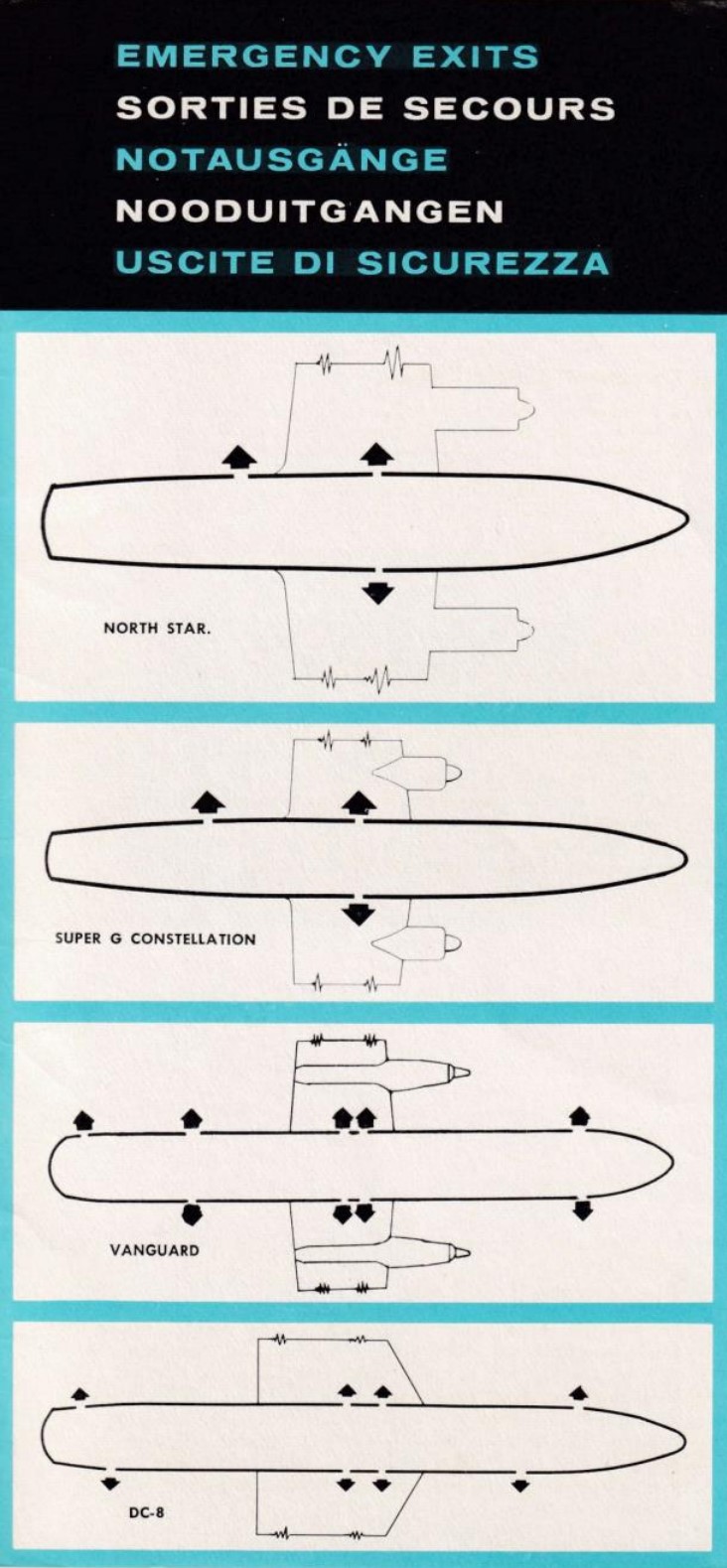
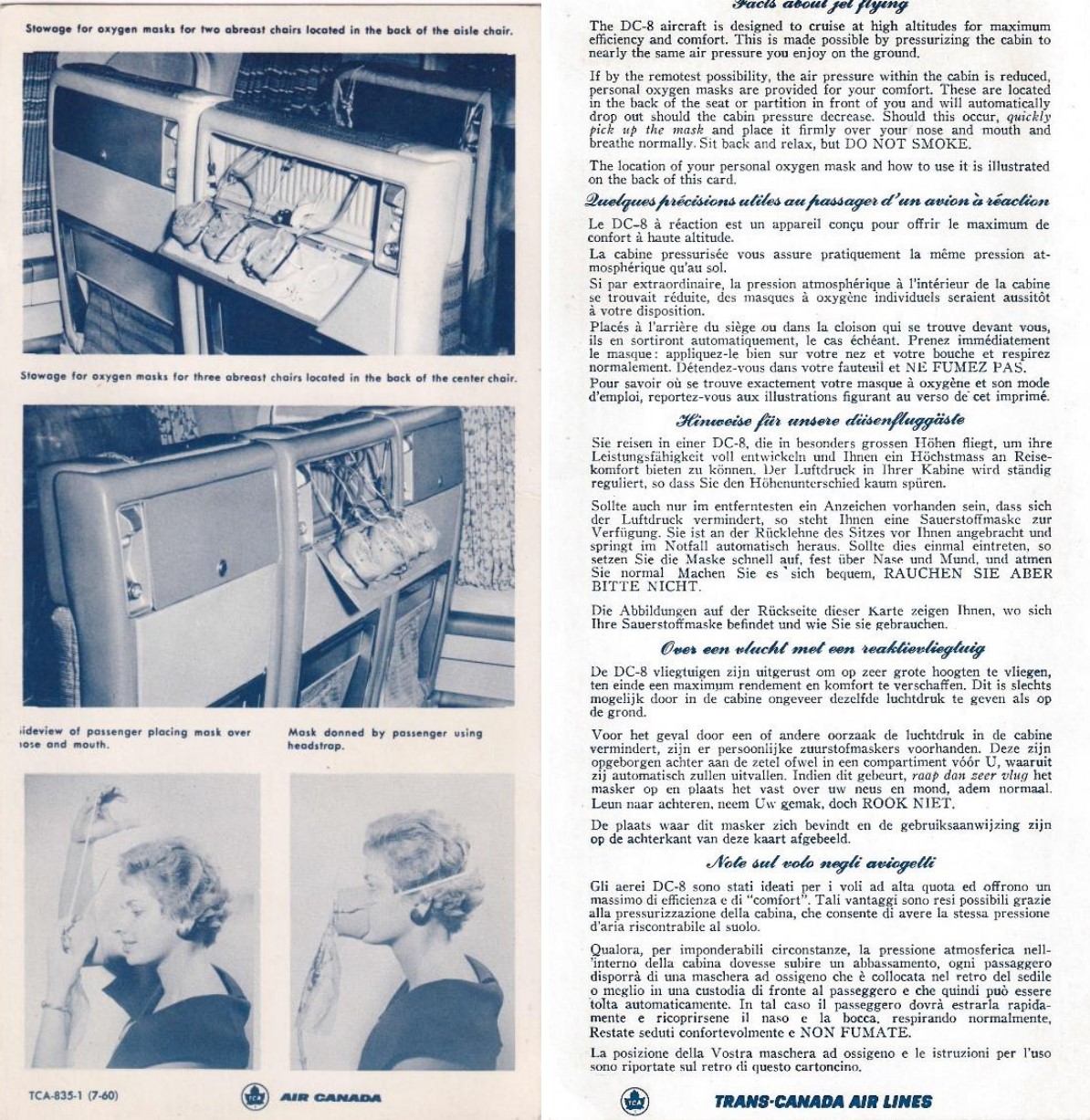
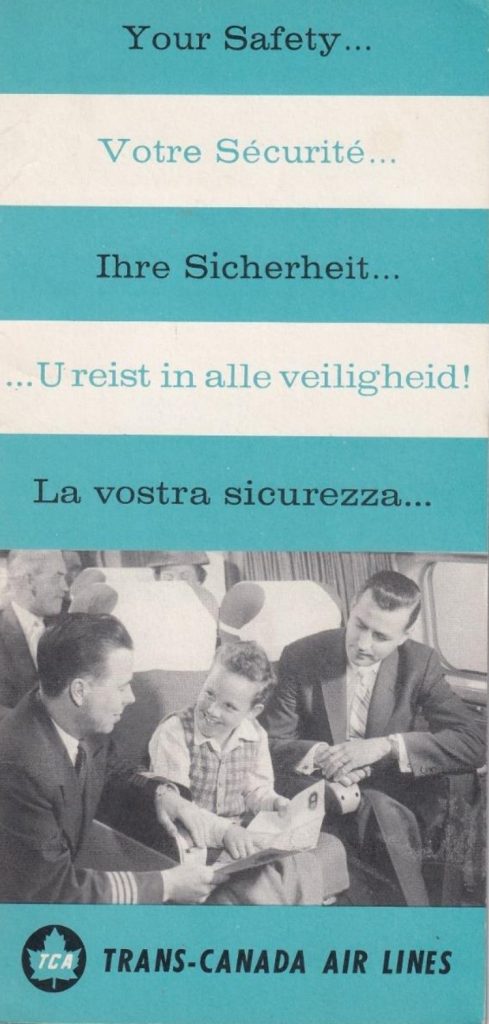
TCA’s 1960 edition of its safety booklet (coded TCA-853) only adds a diagram of the DC-8 but without any exit operation or oxygen guidance. The latter, however, came in the form of a separate card (coded TCA 853-1), with both Trans-Canada Air Lines and Air Canada titles.
The early Pan American World Airways (PAWA) Boeing 707 folder sees automatic oxygen added to the traditional life jacket and life raft instructions (not shown) bu is otherwise very similar to the previous folder for the DC-7C. The latter’s handheld chute is replaced by an inflated slide and the window exit now depicts that of the Boeing.
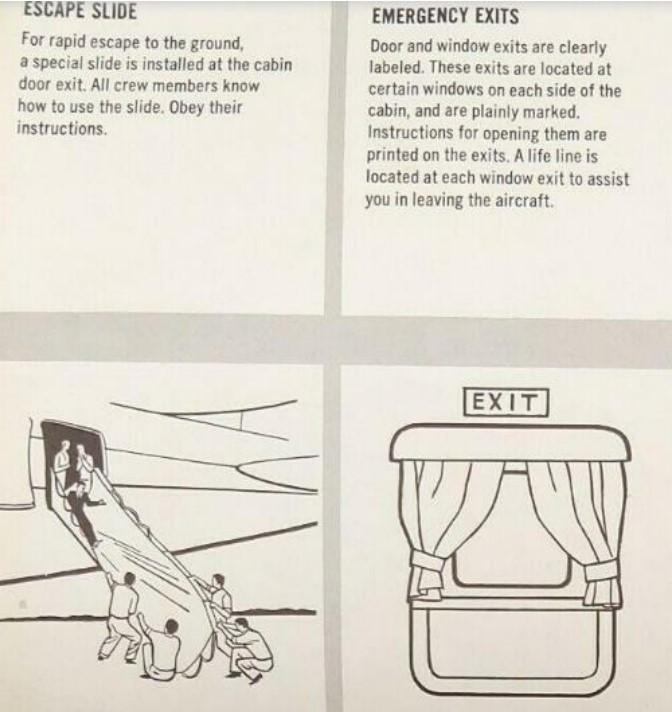
In 1961, PAWA added a note about the dangers of using portable radios and other electronic devices as they may cause interference. Although labeled as important, this note was not translated into any of the other seven languages the folder had. So, perhaps it was added last minute.

PAWA, 1961

Yes: new concepts

Maybe calling them a quantum leap in safety card development goes too far, but several US airlines did use the new jets as an incentive for launching new concepts and ideas.

American Airlines (AA) was probably the first in safety information history to use a double-sided but unfolded heavy paper card. It is coded ‘T-352’ and is believed to be made for the introduction of the type in January 1959. Another AA innovation is to use graphics as the primary means of information, with text in a supportive role. That broke the industry standard of having text prevail with the occasional supporting graphic or photo. AA kept the information on the card to a minimum: an aircraft layout with all seats and exit locations/window exit operation/illustration of a deployed slide/an explanation of the passenger service unit and the automatic oxygen system. There were neither emergency preparation instructions nor brace positions. Also, there was nothing about life vests or rafts, but that matched the route pattern of AA which was then domestic-USA only. Only one language was needed: English.

Curiously, all exits are marked with arrows that point inwards. Only later became it custom to have arrows pointing outwards, in the direction of escape!
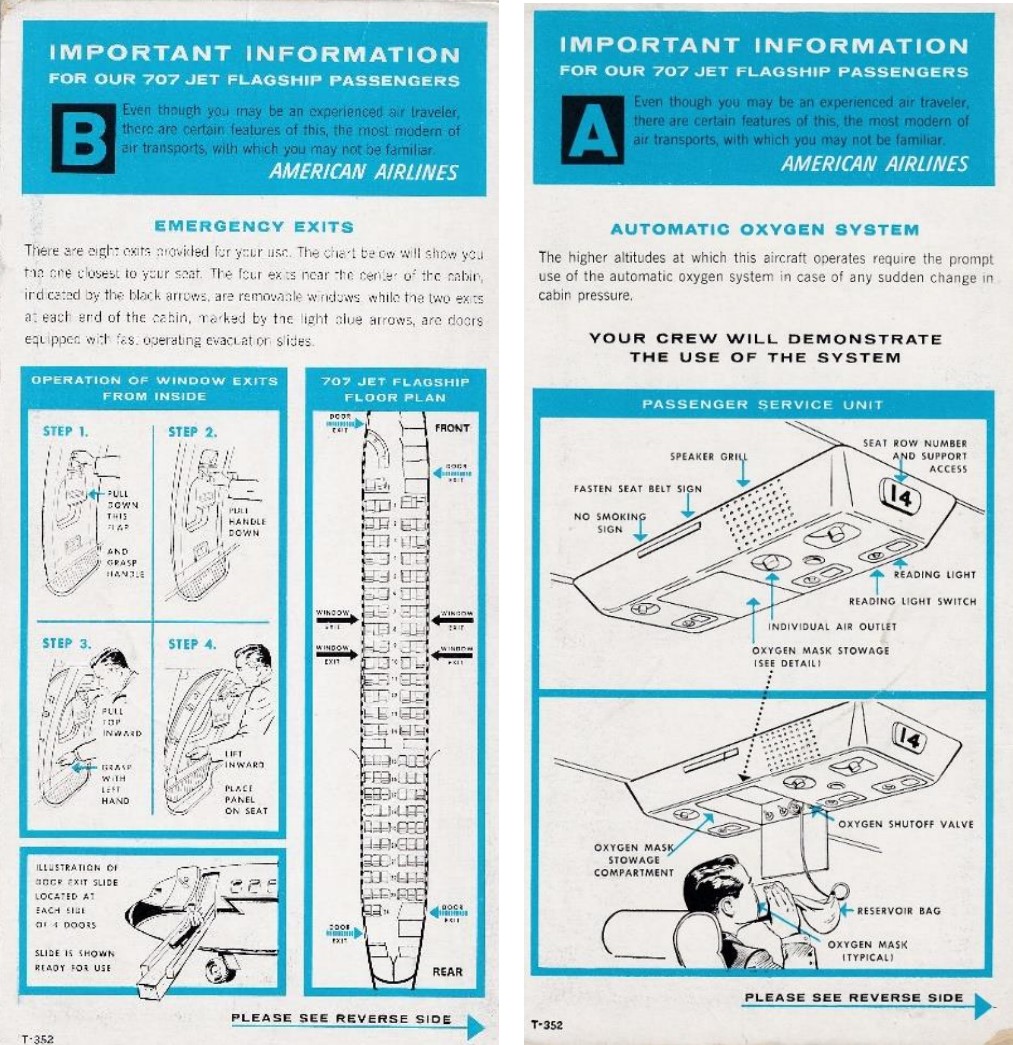
American Airlines, 1959

TWA, which introduced their first jet only two months after AA, also came with a double-sided, unfolded card for their 707. This was laminated, which would be a first. The presentation was similar to that of AA, minus the window exit, but with the supporting text appearing in four languages. The window exit and PSU/oxygen illustrations closely resemble those of AA, so was likely provided by Boeing.

United, already known for its very detailed safety information (see previous part), continued that policy for their new DC-8s and Boeing 720s. In its eight-page 1959 DC-8 folder, it uses a mix of illustrations and text, e.g. to explain how to use the seat-mounted oxygen masks.
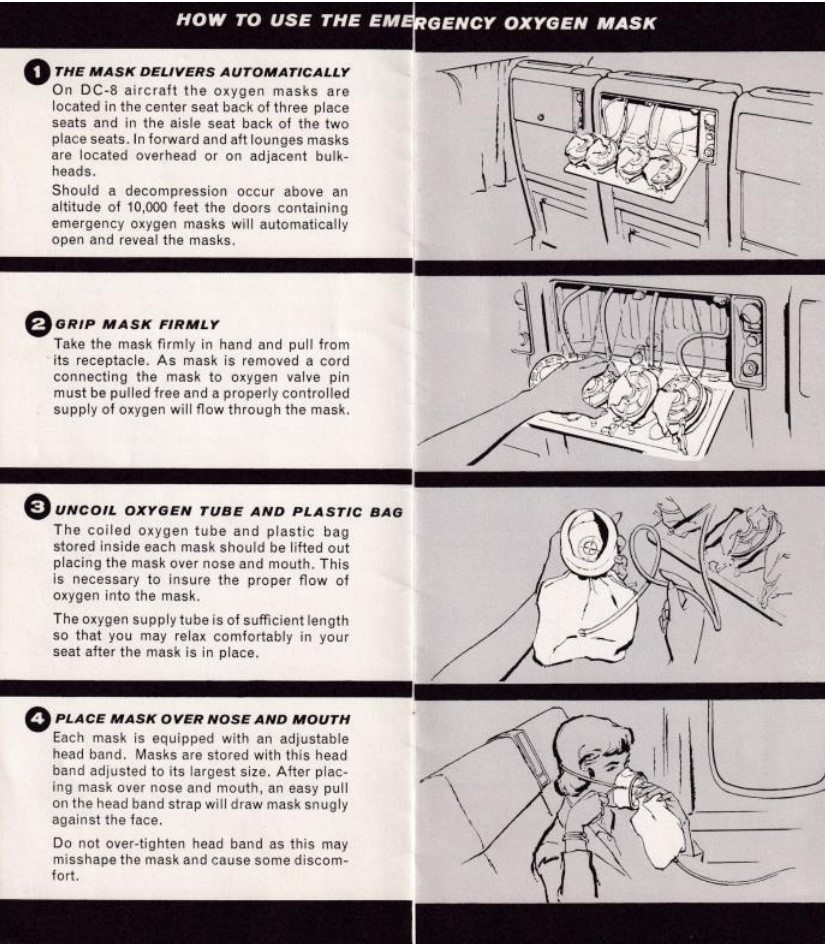
United Airlines DC-8 overwater booklet, 1961

In 1953, United became the first airline to show how to open and use exits and continued as the first to do so for the jets. No other airline at the time showed how to open door exits (as opposed to window exits) and, in detail, how to attach and inflate the escape slides. In early DC-8s (and 707/720s) these were ceiling mounted and required quite a few actions before being operational. The illustrations shown are from the 1961 overwater DC-8 booklet edition, but the 1959 folder fielded the same.
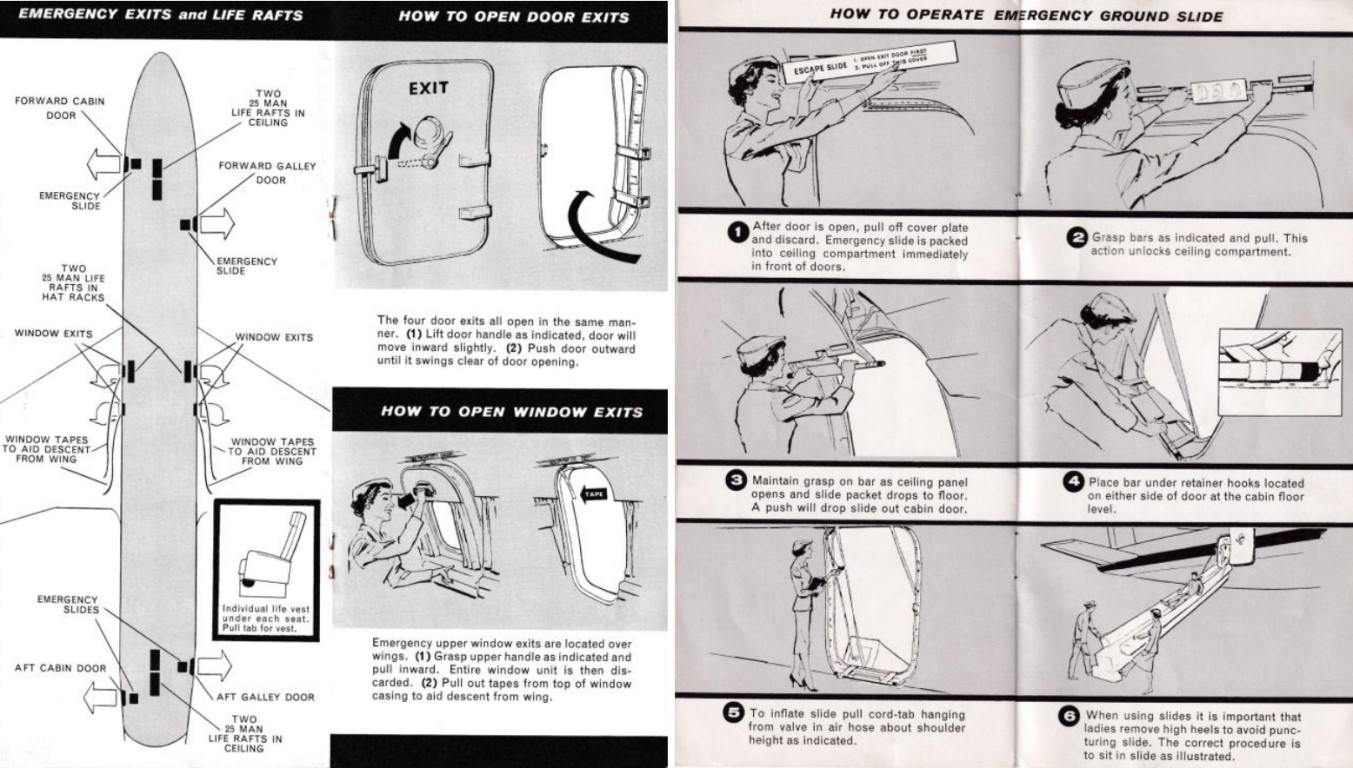
United Airlines DC-8 overwater booklet, 1961

Qantas and Cathay

I’d like to share the details of two more leaflets. They are from two airlines deep in the eastern hemisphere: Qantas from Australia and Cathay Pacific from Hong Kong. Both do not fit the patterns described above as their leaflets are neither next iterations of a series, nor truly novel. Yet they are of interest as they have some features not seen elsewhere. They are from a Qantas 707 leaflet c. 1963 and from a Cathay Pacific fleet leaflet that dates from around 1966.

Both show emergency equipment locations, a practice not applied widely in those days. Cathay included the cockpit windows of their Convairs as emergency exits for passengers. This wasn’t something widely-practiced then, although some other Convair 880 operators did it as well, perhaps on instigation by Convair.

Qantas ordered the smallest 707 variant (which was even smaller than the 720), but I doubt whether their fuselage tapering was indeed as shown. Boeing was very keen on keeping constant diameter cabins, so perhaps Qantas’ artist was still a bit distracted by the curvatures of the 707’s predecessor, the Lockheed Super Constellation.

Qantas explained the use of the escape slides on their new jets by comparing them to, what looks to me, as a playground slide. Qantas explains that they “operate on the same principle as a slippery dip, or in the French translation: toboggan de plage, which, in turn, translates as beach slide.”
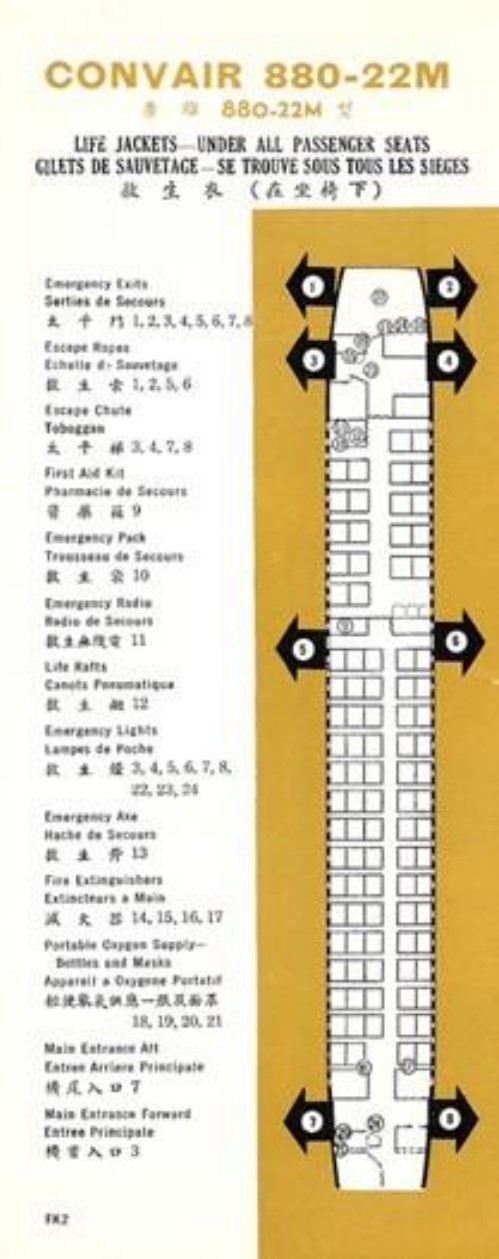
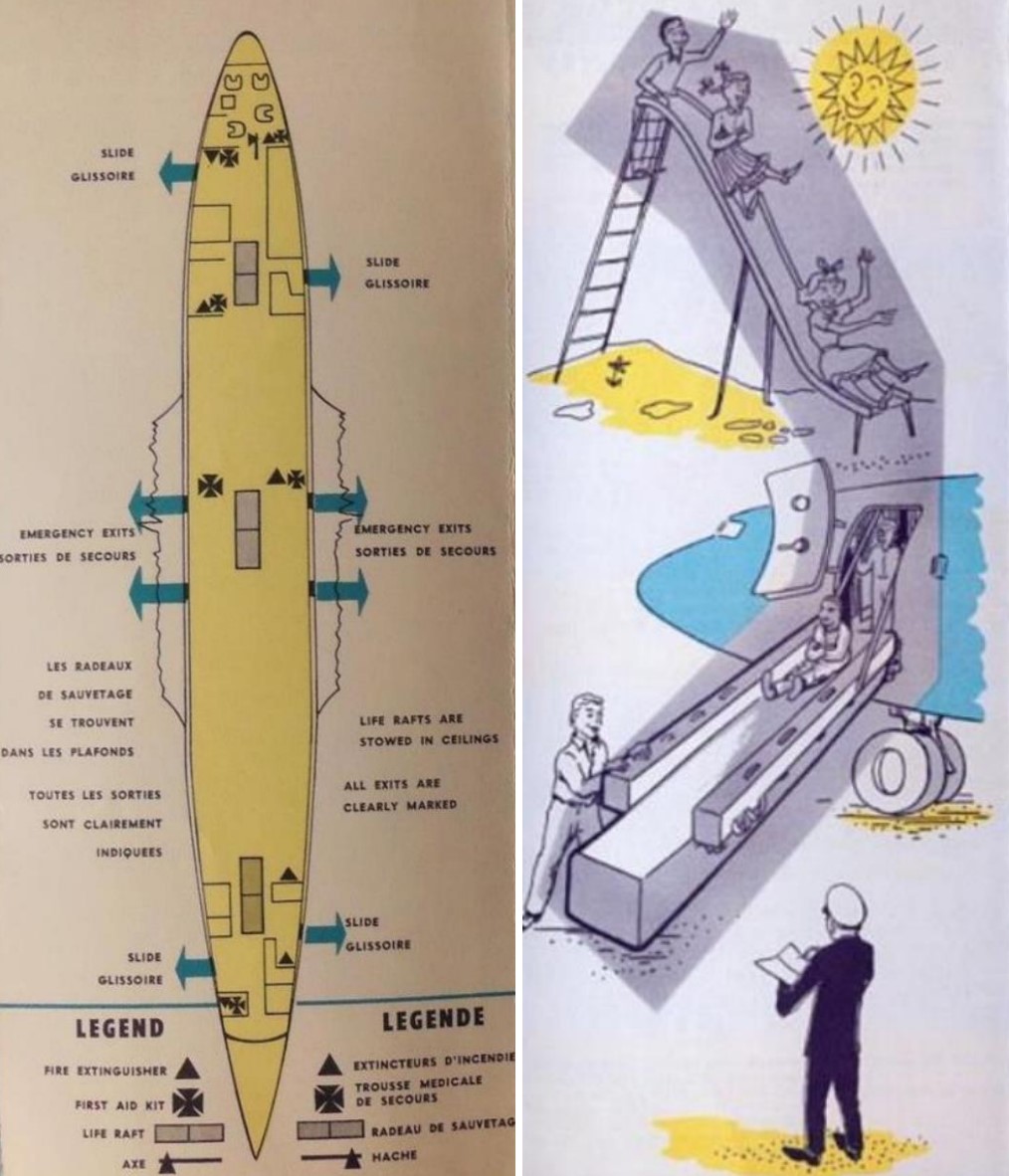
Cathay fleet leaflet 880/Electra, c. 1966
Qantas 707, c. 1963

Trends

The turn of the decade 1950s/1960s was not only marked by the introduction of the jets but also by increasing awareness that many accidents were survivable and passengers needed education on matters other than ditching. As a result, there were quite a few changes in what safety information was given to passengers and how it was presented. Let me summarize the main trends.

Less water, more land

As mentioned, in the 1950s it was realized that the ditching scenario was not unique in being survivable. Crash landings on land became more frequent and often turned out to be survived as well. The safety leaflets, booklets, and cards started to reflect this and the long lists of preparation for a ditching were replaced by information on opening window exits and using escape slides. Some major airlines that did not fly overwater and had never provided safety cards now started to do so. Life jacket and life raft information remained, but for overwater operations only.

Less reliance on crew, more self-help

Before, leaflets stated the crew would open exits and passengers had to obey their orders. An evacuation would be led by them and no further guidance was provided. This example is by Air India.
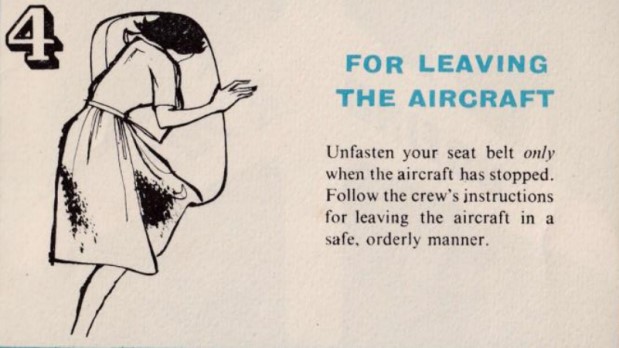
Air India 707 folder, c. 1960

In the new decade, passengers were called upon to take responsibility and help open exits. Opening instructions were given, especially for those exits near where they were seated. This was already recognized by TWA and United in the early 1940s (see previous part), but since then had faded away, perhaps overshadowed by the focus on ditching.

The new cards gave detailed floor plans (sometimes even showing all seats), evacuation routes, exit locations, and emergency exit operation. The jets brought automatic oxygen systems for which passenger education was considered essential. The cards were ideal for that, but as we have seen, not all airlines were ready for this so had to improvise by making impromptu cards.

Less text, more graphics

In the ditching years, text prevailed in the leaflets, often repeating the same message in many languages. PAWA and BOAC had up to eight different languages on their folders. This led to large folders with endless text in small print that even fond readers may have found hard to digest. The introduction of the jets coincided with illustrations replacing words. Text became of secondary purpose. This trend developed gradually into today’s graphics-only cards.

Fewer folders, more cards

More graphics and less text meant the large folders could be compressed on smaller but heavier paper. The term safety card started to become a reality.

Less fleets, more type-specific

A trend that was slightly less pronounced was that of single aircraft type leaflets/cards replacing entire fleet leaflets/cards. Many airlines still found it convenient to have a leaflet that would suit all the aircraft in their fleet. I estimate at the turn of the decade, about half of the airlines used fleet leaflets, sometimes showing up to five or six different aircraft types, such as BOAC and SAS as shown above. But how would passengers know which aircraft type they were on? Perhaps it was mentioned in their ticket folder or at the start of the flight, but would they remember that when consulting the card or worse, when they needed to heed its lessons?

Other airlines issued separate leaflets or cards per aircraft type, such as American Airlines and TWA. Interestingly, a hybrid form came into use, made possible by the fact that the trio of early US jets had the same exit pattern. American Airlines used one and the same card for the 707, 720, and 990, collectively called the Astrojet. The exit pair that did not exist on the 720 and 990 was dashed.
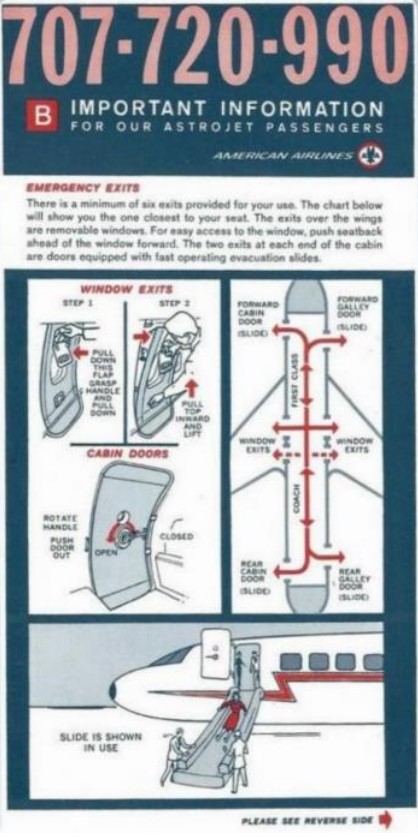
American Airlines, c. 1962

There was one airline that flew all three first-generation US jets: Varig from Brazil. This was not by careful fleet development choice, but rather by inheritance. Varig itself, in 1960, had bought the Boeing 707. When it took over REAL in 1961 it inherited its order for three Convair 990s. And when in 1965, Panair was amalgamated into Varig, its two DC-8s were added to Varig’s fleet. Varig used a single safety card for the three types. Only the asterisks on the aft pair of window exits, explained as ‘Boeing and DC-8 only,’ betray this was indeed the case. (see Brian Barron’s contribution for entire card).
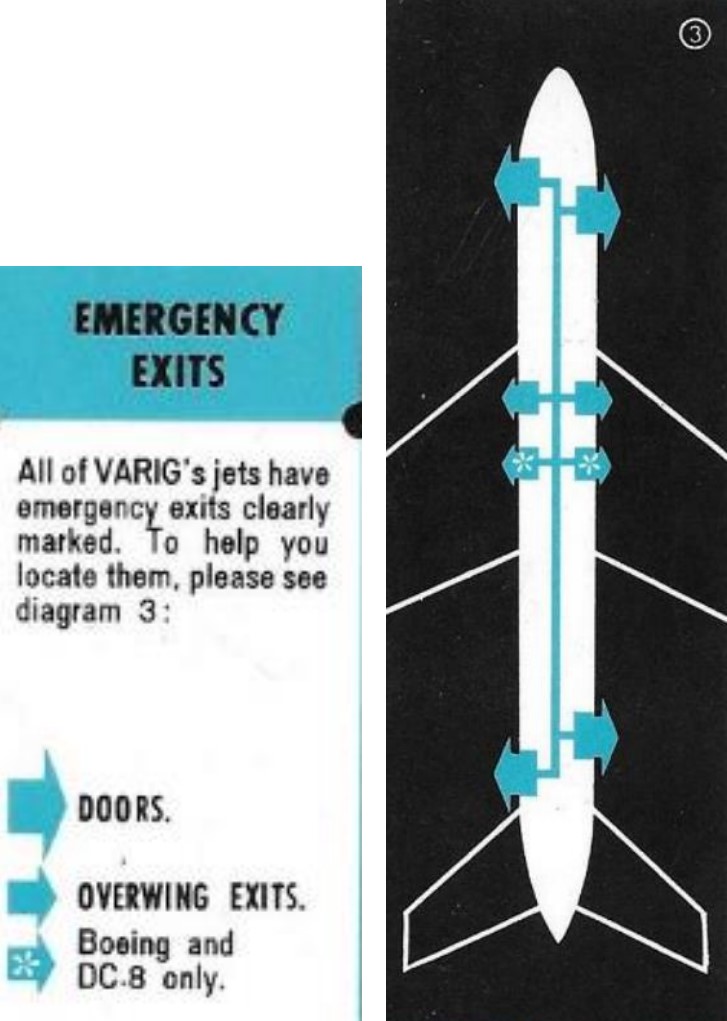
VARIG, c. 1965

Survivability issues

As the decade unfolded, jets became involved in accidents, some of which raised survivability issues. These triggered a host of cabin safety improvements later in the decade, including that safety cards were mandated by law. More about that in the next part.


August 2022
Email: f.schaefers@planet.nl

Continue Reading No Comments

AeroMech,AirLA,Allegheny Commuter,Atlantic Southeast,Bandierante,EMB-110,Embraer,PBA

THE EMBRAER EMB-110 BANDEIRANTE

By Robert G. Waldvogel
The Embraer EMB-110 is the story of a turboprop regional airliner, the aircraft manufacturer that was established to build it, and the foundation of the Brazilian aviation industry. Two people were instrumental during these developments: Ozires Silva and Max Holste. Previously, Embraer built various models of Piper aircraft under license and continued well into the 1970s.

The former, who served in the Brazilian Air Force, earned an engineering degree from the Aeronautical Institute of Technology in Brazil, and a master’s degree from the California Institute of Technology in the US. He was promoted to the CTA’s Institute of Research and Development at the Aeronautical Technical Center in 1964 and became the catalyst for the country’s first commercial aircraft.

The former, who served in the Brazilian Air Force, earned an engineering degree from the Aeronautical Institute of Technology in Brazil, and a master’s degree from the California Institute of Technology in the US. He was promoted to the CTA’s Institute of Research and Development at the Aeronautical Technical Center in 1964 and became the catalyst for the country’s first commercial aircraft.

“The CTA’s market research showed that a vacancy existed in a market segment in what would later become known as “feeder lines,” according to Jeffrey L. Rodengen in The History of Embraer (Wright Stuff Enterprises, Inc., 2009, p. 36).  “The research also revealed that airlines served just 45 Brazilian communities by the 1960s compared with 360 a decade ago.”

What was needed was a simple, rugged, reliable, low-capacity airplane that could operate from small-community, unprepared airfields that generated low-traffic demand, yet be profitable on short sectors characterized by comparatively high ratios of climb and descent to inflight cruise profiles.

The result was the IPD-6504, a low, straight-wing, twin-turboprop, conventional tail, retractable undercarriage design capable of carrying a dozen passengers.

Although its assembly began in 1966, conditions were hardly ideal: funding was rechanneled from other projects to breathe financial life into the transport, and only a single computer existed at the CTA’s campus three miles away. In order to avoid interference with student use, it was usually used throughout the night. The IPD-6504 designation also sounded too industrial.

To provide it with a better-sounding name, CTA Director Colonel Paulo Victor da Silva re-designated it “Bandeirante”—or “Pioneer”—to reflect the country’s 17th-century settlers who colonized the western portion of Brazil.  As what would later prove to be the first of Brazil’s turboprop and pure-jet airliner designs, it served in a pioneering role of its own.

Taking to the sky for the first time two years later on October 22, 1968, it rose into the air after a short acceleration run, at which time the numerous witnesses of the historic event raised their arms in unison “to commemorate a moment that was ours alone,” Ozires Silva later commented.

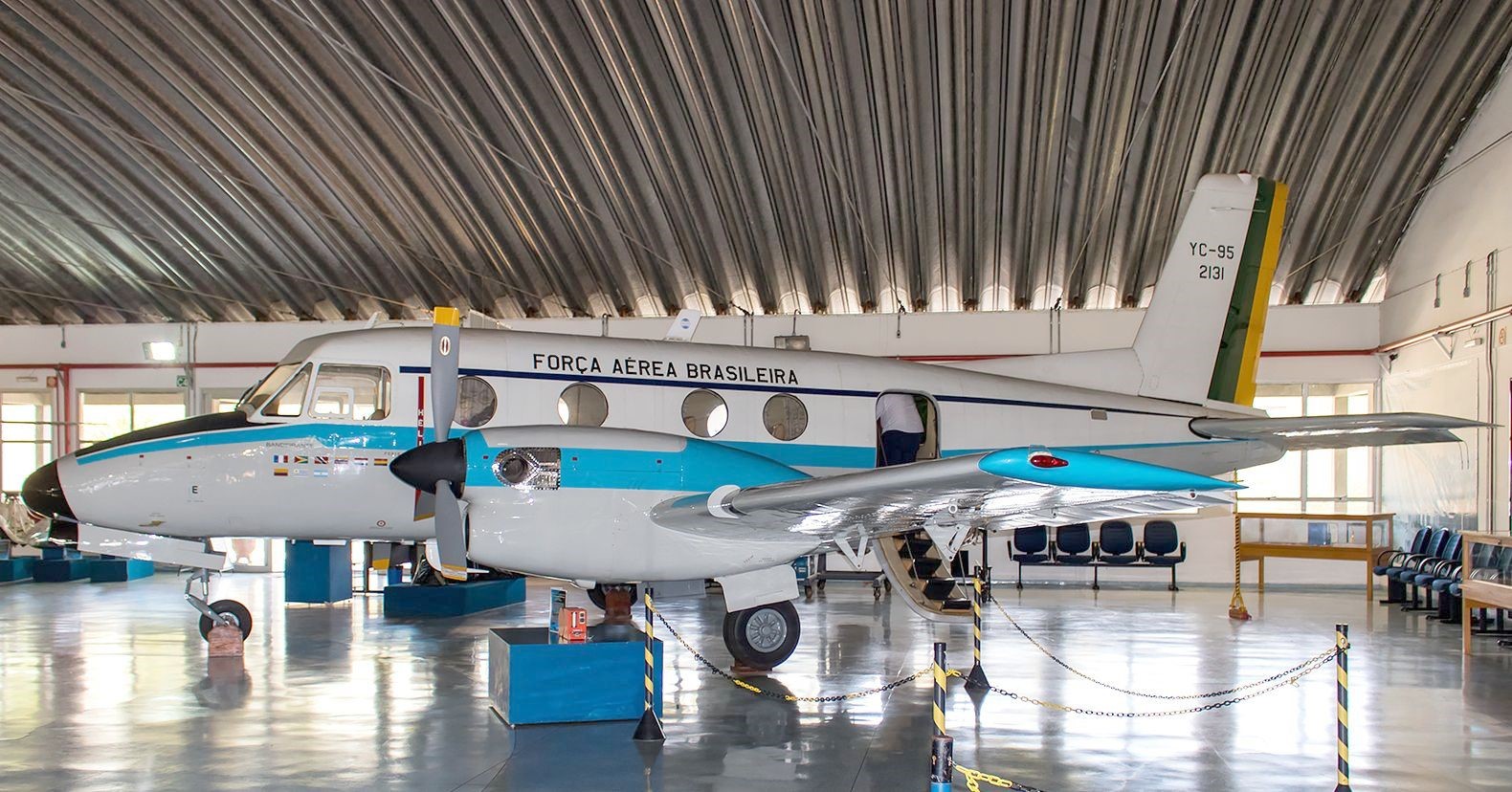
Two other prototypes respectively first flew on October 19, 1969, and June 26, 1970.  All three were Pratt and Whitney PT6A-20-powered and featured circular passenger windows and partially exposed main undercarriage wheels in the retracted position. They were alternatively designated  YC-95s for military use.

Integral to it was the aircraft manufacturer that was established to produce it, Empresa Brasileira de Aeronautica, or Embraer, which was approved by Brazilian Congress decree 770 on August 19, 1969, creating the country’s first state-owned concern, located in São José dos Campos.

“Since the beginning, the successful Bandeirante prototype served to inspire Brazil’s aviation ambitions,” according to Rodengen (ibid, p. 39).

While Max Holste left the project two months before Embraer’s approval was granted, the aircraft’s development continued to be led by his deputy.

Aside from Brazilian Air force C-95 orders, the Chilean Navy also operated three aircraft.

Reflecting its new manufacturer, the re-designated EMB-110, in production form, introduced several improvements, including 680-shp PT6A-27 turboprops that drove constant-speed, reversible-pitch propellers, a slightly longer fuselage with square passenger windows, a more aerodynamic windscreen, redesigned wings with integral fuel tanks, fries-type ailerons, double-slotted trailing edge flaps and modified engine nacelles in which the retracted main wheels were now fully enclosed.

Its single-wheel tires were developed by Goodyear’s Brazilian division and its cockpit was equipped with a Rockwell Collins Automatic Direction Finder (ADF) and a Very High Frequency Omni-Directional Range (VOR).  It first flew on August 9, 1973.

Powered by PT6A-27 turboprops, the commercial EMB-110C featured a 46-foot, 8.25-inch overall length; a 15-passenger capacity, an aft left downward-hinged air-stair, a 50.3-foot wingspan with a corresponding 312-square-foot area and a 12,345-pound gross weight. Range depended upon ratios of payload to fuel, increasing from 153 miles with the former to 1,379 miles with the latter. Speed was 262 mph at 15,000 feet.

Transbrasil, the launch customer, ordered six aircraft and VASP followed suit with an order for five in 1973.

Rio Sul, another Brazilian commuter carrier, proved instrumental in demonstrating the aircraft’s design merits to potential customers. Whenever airline representatives visited Embraer’s São José dos Campos facility, they would be flown to the airline’s headquarters so that they could observe its reliable operation firsthand.

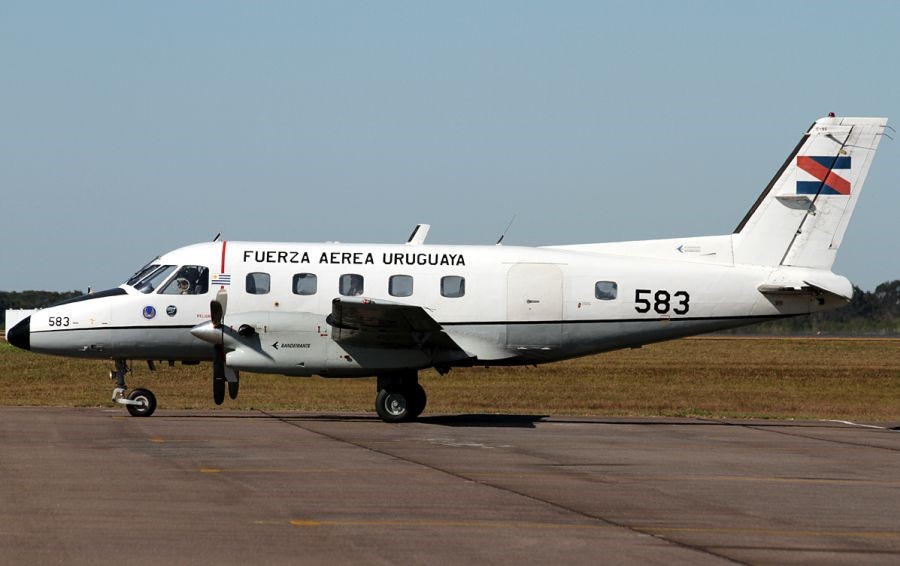
The Uruguayan Air Force became the EMB-110C’s first export customer when it purchased five in 1975. (See illustration below).

Rectifying its principal deficiency, the EMB-110P1 introduced an 18-passenger interior, configured with six three-breast, one-two-arranged seats with an offset aisle, and 750-shp PT6A-34 engines optimizing it for commuter or third-level airline operations. Belem, Brazil-based TABA (Transportes Aereas de Bacia Amazonica) became its launch customer.

Several variants of the baseline version were produced. The EMB-110A, of which two were operated by the Brazilian Air Force, incorporated navaid calibration instrumentation. The EMB-110B was an aerial photography platform. The EMB-110E was an executive version, seating seven in a luxurious interior. The EMB-110F was a pure freighter and the EMB-110K facilitated bulky and outsize shipment loading through a large cargo door. The EMB-110S was a geophysical survey variant.

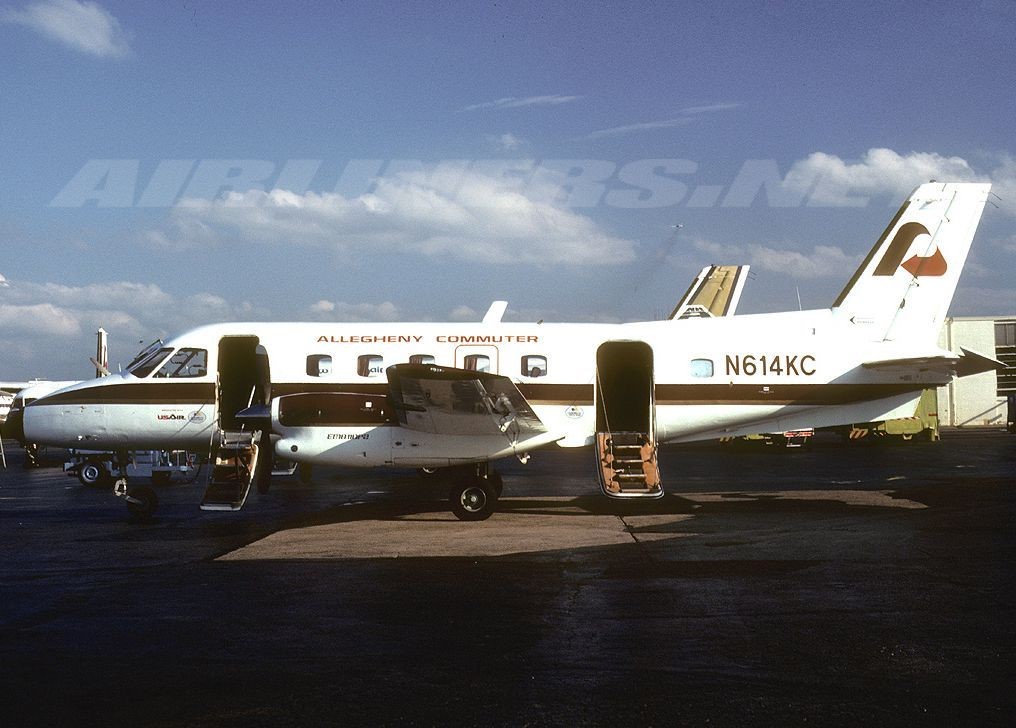
The EMB-110P2 was basically the same as the P1 with the exception that the large aft cargo door was replaced with a second airstair entrance door. Featuring the 49-foot, 6.5-inch length of the EMB-110P1, accommodation for 18-19 passengers in seven three-abreast rows, and 750-shp PT6A-34 engines, Both P1 and P2 versions were offered with a 12,500-pound gross weight or 5900KG  (13,007 pound) gross weight. and first flew on May 3, 1977.

Sales often depended upon country of operation certification.

“Many of Embraer’s foreign markets already had domestic aviation manufacturers, often established decades earlier,” according to Rodengen (ibid, p. 70). “While the Embraer brand was becoming better known throughout the world, manufacturers based in the United Kingdom, France, Germany, and the United States already dominated their individual domestic markets.”

Because the Brazilian regional type had initially been influenced by French national Max Holste, it found its way “home,” to a degree, when it was awarded the French Direction Generale de l’AviationCivile (DGAC) certification, paving the way for its first European operation when local commuter carrier Air Littoral ordered two stretched EMB-110P2s on May 5, 1977.  Air Ecosse followed suit.

Other European certifications led to orders by Air Wales, BritAir, and Kar-Air, and Air Masling operated the type down-under when the Australian Department of Transportation granted its own type approval.

Gateway to the US market and FAA certification was Robert “Bob” Terry, who founded Mountain West Airlines, ordered three EMB-110P1s, and established the type’s sales agent, Aero Industries. Wyoming Airlines also ordered the Brazilian regional aircraft.

On the east coast, Connecticut-based NewAir, which was originally known as New Haven Airways, linked the state with the major New York airports, billing itself as “Connecticut’s Airline Connection,” as well as serving Islip’s Long Island MacArthur Airport, Philadelphia, and Washington-National. Some 20-weekday roundtrips, requiring 30 minutes for the aerial hop over Long Island Sound with its 18-passenger EMB-110s, connected New Haven and New London/Groton with the Metropolitan New York area.

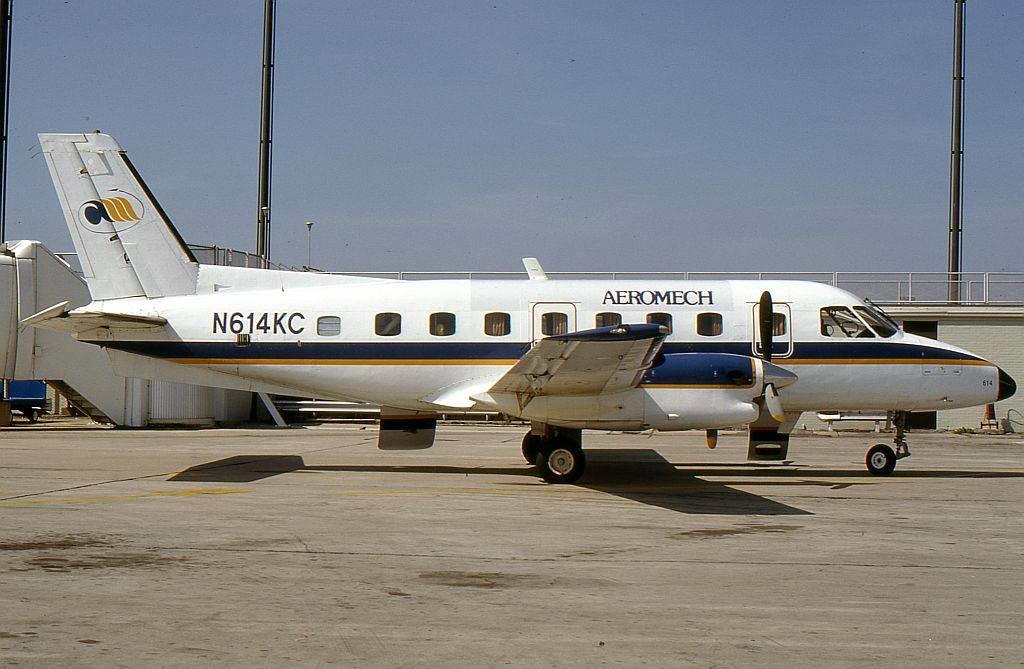
Dolphin Airways, later Dolphin Airlines, was a significant operator based in Tampa, FL. It served cities in Florida plus Savanna, GA, Charleston, SC, and New Orleans, LA from 1982-1984 as a businessman’s airline.  In addition to a fleet of new EMB-110P1s delivered from the factory, short-term leases included a P2 (N614KC) and an older P1 (N101RA). 

PBA Provincetown Boston Airlines operated EMB-110P1s throughout Florida as a direct competitor to Dolphin Airlines and absorbed much of the Dolphin fleet after the latter ceased operations in January 1984. Seasonally, PBA fed PEOPLExpress and later Continental Airlines flights at Newark International Airport with its Bandeirantes, linking Farmingdale’s Republic Airport with five daily roundtrips.

Atlantic Southeast Airlines and Aeromech were other significant east coast operators as well as American Central Airlines and Tennessee Airways covered the Midwest United States.

On the west coast, Imperial Airlines provided its own EMB-110 shuttle between Los Angeles and San Diego. United Express and Dash Air were other significant operators in the Western States.

United States airlines ultimately operated 130 Bandeirantes—or more than a quarter—of the 501 aircraft of all versions produced between 1968 and 1990.

The EMB-110 competed in the regional airliner market with the Swearingen Metroliner and Beechcraft 1900 series but, suffered from a shorter range, slower speed, lack of pressurization, and a higher fuel consumption. Its acquisition price was lower because of the lower cost of manufacturing products in Brazil. All of the competing 18-passenger commuter types could comfortably accommodate those passengers while the double seats in the Bandeirante were quite cramped for adults. Most operators later reduced the seating to a total of 15 individual seats. Its commuter versions, particularly, demonstrated low-maintenance requirements, reliable service, passenger and cargo configuration flexibility, and enabled its operators to serve low-demand routes from unprepared fields previously never having received scheduled service and it often became the first type in a fledgling carrier’s fleet, enabling it to expand.

Many EMB-110 Bandeirante operators replaced their fleets with EMB-120 Brasilias and later went on to operate EMB-135/145 regional jet airliners.

“The existence of the Bandeirante led to the creation of smaller regional air travel services in Brazil and around the world, a global market that Embraer has come to dominate, thanks in part to the specialized, flexible, resilient Bandeirante,” Rodengen concludes (ibid, p. 43).

Brazilian Air Force Embraer YC-95 Bandeirante, FAB2131.
Preserved in São José dos Campos, Brazil
Photo Courtesy: Raphael Albrecht
.
Uruguayan Air Force Embraer C-95 (110C)
Florianópolis Hercílio Luz International Airport (FLN) on July 7, 2016.
Photo courtesy of Bruno Orifino
Note: the short fuselage and rear passenger entry door on this early Bandeirante model.
Allegheny Commuter, operated by Aeromech Commuter Airlines
Embraer EMB-110 P2, N614KC
Washington National Airport (DCA)
The P2 version had dual airstair doors instead of the large rear cargo door.
Photo Courtesy of Jay Selman via Airliners.net
Aeromech Commuter Airlines EMB-110 P2, N614KC
Pictured at Cincinnati (CVG) in May 1982
Photo Courtesy: Charlie Pyles/Air Pix
Note: The rear airstair is lowered.
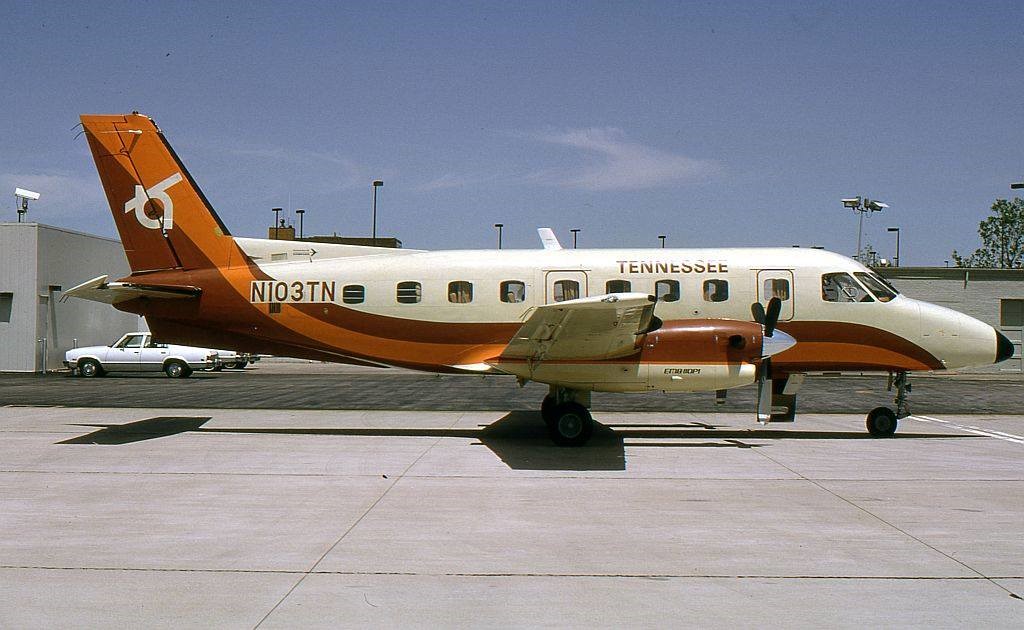
Tennessee Airways EMB-110 P1, N103TN
Pictured at Cincinnati (CVG) May 1983.
Photo Courtesy: Charlie Pyles/Air Pix
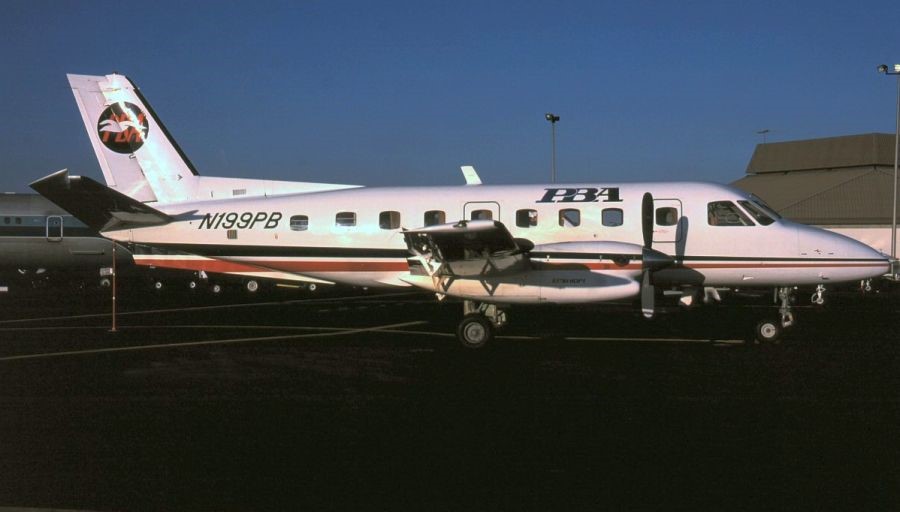
Provincetown Boston Airlines PBA
Embraer EMB-110 P1, N199PB seen at rest between flights.
Photo Courtesy of Ellis Chernoff

Note: the modified horizontal stabilizer came about as a result of a mysterious in-flight loss of a PBA Bandeirante with the standard tail plane becoming detached from the aircraft in flight.
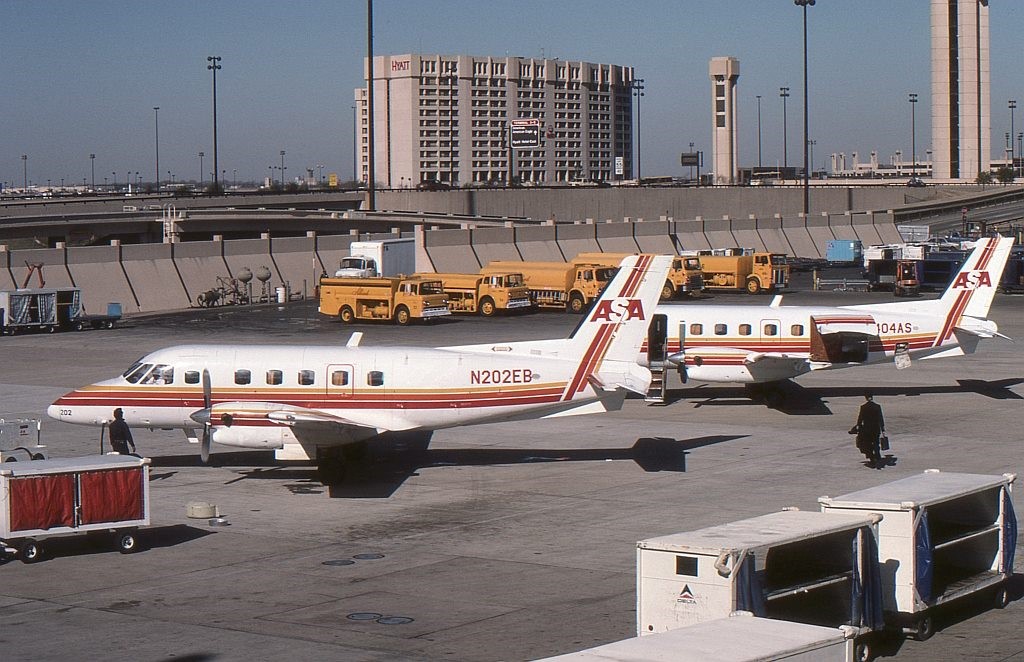
Atlantic Southeast EMB-110 P1s, N220EB and N404AS
As seen at Dallas/Ft. Worth (DFW) in 1987.
Photographer Unknown
Gary C. Orlando Slide Collection
Note: the standard Large Cargo Door found on the more widely produced P1 model.
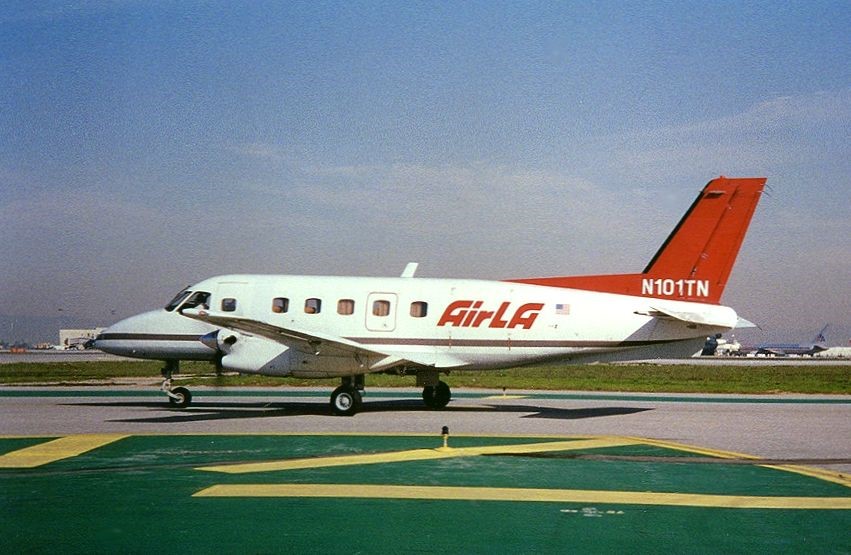
Air LA Embraer EMB-110 P1, N101TN
Seen taxiing out from the Imperial Terminal at Los Angeles (LAX) in February 1993.
Gary C. Orlando Photo.
Originally delivered to Tennessee Airways, it passed to Iowa Airways where it flew as a Midway Connection carrier as evidenced by the livery.

EMB-110 Article Sources

Green, William, and Swanborough, Gordon. An Illustrated Guide to the World’s Airliners. New York: Arco Publishing, Inc., 1982.

Hardy, Michael. World Civil Aircraft Since 1945. New York: Charles Scribner’s Sons, 1979.

Rodengen, Jeffrey L. The History of Embraer. Ft. Lauderdale, Florida: Write Stuff Enterprises, Inc., 2009.

Waldvogel, Robert G. “The Airline History of Long Island’s Republic Airport.” Metropolitan Airport News. October 2021.

Waldvogel, Robert G. “The Commuter Airlines of Long Island MacArthur Airport.” EzineArticles. August 5, 2019.

Continue Reading 2 Comments

Delft,Houses,KLM Royal Dutch Airlines

Miniature Delft-Style Collectibles of KLM Royal Dutch Airlines

By Pat and Keith Armes

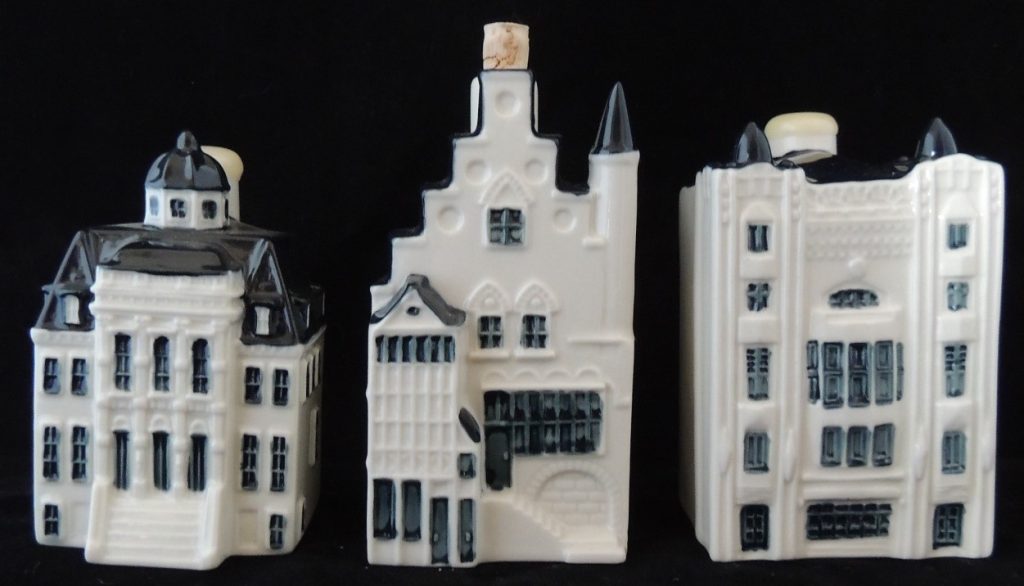
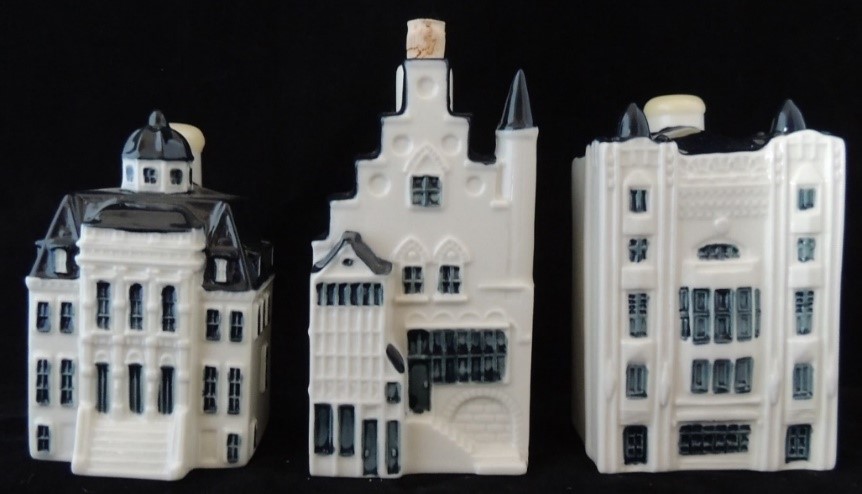
Three Delft blue-style KLM houses
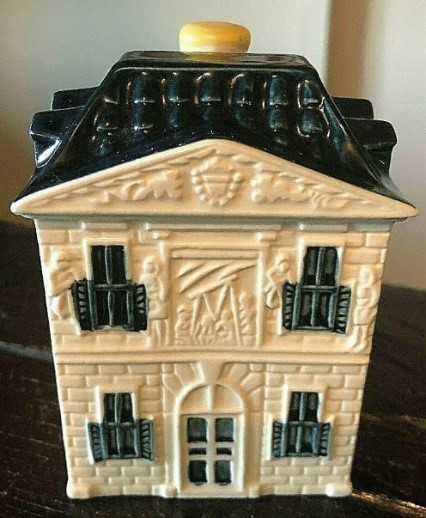
(Fig. 1) L-R: Houses 100-102)

Have you noticed the many Delft-style miniature ceramic Dutch canal houses produced for KLM Royal Dutch Airlines? They have become quite an airline collectible since their introduction in 1952. There are now 102 different houses that have been produced and distributed to KLM passengers.  In addition, KLM has added limited and special edition Dutch buildings, tile “coasters,’ and ashtrays to this unique area of airline collectibles.

HISTORY

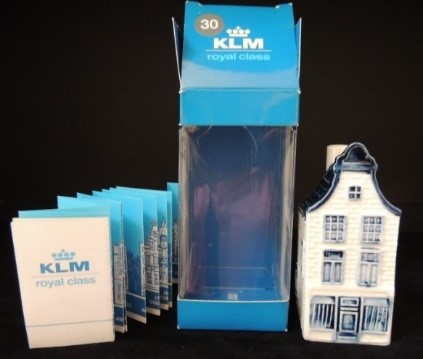
Beginning in 1952, passengers traveling in “KLM Royal Class” (as first class was known at the time) on intercontinental flights were given one of these miniature KLM Delft Blue houses as a “gift” at the end of their flight. In order to be compliant with international rules and restrictions for gifts to passengers, KLM was quick to ensure the “gift” was a “last drink on the house” and cleverly served in a miniature Delft replica canal house. They were individually packaged in a blue box labeled KLM Royal Class, with the house number on top, and included a leaflet picturing previously-issued miniatures. (Fig. 2). The houses varied in size from about 3 to 4 inches tall to 1 ½ to 2 inches wide.  Depth varied slightly, most being around 2 inches.  Over the years the houses were filled with alcohol (Dutch genever/gin) produced in the Dutch distilleries of Rynbende, Henkes, and, since the 1980s, Bols. Today a miniature KLM Delft Blue house is given to all passengers with a business class ticket.

(Fig. 2)

Production and distribution of the miniature houses was sporadic between 1952 and 1994, with many houses produced at one time, and then none for several years. Through 1993, KLM had produced 60 miniature houses. The year 1994 was significant, as it was the 75th anniversary of KLM Royal Dutch Airlines. In honor of this milestone, an extra 15 houses (numbers 61-75) were produced to match the age of the airline. Annually since 1994, a new house is introduced on October 7th, KLM’s anniversary. The first production model is presented to the owner of the house the miniature is modeled after. The most recent house produced was #102, which began distribution on October 7, 2021.  It is modeled after the Tuschinski Theatre building in Amsterdam.

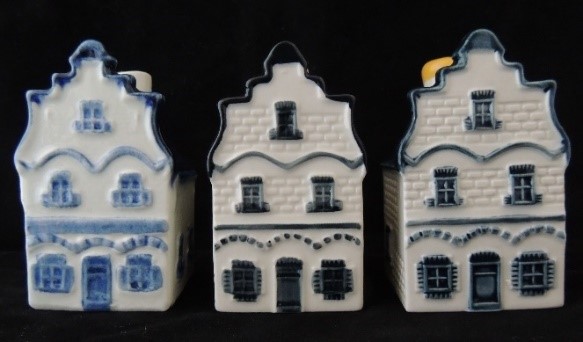
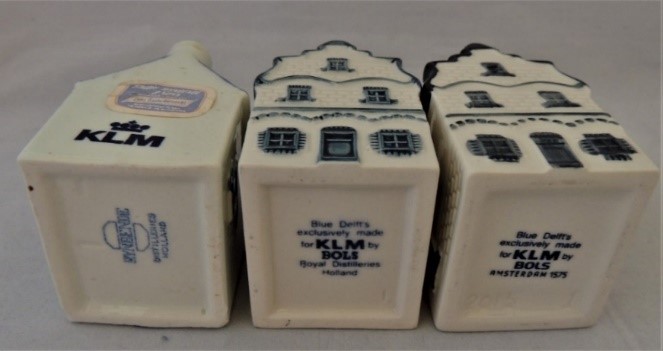
The houses were originally produced by Royal Goedewaagen in Gouda, the Netherlands. Even though not manufactured in Delft, they are made in the traditional Delft manner (tin-glazed porcelain, with blue printing and highlights).  KLM ended its contract with Royal Goedewaagen in 1995. Houses #75 and higher, as well as any additional production runs of the earlier numbered houses (reproductions), have been made in Taiwan. The houses are still in production today, so you may find some that have a low number, but are actually from a more recent production year. Beware if your plan is to complete your collection with “original” houses. In order to verify its authenticity, you should carefully examine any house you are considering for purchase. The reproduction houses were made from different molds and will normally have a slightly different “look,” with sharper features and different markings (Fig. 3).

(Fig. 3 additional description) The original house #1 (left) is marked on the base with an impressed “1”, stamped with “Rynbende Distilleries Holland,” and on the back there is a “KLM” stamp and a “Simon Rynbende & Sons” blue & white label. The second house is a reproduction of house #1 (center) which is marked on the base with an impressed “2015” and a “1″ stamped with “Blue Delft’s exclusively made for KLM by BOLS AMSTERDAM 1575” and the back has a “1” “BOLS AMSTERDAM 1575” and “KLM” stamped on it. The third house #1 (Right) is also a reproduction with a “1” impressed on the base along with a “Blue Delft’s exclusively made for KLM by BOLS Royal Distilleries Holland” stamp and “1”, “BOLS” and “KLM” stamped on the back.

HOUSE SELECTION

KLM has a team of real estate professionals and historians that make the recommendation for the next KLM Delft Blue house to be produced each year. The current manufacturing contract is with Bols (Royal Distilleries Holland). According to their requirements, the house must have “Dutch” character and be interesting architecturally and/or historically. It should also be linked to a special historical or cultural event, if possible. Many of the model houses selected are currently privately owned. They are also many that are designated as “local” or “national” monuments.

Most of the houses KLM has used as models have been identified by address and city. The exceptions include numbers 1, 3, 4, 5 & 7.  Identification and location of these houses continues to baffle city and architectural historians. It is speculated they may be the result of an artist adding features from many different houses to create a Dutch “fantasy” house.

LIMITED AND SPECIAL EDITION HOUSES

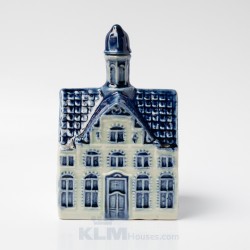
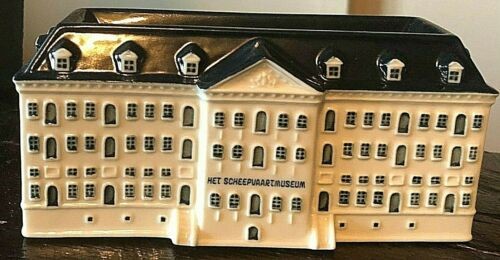
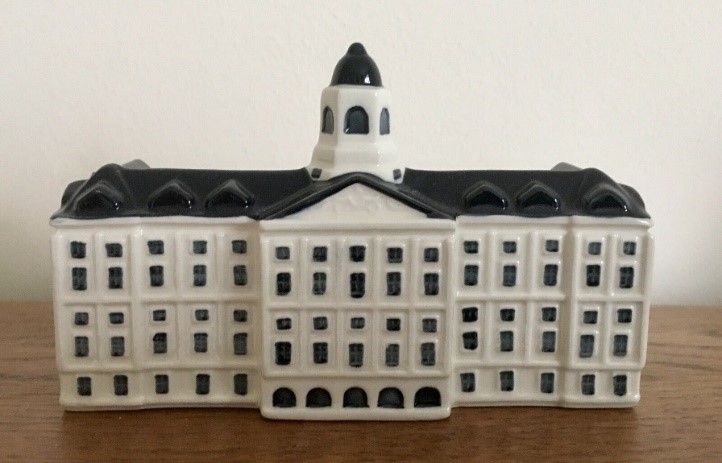
In addition to the canal houses, there are several well-known “Limited and Special Edition” buildings commissioned by KLM and produced by Bols in the same Delft style.  They were never given away on KLM flights, are not numbered, are larger than the miniature canal houses, and usually more valuable.  Shown below (Fig. 4-7) are the Frans Hals Museum (Groot Heiligland 62, Haarlem), the “Scheepvaart Museum” (National Maritime Museum), “The Royal Palace” (Palace on Dam Square), and “Kaaswaag Gouda” (Cheese Weigh House, Gouda).  They also produced the Hotel Waldorf Astoria Amsterdam (House Marot – Herengracht 548), Hermitage Museum (Amstel 5 Amsterdam), Royal Theater Carré (Amstel 115-125, Amsterdam), Royal Palace Het Loo (Koninklijk Park 1, Apeldorn), The Royal Concertgebouw (Concerthall – Concertgebouwplein 10, Amsterdam) and Huisterkleef (oldest inner tennis courts– Kleverlaan 9, Haarlem) as well as others.

(Fig. 4) The Frans Hals Museum, Groot Heiligland 62, Harleem

(Fig. 5) The Scheepvaart Museum (National Maritime Museum – Kattenburgerplein 1)
(Fig. 6) The Palace on Dam Square – The Royal Palace – Nieuwezijds Voorburgwal 147
(Fig. 7) The Kaaswaag Gouda (The Cheese Weigh House – Markt 35, Gouda)

A larger version of the Palace on Dam Square (approximately 19.7” X 10.6” X 4.3”) is presented to the winner of the KLM Open Golf Tournament annually. Newlyweds flying KLM World Business Class on their honeymoon have, in the past, been gifted with a limited edition “The Palace on Dam Square” or the “Cheese Weigh house” in Gouda.

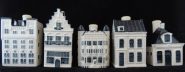
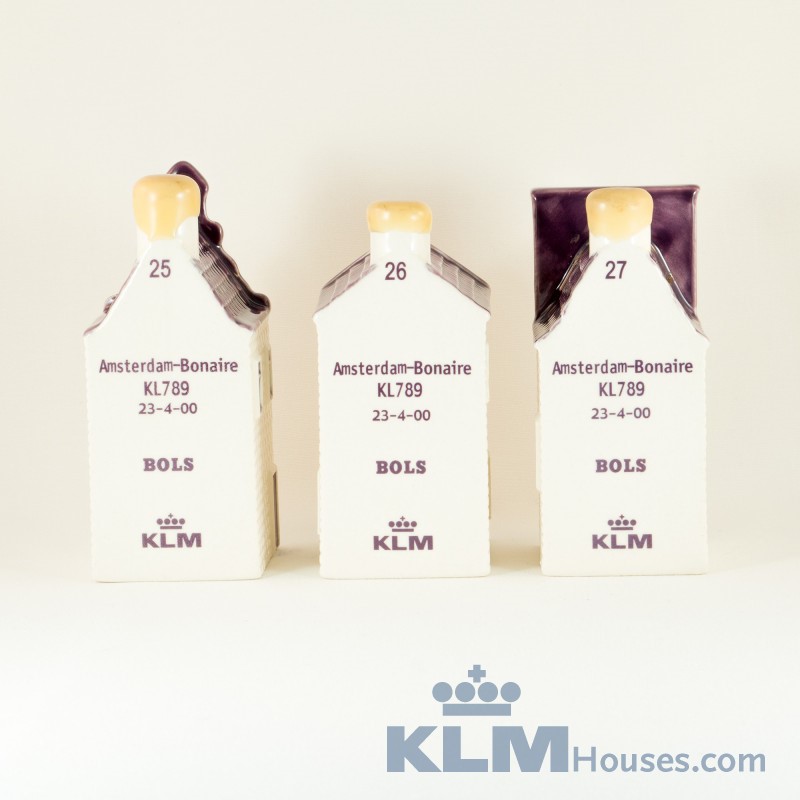
If you run across KLM houses #25, #26 or #27 that have purple-colored trim and lettering, you might want to add these elusive houses to your collection (Fig. 8).  They are a special set that was produced to commemorate KLM resuming flights to Bonaire, the Netherlands on April 23, 2000. They use the same design as the KLM houses, including the original numbers, and are appropriately called “Bonaire Houses.”

(Fig. 8) Bonaire purple lettered and highlighted houses

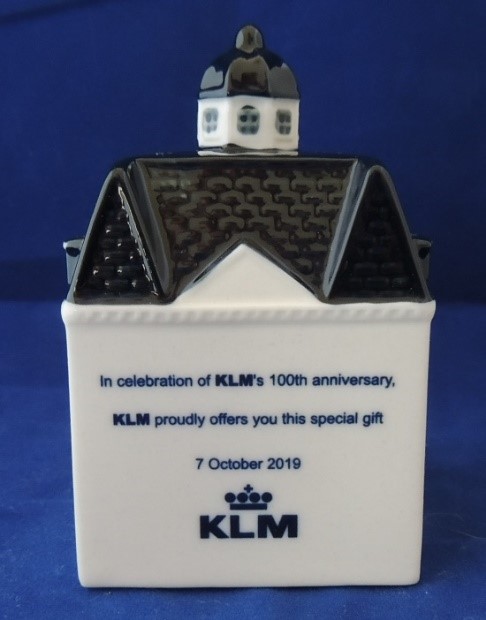
In 1999, the 100th anniversary of KLM, a 100th house was produced representing the Huis ten Bosch Palace (Fig. 1). A second version was also produced and given as a special gift to guests, business partners, and the employees of KLM.  This version was unique in that it did not have alcohol in it, and consequently did not need a chimney.  It also has a special dedication stamp on the back of the house (Fig. 9).

(Fig. 9)

IN ADDITION TO KLM HOUSES AND BUILDINGS

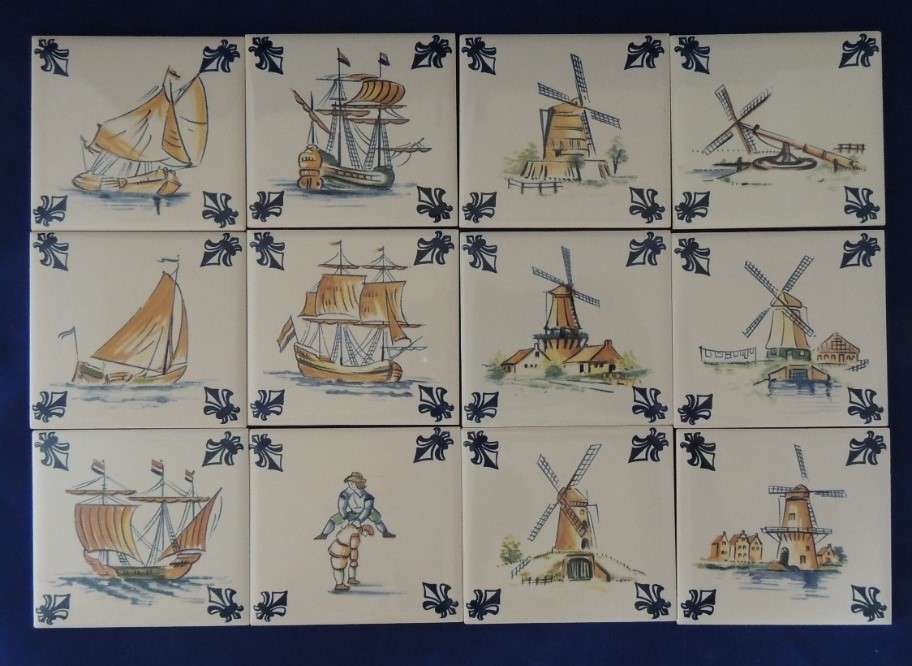
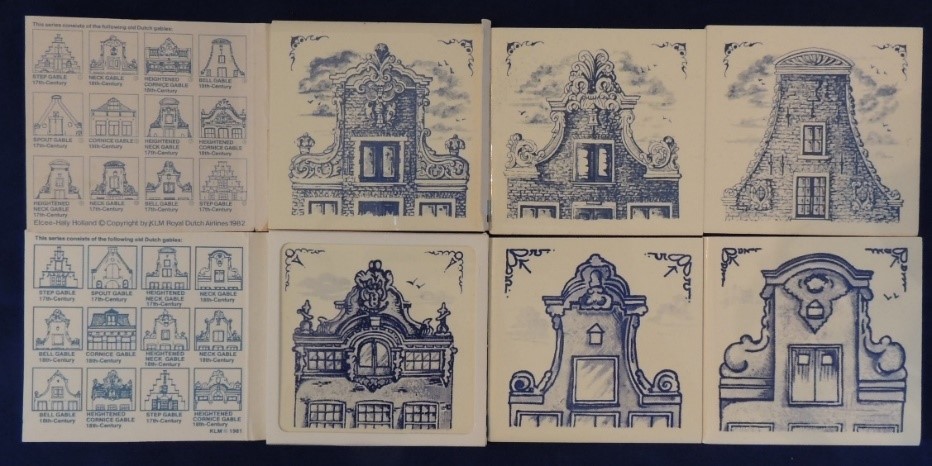
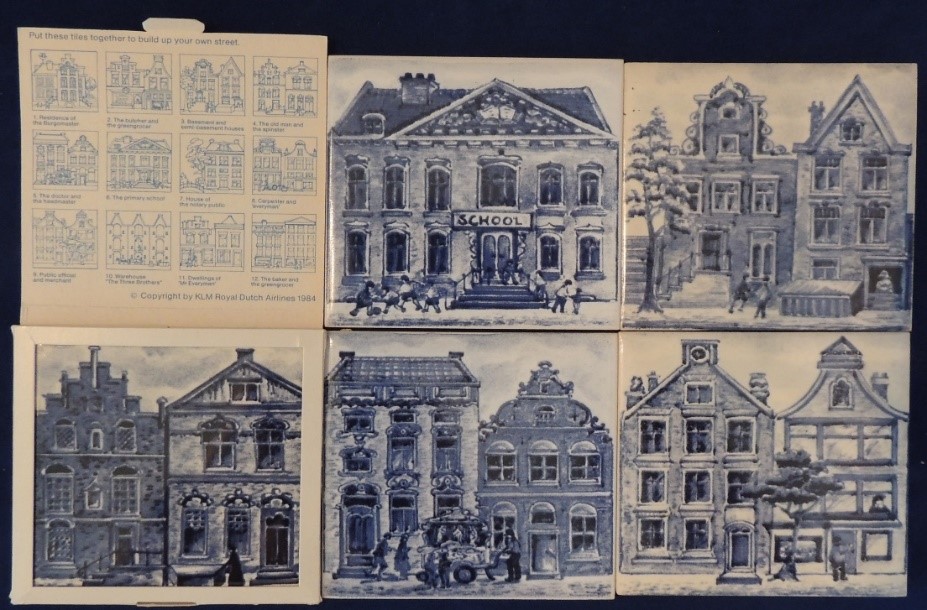
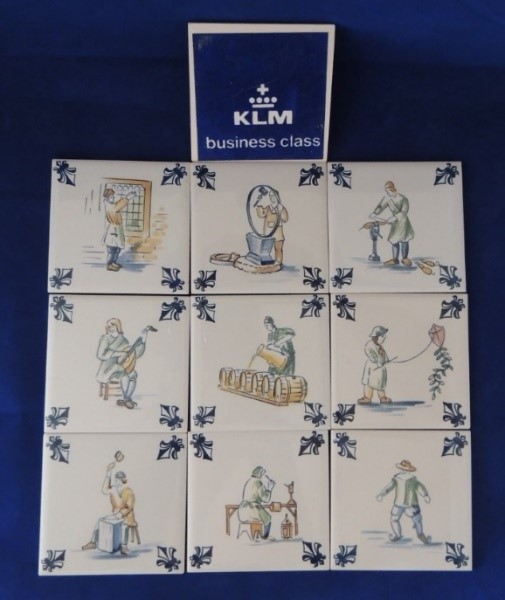
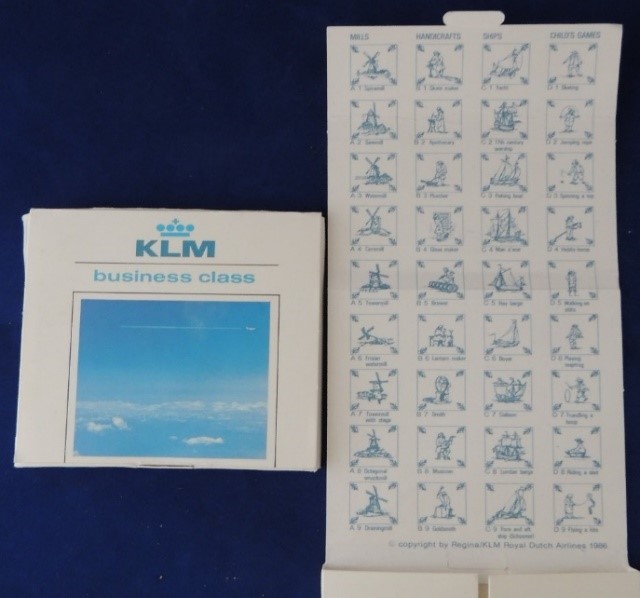
During the 1980s KLM also produced Dutch ceramic tile “coasters” with blue felt affixed to the back. These were given to business class passengers, while the Royal Class passengers received the miniature KLM canal houses. These tile coasters featured classic Dutch house gables (produced in 1981), row houses that could be placed together to form a street (produced in 1984), and Dutch windmills, crafts, children’s games and ships (produced in 1986).   When Royal Class was discontinued in 1994, KLM discontinued producing these tiles. World Business Class passengers were then given the KLM miniature houses.

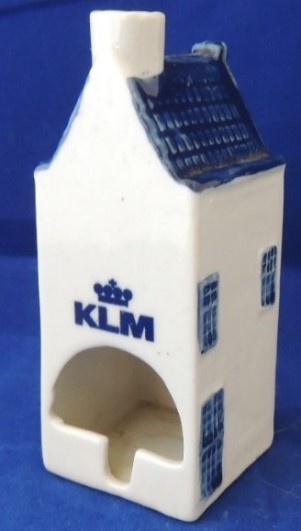
At one time KLM also produced ashtrays, in the form of miniature houses, for distribution in markets that did not allow alcohol to be served, such as the Middle East (Fig. 14).

(Fig. 14)
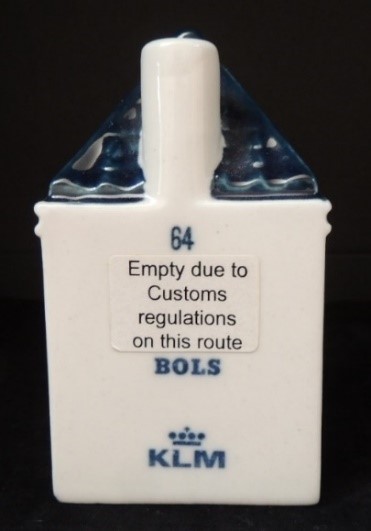
(Fig. 15)

Once smoking was banned on airlines, KLM began offering the same miniature houses with special notations on them: “empty due to customs regulations” (Fig. 15).  This is still the practice today for those destinations.

CANAL HOUSE MARKINGS

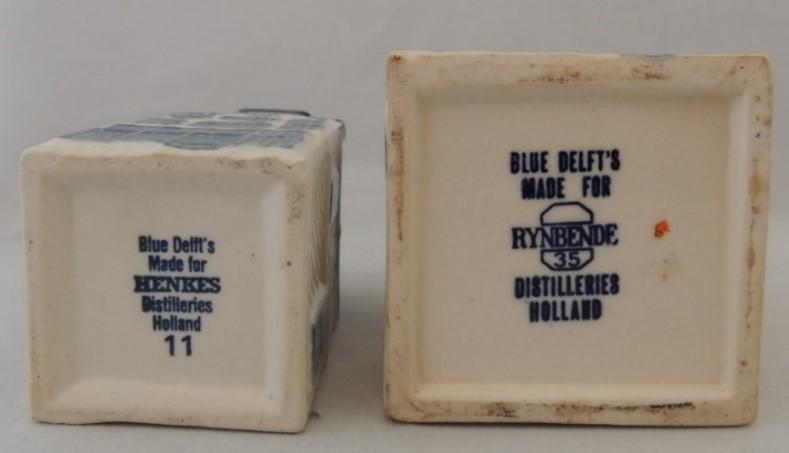
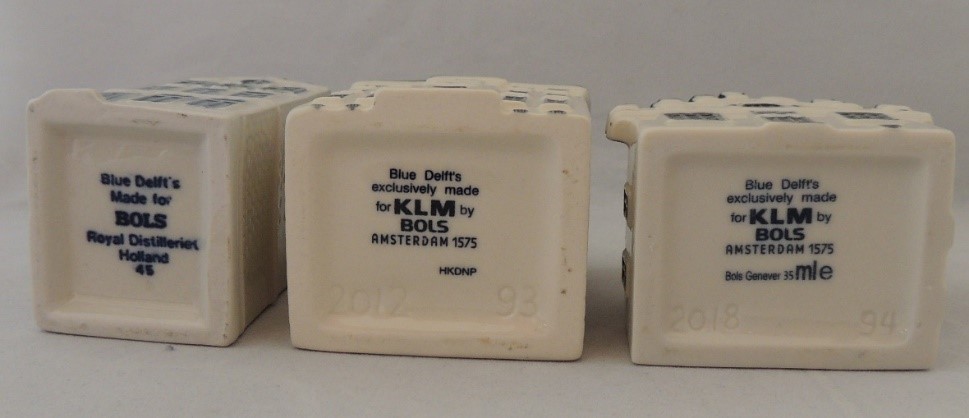
The KLM miniature canal houses produced through 2021 are House #1 through House #102. Photos of our collection are at the end of this article. While collecting, we noticed that the labels and markings on the KLM houses changed many times over the years. Our research indicates that Rynbende started the distillery in 1793, then in 1953 it was sold to Henkes and was then taken over by Bols in the 1980s. The earlier (original) houses have the Rynebende stamp, the house number impressed, and usually a “Simon Rynebende & Sons” paper label attached. The numbers are sometimes difficult to read and the labels may have been lost over time. In another version, the house number is printed on the base between the “Rynebende” and “Distilleries Holland” while others have “Blue Delft’s Made for HENKES Distilleries Holland” printed on the base (Fig. 16). At some point in the early years, the production year was added and impressed on the base of each house along with house number. This marking method was also used in later years on the reproductions (Fig. 17).

We have a House #1, in our collection, labeled as “made for KLM by BOLS” and a House #1 that has a “made for KLM by BOLS AMSTERDAM 1575” with the year 2015 on it (Fig. 3). Originally House #1 was distributed to passengers in 1952, but BOLS did not take over the distillery until the 1980s, so they are more than likely reproductions. In the center house on Fig. 17 you will notice that there is a marking “HKDNP” which is the abbreviation of “Hong Kong Duty Not Paid” so at some point it must have been in transit (from Taiwan) through Hong Kong.

MOST WELL-KNOWN MINIATURES

Most of the houses have an interesting history that directly relates to when they were built and events that were taking place at the time. Most of the canal houses have had multiple owners over the years with some being built as early as the 1600s. Over the hundreds of years they have existed, and with many owners, the canal houses’ appearance has often changed from the original construction. These include cornice modifications and architectural embellishments.  Many of the houses have been saved from destruction and restored back to their original look thanks to preservation foundations. One of those is the Vereniging Hendrick de Keyser (named after the famous Dutch architect of the same name) which purchases, preserves and restores houses with architectural and historical value in the Netherlands.

Below are some of the more well-known buildings used as KLM Miniatures

  • House #47 at Prinsengracht 263, Amsterdam, known as the Anne Frank House. It was built in 1635. This is the canal house in Amsterdam where Anne Frank and her family hid to avoid persecution by the Nazis during World War II. They lived in hiding there from July 6, 1942, until August 4, 1944. Anne recorded her story in a series of diaries which her father had published in 1947 after his return from the concentration camps. The house is currently operated as a museum and is owned by the Anne Frank Foundation. It attracts more than a million visitors each year.
  • House #48 at Josenbreesstraat 4, Amsterdam, known as the Rembrandt House. The house was built in 1606 on three vacant lots. Rembrandt van Rijn owned it from 1639 until 1656 when he went bankrupt. The house was purchased by the Amsterdam City Council in 1906 and currently operates as the Rembrandthuis Museum.
  • House #75 at Hofweg 9-11, The Hague, known as the KLM House. The building was built in 1915 as a luxury department store. It was designed by the famous modern Dutch architect, H.P. Berlage. The corner building at 9 Hofweg was occupied by an automobile sales company on the 1st floor. KLM occupied the upper floors as a ticketing office beginning May 1925. KLM continues to operate, in the Berlage building, offering many services including a KLM Travel Clinic. The sandstone relief structure on the front of the building is of Saint Martin handing half of his cloak to a beggar.
  • House #76 at Vlamingstraat 40-42, Delft, known as “The Little Street.” Johannes Vermeer is an important Dutch painter who lived from 1632-1675. His famous paintings include “View of the Houses in Delft,” which is better known as “The Little Street,” and “Girl with a Pearl Earring.” His attention to detail required long periods of time to complete paintings so there are only 36 known paintings by this artist. After an exhaustive search, it was determined the house depicted in the painting by Vermeer was of the Little House which is also the model for KLM House #76.
  • House #26 at Nieuwe Uitleg 16, The Hague, known as a secret hideaway for secret agent Mata Hari. Mata Hari was a Dutch exotic dancer born in 1876 who later became a spy for Germany, England, and later France. She lived in the house at Uitleg 16 in 1914 until she was executed in France for espionage on October 15, 1917.
  • House #95 at Stadhouderskade 78, Amsterdam, known as the Heineken Brew House. The original red brick building on Stadhouderskade was built in 1865 with a boiler building next door to house the steam engine. The new brewhouse was erected in 1913 with distinct lancet-shaped windows and colorful stained-glass panes. A second brewery was built on the property in 1958 and a laboratory was added in 1968 but the complex became too small due to the demand and production moved out of Amsterdam in 1987. The house has reopened as a visitors’ center for the “Heineken Experience.”
  • House #102 at Reguliersbreestraat 26-34, Amsterdam is the Tuschinski Theatre, which is one of the oldest original theatres in the world. It is a 1920s movie palace located in Rembrandtplein (Rembrandt Square) in City Center. This cinema was opened by Polish immigrant Icek Tuschinski on October 28, 1921, and has been restored to its original grandeur. It is on the list of Rijkmonuments (National Monuments) of the Netherlands.

OUR KLM HOUSE COLLECTION

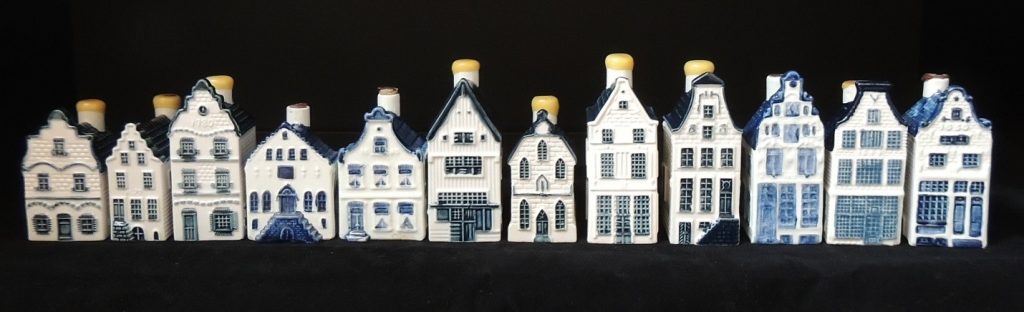
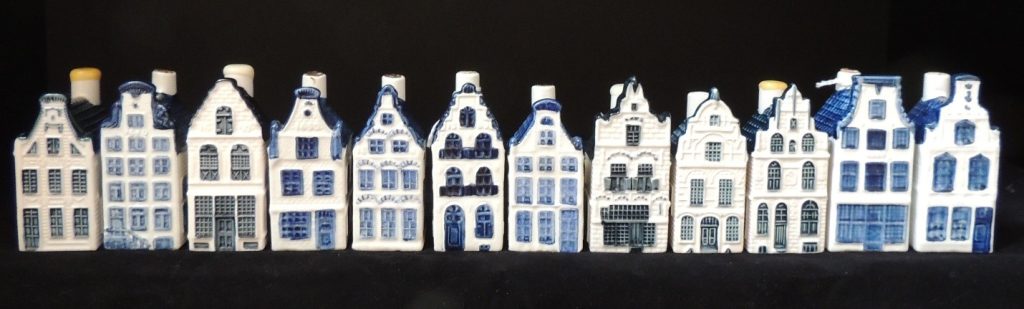
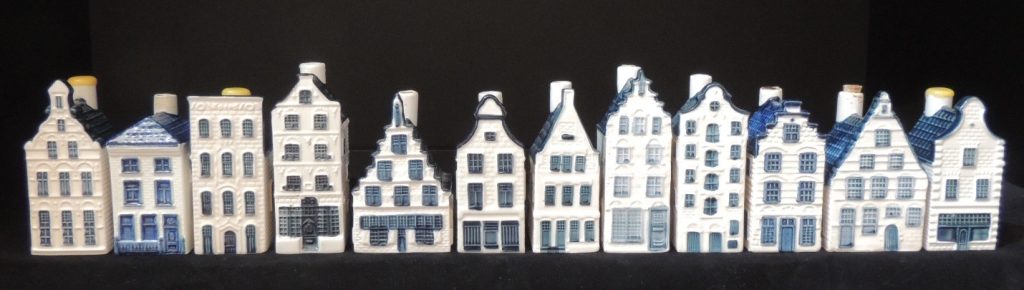
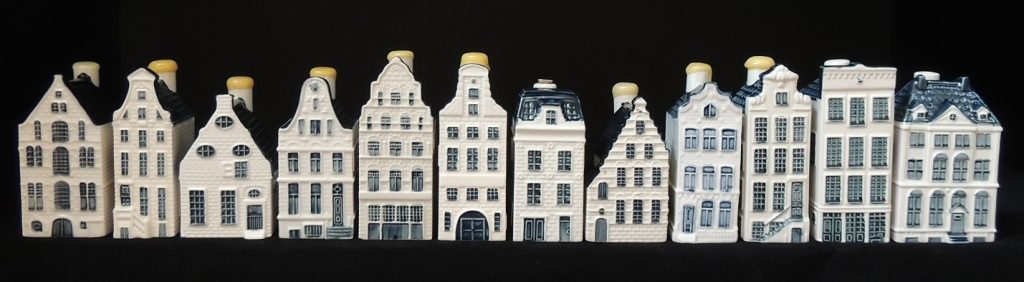
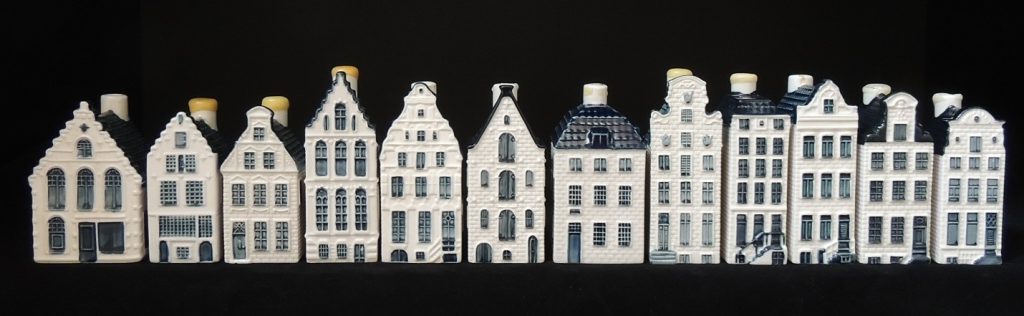
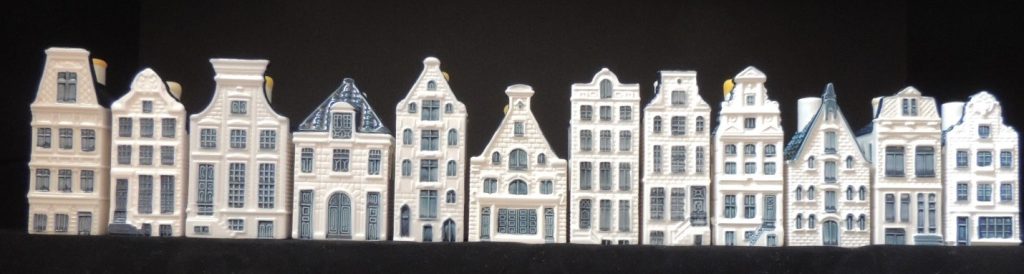
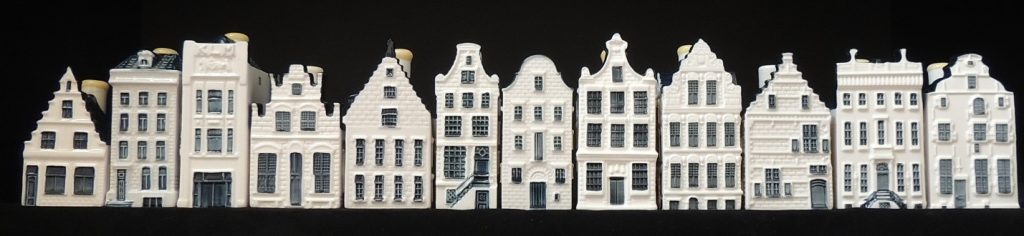
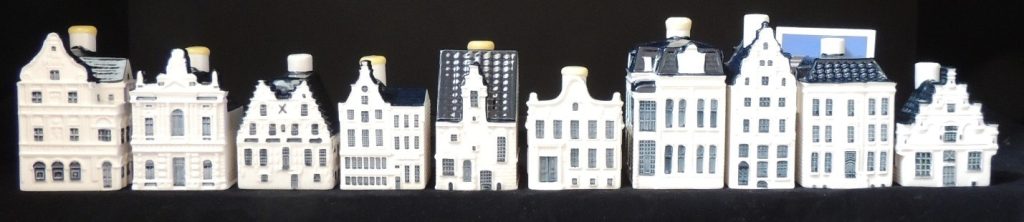
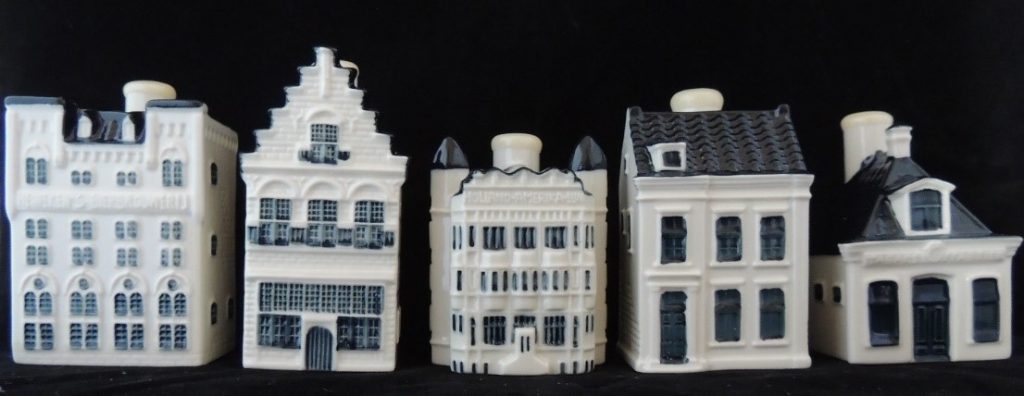
Below are images of our personal collection of KLM Houses (Fig. 18-27).

(Fig. 18) L-R: Houses 1-12
(Fig. 19) L-R: Houses 13-24
(Fig. 20) L-R: Houses 25-36
(Fig. 21) :-R: Houses 37-48
(Fig. 22) L-R: Houses 49-60
(Fig. 23) L-R: Houses 61-72
(Fig. 24) L-R: Houses 73-84
(Fig. 25) L-R: Houses 85-94
(Fig. 26) L-R: Houses 95-99
(Fig. 27) L-R: Houses 100-102

WHERE TO FIND KLM DELFT MINIATURES

There are several ways to obtain these KLM Delft Miniatures. The first, and most expensive, would be to purchase a business class ticket on a KLM international flight and receive one on board that day. Airline memorabilia shows are another good source, where vendors usually have a selection of these KLM miniatures for sale. Information on these shows can be found on this site with the next annual Airliners International show scheduled in Dallas, TX, in June 2023. Internet Auction Sites, such as Ebay and Etsy, have sellers that offer these miniatures at varying prices (be careful of bidding wars that may overinflate the value). There are also two websites that offer the entire collection so you can fill in missing houses and obtain new releases for your collection. These websites are www.klmhouses.com and www.klmdutchhouses.com. The shipping is expensive to the U.S. but the cost is the same for a single house or multiple houses, so buying in quantity can greatly reduce the shipping cost per house.

RESOURCES

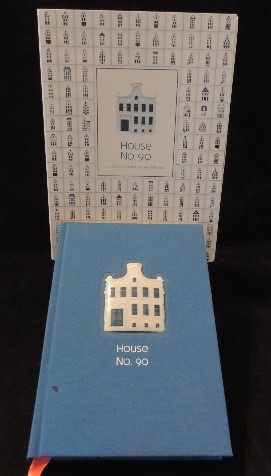
The book, House No. 90, written by Bonnie Parren and Limoen Producties in 2009 for KLM Royal Dutch Airlines, is a very interesting introductory reading related to the KLM miniature houses. As indicated by its title, the history only goes through house #90 and the descriptions of the actual model houses are very brief. This book comes in a nice box with a “relief” style plastic house #90 glued to the cover.

House No. 90

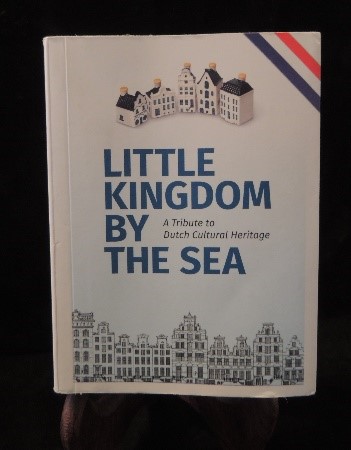
The second book used for research and highly recommended is Little Kingdom By the Sea: A Tribute to Dutch Cultural Heritage written by Mark Zegeling and published in 2019.  It has very detailed information about the history of each KLM model house, including the current status of most of them.  It also has helpful maps of Amsterdam and the Netherlands which show the location of the model houses still in existence. See Appendix 1 for house listing.

Little Kingdom By the Sea

COLLECTING THOUGHTS

Hopefully, this review of the KLM miniature houses and other specialty items will help you in finding and identifying these unique collectibles. Or, as this is just one small group of the thousands of gift and advertising items airlines have produced from their beginning (from commemorative plates and glasses to kiddie wings and beyond), it will whet your appetite in seeking those airline items that you find most desirable to collect. After all, it’s finding that one special new or historical airline item that makes collecting so much fun!

Happy Collecting,

Pat and Keith Armes


APPENDIX 1

Below is a listing of the KLM Houses, with numbering sequence and the Address and City of the modeled house as referenced in the book Little Kingdom by the Sea.

HOUSE#ADDRESSCITY
#1UNIDENTIFIED HOUSE
#2SPUISTRAAT 294AMSTERDAM
#3UNIDENTIFIED HOUSE
#4UNIDENTIFIED HOUSE
#5UNIDENTIFIED HOUSE
#6ACHTER HET HOFPLEINMIDDELBURG
#7UNIDENTIFIED HOUSE
#8OUDEZIJDS VOORBURGWAL (OLD RAMPART) 18A/BAMSTERDAM
#9LEIDSEGRACHT 10AMSTERDAM
#10OUDEZIJDS VOORBURGWAL 57AMSTERDAM
#11PIJLSTEEG 31 (Same as house #23)AMSTERDAM
#12ZANDHOEK 4AMSTERDAM
#13KAMP 10AMERSFOORT
#14HERENGRACHT 510AMSTERDAM
#15VOORSTRAAT 282DORDRECHT
#16HOUTMARKT 17HAARLEM
#17SPIERINGSTRAAT 1-3  (Same as house #25)GOUDA
#18OUDEGRACHT 111UTRECHT
#19RAPENBURG 31LEIDEN
#20DAMPLEIN 8EDAM
#21MARKT 47DELFT
#22KAAI 25VEERE
#23PIJLSTEEG 31 (Same as house #11)AMSTERDAM
#24MIENT 31ALKMAAR
#25SPIERINGSTRAAT 1-3 (Same as house #17)GOUDA
#26NIEUWE UITLEG 16THE HAGUE
#27NIEUWEHAVEN 59 – DESTROYED BY FIRE 1940ROTTERDAM
#28GROOTE MARKT 2A – DESTROYED BY FIRE 1940ROTTERDAM
#29KORT GALGEWATER 21LEIDEN
#30HIPPOLYTUSBUURT 26DELFT
#31KOORNMARKT 87DELFT
#32KOORNMARKT 81DELFT
#33VOORHAVEN 12ROTTERDAM
#34WIJNHAVEN 16DELFT
#35OUDE DELFT 39DELFT
#36HIPPOLYTUSBUURT 8DELFT
#37OUDEZIJDS VOORBURGWAL 300AMSTERDAM
#38HERENGRACHT 607AMSTERDAM
#39NIEUWEWEG 12 HINDELOOPEN
#40KEIZERSGRACHT 104AMSTERDAM
#41SINT JACOBSSTRAAT 13LEEUWARDEN
#42PRINSENGRACHT 514AMSTERDAM
#43PRINSENGRACHT 516AMSTERDAM
#44HOOGLANDSE KERKGRACHT 19LEIDEN
#45KEIZERSGRACHT 140AMSTERDAM
#46BEGIJNHOF 27AMSTERDAM
#47PRINSENGRACHT 263AMSTERDAM
#48JODENBREESTRAAT 4AMSTERDAM
#49FR+B13IESESTRAAT 42COEVORDEN
#50ROZENGRACHT 106AMSTERDAM
#51VOORSTRAAT 49FRANEKER
#52HERENGRACHT 415AMSTERDAM
#53HERENGRACHT 203AMSTERDAM
#54PRINSENGRACHT 773AMSTERDAM
#55OUDE SLUIS 19SCHIEDAM
#56HERENGRACHT 64AMSTERDAM
#57HERENGRACHT 95AMSTERDAM
#58HERENGRACHT 101AMSTERDAM
#59HERENGRACHT 163AMSTERDAM
#60HERENGRACHT 314AMSTERDAM
#61KEIZERSGRACHT 439AMSTERDAM
#62PRINSENGRACHT 305AMSTERDAM
#63KEIZERSGRACHT 407AMSTERDAM
#64KEIZERSGRACHT 755AMSTERDAM
#65KEIZERSGRACHT 487AMSTERDAM
#66KEIZERSGRACHT 403AMSTERDAM
#67PRINSENGRACHT 721AMSTERDAM
#68PRINSENGRACHT 969AMSTERDAM
#69KEIZERSGRACHT 319AMSTERDAM
#70KONINGSSTRAAT 4ALKMAAR
#71SINGEL 81AMSTERDAM
#72SINGEL 87AMSTERDAM
#73DIJK 11ALKMAAR
#74REGULIERSGRACHT 7AMSTERDAM
#75HOFWEG 9-11THE HAGUE
#76VLAMINGSTRAAT 40-42DELFT
#77SCHOOLSTRAAT 2BREDA
#78LEIDSEGRACHT 51AMSTERDAM
#79LANGE HAVEN 74-76SCHIEDAM
#80GRAVENSTRAAT 18AMSTERDAM
#81WAAGPLEIN 1GRONINGEN
#82BONNEFANTENSTRAAT 5MAASTRICHT
#83KEIZERGRACHT 672AMSTERDAM
#84MUNTPROMENADE 7WEERT
#85HEERENSTRAAT 1CURACAO
#86SPAARNE 16HAARLEM
#87WIERDIJK 12ENKHUIZEN
#88ROZENGRACHT 99-101AMSTERDAM
#89MUURHUIZEN 109AMERSFOORT
#90AMSTELDIJK NOORD 55AMSTELVEEN
#91BADHUISWEG 175THE HAGUE
#92BRINK 55DEVENTER
#93RAPENBURG 19LEIDEN
#94KOGERSTRAAT 1DEN BURG/TEXEL
#95STADHOUDERSKADE 78AMSTERDAM
#96KORTENDIJK 67GORINCHEM
#97KONINGINNENHOOFD 1ROTTERDAM
#98KLEINE HOUTWEG 65HAARLEM
#9997 MIDSTRAATJOURE
#100‘S-GRAVENHAAGSE BOS 10THE HAGUE
#101‘S-HERTOGENBOSCH MARKET 79‘S-HERTOGENBOSCH
#102REGULIERSBREESTAAT 26-34AMSTERDAM

Continue Reading 2 Comments

World Airline Historical Society, Inc.
PO Box 13693, Tampa, FL 33681-3693 USA
Contact Us

Archives

Copyright © 1975-2025 World Airline Historical Society, Inc.

Read our Privacy Policy