Posts Tagged ‘pilot career’

Metro I,Metro II,Palm Springs,pilot career,Sun Aire,Sun Aire Lines,turboprop
TURBOPROPS, ROUND THREE: Sun Aire Lines

By Ellis M. Chernoff

Having packed up and returned to California, it was back to sending out resumes and applications to all of the airlines and scanning classifieds for pilot jobs. Sun Aire Lines, in Palm Springs (PSP), invited me for an interview. I had tried previously to gain employment with this commuter airline, but they rarely had openings, rarely expanded their fleet, and required experience with the Metroliner.  This time, when they had an opening, I had the required flight experience. I was issued a non-revenue pass to ride from LAX to PSP. Sitting in the rear of the cabin, I was to experience something somewhat shocking. The plane made a steep approach from over the mountains, west of PSP. There was no curtain blocking the view of the cockpit, and looking forward from the rear, it looked to me like we were pointed straight down.

I interviewed with the Director of Operations in his office, took a short written exam, and we headed out to fly N1006L, a beautifully painted Metro II. This flight, which lasted less than an hour, was my checkride, and I was hired as a first officer to replace one who had gone to a major airline. Sun Aire, as well, didn’t waste money on training!  Soon after, I was flying the line on their routes that included Los Angeles, San Diego, Burbank, Imperial County, Yuma and Borrego Springs.
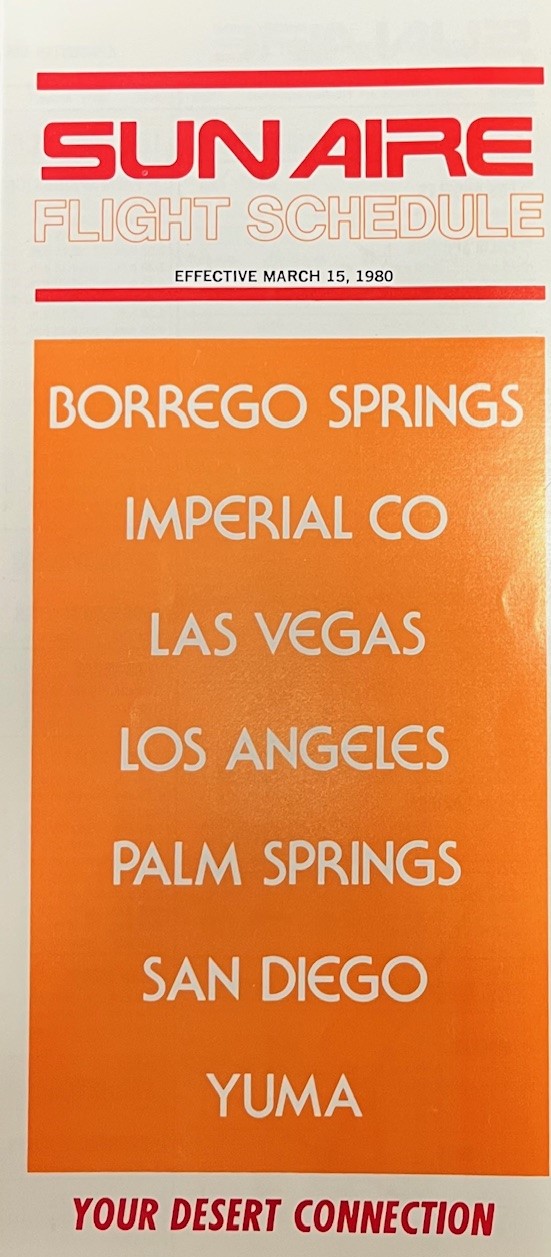
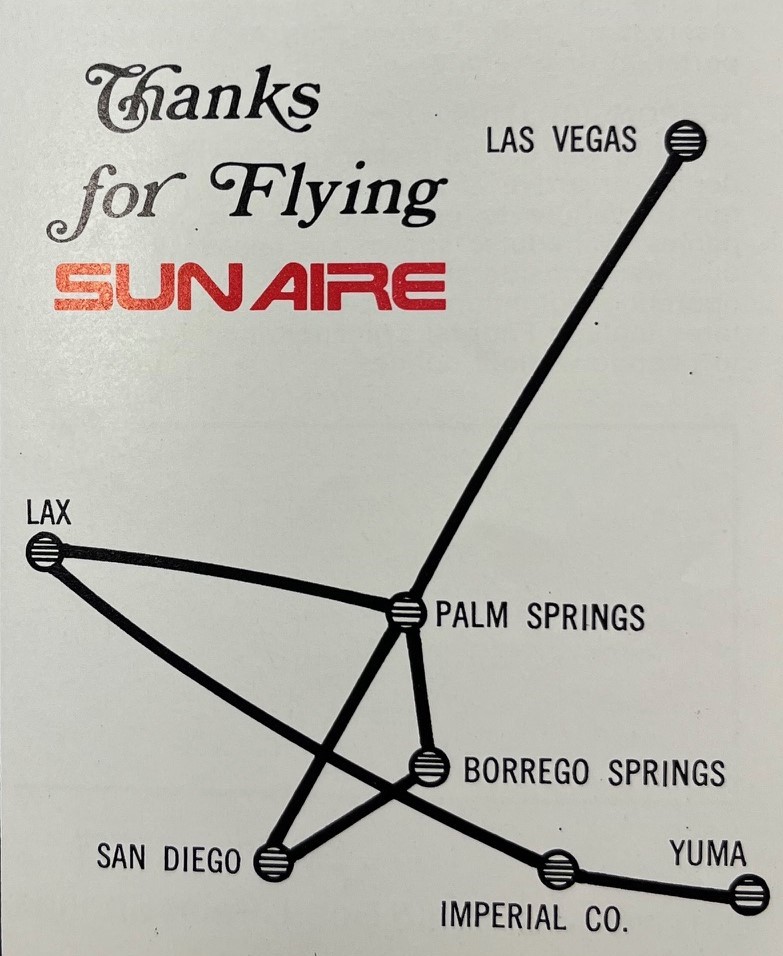
Sun Aire March 15, 1980 timetable and route map. Daniel Gradwohl collection.

I interviewed with the Director of Operations in his office, took a short written exam, and we headed out to fly N1006L, a beautifully painted Metro II. This flight, which lasted less than an hour, was my check-ride and I was hired as a first officer to replace one who had left for a job at a major airline. Sun Aire didn’t waste money on training! Soon after, I was flying the line on their routes that included LAX, San Diego, Burbank, Imperial County, Yuma, and Borrego Springs.
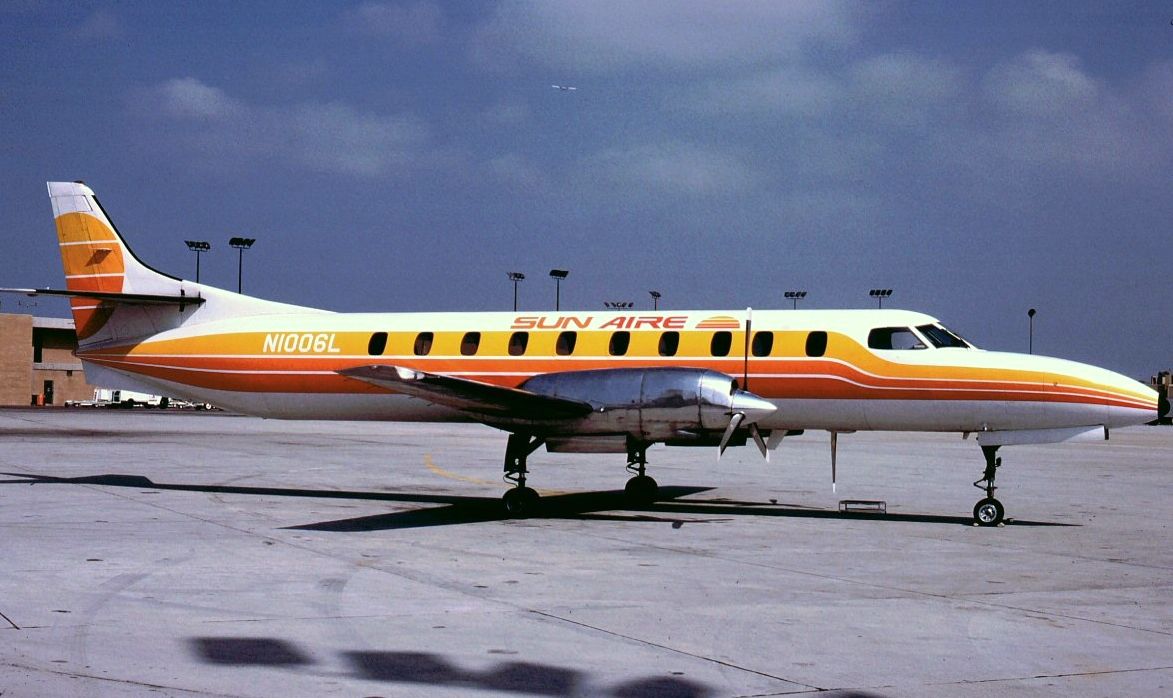
Sun Aire Lines Metroliner II, N1006L, seen in August 1981 at the old terminal operating scheduled service to Burbank and Palm Springs. Photo by Ellis M. Chernoff.

The pay scheme at Sun Aire was unusual in that rather than pay for block time, they paid by the leg. The routes were categorized as Short, Medium, and Long legs. The company view was that they did not want to provide an incentive to operate slowly and get behind schedule. In truth, not so bad; I made more money at Sun Aire as a first officer than I did as a captain at SoonAir. Easy duty as well. Ties and jackets not required, nor did we have flight bags to carry. There was a set of navigation charts in each airplane, and the company supplied a David Clark headset. I only had to bring the headset and a flashlight to work.
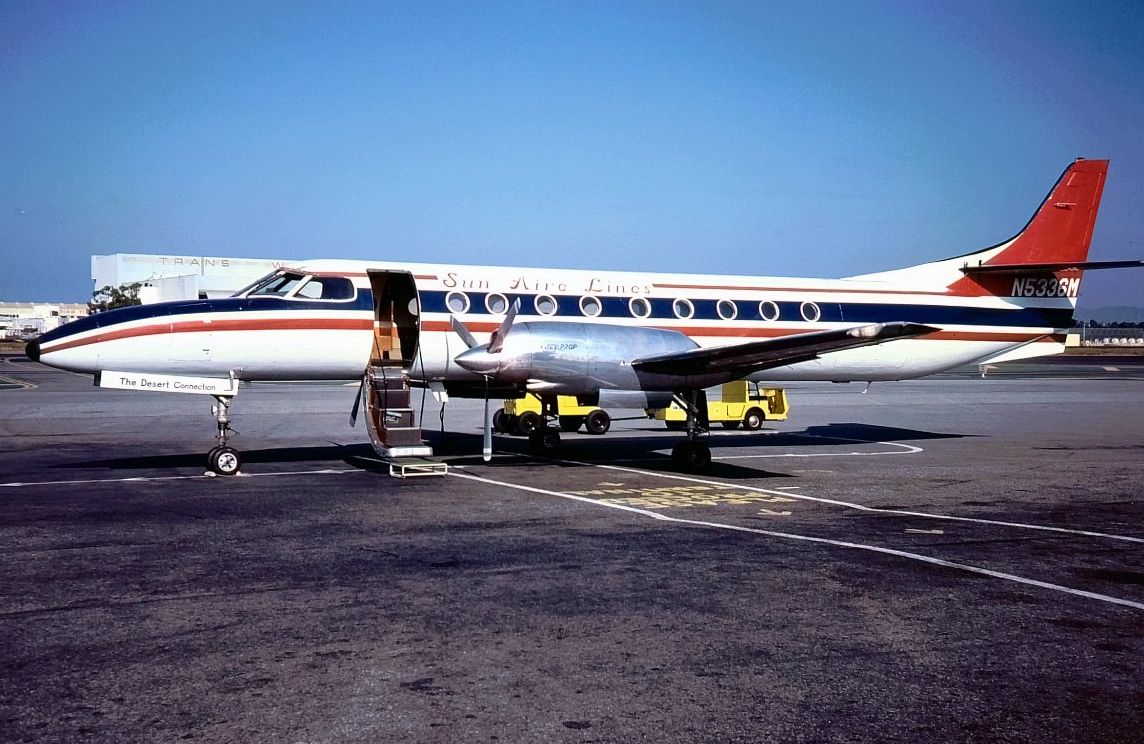
Sun Aire Lines Metroliner I, N5336M, seen in September 1980 at the old commuter terminal at LAX between flights. This is now the location of the Tom Bradley International Terminal at LAX.
Photo by Ellis M. Chernoff.

The Sun Aire fleet consisted of only four Metros when I started there. A single Metro I, the previously mentioned N1006L a Metro II that they had bought new, and two former Scenic Airlines Metro IIs. All of these were equipped with the Garrett TPE-331-303 engines that produced 840 HP at sea level standard day. The aircraft had a maximum weight of 12,500 pounds. While the plane had wet wing fuel tanks that could take the plane nearly 2,000 miles, on our short-haul routes, we would trade fuel for passengers and baggage. In fact, normal fuel at departure to operate between Los Angeles and Palm Springs was only 800 pounds.

One of the responsibilities of the first officer was to plot the takeoff weight and balance. This was made easy with a custom plotter to include the fuel load, number of passengers and weight of the baggage.  The ramp crew was tasked with loading the baggage and providing a number. Miraculously, we never took off overweight. The plane had a large baggage compartment and door in the rear that was pressurized. There was also an unpressurized compartment in the nose.

The Metro IIs also had a water-methanol injection system to add 100 hp per engine during takeoff. With the hot ambient temperatures typical on our route structure, use of this was necessary to obtain the required initial climb performance without reducing the passenger and baggage load. Similarly, the Metro I had an emergency water-methanol system that would augment the thrust of one engine in the event the other failed during takeoff.

We later acquired additional Metro IIs, and a few were equipped with a JATO bottle in the tail. Much lore about this rocket exists. While the water-methanol injection improved initial climb performance at high weights and in high temperature conditions, takeoffs with both high temperature and field elevations were an issue for some operators. The idea of the JATO rocket was to keep the plane from settling back onto the runway if an engine failed before the landing gear was retracted.

What a concept; maximum takeoff weight, and engine fails just at liftoff, and even with 940 HP on the working engine, the plane could only remain in the air if the JATO was fired. But it was not automatic; it had to be armed prior to takeoff, and a button pushed to fire it. But the Metro was a real handful with an engine out on one side. It took lots of rudder and two hands on the yoke. The other pilot had to carefully handle the very sensitive thrust levers to keep the working engine at maximum power without over-temping it and melting it. So, how does one also punch the JATO button? Thankfully, Sun Air deactivated them, so I never needed to!

Flying right seat to the captains at Sun Aire was an enjoyable experience. Once I got familiar with the routes and destination airports, I could fly as aggressively toward landings as any of them. One captain I flew with regularly had earlier in his career been a pilot at Catalina Airlines, flying the Grumman Goose.  I enjoyed sharing experiences and my affection for that vintage airplane. This particular pilot did not particularly feel comfortable flying in instrument conditions. This was in spite of his being a designated pilot examiner. So on foggy and cloudy days, I might find myself flying nearly all of the legs on our schedule.

On one occasion, I was flying between San Diego and Burbank for the entire day. Starting up in San Diego, one of the engines refused to light off. The passengers were sent back to the terminal, and the captain said he was going to call maintenance in Palm Springs for assistance. I volunteered that I knew how to deal with this issue from my prior experience with SoonAir. He said to go ahead. I had to take out my seat to access the electronic speed switches. Having done so, I could use the good one to start the right engine and then switch it to the left one. I reinstalled my seat, and with the passengers once again on board, we were able to start the left engine. We avoided cancelling the flight with minimal delay. I was the hero of the day, although today I would not be allowed to do this type of hands-on work.
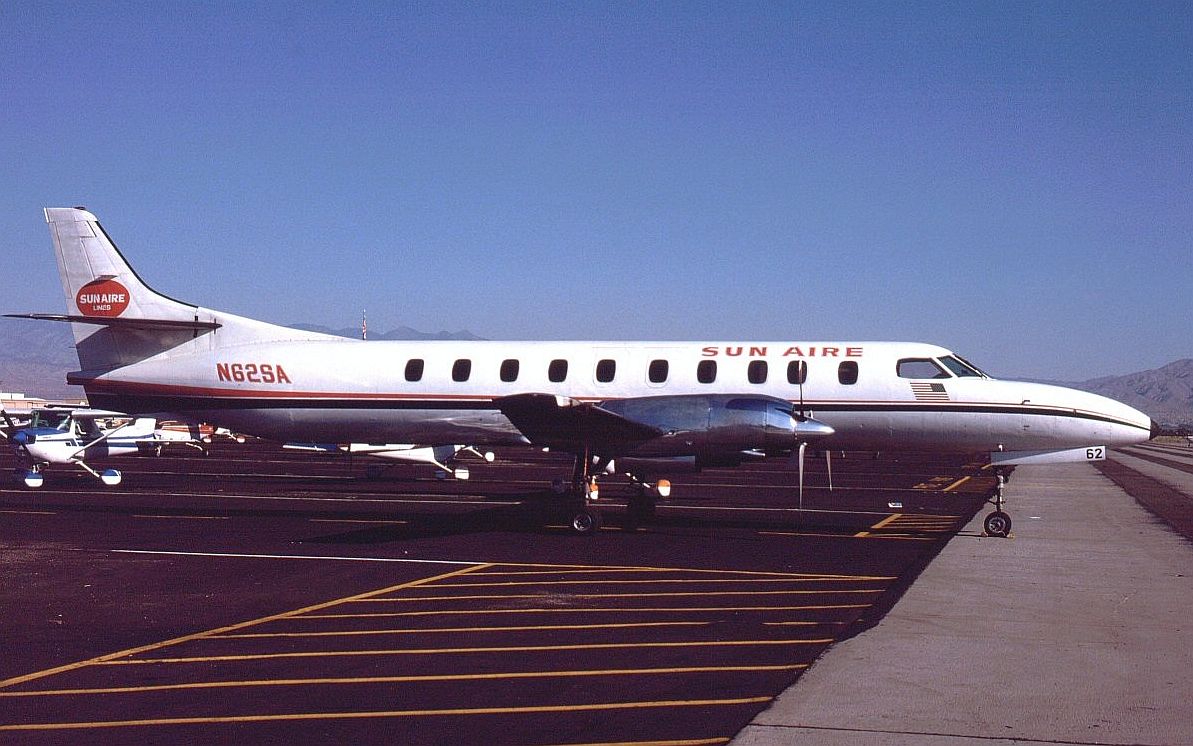
Sun Aire Metroliner II, N62SA, seen at Palm Springs, CA, in October 1980, wearing the original hybrid Scenic Airlines scheme that she had for quite some time. Photo by Ellis M. Chernoff.

The Director of Operations made up each pilot’s schedule and it would be a weekly scheduled until there was a need for a change.  Typical duty would be four, ten or twelve legs per duty period.  Rarely would my schedule involve a layover hotel. The planes were well maintained, the company was profitable, and life was good.

Flying between Los Angeles and Palm Springs, I had some interesting passengers. Among some of the famous people who were on my flights were President Gerald Ford (post presidency), Bob Hope, Howard Cosell, Arthur Ashe, David Hartman, and Eva Gabor. Unlike today where the pilots have no contact with the passengers, we did greet each boarding and deplaning.  In the case of President Ford, the secret service always made a big deal of exactly when we would arrive at the destination.  I had to be clear that we were NOT Air Force One and had zero control or priority with air traffic control.  I could merely assure them that we would arrive X minutes after takeoff.

During my first month of employment, my prior efforts to get a job at a major airline paid off: I was invited to interview with two airlines! Of course, I had to confess this to the Director of Operations, as he would schedule my time off.  He expressed encouragement as he would have liked a major airline career earlier in his life.  But this sealed my prospects with Sun Aire. Ultimately, in that round, I did not get a job offer from the majors, and, knowing I had loftier aspirations, this sealed my prospects with Sun Aire: I would never upgrade to captain.
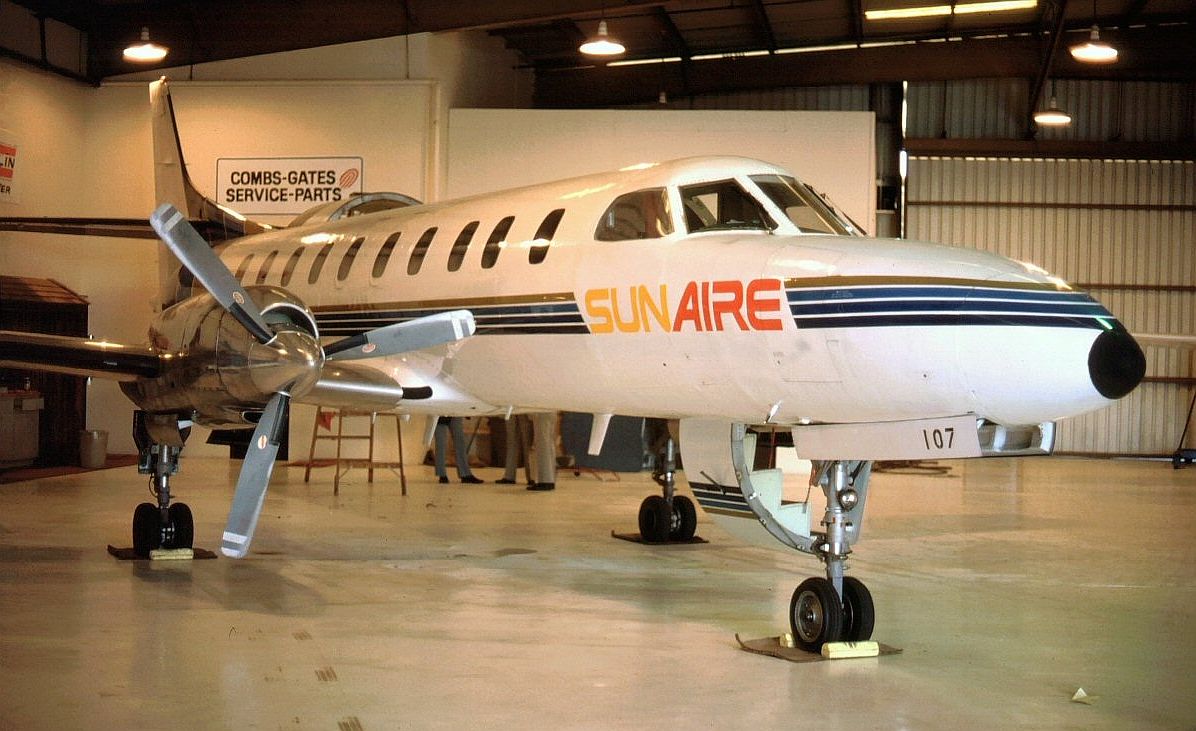
Sun Aire Lines Metroliner II, N1007W, seen in October 1981 in the Combs-Gates hangar for regular maintenance. Sun Aire planes were the best-maintained aircraft in my career. Photo: Ellis M. Chernoff.

The Sun Aire Metroliners were just a bit different than the others I had flown. While they were equipped with the same engines and propellers, they had been tweaked to settings that produce less idle power and more drag than manufacturer specifications.  This facilitated the standard Space Shuttle-type approach we did in Palm Springs, as well as the high-speed approaches we did in places like LAX and SAN.  In fact, we could approach at the 248 knot redline to nearly three miles from the runway and suddenly slow, drop the landing gear and flaps.  It was fun to race other planes on parallel approach paths and watch Boeing and Douglas jets appearing to be going backwards.  ATC would often as us to maintain maximum speed which we called “Warp Factor Nine”. However, you did not dare reduce power to idle until the wheels were on the ground. Landing with power on was a must. 

On one occasion, I was with a captain who misjudged his height while landing at night in Yuma, AZ. He thought he had touched down, yet was still a good six feet or more in the air. As the plane fell to a very firm contact with the earth, all the passengers could hear him yell, “OH NO!”

Sun Aire was a subsidiary of a San Francisco-headquartered conglomerate corporation. Unusual for a regional or commuter airline, the little airline made money and was in the black. I actually bought some stock in the parent corporation and received the annual reports. Yet, mention of the airline was little more than a tiny picture and footnotes in the financials. I truly enjoyed working there and the lifestyle of living in Palm Springs.

Life and love threw me a curveball, and toward the end of 1981, I would be considering yet another airline and a start-up at that. There was an expectation that I would finally be flying a jet airliner, too. Great expectations.
Continue Reading 3 Comments

Emery Air Freight,Federal Express,Metro I,Metro II,pilot,pilot career,Portland,Purolator Courier,Soonair Lines,Swearingen,Tulsa,Volpar

TURBOPROPS, ROUND TWO: Soonair Metroliner

By Ellis M. Chernoff

Following rounds of flying the three SoonAir Lines Volpar Turboliners on contract schedules for Purolator Courier, Federal Express, and Emery Air Freight, I was to transition to the Swearingen SA-226TC Metroliner. Soonair operated three of these aircraft as well, with one early production Metroliner I that was converted from a corporate Merlin IV, a second early Metro I, and a single Metro II that had
previously operated in Alaska. The outward distinguishing characteristic of the Metro I vs. Metro II was the passenger cabin windows. Early Metro Is had round windows, while later versions and the Metro IIs had conventional airline-shaped windows. The early Metro I also had an electric nose steering system controlled with a tiller to the left of the captain’s seat. Later production changed to a hydraulic system controlled through the rudder pedals. More on that later.

As was the case with my Volpar training, my transition training was limited, consisting of a single two-hour flight in mid-January 1980. These planes were equipped with excellent radios and flight instruments, but no flight directors or autopilots. In fact, the entire Metro was more of a scaled-down airliner than a scaled-up general aviation light aircraft. The systems and structures were certainly air transport
grade, including pressurization, wet wing fuel tanks, de-ice and anti-ice systems, and the flight controls. However, with a maximum gross weight of 12,500 pounds, it was certified under FAR Part 23 and did not require a type rating.

The engines were similar to those installed on the Volpar, but were the more powerful TPE-331-303 of 840 shaft horsepower. Unlike later versions of the -331 line, these were rated as above at sea level and standard temperature of 59 degrees F. To achieve the rated power, the engines had to be advanced right up to the turbine temperature limit of 923 degrees Celsius at and above standard conditions. If it
were colder, the power limit was reached at a torque limit value; I don’t recall the exact number but it was around 2,200.

Volpar Turboliner N8SL in 1979 at Tulsa, OK.
Conversion of a stretched variant of the Beech 18 began in December 1966, which would eventually lead to the 15-seat Volpar Turboliner 1. The aircraft was certificated on March 29, 1968.
The fuselage was stretched by 81 inches (2.07m), and TPE-331-101b engines were installed. Its maiden flight was on April 12, 1967. N8SL originally operated for Allegheny Commuter as N342V.
Photo by Ellis M.Chernoff.

My short training flight was uneventful, with the exception that I noted something strange about the engines on the Metro II. With fuel flow and ITT temperatures matched on the two engines, the torque reading on one engine was much lower than the other, requiring me to adjust the rudder trim as the thrust/power was not matched. However, if I matched the torque indications, I could center the trim, but
the other parameters were uneven. I brought this to the attention of the chief pilot, who was conducting my training. He answered that this plane had been this way since they received it after it had been in an accident in Alaska. Since the offending engine only had seven hours at the time they got it, SoonAir chalked it up to an indication error. I didn’t see it that way.

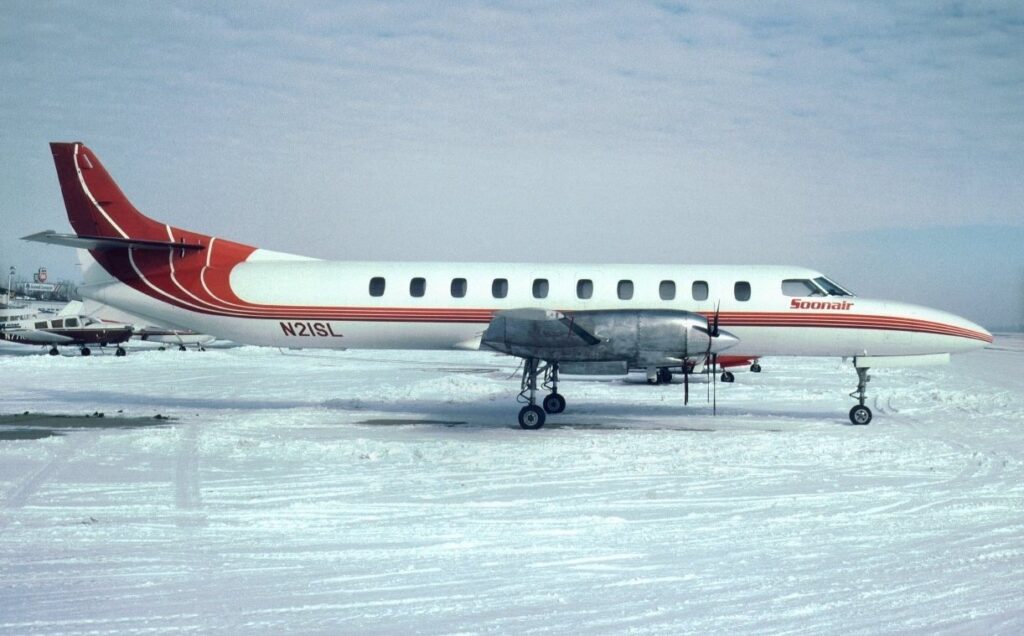
N21SL (ex: N442JA), Soonair Lines Swearingen SA-226TC Metro II at OMA, February 1980. Daytime layover after flying night cargo for Purolator Courier. Photo by Ellis M. Chernoff.

In fact, an FAA inspector was aboard the following day for my checkride.  Once we were established in cruise condition, he got into a heated discussion with the chief pilot while I just flew the plane and stayed out of the argument. Of course, aerodynamics don’t lie, and since the airplane was in trim when the torques matched, clearly there was something amiss with an engine and not just an indication. The FAA inspector terminated the ride, ordering us to land at the nearest airport and let him off. He called his wife to pick him up, and my chief pilot got back on board the aircraft and closed the door. “We will finish the checkride and I will sign you off,” was the answer to my question.

I finally got out on the line with the chief pilot flying a revenue trip. Approaching the first stop, the Tower reported the runways closed with snow removal in progress. My right-hand man was working the radio communications and insisted we could not wait a significant time for them to finish. So what was negotiated was that the equipment would clear the runway and I would land on the cleared portion, which was not in the center of the runway. 

All of my Soonair Lines Metroliner flying would be on two routes for Purolator Courier with nightly hub operations at Port Columbus, Ohio (CMH). Operating this type of plane was great since it could carry plenty of fuel and cargo, and was pressurized and heated. The ice protection systems were certified for flight into known icing as well. The engines were reliable, but the only concern was getting them started.  The Garrett is a single-shaft design that has an automatic start sequence. A great deal of electrical power is required to get the thing started, and trying to do that on internal battery power alone is dicey, especially in cold conditions. A ground power unit was essential.

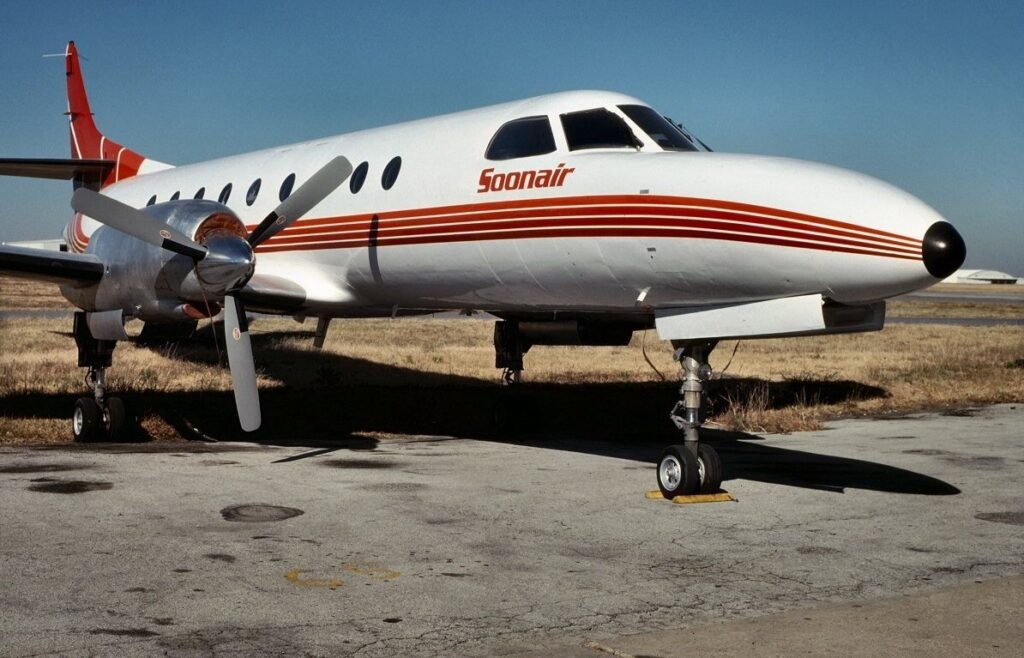
Nose-on view of N18SL, Soonair Lines Swearingen SA-226TC Metro I at TUL in November 1979. This aircraft flew freight for the Purolator Courier system.
Photo by Ellis M. Chernoff.

On more than one occasion at an intermediate stop, the local operator could not get their ground power unit to start, so I had to keep an engine running while the cargo was off or on loaded. This had to be anticipated as they would not fuel the plane with the engine running.

Other cold-weather experiences included not being able to get the propeller blades on the start locks during shutdown. They must have frozen in the release condition during flight. So when the engine shut down, the blades went to feather. It is not possible to start this type of engine with the propeller in feather. The normal remedy is to use a device (we carried one) to manually twist the blades back to the proper flat angle, and the locks should engage. We tried it and they didn’t move. After conferring with the boss by telephone, I came up with a novel idea: I would use the manual unfeathering pump to return the prop to the start angle, and while there, would initiate the start. This had to be done before the oil tank was depleted. It took all four hands in the cockpit, but I pulled it off.

On another occasion, I made an intermediate stop in Olathe, Kansas, in a blizzard. During the crosswind landing, the snow was blowing across the runway from right to left, creating a strange visual apparition. But the landing and taxi to the ramp were uneventful. However, while I was inside on the telephone to get weather updates, my first officer came in telling me that the engines had seized. In just the few minutes since the engines were shut down, snow had blown into the inlet, melted, and then froze inside.  It looked like an old freezer that had not been defrosted in months!  The flight cancelled and we were stuck there until the next afternoon. Lesson learned: always cover the engine inlets.

A few months had gone by, and Soonair, on advice of a consulting firm, reconfigured one of the remaining Metros back to passenger configuration and was setting up to launch scheduled passenger service between Tulsa and Dallas Love Field.  One day, I was called into the office of the Director of Operations. I had guessed they would want me to operate the passenger flights since I already had plenty of that type of service. But no, I was instead informed that due to recent first officer upgrades, I could either be laid off or accept rehire as a first officer. What a shock, especially since I had raised this issue during my initial interview and was assured that this would not occur. So now, with no notice, my choice was half pay or no pay.

A couple of days later, I would head out in the right seat with a newly minted captain who had previously been my co-pilot. Adding insult to injury, I was expected to supervise him and give him training and operational experience. As a professional, I would do this, but I informed my new captain that he would get to fly all of the legs, not only to find out what it’s like to be in charge, but to experience the fatigue and conditions he could expect flying with less experienced co-pilots. On a minimums approach into St Louis in the middle of the night, he nearly landed on the grass when he looked up from the instruments, tensed up, and ruddered the plane away from the runway. I grabbed the controls and got things back in order.

Another one of these new captains made a poor choice when faced with in-flight icing and strong headwinds. He thought he could descend out of the icing and get less headwind rather than climbing out of the clouds. The result of this error had us at 3000 feet using full power and barely maintaining flying speed. The de-icing systems could not cope with the very heavy ice we were accumulating. Were it not for flying out of the clouds into clear air, we would have ended up a wreck out in some field.

One day, one of the pilots now flying the Volpar into Portland, Maine, encountered the same FAA inspector who tried to intimidate me. However, this time the inspector succeeded, and the captain called the Director of Operations to say that he could not operate the next scheduled departure on threat of losing his pilot certificate. The D.O. told him it was nonsense; his job is to fly. Faced with two ultimatums, this pilot resigned, and all of the other pilots at Soonair, including me, supported him through mass resignation. 

It was time to pack up and move again.

Continue Reading No Comments

Airline,airliner,airlines,Beech 18,Federal Express,pilot career,Soonair,Tulsa,Volpar Turboliner

TURBOPROPS, ROUND ONE: Soonair Volpar Turboliner

By Ellis M. Chernoff

With a newly added Flight Engineer-Turbojet certificate in my wallet, I again set out with an updated resume and submitted applications to all of the airlines. But my expectations of getting a seat in the cockpit of an airline were dashed following the crash of an American Airlines DC-10 at Chicago in 1979. I returned to California to scour the pages of “Trade-A-Plane” and other sources for potential pilot employment information. Meanwhile, local efforts to gain a position with the three airlines based at LAX (Western Airlines, Continental Airlines, and Flying Tiger Lines) did not amount to anything. Neither did my attempt to get an entry-level position with Golden West Airlines or Sun Aire Lines. Golden West required pilots to go to Toronto and buy training at the factory for the DHC-6 Twin Otter. Sun Aire had no openings; even if they did, I wasn’t competitive. They required currency in the Swearingen Metroliner just to be considered.

Finally, I spotted a “pilot wanted” listing for an operator in Tulsa, Oklahoma. After a quick phone call, I bought an airline ticket and went for an interview with the Director of Operations. He was impressed with my experience. He was offering a captain position, which would entail two weeks flying plus a week of flight following duties each month for a salary. Soonair Lines operated six turboprop airplanes: three Volpar Turboliners and three SA-226TC Metroliners on cargo contracts with Purolator Courier, Federal Express, and Emery Air Freight.

I was a bit concerned about one issue: as I was being hired as a captain, what would happen when the existing first officers gained sufficient time to upgrade? I was assured that my position would always be captain. With that, I returned home to once again pack my car and drive to Tulsa.

While getting oriented with new company manuals and employment details, I quickly set up an apartment and other necessities of starting a new job. One other new captain had also been hired, and the two of us met with the chief pilot one night to get checked out in the Volpar.

In the mid-1960s, there weren’t many commuter or regional aircraft types. Mainly for the Allegheny system, the Volpar Company at Van Nuys Airport took surplus Beech 18/C-45 airframes, added some wing area, stretched the fuselage, added their STC nose gear package, and replaced the P&W R-985 piston radial engines with Garrett TPE-331 turboprops. These engines increased the power from 450 to 620hp each while also reducing frontal drag. As an early commuter passenger plane, it offered 12-15 seats. Increased speed and payload were added benefits. As the Volpars were replaced with Beech 99 aircraft, they were stripped of passenger fittings and converted to freighters.

During the single night of flight training, we did all of the usual maneuvers with the added test of full takeoffs under the hood (zero-zero). However, since the other pilot went first, only he got to actually start the engines. But my FAR 135 proficiency check was complete with an authorization for reduced minimums.

My first line flight would occur on November 2, 1979, with a positioning flight from Tulsa to Little Rock Adams Field. The boss came out to make sure that I could get the engines started! This would also be the last time I would ever operate an airplane “solo,” although there would be times when I might as well have been alone.

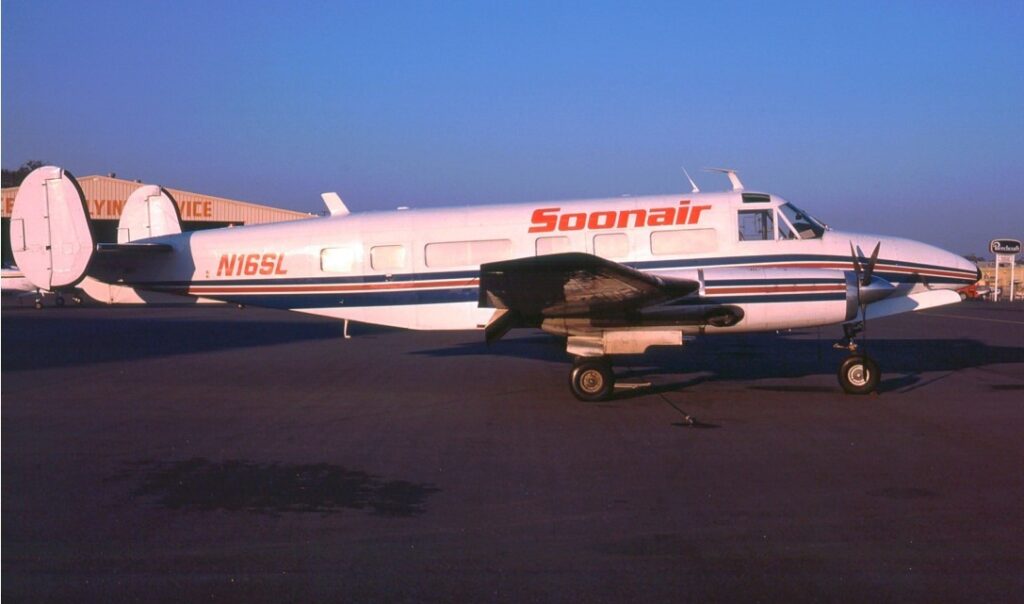
Soonair Lines Volpar Turboliner N16SL, November 1979, during a daytime layover following a night run for Purolator Courier: LIT-CMH-STL-MEM-LIT. Converted from a Beech E18S, the engines are Garrett TPE-331-101. Photo: Ellis M. Chernoff.

Those familiar with the Garrett turboprop probably think of the latest versions that have all sorts of automatic features. The Volpar had the earliest version, TPE-331-101, which was not flat-rated nor did it have any automatic limiters. The only automatic feature was the start sequence. The Turboliner did not have nose wheel steering but was very easy to handle on the ground by deft use of the propellers. Engines are started with the propellers in flat pitch, and the power levers move forward to go forward, and aft to produce BETA, or negative thrust to slow or help with turns.

It was a real rocket ship, but exceptionally loud in the cockpit. That nose was like an aluminum bullhorn amplifying the prop noise to the cockpit. Temperature control was a challenge, too. As the season was already autumn, only heat was needed, but the original heat distribution plumbing had been removed.  Two needle valve knobs opened raw hot bleed air to respective pilot floor outlets. Your socks could be melting while your thighs were freezing.

The Purolator runs were from Little Rock non-stop to Columbus, Ohio, where the sort occurred. Offload and loading crews handled the cargo there, but the pilots and copilots had to do the work at the out stations. The return flight was from Columbus to Memphis, TN, continuing back to Little Rock with arrival around dawn.

The Volpar Turboliner had good space for bulk cargo. Loading was facilitated with a large door on the left rear of the cabin. A tail stand was attached to the tail tie-down fitting, and as long as it hung above the pavement, without touching the surface, the load would be within balance limits. Pilots entered the cockpit via a pilot door, but the flaps had to be fully down for a step to access the wing to allow pilot entry.

Following days off and flight following duty in my apartment in Tulsa, I was given an airline ticket to Boston.  Before I departed, I had a meeting with the director of operations (D.O.).  He informed me that my plane would park and layover during the day in front of the FAA office at the Portland, Maine airport (PWM). I could expect an FAA inspector to meet me and challenge the airworthiness of our aircraft. I said that didn’t worry me; I had a lot of experience with the FAA. The D.O. had been impressed by not only my professionalism, but he could tell that I was not easily intimidated.

So it was that I took the Soonair Volpar, full of Federal Express packages, from Boston to Portland on the morning of December 1 and was met by the FAA on the ramp as soon as I arrived. As expected, he demanded the aircraft logs and challenged the airworthiness of the airplane, with specific attention to the de-icer boots. My reply to him was that as pilot in command, it’s my responsibility to determine that the plane was airworthy and legal to fly and that I was not a suicidal maniac. Perhaps the plane looks like an obsolete junker, but everything functions. I never saw that inspector again.

Operating flights for Federal Express was a bit different than for Purolator. One of the essential duties was to phone in a flight closeout ASAP after each flight. Federal Express had established times for every flight that included block out, takeoff, landing, and block in. So, I phoned in my first report after arriving in Portland a few minutes early.

“What was your delay, Captain Chernoff?” 

“Huh?”

“Your delay, sir. You blocked out three minutes late.”

“But I arrived early,” I said.

“Why did you block out three minutes late and take off 1 minute late?” 

From then on, I understood how the “Purple Air Force” worked.  It would serve me well years later.

The Portland run was simply to fly PWM-BOS and then spend the entire night in the FBO at Boston. When the big purple plane returned from Memphis, the cargo would be transloaded and we would fly back to PWM, where the company provided one motel room for day use for the two of us pilots. The glory of building turbine time 45 minutes at a time.

Continue Reading 3 Comments

Airline,airline pilot,airlines,Boeing 727,engineer,FAA,Federal Express,FedEx,flight engineer,pilot career,type rating

BOEING 727 – ROUND ONE

By Ellis M. Chernoff

Like all of my peers flying for small commuter airlines, we aspired to fly the big jets. Since about 1964, nearly all of the major U.S. airlines were flying fleets of the Boeing trijet. Serving as a second officer, or Flight Engineer, was the usual entry level for new hires. Very few airlines were hiring new pilots in the mid-1970s. To be competitive, at a minimum, an applicant must have passed the FAA Flight Engineer-Turbojet written exam. This exam was based on the Boeing 727 systems, limitations, and procedures. To be truly a standout applicant, a pilot needed to have the full FAA certificate. The airlines took advantage of the glut of potential applicants and expected pilots to purchase their own training rather than have the airline provide it upon employment.

Countless books and articles have been written on the history and characteristics of the classic Boeing. I need not repeat it here other than to say that I rode on my first one, a Northeast Airlines B727-95 from Montreal to Boston in 1967. My first jumpseat ride was on a United B727-22 from Charlotte on a multistop flight to Los Angeles in 1977.

Like most people, I prepared for the written exam with a study guide and attending a quickie weekend ground school. Only the very basics were explained, and many test question answers were pure rote memory.

By 1979, the airlines were finally hiring aggressively, and there was a rush to complete the full training and receive the certificate to land that coveted airline job. Since the course would be several weeks, it would not be possible to complete it on a vacation, so it was necessary to resign from one’s current employer. That came with the consolation that one’s dream airline job could be just weeks away!

So it was that I left Air Carolina and their fleet of Pipers and enrolled at Flight International in Atlanta. They operated a full school with classroom instruction, a cockpit procedures trainer (CPT), and a fully functional simulator based on the Delta Air Lines Boeing 727-232A version cockpit. It was a non-motion and non-visual simulator strictly for training flight engineers.

The classroom systems instructor really knew the plane, having retired from Pan Am on their Boeing 727s. The handouts and system boards were excellent for preparing for procedure practice in the CPT. This also built toward the required FAA oral examination. Finally, pairs of students were assigned to a “flight instructor” to learn to operate the systems in the normal, abnormal, and emergency procedures. I learned to know what every switch and gauge did and how to identify the results of every action.

Some procedures, such as Hydraulic Leak/Loss and Electrical Fire of Unknown Origin, were drilled again and again so the student flight engineer could isolate a fault in a system and restore as many functions as possible. Real system knowledge stuff. Strut overheat and Lower Aft Body Overheat were other classics drilled again and again.

Each student was scheduled for their closed-door oral exam with the FAA. This spread much anxiety as many guys did not pass or spent many hours being grilled and barely getting a pass. Not to brag, but when my turn came, the inspector gave me a performance problem first and then began the questions. In about 20 minutes, he asked a question I had never encountered before. He said, “I know they didn’t give this to you, but how do you think it works?” Before I could even answer, he told me I had the oral in the bag. I postulated an answer to his technical question, which was correct. We chatted for a few more minutes so it would not appear to the next guy that I had finished so quickly.

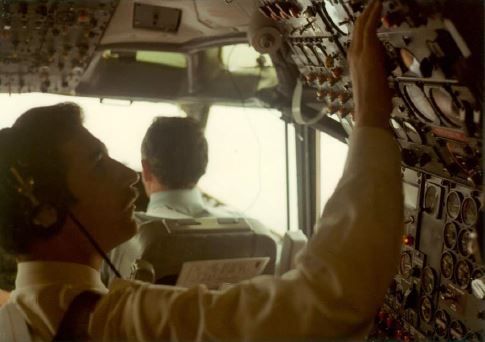
Since the simulator did not “fly”, it was necessary to do one more thing to finish up the exams. A Federal Express B727-22QC was rented in Memphis and six of us would go there and get 20 minutes each in the seat. Before the flight, we would receive a “differences“ training class and a walk-around preflight on the ramp. I would start an engine, run the after-start and before-takeoff procedures and checklists, the
pilots would fly once around the pattern, and after landing, I would restart the APU and do the after-landing procedures through an engine shutdown. The cost of this little ride worked out to $920.00 of the total tuition.

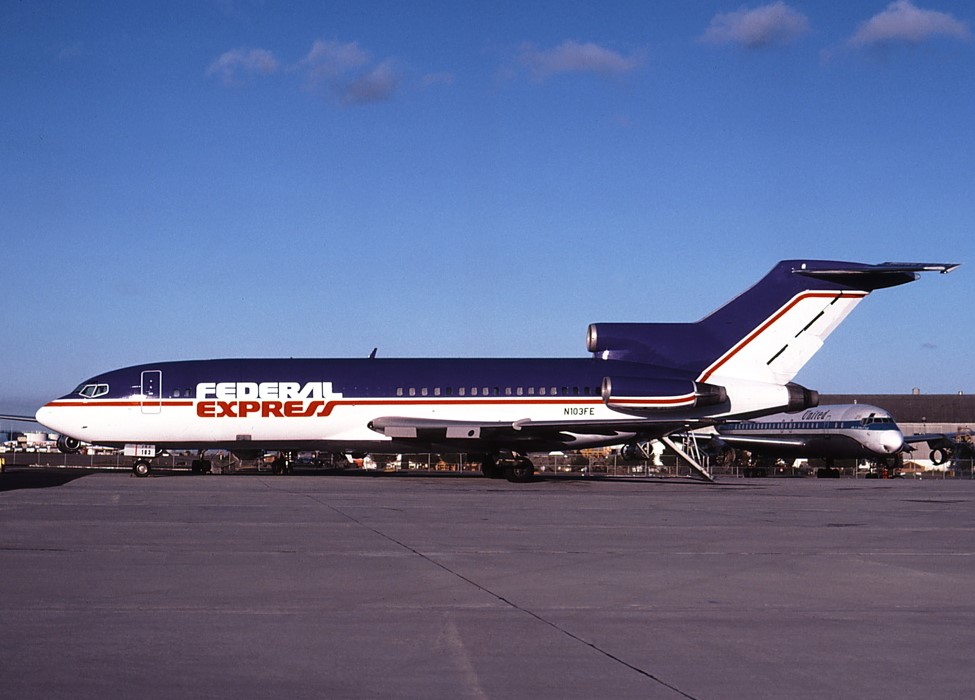
Final certification exam being flown in FedEx B727-22QC N103FE. Unknown photographer, Ellis Chernoff Collection.
N103FE, Boeing 727-22QC at San Francisco Int’l Airport on Mar 31, 1978. Photo by Jon Proctor.

With another temporary FAA Airman certificate in hand, I could again start the process of applying to the airlines and hopefully land an airline job and start that long-planned for dream airline career. But that would not be how it turned out.

On May 25, 1979, American Airlines 191, a DC-10, took off from Chicago. The #1 engine detached from the wing, resulting in loss of control and a crash. All 271 occupants on board were killed on impact, along with two people on the ground. It remains the deadliest aviation accident to have occurred in the United States. The FAA subsequently grounded all DC-10s in service, resulting in nearly all airlines cancelling hiring and new hire training classes.

For now, my Flight Engineer-Turbojet certificate was useless paper in my wallet. Having given up my prior employment, I returned to my parents’ house and began again to look for any flying job I could get. Hopefully, I would get something where I could log turbine time. I already had plenty of PIC and Multiengine time. It seemed every interviewer would talk about what I didn’t have and not give me much credit for the experience and potential I did have.

For now, my Boeing 727 materials and knowledge would be stored away for another nine years.

Stand by for Round Two.

Continue Reading No Comments

World Airline Historical Society, Inc.
PO Box 13693, Tampa, FL 33681-3693 USA
Contact Us

Archives

Copyright © 1975-2025 World Airline Historical Society, Inc.

Read our Privacy Policy