Posts Tagged ‘Air Cortez’

Air Cortez,Denver,F-27,Rolls-Royce,winter airline operations
Turboprops, Round Six: Air Cortez, Scene 2

By Ellis M. Chernoff

January 1985 began with a recall from Air Cortez. The FAA had revalidated their operating certificate upon approval of their tie-down nets, weight and balance program, and other details. I was told to report to Denver Stapelton Airport, where one of the F-27s was in position. Weeknight runs with cargo from UPS operated Denver, Casper, Billings, Great Falls, and return through the same airports. This was a dusk-to-dawn operation in the dead of winter.

If there was snow at any of the airfields, it would surely be at Casper, Wyoming. However, the stopover was brief, and if it was snowing, it was dry powder. No deicing equipment was available, so we had to expect the snow to blow off the surfaces. Air Cortez expected the pilots to “help” offload and load cargo at the stations other than Denver. I was not too keen on this heavy exertion while also being fit to fly a tight schedule.

The basic Fairchild F-27, as I have previously mentioned, used pneumatic pressure to operate the landing gear, brakes, and nose wheel steering. In modern planes, pneumatic air is taken from the engines themselves. But in the ancient systems of this aircraft, a four-cylinder mechanical air compressor was mounted as an accessory to each of the Rolls-Royce Darts. These compressors were like shop air compressors, and they charged up a series of three compressed air bottles. One for the landing gear operation, one for the normal brakes, and one for the emergency system.

Again, in modern aircraft, conditioned air to pressurize the cabin comes from the aircraft engines. But in the F-27, there were dedicated “Roots” blowers. These were the type of accessory found in older piston airliners. These blowers were also mechanical devices run by the Dart’s accessory section. Pressurization is designed for a maximum of 4.16 PSID, or an 8000-foot cabin at FL250. But the blowers were so worn out that barely half of that pressurization was available. In addition, the “choke valve” that was designed to
enhance cabin heating in the original production had been removed by prior operators who had this aircraft in the tropics. The cockpit was darned cold, and the main source of real heat came from the lights and electronics in the cockpit itself. The modest amount of pressurization barely kept the cockpit at freezing.

During the month that I was in Denver, I had three different ships, and none was in very good condition. Logbook write-ups of mechanical issues often caused a flight to be cancelled. Following the FAA suspension, UPS was not too happy with the reliability of performing the schedule.

One of the planes had issues with weak engine ignition. During every engine start, fuel would pool in the exhaust, as well as drip onto the tarmac, and when the engine would finally light off, a flame would extend all the way to the tail and light up the whole airport. It was truly spectacular.

The engine-driven air compressors were also worn out. The system was designed to operate at 3000 psi. This ensured rapid retraction of the landing gear. The pressure tank provided a reservoir of air to operate the gear and brakes and was recharged by the compressors. The pressure should be at 3000 psi at preflight, but there was a lower minimum for flight. On one of the planes, the mechanics had to charge the bottle on the ground. One night, I idled the engines for 45 minutes just to get the pressure up to the minimum for takeoff. The poor mechanics had little experience and few parts.

On a different night, climbing out from Billings, a side window shattered, causing the loss of even the modest pressurization. Normally, the young man who had driven the cargo van to meet our flight would have left the airport. But he stuck around to phone his girlfriend. Thankfully, he was still at the airport when we made an emergency return.

Contemplating being locked out, I had figured we would have to burn the freight to survive the cold night. But since the guy was still there, we were safe and able to get to a local hotel in town. Once in a warm hotel bar, I telephoned the boss in Las Vegas. He wanted us to return to the plane and ferry it unpressurized back to Denver.

No way I would do that. The route had minimum altitudes between 7,000 and 9,000 feet. It would be insane, not to mention highly dangerous, to fly two-plus hours back to Denver with no heat or supplemental oxygen in the middle of the night.

The following day, I reluctantly agreed to the ferry flight. By the time I contacted Denver Approach Control, hypothermia had set in. We were given holding instructions due to the amount of arrival traffic. It was snowing. I refused the holding instructions and told the controller we had no heat. He asked what other problems we might have. We had plenty, including almost no pressure in the pneumatic tanks. I was pretty sure that we could extend the landing gear, but steering and braking would be limited at best. We were assigned an inactive snow-covered runway, and this assisted the deceleration after landing. The pressure gauge read zero upon shutdown at the ramp.

More cancelled flights and another replacement junker plane. On my last flight for Air Cortez, I had to write up 21 items in the logbook. Upon arrival in the morning, the boss met the flight on the ramp. While the prop was spinning down, he motioned for me to open the window and hand him the logbook. His face turned red, and he shouted, “You’re fired!” I replied from the cockpit, “Thank you, sir. I’ll live longer.”

Air Cortez had originally been issued their Air Taxi (FAR 135) certificate many years ago. They had operated charters mainly to Mexican resorts and fishing destinations using light twins. When they acquired the Fairchilds, their certificate had been upgraded to a Supplemental Air Carrier (FAR 121), but clearly, the FAA had not demanded of them the more detailed manuals and procedures mandated by those rules. The family that owned the airline was really nice and were well-intentioned people. But, lack of competent and experienced staff and lack of FAA oversight were responsible for a sub-standard
operation.

The first officer who had shared most of my experiences for that month in Denver would also later be a pilot with FedEx. We would often share our recollections of those flights and mutual respect for the decisions we had to make.

The night I packed up to depart Denver for home, I received a phone call from my parents. They were relieved that I had been let go from this operation. But they also informed me that they had received a phone call from a former Dolphin Airlines colleague who had been trying to locate me. This information would ultimately lead to my next gig.
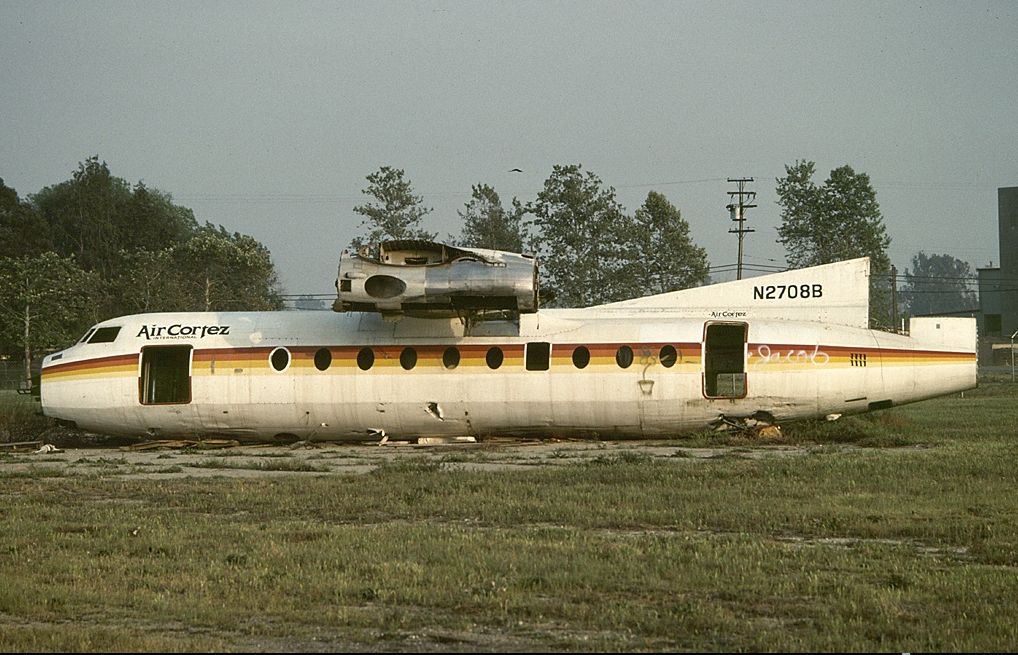
Air Cortez F-27A, N2708B, sits derelict at Ontario International Airport (ONT), CA, March 26, 1990.
It would become a fixture at ONT as a rotting hulk used for firefighter training.
Photo by Bill Blanchard.
Continue Reading No Comments

Air Cortez,airline pilot,F.27,F27,Fokker,Furlough,Pilgrim Airlines,Rolls-Royce

Turboprops, Round Six: Rolls-Royce

By Ellis M. Chernoff

It turns out 1984 still had more in store for me. Following the sudden shutdown of ConnectAir, I needed to find employment quickly.

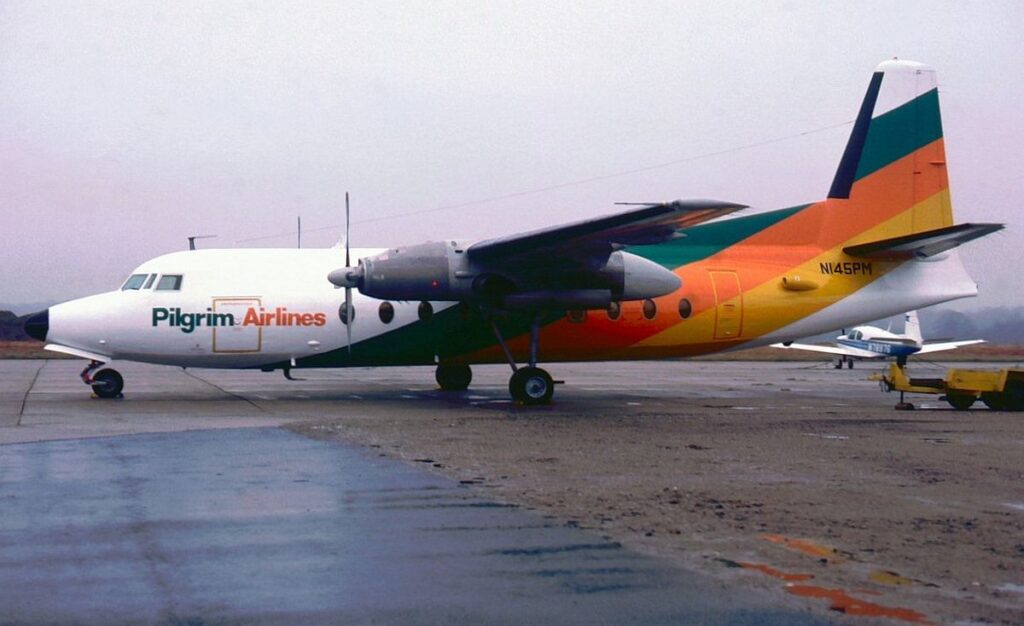
Pilgrim Airlines in New Groton, CT, was looking to hire a captain, and I held a type rating in the F.27. I got an airline ticket to New York La Guardia Airport, where a pass was waiting for me at the Pilgrim Airlines ticket counter for a ride to Groton-New London, CT. This was my first flight on a Twin Otter.

In addition to the de Havilland DHC-6-100 fleet, Pilgrim also operated several early production Fokker F27-100 aircraft. The cockpits of these were different than the Fairchilds I had been flying, but that was of little concern. Also, the Rolls-Royce RDa-6 Darts were lower power than the RDa-7 versions I had been operating. Neither was an immediate issue since my type rating covered all versions.

When I arrived, the chief pilot was out flying the line. I was invited to self-tour the maintenance hangar and anything else I wanted to see while I waited for the evening flights to arrive, when I would be able to meet the chief pilot. I was impressed with the maintenance department; everything looked well-maintained and professionally run. However, as each flight arrived at the end of the day, each crew removed their insignia and proceeded to the airport terminal bar. Chart bags were lined up at the entrance, and all of the pilots gathered for drinks and hangar talk. This included the chief pilot. Clearly, this was a daily ritual. It struck me as less than professional for a whole bunch of pilots to hang out in the airport terminal bar drinking in uniform, albeit sans rank insignia.

Pilgrim Fokker F27-100, N145PM, seen at Groton-New London Airport, CT, in November 1984. Pilgrim used these vintage but well-maintained Fokker F27-100 series in scheduled service on the East Coast. Pilgrim operated the only Mk100 series in the USA. Engines were Rolls-Royce RDa6 Darts.
Ellis M Chernoff Photo.

The following morning, I had my interview with the chief pilot and rode jumpseat on a round-trip flight to Washington National Airport. The flight operation was professional enough, but the overall impression I got was that this was a loose operation that I didn’t care to move all the way across the country to join. I respectfully declined the employment offer and got a pass to return to California.

Soon after I arrived home, another F.27 position presented itself. This was with Air Cortez International. I had been familiar with this firm when they were operating Beech 18s and other light twins out of Ontario Airport. However, now they were operating from Las Vegas. When I went to interview with the Director of Operations, I was surprised that they were looking to hire a captain off the street. They had planes and first officers, but most of their captains were gone. The other thing that had changed was that while they set up operations in Las Vegas to fly tourists over the Grand Canyon, that business had dried up. The planes were stripped of their passenger accommodations and were now flying cargo on behalf of UPS.

I had many questions about their operations specifications, procedures, and manuals, but those were deflected and deferred until I met with the chief pilot who was flying the line out of Dallas. I was given a ticket to go there, and the following morning, I met the guy who would accompany me on a scheduled run to San Antonio while he gave me my line check-ride. I was shocked to find that there were at least four different printed checklists in the cockpit. All different.

In preparation for the walk-around inspection of the plane and preparation of the takeoff performance, I asked about the quantity of water-methanol on board. The chief pilot didn’t have an answer to that question. In all of my prior F-27 flying, water-methanol was used for nearly every takeoff.

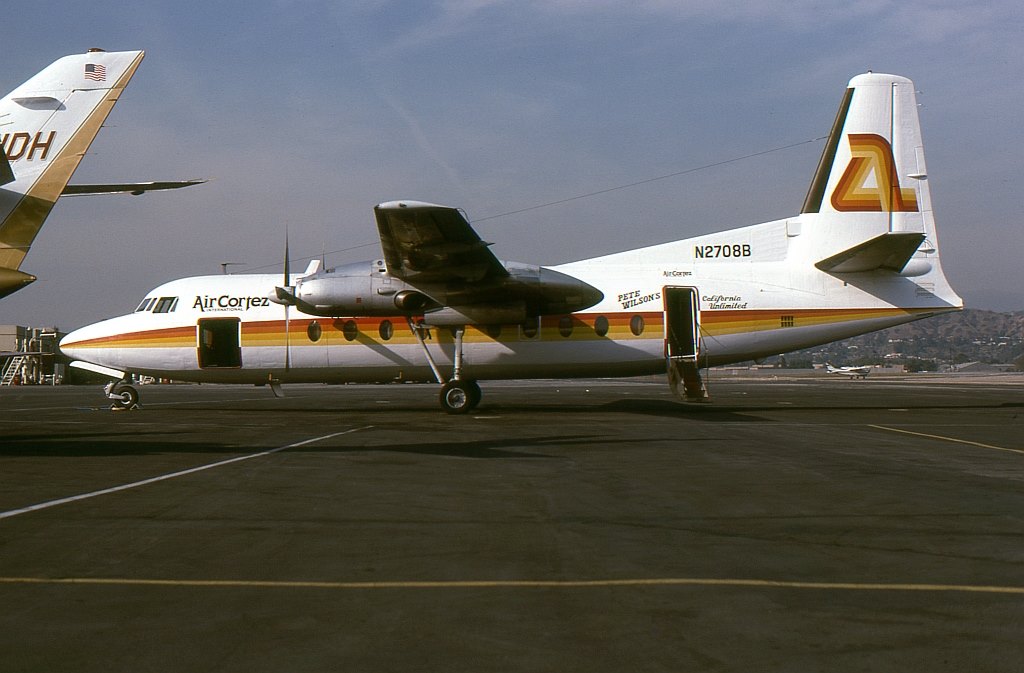
Air Cortez Fairchild F-27A, N2708B on Oct. 29, 1982, in Burbank, CA.
Photographer: J. Kauppinen. Gary C. Orlando Slide Collection.

The cargo was loaded by UPS personnel, and I was given the total weight of the cargo loaded. However, there was no information about how it was distributed, and the weight and balance document had only a single place to enter this vital information. So it was assumed that it would be evenly distributed. But this is contrary to acceptable preflight preparation. As expected, the acceleration down the runway was sluggish, but even more than I anticipated with the un-augmented power. The climb performance was equally poor. Arriving in San Antonio, I requested that UPS weigh the offloaded cargo as I suspected that it weighed more than they had documented out of Dallas. UPS refused to do the offload scaled weighing.

The return flight in the evening was similar to what was experienced in the morning, although I paid closer attention to the cargo weighing and loading. At the end of the day, I was signed off and good to assume regular scheduled flights for the remainder of the week. The next morning, I was met by a first officer who also didn’t seem to know anything about water-methanol injection. He conducted the preflight inspection while I supervised the cargo loading. The flight to San Antonio was routine. However, upon arriving at the ramp, there were several men in suits to meet this flight.

Even before the props had come to a stop, they had opened the cargo door and came into the cockpit, making demands. I told them they could exit the plane, and I would meet with them as soon as I had completed the post-flight checklists and briefed my first officer. These men were an FAA SWAT team of inspectors who demanded the flight manifest, maintenance documents, checklists, and, of course, my certificates. Evidently, this sting operation was weeks in the planning, and I was unlucky enough to be the Pilot In Command today. They claimed the Air Cortez checklists, weight and balance procedures, cargo tie-down hardware, and more were not approved, and the intention was to execute an emergency revocation of the company’s operating certificate. No wonder Air Cortez was in such a hurry to hire me and send me out on the line. Even I could see that the operation was barely adequate as a FAR-135 operation with light twins but totally inadequate as a FAR-121 carrier.

My first officer and I went to the hotel dayroom, and I started my round of phone calls. Thankfully, I had a lot of prior experience with the FAA and compliance. My honesty and credibility saved my pilot’s license. Usually, the FAA cannot take action against a company without also taking legal action against a pilot. But today, I obtained a compromise. The FAA would issue a ferry permit and allow me to return the plane empty to Dallas. It was an exhausting day, and the next day, I had an airline ticket back home.

The date was December 7; I was now on furlough. So ended 1984.

Continue Reading No Comments

World Airline Historical Society, Inc.
PO Box 13693, Tampa, FL 33681-3693 USA
Contact Us

Archives

Copyright © 1975-2025 World Airline Historical Society, Inc.

Read our Privacy Policy