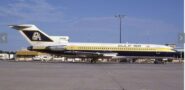
Turboprops to Jets: Boeing 727 Take 2, Gulf Air Transport

By Ellis M. Chernoff
1986 ended much as 1984 had begun. No employment or income. Federal Express had enticed me but then left me jilted. Again, I was frantically packing up and renting a storage unit to vacate my apartment by the end of December so I could drive back to California. Upon arriving in Southern California, I once again began the process of finding employment leads and updating my applications. A glimmer of promise came with the information that Flying Tigers would resume hiring pilots after a many-year hiatus. But while I (and about 20 other prospects) attended an interview there, I was not offered a simulator ride and sent home on some pretext. It took several weeks to learn the truth that younger and less-experienced pilots were hired for a class, bypassing me.
I attended a real estate school and obtained a Real Estate Salesperson License. But despite sincere efforts, I was not making a living. Finally, I spotted a “Help Wanted” ad in mid-1987 for a corporate pilot position. Allied Signal had an executive shuttle operation based at LAX and had an opening. The interview went well, as did a 1-hour evaluation flight in their Piper Cheyenne 400LS turboprop. This was my first time back in the cockpit in over two years, but I had no problem with this unfamiliar type. I was offered the job. A recurrent ground school was being set up for all of their staff pilots, and that would be sufficient formal training for me.
Thankfully, this corporate flight department operated like a scheduled commuter airline. Flights and crews were scheduled in advance and most often were on weekdays. Occasionally, the plane might lay over for a weekend, but the company paid for airline tickets to get home and then return the following week to resume the flights. The operation was professional, and the pilots swapped seats along with legs, so I got plenty of time in the left seat in spite of being the junior pilot on the roles.
The 400LS uses a very powerful version of the Garrett TPE-331 turboprop engine that is actually derated. That is, it is capable of more power than the charts allow for normal use. It also had all of the latest electronic controls and limiters that I was very familiar with from the Bae 31 Jetstream. Massive four-blade propellers gave very impressive performance even on a hot day with a maximum load.
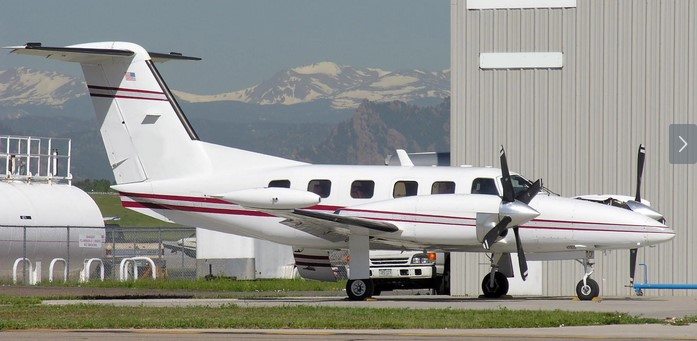
The regular run was between Los Angeles and Tucson, AZ, where Allied Signal operated a production plant. We could take off from LAX and climb to FL290 (29,000 feet) in about 14 minutes and then cruise at 333 knots airspeed. In fact, another company operated a Cessna Citation jet that was only a couple of minutes faster on the same route.
The other pilots flying the Piper were surprised that I could land and exit the runway in a shorter distance than they could. This was because they were not using the BETA, or reverse, capability of the propellers effectively. They were too timid and were eager for me to teach them how to operate them better. This was a great group of people to work with, while it also got me something I desperately needed: current hours in my logbook. Unlike other places I had applied, they were not at all concerned that I had not been actively flying for so long.
Around September 1987, I received a telephone call from an old colleague who had, on several occasions, led me astray while trying to “assist me” in advancing my career. He said that he was now flying for Gulf Air Transport. Their operational headquarters was in Philadelphia, PA, and they were preparing to hire a new class of pilots for their fleet of Boeing 727s. From my prior history with this guy, he knew I would not take action solely on his word. He told me that I would receive a phone call from the chief pilot. We ended the call, and sure enough, the phone rang again. The caller identified himself as the Gulf Air chief pilot. He told me that my friend had highly recommended me, and he was offering me a first officer position. I accepted and packed up the car for another transcontinental drive to the East Coast.
Arriving at their offices was a group assembled for hiring formalities and basic ground school. I learned that I was the only one who was hired sight unseen over the telephone. The others had all come to PHL for an interview and a simulator evaluation. The next phase involved getting a ticket and being sent to Seattle. A school there, adjacent to the SEATAC airport, would provide a full 120-hour Boeing 727 systems training class. The prime instructor for this was a former Boeing factory instructor, and he provided tons of supplementary technical materials along with even more extensive and detailed instruction than I had gotten back in 1979.
Upon completion of the ground school, the other pilots remained in Seattle to use that school’s simulator for training. I was recalled to the main office, where I was dispatched to New York . I would be personally trained by the airline’s head of flight standards. We would be using a TWA Boeing 727-231A simulator located at JFK airport. For the training, I would be paired up with a Gulf Air first officer who was upgrading to captain. The instructor had formerly been a check airman with TWA and had taken medical retirement. Although he had some physical limitations from his condition, he could sure fly that simulator.
It turned out the upgrading pilot was not so skilled. Neither the instructor nor I were impressed with the fellow’s flying or leadership, and there was a comment that they were upgrading the wrong guy. While I could have easily taken the opportunity to check out as a captain rather than first officer, that was not formally offered, and I was just happy to finally have a “jet job.”
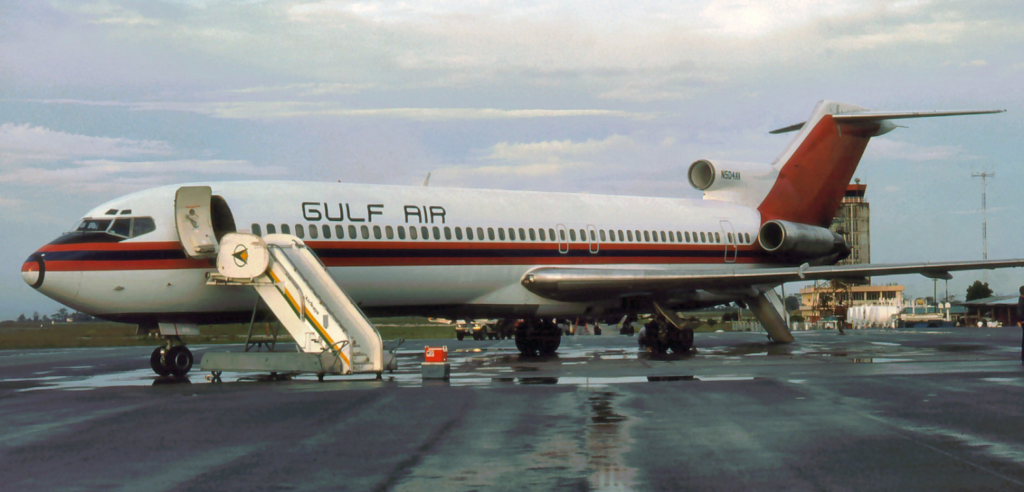
It is worth noting that TWA versions of the Boeing jet are different from those built for other airlines. The switch orientation on the overhead panel is different, and there are several systems differences in electrical and hydraulics unique to the version. These differences were not difficult to understand or adapt to. Gulf Air actually operated six former TWA Boeing 727-31 planes, and the paint scheme was only changed from red stripes to blue and yellow.
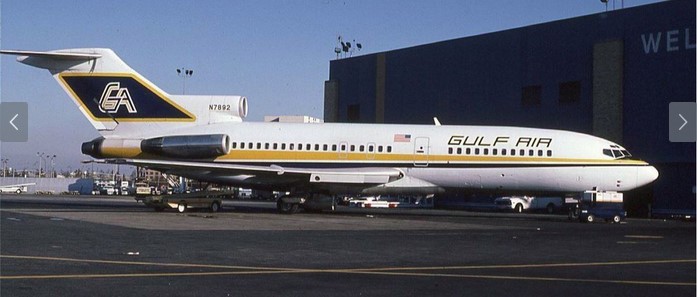
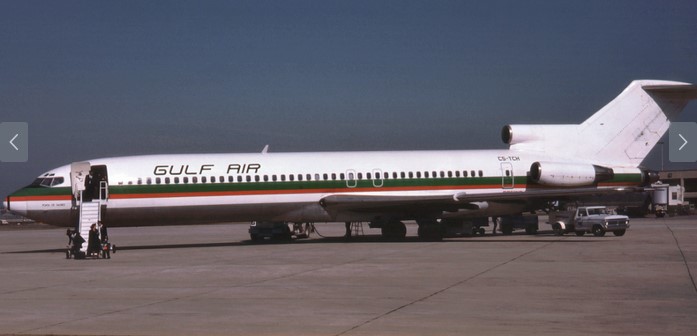
January 1988 found me starting line flying with virtually all of it being international. Gulf Air worked with travel agencies providing groups of passengers to vacation destinations in the Caribbean and Mexico. In addition to the former TWA 727-100 series planes, former Western Airlines and Delta Air Lines series -200 advanced filled out the fleet. All of the planes were in an all-coach configuration, and the -200s were configured for 173 passengers.
The two former Delta aircraft carried Portuguese registrations, CS-TCH & CS-TCI, reflecting their most recent operator. They had been modified so that the instruments were in kilograms rather than pounds. This made power settings and fuel management interesting. Imagine a flight plan in pounds, and you are ordering fuel in a foreign country that uses liters instead of gallons. Better get all of the conversions correct! I seem to recall being issued a Portuguese license on a temporary basis as well. It is also interesting to note that many years later, these same two planes would be incorporated into the FedEx fleet and modified once again to the FedEx fleet standard. I flew them each while in the FedEx operation.
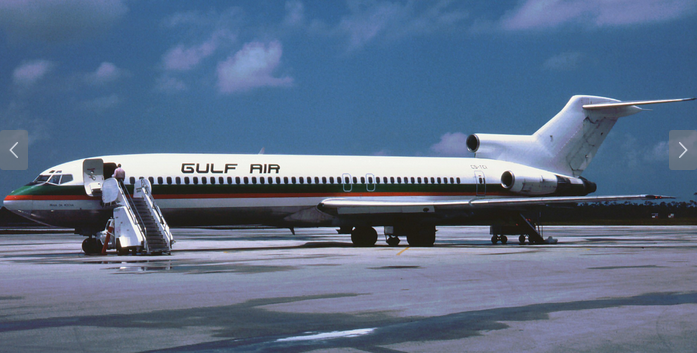
Early in March 1988, Gulf Air accepted a special charter. It was to be a pilgrimage trip to Poland for Hasidic Jews. In addition to kosher catering, the request was for an all-male crew, preferably also Jewish. In fact, there were three Jewish pilots at Gulf Air, including myself. While we did have the mandatory four male flight attendants, none were Jewish, and only three were available for the charter. All of us had to pre-position to New York and visit the Polish embassy to obtain our one-day visas. Poland was still behind the Iron Curtain. While the plane was being cleaned to kosher standards, I conducted a briefing of the entire crew regarding what to expect with this group of passengers. There are many do’s and don’ts when interacting with highly religious persons. This is especially true of interactions between men and women. The only women aboard would be wives, plus the single female flight attendant we provided. But some of the things that happened, even I had not fully anticipated.
Most of the passengers would embark at New York’s JFK airport. The plane was parked at a remote stand, and the passengers were bussed to the airplane. Even though none of them would be staying at a hotel on this trip, they still brought carry-on baggage. They also brought large boxes of beverages and bakery goods from Brooklyn in spite of us having loaded many services of kosher catering. Upon entering the cabin, passengers started removing emergency equipment from the overhead compartments. They also were kibitzing and not taking their assigned seats. This slowed the boarding process, especially when the second busload of passengers arrived.
The plane, N2818W, had standard fuel capacity, so it would be necessary to make stops along the way to Krakow, Poland. The first stop was to take on fuel in Halifax, Nova Scotia. Next, we flew to Shannon, Ireland. An intermediate stop in Brussels, Belgium, would fill the cabin to capacity with passengers from Europe. Finally, we landed just as dawn was breaking in Poland to be met by a “Follow Me” vehicle equipped with an AK-47 machine gun. We were directed to taxi to a remote parking location where everyone was deplaned into a small building. All passports were taken, and we waited a considerable time before they were returned and our passengers were placed on buses. It was an eerie feeling seeing all of those Jewish people departing on the buses. The crew departed for the Holiday Inn Krakow by taxi, and upon arrival there were told that no rooms had been reserved for us. A bribe brought some action, and again they took our passports to hold until we checked out of our day rooms.
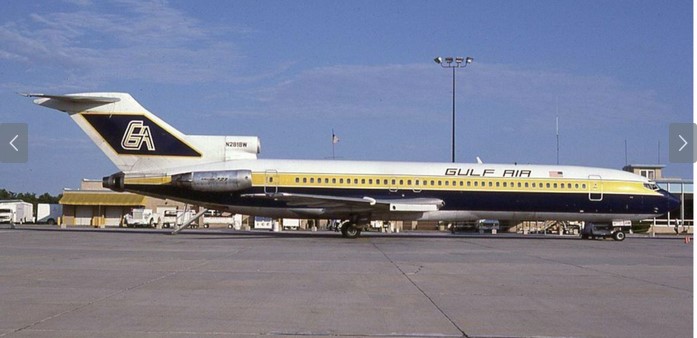
Our passengers started returning to the airport around 9:00 pm, and I recall that we finally took off close to midnight. Again, we stopped at Brussels to offload the European passengers and settle our billing for fuel and services. The agent came to the cockpit demanding payment of over $100,000 in cash. She had made a conversion error, but it took some time to prove that to her. The flight back made stops in the Azores and Gander, Newfoundland. Each time we stopped, the passengers were unruly and difficult to get seated so we could taxi. Somewhere over the Atlantic, I joined them in the cabin for morning prayers. This they truly appreciated. But as the trip progressed, there was increasing concern about how late we would arrive in New York. It was Friday afternoon, and they had to get home before sunset and the start of the sabbath. On the last stop, I really had to plead with them to get into their seats as the flight attendants had given up. Someone out there has a VHS tape of this trip, and I would love to see it! I made the final landing at JFK, and it was one of the smoothest landings I ever made in a Boeing 727.
After this trip, I was assigned to a crew base in Detroit, where I would share lodging with another crewmember and be on call. Most of the charters from Detroit were to vacation destinations like Cancun and Montego Bay. For the crews, the flights usually were an out and back, taking a plane load of vacationers to fun and sun and returning the group that had been taken the prior week. It was often amusing that the passengers would board at the end of their vacation, wearing shorts and light tops, only to have us announce that the weather in Detroit was below freezing. Gulf Air provided excellent inflight service with a full bar and traditional hot meals. Other charters included gambling destinations like Atlantic City, NJ. These were day trips for both the passengers and crew. The crew had day rooms while the customers were at the casinos.
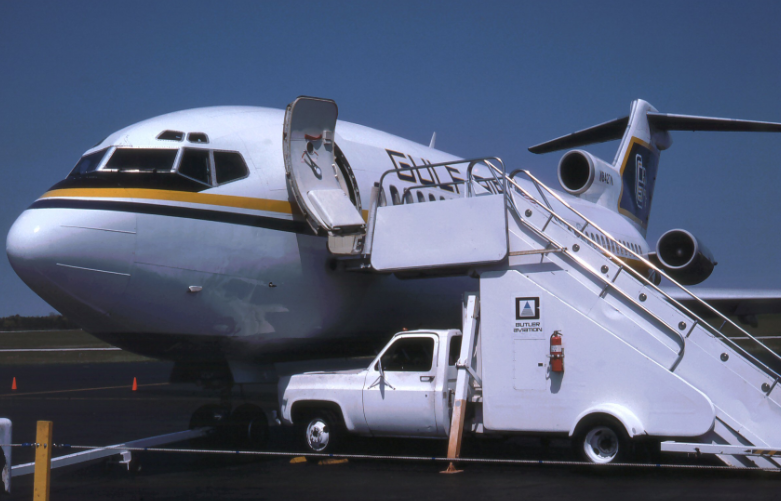
N842TW B727-31 at Atlantic City 1988. Photo by author.
One very enjoyable charter was a multi-day, multi-stop junket for a resort management company that was having grand opening celebrations at a number of their properties in the Caribbean, including Nassau, St. Marten, and St. Croix. At each resort, we received luxury accommodations and were invited to lavishly catered parties.
In June, a new contract was established with a tour agency for flights from Dallas. Gulf Air would provide airline tickets for me to get to and from Dallas and provide hotel accommodations for the crews. Trips out of DFW were also mainly to the Islands and resorts in Mexico. We used gates at terminal 2W, which many people are familiar with. The contract went well, but management was not happy with the high cost of having full crews in the hotel and paying per diem. They put it out as a new domicile and system bid. Everyone who was already operating out of DFW bid that domicile except for me. I bid Chicago instead, knowing that they did not need me there. After the Dallas bids were awarded, I was the only one who still received paid travel, hotel, and per diem in Dallas. I get an A+ in bidding.
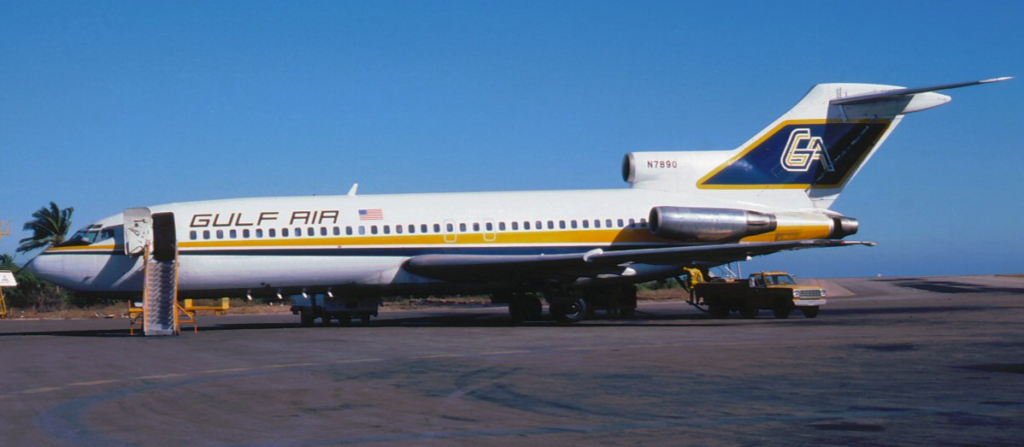
One particular trip was especially interesting. It was a midnight departure out of Miami International to Georgetown, Guyana. This was the location of the mass suicide of a cult in 1978. The aircraft was a Boeing 727-281, new to the Gulf Air fleet, that was the only -200 series with JT8D-9 engines. The others were powered by the more powerful -15 version. Although there was a light load of passengers, the airplane was loaded to its maximum with cargo. The takeoff run was one of the most labored I had experienced in the Boeing 727. The long flight was on a very dark night, although lightning could be seen as we flew farther south. I was concerned about the destination and alternate weather, both because I was not familiar with either place and there was limited reporting. I was also concerned about whether the runway lights would be on since we would be landing in the dark before dawn. I was relieved to complete this flight successfully, especially since fog developed at sunrise. Aircraft arrivals and departures must have been a big deal to the local residents. Bleachers were on the roof of the terminal building and were full of people witnessing our flight.
Through that summer, we made many flights to Cancun, Cozumel, and Montego Bay. A couple of hurricanes hit those areas during that year, and Cancun was particularly battered. The control tower and the terminal were literally blown out, and scheduled airline service was suspended. During the storm, tourists hunkered down in their hotels. Gulf Air resumed flights as soon as the weather permitted, and we were pretty much on our own at the airport and in the surrounding Mexican airspace. A plainclothes guy with a satellite phone made himself available if we needed communications assistance. We filled our planes with both our own customers and any other stranded tourists we could accommodate. Media met our flight at New Orleans on at least one occasion.
During that same summer, Gulf Air had a contract with Air Malta to operate two of our B727-247s on their scheduled flights. The planes were painted in full Air Malta schemes and were piloted and maintained by Gulf Air pilots and maintenance personnel. But the flight attendants and all inflight services were Air Malta. Initially, Gulf Air intended this to be a seasonal crew base with a bonus paid to pilots who would bid for this assignment. However, the Maltese government would not allow our employees to work there for that span of time, so crews were rotated from the USA.
In late October, as the season and contract were coming to an end, I was sent over there since I was one of only a few pilots qualified to bring the planes back via the North Atlantic routes. Prior to the ferry operation, I got to fly the scheduled Air Malta operation for more than a week. I was issued a temporary Maltese pilot license and crew insignia for my uniform. The Air Malta flight attendants went shopping during our turns in mainland Europe and in the UK. Lodging was provided at a resort, and I even had some time to play tourist myself.
The year closed out with a few more flights from DFW, and then I actually was based at Chicago O’Hare for the last couple of weeks. Thankfully, not for longer than that.
Trackback from your site.