Written by Emma Rasmussen
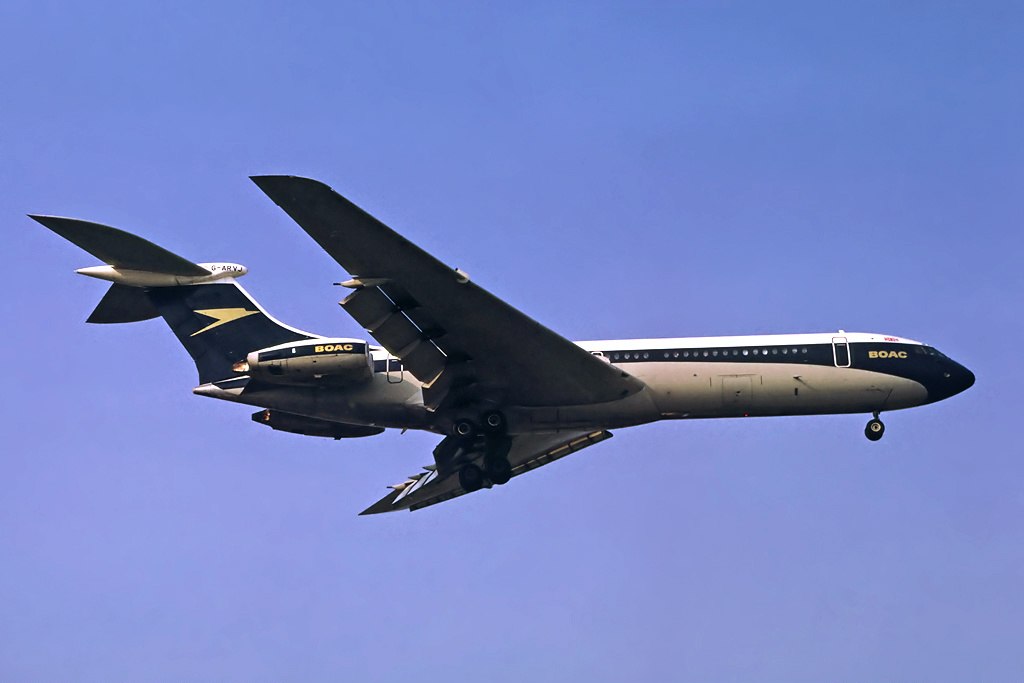
BOAC Vickers VC10 on finals into Heathrow – April 1974 – http://www.airliners.net/photo/BOAC/Vickers-VC10-Srs1101/1412500/L/ Richard Vandervord (from Airliners.net via WikiCommons)
The airline industry of quieter engines, carbon fiber, advanced computers, and glass cockpits is a far cry from the industry that followed the Second World War. Instead, the airline industry consisted of piston-driven airliners, chrome fuselages, iconic cheatlines, and a whole lot of smoke. Enjoying economic superiority and unscathed infrastructure, the United States dominated this bygone aviation industry with the innovations that directly resulted from the war. However, the United States was not alone in recalibrating its focus on civilian aviation with newfound technology. Despite being on the mend from a tumultuous war, Britain was investing heavily in its civilian aviation sector and had successfully developed the first ever jet airliner. The sleek design of the De Havilland DH106 Comet and its quieter, more comfortable passenger experience became an attractive distinction from the noisy propellor aircraft of the era. British Overseas Airways Corporation (B.O.A.C) was keenly interested in introducing the aircraft to its fleet, and did so in 1954 with a voyage between London and Johannesburg.
Her Majesty’s pioneering aircraft, and the national prestige it attracted, was short-lived, much to the misfortune of De Havilland. Numerous hull-losses from structural failure and a flawed wing profile marred the image of Britain’s aviation industry, and the Comet subsequently lost public confidence. After design modifications to the aircraft, it quietly continued service for over a decade. Unfortunately, the British jetliner market never fully recovered as the world’s airlines opted for the American Boeing 707 and Douglas DC-8. Aviation’s so-called “jet age” came into its own shortly thereafter, with the Americans once again dominating. The British aviation industry, now largely privatized, continued to develop future jet airliners in hopes of finding their own success.
One such result of their venture was the Vickers VC-10, a handsome airliner that was the visual epitome of 1960s optimism. Unexpectedly birthed from the Vickers Valiant, a high-altitude bomber and member of the Royal Air Force’s (RAF) “V Force,” the VC-10 began its life on paper as a potential tanker, military transport, and airliner. B.O.A.C heavily invested in the program, seeking an aircraft that could serve higher, hotter, and shorter airfields for their eastern routes. The development of the VC-10 was effectively an extension of the cancelled VC-7 project, which had been in progress during the 1950s. While the VC-10 was an entirely new aircraft, much of the technology used for the VC-7 was allocated towards the alternative project.
Vickers-Armstrongs Limited undertook the VC-10 in earnest upon learning of De Havilland’s proposal to update its ill-fated Comet. Additionally, Handley Page had offered to develop an airliner based on their RAF “V Force” contribution, the Victor. Amid mounting pressures, the Vickers VC-10 prevailed over the competing propositions, as it was the only firm willing to launch the airliner privately. In 1962 the VC-10 was rolled out of the Weybridge factory in Surrey, which then went on to endure two months of ground and taxi tests, and finally made the first flight.
The final design of the VC-10 featured a swept-wing with ample surface area, a T-shaped empennage, and four rear-mounted engines in a quad layout. The T-tail provided additional lift to aid the present design’s abilities, although it increased the aircraft’s risk for deep stalls. Vicker’s concept was unique, as only two other aircraft had a similar engine configuration. The Soviet Ilyushin IL-62 was slightly larger and more widely exported, but was plagued with safety implications. Lockheed had also developed an aircraft known as the JetStar business jet with this engine configuration. Though seemingly relegated to history and largely forgotten to the rest of the world, the VC-10 became a British icon and a favorite of the RAF.
Vicker’s choice of engine placement enabled a quieter cabin, and the powerful Rolls Royce Conways satisfied the higher, hotter, and shorter airfield requirements. B.O.A.C had previously lost faith in the British aviation industry due to the countless delays surrounding the Bristol Britannia and the bad press after several fatal Comet accidents. Naturally, they were reluctant to trust the VC-10. Amazingly, B.O.A.C was impressed with the design and placed an order for 35 aircraft with options for 20 additional aircraft. Airlines from developing nations such as East African Airways and Ghana Airways saw the benefit of having the VC-10 in their fleets, thus placing their orders shortly thereafter.
Entering service with B.O.A.C by the mid-1960s, the VC-10 attained higher load factors than its American competitors, the Boeing 707 and the Douglas DC-8. As a result, the aircraft earned a positive reputation with B.O.A.C. Additionally, the engine performance and overall design significantly increased the aircraft’s range and speed. The passenger cabin was defined by a six abreast seating layout and divided by a single aisle. Depending on the variant, the aircraft could accommodate a 100-150 passenger payload. While most argue that the fastest subsonic airliner was likely the American Convair 880/990, the VC-10 is famous for holding the world record for fastest subsonic transatlantic crossing ever. In 1979, a British Airways VC-10 departed New York for Glasgow-Prestwick, arriving in 5 hours and 1 minute. Only the supersonic Concorde crossed the Atlantic faster. Shea Oakley, an expert aviation historian and Executive Director Emeritus of the New Jersey Aviation Hall of Fame, had his first ever flight on the VC-10. “The VC-10 sparked my lifelong passion for commercial flight” Shea expressed with a tinge of nostalgia.
The airliner’s success within the confines of Britain called for several variants, one of which being the Super VC-10. The aircraft became popular in B.O.A.C advertisements and was ostensibly not unlike the standard VC-10. However, the Super VC-10 had an updated wing, stretched fuselage, and an updated power plant. The Super VC-10 was in passenger service well into the 1980s, later undertaking RAF roles such as aerial refueling. B.O.A.C opened routes to South America utilizing the VC-10, though British Airways would become the successor to B.O.A.C and shut down these routes during the 1973 oil crisis. Unfortunately, the aircraft failed to break out of the apparent “British bubble,” not including a few orders from the African airlines. Nevertheless, it was a popular aircraft to fly for both the average passenger and crew member. Tony Yule, an airline veteran of 46 years and former VC-10 pilot for the RAF and B.O.A.C says as much. “It was a lovely, lovely aircraft to fly. So smooth, so quiet for the passengers. It was magic, it handled like a dream” said Tony. “If I hadn’t flown Concorde in the 80s and 90s, I would have said the most iconic aeroplane was the VC-10.”
During the 1970s, the RAF leased a single VC-10 to Rolls Royce as an engine test bed. Rolls Royce was seeking a platform to experiment with their latest engine, the RB.211. This engine was later used on more notable airliners, such as the Lockheed L-1011 Tristar and Boeing 757. There had been some consideration regarding the possibility of re-engining the VC-10. Instead of four Conway engines, the VC-10 would be updated with two RB.211 engines. The idea did not leave paper, and the aircraft was returned to the RAF. The airlines also considered hush-kitting the Conways as noise regulations evolved, but the costs were too high to justify the modifications.
By the 1980s, British Airways and the African airlines were phasing out their VC-10s in favor of other emerging airliners. The RAF purchased the retiring aircraft from the airlines, and retrofitted them to become aerial tankers or military transports. Like B.O.A.C, the RAF was attracted to the VC-10’s performance and had been operating them since the 1960s. The VC-10 would go on to serve in several missions. During the First Gulf War, several VC-10 tankers were stationed in Bahrain, Saudi Arabia, and Oman. The VC-10 participated in enforcing no-fly zones while airstrikes were being carried out over Iraq in 1998. After the September 11th attacks in 2001, the VC-10 spent the remainder of its flying career in Afghanistan. In 2013, the RAF retired their VC-10 fleet in favor of modern aerial tankers and military transports.
Like many other British airliners from the early jet age, the VC-10 is often regarded as “underrated,” and unfortunately “left in the dust” by its American counterparts. In Britain, the VC-10 is considered a piece of aviation heritage, with several on display at local air museums. At Bruntingthorpe Aerodrome, a VC-10 is maintained and in taxiable condition. A second VC-10, the last ever to fly, is a static display. A vestige of an antiquated era, the VC-10 remains symbolic of mid-century optimism, innovation, and excellence. The VC-10 leaves behind a legacy of speedy flights, quietude and comfort, and a lustrous reflection of 1960s aeronautical design.
Notice: This article was originally published in Horizons, online student paper of Embry Riddle- Prescott